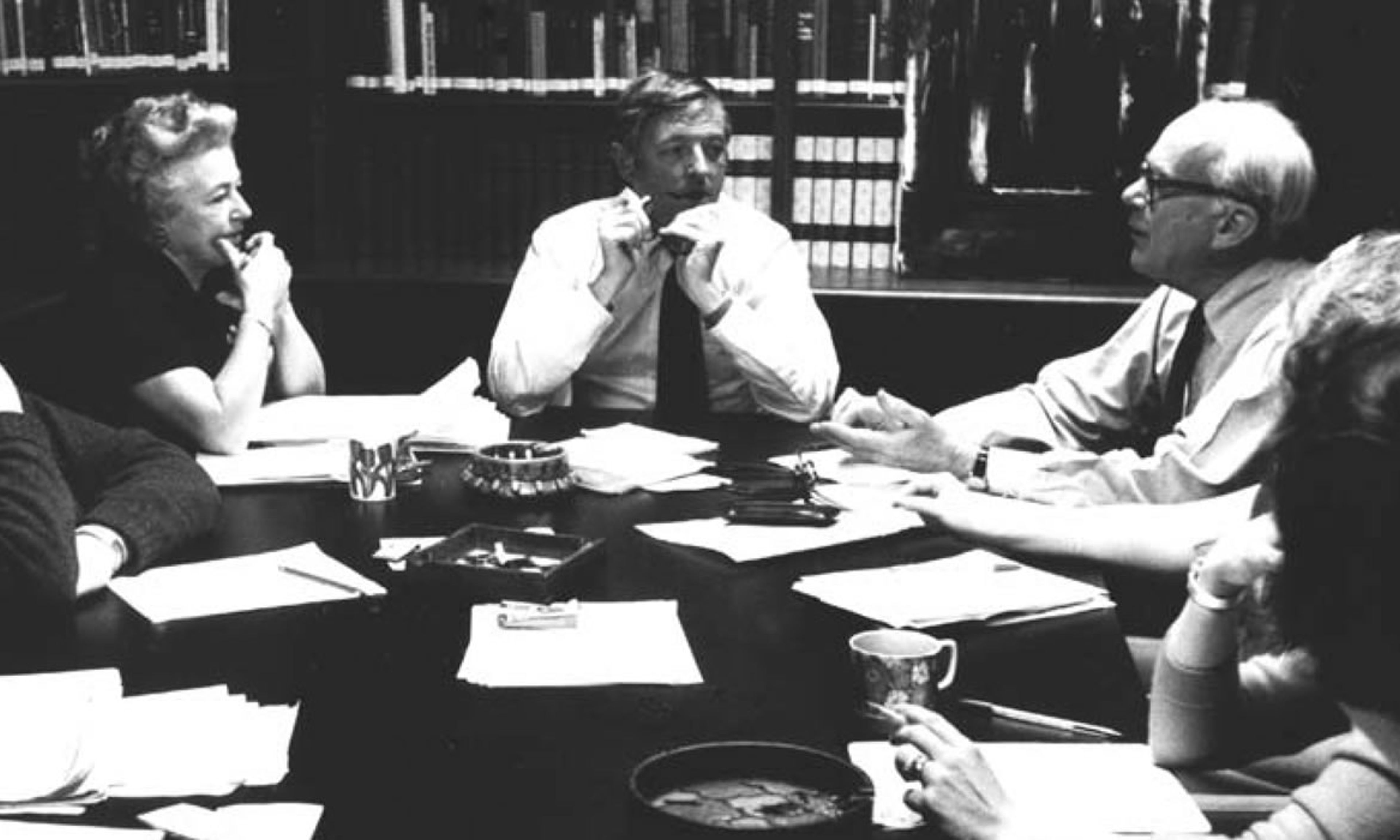
By the time I arrived in 1963, much of the National Review village had been pacified. There remained only low-intensity conflict.
The most widely known of the early editors, Whittaker Chambers, had died two years earlier, leaving behind few warm relationships, but, somewhat more usefully, a world-historical aura. People still referred to him as “Uncle Whit,” which in wry NR lingo meant that he was lacking in avuncular qualities. But everybody who had read Witness, which included all of us fuzzy-cheeked anti-Commies, knew his story in excruciating detail. What Chambers gave us, institutionally, was a precious moment of opportunity. His willingness to link his name with ours caused elite audiences to suspend their disbelief that a conservative magazine could be consequential.
William Schlamm, who had lobbied long and irresistibly for the founding of NR and can thus be described fairly as the magazine’s co-founder, had been defenestrated. He once told me that he was only 16 when he met Lenin on a visit to Moscow. I like to think that Willi backed the old Bolshie into a dank Kremlin corner and straightened him out — at length — on how to run a proper revolution. Learned, frenetic, often angry and always overbearing, Schlamm had been fired by WFB to general applause. (Willi earned immortality as the only named individual ever enshrined in James Burnham’s Timeless Rules. In Rule No. 6, Burnham had promulgated, “In every project there’s a Schlamm.”)
Willmoore Kendall had also been asked to leave and, ultimately, he complied. In his heyday at Yale, Kendall had been, along with his friendly rivals Eric Voegelin in Baton Rouge and Leo Strauss in Chicago, one of the preeminent political scientists in the country. WFB might have quibbled with the “generosity of taxonomy” here, but there is no other word: Willmoore was a genius, and he gave NR what it desperately needed in a skeptical media environment: intellectual rigor. He challenged everybody and everything, a practice that was personally tiresome but professionally tolerable. Over time, alas, some of Willmoore’s personal habits proved to be professionally intolerable and WFB felt obliged to show him the door. Willmoore left the premises, loudly, but he continued to be a telephonic omnipresence, becoming the indispensable man in shaping NR’s regnant doctrine of ordered liberty.
I should note also that Willmoore helped to illuminate the difference between WFB and the rest of us mere mortals. In my own time in New Haven, Conn., the grapevine had been clear on the point. There was one way and one way only to engage the legendarily prickly Professor Kendall. The seminarian should overprepare. He should assume a posture of deference bordering on servility. And he should dial back expectations to a slender hope for survival. I did as I was told and lived to tell about it. WFB, 15 years earlier, had taken a road less traveled. He liked the cut of Kendall’s jib and resolved to recruit the towering figure as his underling at a start-up magazine.
Toward the end of NR’s shakedown cruise, the last of the volcanic, first-generation personalities departed. Frank Meyer was not banished, I hasten to note, but, rather, was removed from office following bureaucratic defeat at the hand of James Burnham. (There was no disgrace in that. Everybody lost bureaucratic battles with Burnham.) Meyer retreated to a hilltop redoubt in Woodstock, N.Y., and, by remote control, performed three essential tasks for WFB’s young enterprise. For the magazine, Frank edited a fine back-of-the-book section, showcasing two of the country’s four or five best literary critics — Hugh Kenner and Guy Davenport. (In these days of mulled wine and depleted home libraries, you might want to luxuriate in the correspondence between Kenner and Davenport, two of the most delightfully literate men in the English-speaking world. There’s a good two-volume collection out there.)
For the movement, Frank wired together a national network of rightish academics. He became the de facto human-resources director for what M. Stanton Evans used to call the half-vast right-wing conspiracy. If you were a pro-market economist a few years this side of tenure, say, and if the thought police were closing in on you, your first call would be to Frank Meyer. He would make things right, or exhaust himself (and everybody else involved) trying.
Frank’s third contribution was seminal. And epochal. He pulled Kendall and Brent Bozell into a marathon dialogue and hammered out the loose-jointed and more or less coherent fusionist philosophy that came to be known as Buckley-style conservatism. WFB would be and, now that I think of it, was in fact the first to concede that Frank had been the principal blacksmith. WFB liked to add that he wasn’t bright enough himself to have served in the Meyer role. Uh, no. WFB wasn’t patient enough. He always had places to go and people to see.
And then there were four.
I have already mentioned James Burnham. He made the editorial trains, always clean and well-lighted, run on time. He was a professional editor, which was rare in NR precincts, and a consummate office politician, which was unknown. He gave the magazine its consistently white-hot, anti-communist glow.
Much to the amusement of WFB, Jim and I bickered constantly about politics. Jim was a Rockefeller man and then a Ford man. I was for Goldwater and then Reagan. (For very different reasons, we agreed on Nixon, about whom, of course, we were both wrong.) But we worked together productively.
For a time, it can be reported immodestly, the two of us produced one of the most successful publications in the history of the printed word — at least by the conventional metrics of renewal rates, profit margins, and the like. To establish continuity between fortnightly editions of the magazine, WFB had decreed that we would publish, on alternate weeks, a two-color newsletter on uncoated stock. It was to be called the “NR Bulletin” and, with most of the top-tier staff off evangelizing for the cause or working side hustles during non-magazine weeks, its production fell largely to Burnham, who was a boundary expander, and me, who was a munchkin and had no say in the matter.
The Bulletin became such a success that at first a few and then too many readers began to call or write, “Hey, Bill, you can go ahead and cancel the magazine. I get all I want from that great little newsletter.” The Bulletin was cannibalizing the magazine. WFB gummed that bullet for some years before doing the necessary and euthanizing it. R.I.P., NRB.
Another large presence during my staff days was William Rickenbacker, a senior editor, a polymath, and a man with a serious problem with which none of us could help him: Rick was good at everything. He had excelled in the classroom at Harvard and, through his early thirties, taught himself a new language every year. He became a scratch golfer, and then a champion, in golf-crazy Westchester County. He played the piano at concert level. He made small fortunes for friends trading their tiny stakes in obscure foreign markets. And as a writer for the magazine, he provided a take on the week’s news that, issue after issue, was so original, so arresting, that even overworked and jaded colleagues would read it once and then a second time.
Rick was good company, and I spent occasional weekends at his vacation place in the Berkshire Mountains. Sometimes with wives, mostly not, we would fly up on a Saturday morning and spend a couple of days hiking, reading, talking, drinking. Good times. On Sunday evening, we would fly back to New York, no instruments needed as we followed the southward course of the Hudson River. If Rick was in a giddy mood, which he frequently was, he would fly under the bridges spanning the great river. Ever the aspirational journalist, I wrote the inevitable headline for my mind’s eye: “Captain Eddie Rickenbacker’s Son and Friend Die in Aerial Assault on Tappan Zee Bridge. Intent Unknown.”
William Rusher, secundus inter pares, was publisher of the magazine during its infancy, through its exuberant youth, and then well into its comfortable middle years. He became a constant in the NR universe, and much has been written about him. (That will happen if you first make an indelible impression on a hundred or so young writers.) I will note here one of his underreported contributions.
At a rare all-hands meeting, I once referred to Rusher as the head of NR’s provisional wing. Almost everybody laughed. Not Rusher. He nodded his rich satisfaction. For years, for decades even, Rusher was our ideological enforcer. When Burnham would spin a Rube Goldbergian argument as to why NR should adopt some objectively unconservative position, and WFB would be momentarily drawn to its sheer brazenness, Rusher would pin the badge to his vest, stride into the saloon, and mete out a little country justice. During the Rusher era, there was an old sheriff in town.
You can appreciate the organizational challenge faced by our proprietor, William F. Buckley Jr. He was the president of a club almost all of whose members were themselves unclubbable. Most of his colleagues were a generation older than he, with reputations made and retirements upholstered. Their best work was behind them, as also what was left of their intellectual flexibility. Their views of what was good for the magazine, good for the cause, good for the world, and good for the galaxy were, all of them, set in dry cement. Imagine. It was with this band of uncles that WFB produced the most influential magazine and one of the most powerful political movements of the 20th century.











Comments