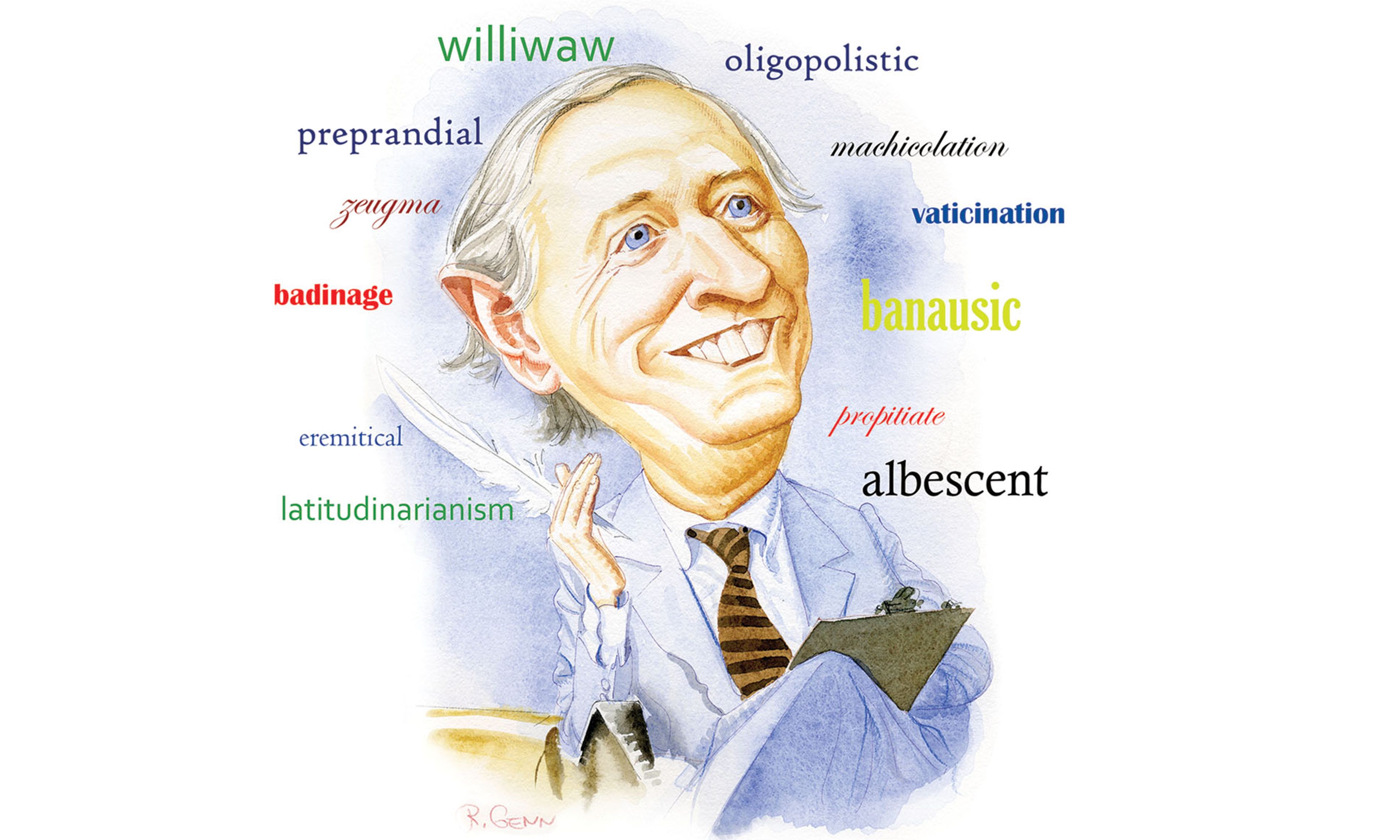
The founder of this magazine, the redoubtable William F. Buckley Jr., had an instantly recognizable trademark: hard words. He was comfortable saying, on his television show Firing Line, that some people sought to “immanentize the eschaton.” When I was a teenager trying to build my own vocabulary, I watched every episode and read every Buckley newspaper column just to discover what words I might learn next. These invariably went into my enormous vocabulary notebook.
Immanentizing the eschaton? It means trying to create a heaven on earth.
Buckley was unapologetic about his lexiphanicism — as if his audience consisted only of the cognoscenti who shared his outsized vocabulary.
What struck me as particularly funny, on Firing Line, was how often he’d have some semiliterate guest on — clearly not in his league as a vocabularian — and pose a question such as, “But could we not move asymptotically toward an eirenicon for this paradox?” Nobody would ever say, “What on earth do you mean by that?” No. It would always be some dodgy answer: “I’m not sure that we could. The people of this country . . .” They’d ramble on despite not having the faintest idea what an eirenicon is — nor what it means to approach it asymptotically. (An eirenicon is a statement that resolves a seeming paradox; asymptotic means approaching but never quite reaching.)
So wide-ranging was Buckley’s vocabulary that you might expect the Oxford English Dictionary to be replete with citations to his writings. You’d think his favorite words — afflatus (= divine inspiration), energumen (= someone possessed by an evil spirit), indite (= to write), maculation (= blemish), and so on — would be supported by Buckley citations. Not so. Although there are 57 Buckley citations in the OED, only six of them illustrate words that might be considered characteristic Buckleyisms: criniferous (= hairy), opsimath (= one who begins serious study late in life), pomposo (= a pretentious person), preprandial (= occurring before a meal), sciolistic (= characteristic of someone possessing only superficial knowledge), and zeugma (= the figure of speech illustrated by You held your breath and the door for me — a single verb bearing two meanings with different objects).
The other Buckley citations mostly illustrate mundane words: adeptly, cough syrup, informality, likelihood, package, preventer, radio direction finder, ski pole, stiff upper lip, sweatily, trench coat, and undershorts. (Try creating a paragraph with those words!) More of Buckley’s quotations in the OED derive from his novel Stained Glass (1978) than from any other source. Some volunteer reader for the OED should contribute more of his recondite vocables, don’t you think?
The OED’s entry for alt-right, by the way, contains a 2003 quotation mentioning Buckley — the first known use of the term: “A right without a Buckley will probably be smaller, and uglier to boot. I would expect this alt-right to be a lot more vigorously opposed to the civil rights movement.” There are other mentions, as well. In 1967, someone at Life magazine wrote: “William F. Buckley could quit playing devil’s advocate and admit he’s a closet liberal.” That sentence illustrates the entry for closet used adjectivally.
The great dictionary even has an entry for immanentize the eschaton. I think you can guess who’s quoted there.
Sometimes his erudite words prompted people to suggest he was something of a pomposo himself. How did he respond? He gave diverse answers over time, but all broadly consistent.
1963: “Surely one must distinguish between those who plunder old tomes to find words which, in someone’s phrase, should never be let out . . . and such others . . . who use words because (a) the words signify just exactly what the user means, and because (b) the user deems it right and proper to preserve in currency words which in the course of history were coined as the result of a felt need.”
1972: “The resistance to a rich vocabulary is inconsistently exercised. When the talk is of scientific or mechanical things, the public is altogether acquiescent to strange and minutely differentiated terms.”
1984: “There are reasons for using words even when they are unfamiliar. It can be a matter of rhythm, it can be a matter of exact fit — and it can be something by way of obeisance to the people whose honed verbal appetites created the need for such a word, which therefore came into being. Call it supply-side linguistics.”
1996: “Every word berthed in the dictionary is there because at some point one of three things happened. Either an objective thing or concept or abstraction came on the scene which hadn’t been descried [yes, that’s the word] before and now just had to be given a name (‘cyberspace’); or an artistic hand closed in on what had been a void and the new word survives the infidelity of the season, earning its way into the dictionary (‘seakindly’); or an authoritative writer simply uses the word and such is his prestige that his mere enunciation of it validates its legitimacy (‘tushery’).”
The man had his reasons. And his style worked for him.
Now let’s take a nostalgic look at some Buckleyisms and test your knowledge of them. They may prompt you to remember his writings, if you know them, or to look up some words new to you. Either way, we can celebrate Buckley’s contributions to maintaining the currency of these words. Commit yourself to answers before consulting the key! Meanwhile, good words to you.
- albescent /al-bes-uhnt/, adj. (a) turning white, (b) becoming treelike, (c) below freezing, (d) theatrically impoverished.
- antinomian /an-ti-noh-mee-uhn/, adj. (a) established in one place because of immovable farming interests, (b) opposed to or defying moral law, (c) involving the lower hemisphere, (d) economically backward.
- badinage /bad-i-nahzh/, n. (a) unskillful performance, (b) thuglike braggadocio, (c) playful banter, (d) a quaint early form of tennis.
- banausic /ba-naw-sik/, adj. (a) trite and predictable, (b) involving the ocean’s greatest depths, (c) worthy of suppression, (d) having a purely mechanical purpose.
- Brobdingnagian /brob-ding-na-gee-uhn/, adj. (a) cacophonous, (b) of or relating to the ringing of bells by Buddhist monks, (c) deriving from an island off the coast of Armenia, (d) huge.
- caudillo /kaw-dee-yoh/, n. (a) a truncated cat’s tail, (b) a postprandial libation taken immediately before sleep, (c) a Latin American dictator, (d) a small burn.
- diapasonal /di-uh-pay-zuh-nuhl/, adj. (a) involving a sudden burst of music, (b) involving dispersed émigrés, (c) involving plants that, once etiolated, grow back even stronger after exposure to sunshine, (d) involving medieval benefices.
- epigone /ep-i-gohn/, n. (a) the sister of a protagonist in Greek drama, (b) a close follower or disciple, (c) a figure of speech involving the reversal of two nouns in a set phrase, (d) a feigned departure.
- epistemological /i-pis-tuh-muh-loj-i-kuhl/, adj. (a) of, relating to, or involving the propagation of plants, (b) of, relating to, or involving the germination of flowers, (c) having to do with the theory or nature of knowledge, (d) involving the theory of God’s existence without regard to ontological arguments.
- eremitical /er-i-met-i-kuhl/, adj. (a) hermit-like, (b) airtight, (c) eleemosynary, (d) involving premodern bloodletting.
- eschatological /es-kuh-tuh-loj-i-kuhl/, adj. (a) extraterritorial, (b) involving trickery, (c) involving hate speech in the form of graffiti, (d) involving the ultimate destiny of humankind.
- exiguous /eg-zig-yoo-uhs/, adj. (a) plentiful, (b) libidinal, (c) telescoping, (d) scant or meager.
- latitudinarianism /lat-i-tyoo-di-na-ree-uhn-iz-uhm/, n. (a) permissiveness, (b) an anthropological theory that peoples farther from the equator are biased against those nearer the equator, (c) an anthropological theory that the thickness of a culture’s typical clothing is inversely proportional to one’s propinquity to the equator, (d) collectively, the programs historically promoted by the French milk lobby.
- lubricity /loo-bris-i-tee/, n. (a) drunkenness, (b) lecherousness, (c) the degree of measurable torque in a well-oiled piston, (d) the smooth glide of a sailboat on a lake free of wind.
- machicolation /mak-i-kuh-lay-shuhn/, n. (a) expulsion from a school, (b) the act of chewing and swallowing, (c) cacophonous laughter, (d) an opening on a parapet for shooting or dropping missiles on assailants below.
- oleaginous /oh-lee-aj-i-nuhs/, adj. (a) consisting of black and white layers, (b) oily or unctuous, (c) involving a shipwreck, (d) gelatinous.
- oligopolistic /oh-li-gop-i-lis-tik/, adj. (a) involving mob rule, (b) involving rule by the richest citizens, (c) involving a coterie of agents who control the market for something, (d) involving rule by a coterie of immigrants.
- phlogistonic /floh-jis-ton-ik/, adj. (a) consisting of oxygen, (b) consisting of nitrogen, (c) combustible, (d) involving the movement of fluids within plants.
- propitiate /proh-pish-ee-ayt/, vb. (a) to celebrate on an auspicious occasion, (b) to appease or conciliate, (c) to put forward an untenable proposal, (d) to stand down after being nominated.
- quotidian /kwoh-tid-ee-uhn/, adj. (a) involving excessive reliance on others’ thoughts, (b) involving the trigger finger, (c) diurnal or circadian, (d) involving incessant name-dropping.
- schismatic /siz-mat-ik/, n. (a) a religious deviant, (b) an architectural plan for a building site, (c) someone who heals ideological rifts, (d) an anti-charismatic leader.
- tocsin /tok-sin/, n. (a) the leader of a Southeast Asian junta, (b) an alarm bell, (c) the venom of a water moccasin, (d) an antivenin.
- vaticination /va-tis-i-nay-shuhn/, n. (a) a feigned vaccination administered as a placebo, (b) purposeful injection of an infectious substance, (c) the placement of the pope’s Easter raiments, (d) a prediction or prophecy.
- velleity /vi-lee-i-tee/, n. (a) the Scottish term for a hole-in-one in golf, (b) a disinclination, (c) arcane scholarship, (d) a slight wish.
- williwaw /wil-i-wah/, n. (a) a South African wind instrument fashioned from a long gourd, (b) a flibbertigibbet, (c) a gust of cold wind, (d) an ignis fatuus.
Answers:
- (a). 2. (b). 3. (c). 4. (d). 5. (d). As for (c), Armenia has no coastline. 6. (c). 7. (a). 8. (b). 9. (c). 10. (a). 11. (d). 12. (d). 13. (a). 14. (b). 15. (d). 16. (b). 17. (c). 18. (c). 19. (b). 20. (c). 21. (a). 22. (b). 23. (d). 24. (d). 25. (c).











Comments