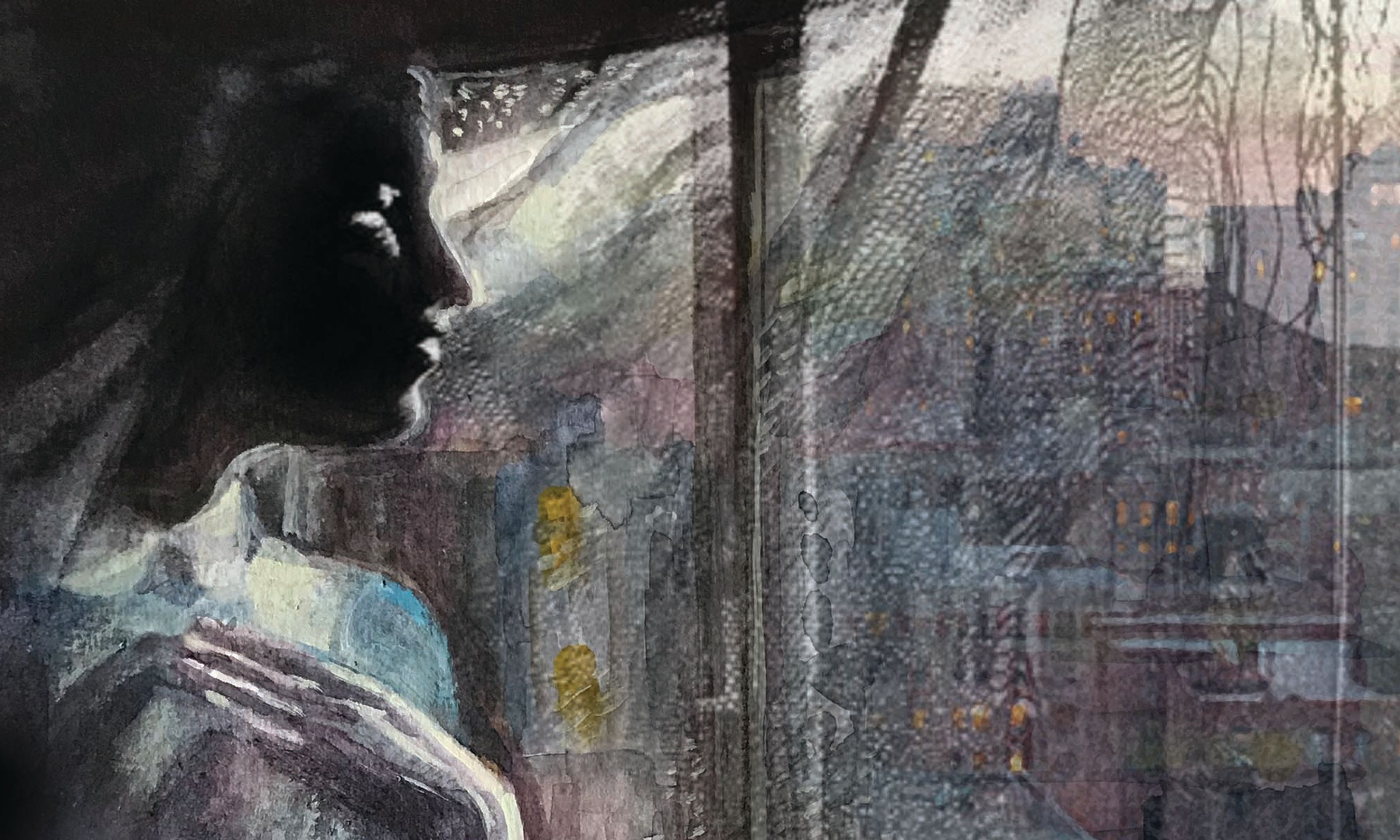
In the late fall of 1918, when the war hardly seemed over, and Anna, the daughter of a watchmaker, was sixteen, she let her father know that she thought what he did was not worthy — of her, of him, of the new country with which she was entirely comfortable and he could never be. This she conveyed not in words but in silences when there should have been words, in her expression, in a stare rather than an answer to a question. At sixteen, she was angry that he was as predictable as his watches and clocks, leaving for work always at the same time, coming home always at the same time, bent all day over a diminutive workbench, hardly moving, breathing in a fashion that would not perturb or blow away the tiny, almost weightless wheels, pins, and shafts that he rebuilt into mechanisms to be locked in airless cases until the next time they failed.
He knew what seemed like everything because he read so much, and he had had academic training as an economist. But he was sedentary, and his conversation was always about things he had neither experienced nor touched — except perhaps a difficult customer, a rare watch, or a red sunset flashing between the blocks as he walked up Broadway from his shop on 56th Street. It was not even his shop, as he was only one of three watchmakers, each of whom worked behind a wavy glass partition, and none of whom had a window. When she was little, she had been interested in the lathes, grinders, magnifiers, and lights, the racks of fine tools, and the many drawers of parts, especially those that held small jewels. But now she never went there. Perhaps out of embarrassment, but also out of anger, she was compelled to this as if directed from without. He didn’t know what to make of it, and tried, though he never could, to please her, to plead his case by impressing her, even though that had nothing to do with the fact of how much he loved her: “I fixed a watch today that cost a thousand dollars, and we charged a hundred for the repair.” Saddened that his only child would stare at him as if she hated him, he told his wife that he didn’t understand how this could be, and she said it would pass.
Anna was unhappy at school, and wanted to shake off everything that was around her and go somewhere else: Spain, Tahiti, to England to be a duchess, to sea to be a sailor. Though going to sea was not possible, it was suggested every day without fail, for although girls did not go to sea they had nonetheless to wear sailor’s suits: which were both the fashion and the required uniform at school. Hers would have been more attractive had it been cut better to fit her slim figure, and if it had lost the sailor’s tie that was forever unbecoming to a girl. Walking to and from school, she used to take the tie off, and when she did, the blue and white uniform, on account of her coloring, was lovely, for even in indirect sun, her long hair shone as if gilded, and her eyes were blue.
So many people had become ill with what was now called the “Spanish flu” that her classes were often sparsely attended. The school didn’t close, and businesses remained open, as did the factories, railroads, and docks. Because the war still had to be won, the country could not afford to stand down. And if it did, who would grow the food and sell it, dig the coal, and drive the trains?
Safe and high on the ninth floor of a huge new building on Broadway in the Eighties, Anna would look out the window and see horse-drawn ambulances waiting to take the dead from tenements on the side streets. But up there, on the ninth floor, they were all right. The influenza would have to fight hard to get past the huge Irish doorman. Her family was clean and conscientious — watchmakers always are — and, besides, although anyone could get sick, and a third or more of everyone did, it was mainly young adults in their very late teens to forty who died (for what reason no one knew), and not people either as young as Anna or as old as her parents.
She got into the habit of going to the window just before dinner when she had finished a section of homework but before food was on the table. Here she often saw the ambulances; the patient, immune horses; the masked drivers; and stretchers rushing straight on after having been skillfully flown down flights of dark stairs, with the bodies — strapped in, seemingly light, and tightly wrapped in white — lifted gently at the very end into the stilled conveyances.
Out of her hearing, her father told her mother, “I went down to Fourteenth Street on the East Side to pick up parts, and on my way back I saw corpses stacked outside the morgue. There must have been a hundred.” After that, Anna’s mother sewed handkerchiefs into face masks, and Anna was told to wear one on her way to school. Half the people on the street wore them, and half did not. Those who didn’t often smiled at one another, congratulating themselves upon their fearlessness, or what they thought was their health. Those who did were quiet, and, their view compromised by the mask, they looked down as if not to trip. So, for a time, for Anna the world was expressed in cloth — the linen face mask she removed and stuffed in a pocket as soon as she was out the door, the shrouds of the dead, and even the lace covers on the arms and back of the chair near the window where she knelt before dinner to watch the ambulances. She vowed never, ever, in her own house, to allow lace upon furniture.
Although her rebellions came and went like senseless gales, rebellions are for love of one thing or another — love overflowing, love bent, or love broken. When she was not in storm, she was sunny, contemplative, or quiet. She thought this alternation, which as difficult as it was made her feel alive, would last forever.
On the second Friday of December, 1918, school let out early. She walked home in a brisk, dry wind, stopping at a bakery to buy poppy-seed cake as her mother had requested. Broadway was fairly empty, the trees on the median stripped of their leaves, the buses few and far between, the cold penetrating, the sunlight weak and white. Rebellious or not, and despite frequently getting into trouble for her behavior, she was a superb student, a natural for whom the work was always light. Though she could have excelled effortlessly, she worked harder than anyone else, and she had a watchmaker’s sense of order and precision. Her usual practice on being dismissed early on Fridays was to retreat to her room for the hours before dinner and attend to her homework. Most of her classmates let it go until Sunday night, but not Anna. She had it buttoned down before the weekend started, and then would look it over, read other things, and learn by heart passages, formulae, and schemata that even the teachers had not mastered. The teachers would sometimes wing their way over lesson parts of which they were unsure but Anna was not, and then they would ask her. A student who floats over her instructors knows a joyous velocity and lightness, a freedom hard to comprehend other than in experiencing it. When one of the faculty wanted to recall something, or clarify what he did not understand, he called on the slim, blonde daughter of the watchmaker.
This was why, that December evening, just after the air and sky of Manhattan had gone from deep blue to black, she did ten trigonometry problems, accurately and elegantly, drawing and writing beneath her bright desk lamp; and memorized Voltaire’s “Les ‘Vous’ et les ‘Tu,’” so that she could say it to herself in its piercing beauty and wise regret. Then she did chemistry. She had the periodic table by heart and, without need for correction, her equations flowed onto the page as rapidly as her math. After dinner, the other subjects would be pure pleasure, and then, with the world bright, secure, and promising, she could dream the waking dreams that more than any academic work infused her character.
Rather than immediately starting American history and English, she went into the living room and sat by the window, in the big chair with the lace antimacassar she hated. Through glass doors, she saw the dining table, candles mounted on silver candlesticks, the challah covered, a cup for wine. A pot roast with small roasted potatoes was simmering in the kitchen, as was often the case on Erev Shabbat. This she had experienced since infancy. Outside, horses were clopping — perhaps the junk man, or a carriage, or, just as likely, an ambulance or a hearse. Rather than look, she sat contentedly in the chair. She yearned to be something higher — she thought — than a watchmaker, although she knew she was a watchmaker’s daughter.
The front door opened and closed. Now her father was home, and they were secure and complete, nine floors up. It was warm and comfortable. The war was over, and everyone thought we had won and the world was safe. She had already done most of her homework. She was the leading student in her school. She was becoming more womanly by the day. “Hello, Anna,” her father said, still in his coat and hat, and even though she stared at him as if she were mute — she wanted to answer, but something in her that she could not countermand stopped her — he waited a moment, and added, “Very nice to see you, too.” At dinner she said almost nothing. Her father talked about watches and European politics, working himself up to frustration sufficient to choke off at least a sentence or two. And her mother detailed the household accounts. Everything was exactly as it always had been, except that, as the table was cleaned, her father said, “I think I won’t have dessert. I’m very tired. I’m going to take a bath and go to bed early.”
“Poppy-seed cake,” her mother said. He loved it.
“I know. I’ll have it tomorrow. Is there enough for you to have it tonight and all of us tomorrow?”
She nodded her head in the affirmative.
After he rose from the table, Anna noticed that as he walked toward the bedroom he would close his eyes as if resting, open them to get his bearings, and close them again. They heard the water streaming and steaming into the bath, the clear, endless supply of water that was one of the great things about living in New York. Then they had their tea and cake.
‘Mama,” Anna began, in the warmth and silence of their apartment — all mechanisms, until that moment, running perfectly and as expected. They drank their tea and slowly ate the cake, the secret of which was that it was not too sweet. “He was breathing at fourteen breaths per minute, and you could hear every one.”
“You counted?”
“Yes.”
“How many times a minute does one normally breathe?”
“I don’t know. I tried to find out, but if you try to count your own breaths you end up breathing deliberately, so you can’t tell.”
“You tried that?”
“I did.”
Her mother thought for a while, and then moved to take advantage of her daughter’s powers. “What else did you notice?”
“When he was eating, he would sometimes pause, and look to the side, down at the surface of the table, take in a breath, exhale, and then not inhale for longer than usual.”
“What does that mean?”
“He was listening to something inside himself, feeling it, trying to determine what it was.”
Her mother steeled herself. “He’s just tired. Sometimes he doesn’t want to go through all the prayers and the blessing, because he’s so very tired.”
“I know. But then he does. Tonight he didn’t.”
“What are you saying?” her mother demanded angrily, only because she was scared.
“I’m saying he may be sick. I think he’s sick. Maybe just a cold. Ask him. Don’t let it wait.”
“I won’t,” her mother said weakly, although it was more her fear and imagination of the worst than her belief that it had come, for there was yet no reason to believe it had.
Anna remained at the table, absolutely still, not eating. Her mother went down the hall and knocked on the bathroom door. Then she opened it slowly, and left it ajar. As steam came lightly through the opening, Anna, whose hearing was sharp, heard the conversation. Because children hear so much better than their parents, who have forgotten how crisp the sounds of the world can be, they hear — through walls, down halls, and from inside or outside windows that vibrate like speakers — many things that parents do not want them to hear but that they must if they are to grow up.
“How do you feel?”
“I’m . . . I’m tired, but pleasantly so. I should have a deep sleep.”
“You hardly ate. You didn’t say the . . .”
“I just want to rest.”
“Tell me how you feel, exactly.”
“Come on!”
“No, tell me.”
“I feel good.”
“You do?”
“Yes. Tired, but almost intoxicated. That is, I’m so relaxed I don’t feel parts of my body sometimes. It comes and goes in waves. The waves are sometimes a little chilly, but then I’m warm again.”
After a silence, and then a few steps, Anna’s mother said, “You’re burning up.”
“Of course I am,” he said impatiently, “I’m in a hot bath. I’ll go to sleep, get a good rest, and then I’ll be fine in the morning.”
“Or not.”
“I know. Or not.” This was said very sadly. “I don’t have to look at another watch until Monday. Do you know how wonderful that is? That alone could cure consumption. We’ll take a long walk, and I’ll look far ahead, my head up instead of bent at the neck. What a relief. You can’t know how much unless you have to squint all day through a loupe. Maybe Anna will deign to come with us, and walk fifty feet behind.”
“She’s sixteen.”
“So, when she’s seventeen she’ll walk a hundred feet behind?”
“Eventually, Morris, she’ll be infinitely far away from us. That’s why she walks fifty feet behind. That’s the real reason, even if she doesn’t know it.”
“No, it’s because she’s ashamed of us.”
“No. It’s because she’s bracing for the inevitable. They think it’s for all kinds of reasons, which it may be in part, but it’s fear, and to prepare. Anyway, it’s the way it’s supposed to be, and that it’s painful for us is irrelevant.”
“I know, I know,” he said. “How much pot roast is left?”
“Enough for Sunday. You hardly touched it.”
“Saturday, chicken?”
“With noodles.”
As Anna washed the dishes (something she hated until she was actually doing it, when it was so methodically satisfying it became enjoyable), she thought of the weekend. There were boys (especially one) whom she wanted to see her, if only as briefly as in the click of a camera shutter. Rich and mobile images combined with her wish and expectation to love and be loved. How impossible it seemed that as a girl condemned just to wait she would ever connect with her beloved, whoever that might be. All she could do was become desirable, though neither boldly nor recklessly, and wait. She thought it was like fishing, and not fair. The fish got to move around, but she had to stay still.
As she was drying the rest of the dishes, holding against her chest a thick serving platter that had been in very hot water and was still quite warm, she listened to a remembered aria present enough for her to follow as if it actually filled the room. Her mother came into the kitchen, buttoning on her coat. It was taupe-colored, with large, flat, tortoiseshell buttons and an almost military collar. Though Anna understood immediately why her mother was going out, and why she was moving so rapidly, it was still a shock.
“He’s burning up, it’s not the bath, and he has chills. Shuddering violently. I’m going to get the doctor.”
“I can.”
“No, you finish.”
“I’m done,” Anna said, taking off her apron.
“No, Anna. I’ll get the doctor. I have more authority than you. It’s not a game.”
This hurt Anna for many reasons, all of which began to change her so fast, the speed of it outrunning even her sensitive intelligence, that she acquiesced. Her mother marched to the bedroom, her grave footfalls such that the people who lived directly beneath on the floor below might have looked up. She opened the door.
At almost the same time that her mother stated, “I’m going to get the doctor,” Anna heard her father say, “Anna must not come in here. Tell her that she is forbidden to do so.”
“I will,” her mother answered.
Anna held the front door open, and her mother rushed out, saying nothing. She pressed the elevator call button, then turned, looking across the hall to her daughter, who stood silently, holding open the door. “We’ve got to send you someplace safe.”
“There’s no place safe,” Anna said, staring at the floor as if it were an abyss nine storeys deep. The pocket doors of the elevator shaft receded; her mother stepped into the cab, pushed the button, and disappeared. Frightened as she had never been before, but still untouched, her soul as unmarred as her flawless skin, Anna clicked shut the front door and stayed next to it without moving, the doorknob held in both hands, her eyes closed, her forehead resting against the wood.
Once, late in spring, she had walked down to the river and, purely by happenstance, come right to the point where the Columbia and Princeton eights glided to a slow stop after their race on an uncharacteristically smooth Hudson. Young oarsmen leaned forward and breathed as if at the edge of extinction, heaving painfully, not quite sure that they hadn’t pushed themselves too far and something would erupt from within, from the heart or lungs, to kill them. Her father breathed like this for six days.
It was a sound she would never forget. At the end, only two breaths per minute, and then none. In the first few days, blood had come out of even his ears. How could that be? He screamed in pain and said he wanted to die, and the doctor said that after two days he would. But he didn’t. Soon, Anna’s mother would be bedridden as well, and Anna forbidden to see either of them. A nurse who had had the flu and was immune came in the mornings, afternoons, and evenings to take away the sheets, which were full of blood, and replace them with horrible, scratchy muslin that had seen death a hundred times and been boiled many times more.
When the nurse was not there, Anna’s mother and Anna did the rest, until Anna’s mother fell ill, and then Anna did everything she could, following her father’s command and then ignoring it after she herself felt the oncoming numbness and chills, which, as he had said, were pleasant. Then she went in, only then, but by this time he was unconscious. She knelt by his bed, took his hand, and begged forgiveness. She told him, and it was true, that until this moment the deepest feeling in her life had been when he would read to her when she was a baby, and she would lean on him, her cheek resting against his shirt, listening to his voice, feeling the vibrations in his chest as he spoke, cradled in his arms and lap. This recollection moved her so, but he was already almost gone, and all she heard was the terrible breathing.
They took him out on a stretcher, cocooned in white, strapped down with three straps, none of him visible, but only a shape. It was then that she realized that love can be infinite even if it is imperfect, that regret can come never to leave, and that one can grow up all in an instant.
She stayed with her mother, who took the normal few days to die. Anna was sick as well, and though the doctor had ordered otherwise the nurse allowed her to lie with her mother in her parents’ double bed. “We’re both going to die, so let’s die together,” Anna said, and the nurse had seen too much to deny her. Early on, the mother had tried to banish her daughter from the room, but then was too weak and too much in pain to speak. She died with Anna holding her hand, lying beside her on the muslin sheets, burning with fever, chest heaving, certain that she would soon follow. As she had when her father died, Anna heard the clop-clop of horses’ hooves when her mother was borne away, her only comfort the relief that comes with absolute defeat.
Because she was the only one left, they took her away, too. She was so delirious she thought she had died. The nurse was there, but so were two soldiers, in puttees, campaign hats, and face masks. They gently lifted her to the stretcher, put a blanket over her, and strapped her in. She thought that now they would cover her face, and that this would be death, but her face was left open to the cool air and blur of things passing as unfocused as if in ebbing green seawater. One of the young soldiers looked at her and, in a brief moment, fell intensely and painfully in love. When they had to tilt the stretcher in the elevator, he knelt, and held her so she wouldn’t slide through the straps, and as he felt her feet and her ankles he looked up at her face, and he loved her. He had come from the war in France, and he himself had already lost both his mother and his father. He helped to put Anna in a motorized ambulance, and as it drove away he went wearily to a building farther down Broadway, the next address on his list.
Anna was surprised not to hear shod hooves on the pavement, but an engine. The roof of the ambulance was metal and painted in thick, gray enamel. The seams were riveted, and there was a dome light, which was not burning. She asked a soldier, “Why can I see the ceiling?,” which was all she could say, and he knew enough to answer, “Because you’re not dead. You’re in an ambulance. We’re taking you to the armory, which is a hospital now.”
As she was only sixteen, it was not that long since she had been carried, sometimes lifted when it was unexpected, hoisted onto shoulders or into arms, always with a surge of love and benevolence that she could feel, and which now she remembered as she floated here and there, either in the delirium of fever or in fact as she was carried on the stretcher. This memory was a shield that made everything that was unbearable somehow able to be borne. She thought, Soon, the way I am now, weightless and carried, will be the way I am always — weightless, flying, unburdened, and light.
Wrapped in white, she did fly out of the ambulance and into the light, past steel bollards that protected the entrance to the armory, through airy portals manned by soldiers who, although they showed no emotion, spoke to her nevertheless, in silence. She flew fast down the rows of beds, of which there were hundreds. Hundreds. She left the half of the armory in which only men lay as nurses and doctors moved between them and along the rows, and passed through a wall of white sheets suspended from a thin steel cable, into the half of the armory where only women lay as nurses and doctors moved between them and along the rows, and then she homed to an empty cot that, like others that fronted the wider allées, had a bentwood chair at its foot.
Although she was sure that someone who had died had probably only recently left the bed, knowing that it was her turn was comforting. From this newfound perspective, and in her newfound state — in which there was no fear — even the fate of nations seemed settled and tranquil. Eternity, she sensed, is smooth and untroubled, and she longed for it as much as for life.
The reason for the wall of white sheets was now unconvincing to her, for she had come to understand what it was like to be past modesty and custom. As if it were some sort of natural magnetism arisen from the rock, she felt the fusion here of men and women, their differences subsumed as they prepared to rise. And at only sixteen and in fever, without ever having been kissed, she understood that in making love this fusion obliterates differences and combines souls, which have no sex. And here she was, knowing this very early on, when, as if with the speed of a sled racing down a steep hill, she rushed through all the stages she had once assumed would pass so slowly she would hardly be able to bear it.
She looked up at winter sunlight wheeling in dust-filled beams from high windows. She would close her eyes, sleep without knowing it, and wake to see that the shining mitres had shifted and now were brightening in bursts of silver places that had been dark. The armory smelled of mortality: of death itself, of vomitus, blood, sputum, and urine. These were counterbalanced — it was like two planes dueling in air — by the smell of carbolic and alcohol, of the adhesive backing of bandages, and of lemon oil used to clean the floor. The battle in the armory was accompanied by cries and moans that by the hundreds of thousands echoed from the distant ceiling like the sound of waves or a fading storm.
At night, the lights went on. Though they were harsh and too bright for someone lying in bed and looking up, for some in fever they seemed like the sun, and so even the hard lights installed to illuminate the night drills of the guard and reserves were a comfort. In the morning, beds would empty as the sun rose and people had given up the ghost.
Every morning for Anna was a reckoning. If she lasted past seven she imagined she might have another day. And she did. Once, she heard a doctor say to a nurse when both thought she was asleep (or at least she thought she heard it, though perhaps she dreamt it), “She’s the daughter of the watchmaker, who took so long to die, and we don’t know why.” This made her proud, and excited, and gave her strength as she understood how well her father had fought. He was a watchmaker, and it was assumed that because he did not need strength he had none. But perhaps people — who seldom understand and thus underestimate the suffering, courage, and work of others — had not taken sufficient or accurate note of the strength and discipline required to command a 175-pound body to a stillness fine enough precisely to maneuver a minuscule component of one one-ten-thousandth of an ounce. Perhaps they had not appreciated the pain of the watchmaker, devoted to his family, bent all day over a world far too small for him, a world that he could sweep away explosively with the smallest shudder or a sneeze, but did not. And now, understanding this, she understood what he had left her — in her bones and in her cells. He had left her his strength, and he had left her something holy, which was the continuance of life, if she could continue it — the greatest achievement, and the greatest obligation.
In the armory, at only sixteen; having come to know this with the velocity of a projectile shot from a gun; as if she had been lifted into a whirlwind and had no power and no knowledge except that now, if she wished and if she willed, she could fight; she decided to live, and she did.
One December afternoon, in its quietest hours, she returned to her family’s apartment. No one was in the elevator with her as it rose. Because her clothes had been irreparably stained with blood — her father’s, her mother’s, her own — they had been burned, and when she left the armory she was given a nurse’s uniform. It was white, with navy piping. It fit loosely on her, but it seemed right. It seemed more than just right, but rather the badge of a new life.
The elevator doors parted and she stepped into the hall that she had known since her earliest infancy. And then, slowly but steadily, she put her key in the lock, opened the door, and entered the apartment.
Of course, no one was there now but Anna, this Anna, this beautiful Anna, dressed in white and blue.











Comments