If only James Lane Buckley had been wearing loafers that day, his life might have turned out quite differently.
But he wasn’t. The year was 1968, the place was Libya, and the corporate lawyer was on the cusp of making political history.
Only he didn’t know it.
About the shoes: They had laces. And when Jim Buckley — preparing to meet with a government minister on behalf of Catawba Corporation, his family’s oil-exploration company — bent over to tie them, a disc ruptured. To an American military hospital the injured corporate counsel went, forced to spend painful days flat on his back. The globetrotter (Catawba’s concerns were in South America, Southeast Asia, and Africa) was, for once, stationary. And easily tracked down.
Brother Bill, the founder of this very magazine, had located him and was on the phone, calling to ask his shy and inescapable sibling, whose ambition was to be a country lawyer, whether the Connecticut resident would run for the U.S. Senate. As the standard-bearer of the fledgling Conservative Party. In, of all places, the political snake pit of New York.
A horizontal Jim Buckley answered: “What?” Translation: That’s ridiculous. But it wasn’t.
Jim Buckley had had no interest or involvement in partisan undertakings until 1965, when Bill launched his famous New York City mayoral run as the candidate of the new Conservative Party, to shock and awe the Republican Party’s liberal inclinations, personified in its candidate, John V. Lindsay. Bill tapped his older brother to serve as his campaign manager, as Jim recounted in his memoirs, Gleanings from an Unplanned Life — “to run interference for him, to protect him from all the amateur politicians in the Conservative Party who would be drowning him with advice.” It was a wild ride, at the end of which no recount was demanded. Still, Bill Buckley had won over 340,000 votes, earning 13.4 percent of the total. More important, he had put the Conservative Party on the map. His quiet campaign manager had not gone unnoticed. The New York Times described Jim as “having some of his brother’s characteristics: much of the same flashing humor; a gift of language and facility of expression; the grand manner engagingly wed to a natural friendliness.”
Come 1966, the Conservatives targeted their political efforts statewide, nominating a Rochester academic, Paul Adams, to take on the man who put the “Rockefeller” in “Rockefeller Republican” — the two-term incumbent governor, Nelson. Adams won a shocking 510,000 votes, finishing in third place. “Rocky” eked out a win, but with only 44 percent of the vote. It all meant that the Conservative Party was emerging as a political force.
Could this be topped? Opportunity beckoned in 1968 to prove that it could. The Conservative Party ached to challenge the poster boy of liberal Republicanism, two-term U.S. senator Jacob Javits. Party leaders turned to Bill again, but, as he explained to his bedridden brother in Libya, he had “done his jury duty.” It was, he argued, Jim’s turn.
Initial shock at the entreaty clashed with Jim’s ways and means: “I have a practice of never saying no until I’ve thought something through.” Returned to America, now confined to his bed in Connecticut, Jim allowed Conservative Party founder Daniel Mahoney to make the case, face to face, that he should toss his hat into the ring. Mahoney’s argument: There was no chance of winning (“If I had a chance,” said Jim, “it would be irresponsible for me to run because of family and business obligations”); the race would be of “intellectual interest”; and there was no expectation of anything but minimal campaigning. As for running in New York, Jim had an apartment and paid income taxes there. It would be a doozie of a year to satisfy intellectual interest: There were assassinations, riots in the streets, campus unrest, rampant crime, and a presidential election. Republican leaders, especially Javits, oozed animus toward the Conservatives.
Into the maelstrom plunged Candidate Buckley. Armed with what a columnist called “one of the most winning TV smiles you are likely to ever see,” Jim soon found that both his campaign’s messaging — which stressed concerns about law and order, and how Javits (also the Liberal Party’s nominee) was deeply out of step with much of the GOP base — and he himself (not comfortable at retail campaigning, Jim thrived in debates) were resonating, from Montauk to Buffalo.
The Nixon presidential campaign noticed, too: The controversial keynote speech by vice-presidential nominee Spiro Agnew at the Conservative Party’s mid-October dinner in New York City was a clear slap at Javits. A much-publicized “Republicans for Buckley” effort (led by Clare Boothe Luce and William Rusher) that promoted both Nixon and Buckley proved effective.
There were even newspaper endorsements: The Syracuse Herald-Journal called Buckley “a sound, clean-cut clear-thinking, feet-on-the-ground candidate who belongs in public office . . . and especially the United States Senate,” while the powerful New York Daily News, albeit in a backhanded endorsement of Javits, praised Buckley as someone who “has a bright future in politics if he wants it.” The paper said it hoped he would “poll, say, 1 million votes as a sharp warning to spenders . . . that the voters are fed up to here with political squandermania.”
When the ballots were tallied on November 5, the News got its wish: The Conservative Party candidate earned 1,139,402 votes, or 17.31 percent, keeping Javits (who tried to spin the outcome as voter repudiation of Conservatives) to a plurality win. Buckley would have none of Javits’s hogwash. He called the outcome “a significant victory” that “demonstrated in the only language that politicians understand that the Conservative Party’s past successes could not be dismissed as flukes; that it represents a force with which, like it or not, the political bosses of New York will have to contend.”
The pundits’ post-election talk was all about the upstart candidate, but Jim Buckley quickly killed the buzz. Ten days after the election, a Daily News headline read, “Buckley: This Was My First and Last Hurrah.”
Except it wasn’t.
The origins of the Second Hurrah are found earlier that year, in September, when Governor Rockefeller appointed Charles Goodell, Republican congressman from western New York, to fill the vacant Senate seat of the late Robert F. Kennedy. It would be up for grabs in 1970. Upon assuming his new office, Goodell plotted a leftward course, quickly abandoning the “moderate conservative” reputation he had earned in the House. The likelihood of a hotly contested Senate race was certain.
Buckley considered a GOP primary challenge against Goodell, but this time, residency was indeed a dream-killer. That left the familiar option of running on the Conservative Party line. To prove a point? That had already been made. The question that needed to be answered was: Could a Conservative Party candidate actually win statewide?
The logic and circumstances were there: The Democrats were sure to nominate someone as liberal as Goodell — they did, in Representative Richard Ottinger. A credible Conservative could prevail in a three-way battle against two liberals.
Conservative Party bosses corralled Clif White, the exceptional political strategist who had quarterbacked Barry Goldwater’s 1964 presidential-primary success, to run a possible Buckley-for-Senate campaign. But before that could happen, Jim would need evidence that victory was not just possible but probable. Days before the party’s nominating convention, Rowland Evans and Robert Novak, writing in their influential column, broke the electrifying news: A statewide poll “shows Buckley getting an amazing 25 percent of the vote next November, almost enough to win in a three-way race.” Coupled with numerous reports from upstate GOP leaders about “an open revolt against incumbent Senator Charles Goodell” — and claims that his support was moving swiftly to Buckley — the Second Hurrah came to be. On April 7, 1970, the man who called himself “the only real Republican in the race” accepted the Conservative Party nomination.
This time, unlike 1968, there was money, which bought air time, which thundered with powerful commercials (the sounds of sirens and scenes of riots and lawlessness) that reinforced the idea that decent, firm, reasonable Jim Buckley was going to stop the agents of chaos. The commercials’ tag line — “Isn’t it about time we had a senator? Buckley” — resonated.
There were a lot of “we” out there.
Volunteers and dollars came from everywhere. White’s campaign operation was sharp. Buckley bumper stickers bedecked hardhats. And New York City’s large and influential fire and police unions formally endorsed Buckley: Jim spoke to the fears and concerns of an emerging coalition that crossed party lines. “The 1969–70 cultural revolution was in full swing with privileged student radicals burning flags, bombing school buildings, and violating sexual norms, to the disgust of citizens across political lines,” he explained a half century later.
But internal polls showed Buckley trailing Ottinger, with Goodell a distant third, and fading. For Jim to prevail, both opponents would have to be viable, and Nixon aide Pat Buchanan was in the thick of developing a strategy to bring them to parity. As he recounted in Nixon’s White House Wars, that strategy was to be “a direct attack by the bête noire of the left, Spiro Agnew himself, on Charlie Goodell as a Republican turncoat and radical liberal who did not deserve election. We assumed this would bring the liberals charging to the defense of Goodell. We were right. Agnew launched attack after attack, . . . and Goodell began a steady ascent, as Empire State liberals began abandoning Ottinger to rally to Charlie.” Parity was reached. Buckley had a real path to victory.
As the race gelled, everything broke his way. The White House announced that there would be no formal endorsement of the Republican nominee. As for Governor Rockefeller — he was also on the ballot. Worried about his own reelection chances and sensing the mood of the electorate, he refused to attack the Conservative Party nominee. And failed to come to Goodell’s aid on the hustings. And denied him the Rockefeller money that the Republican was counting on.
The newspaper endorsements for Buckley were copious. The Daily News was giddy that the voters might “take a brilliant and courageous new personality to Capitol Hill.”
Then, in late October, the paper published its bellwether straw poll. It confirmed what everyone had sensed: Jim Buckley was winning the race. At 37 percent, he led both Ottinger (30 percent) and the lagging Goodell (24 percent). And he was ahead in all the geographical breakdowns — the Big Apple, its suburbs, and upstate.
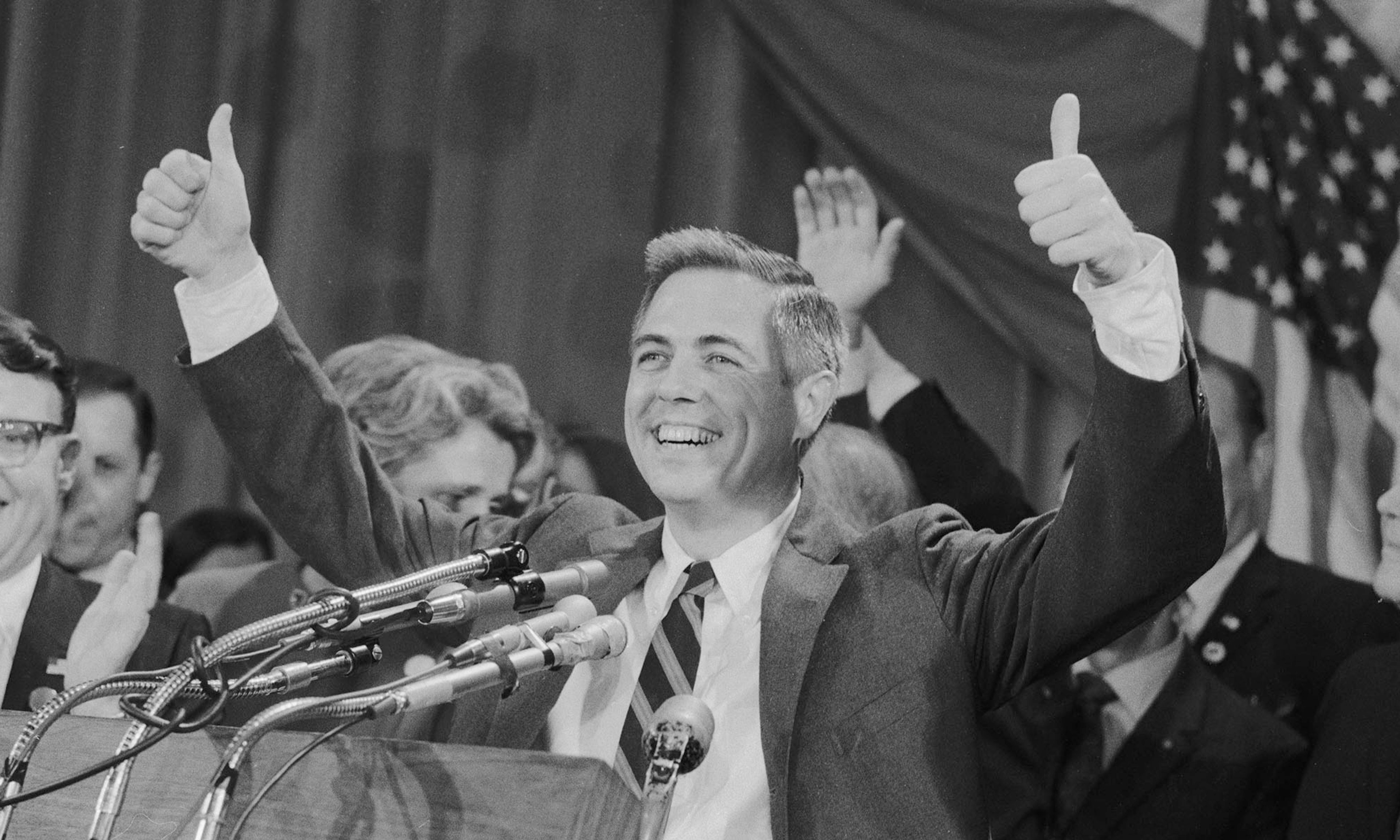
On Election Night, November 3, 1970, James Lane Buckley, the standard-bearer of the eight-year-old Conservative Party, stood before a throng in the vast ballroom of the Waldorf-Astoria Hotel. It was late, and the returns were finally in. “The American people want a new course; they want a new politics,” he said, and paused for the slightest moment. “And I am the voice for the new politics.” A roar ensued: Jim Buckley had won, gathering 2,288,190 votes, some 38.75 percent of all ballots cast. Ottinger earned 2,171,232 votes, trailing by two percentage points. In the dust was Goodell — with 1,434,472 votes, he failed to crack 25 percent.
Reflecting a half century later, America’s oldest living former senator (Jim Buckley is 97 years young) sees his 1970 election as proof “that a third-party candidate could indeed win a significant political race, but only with the confluence of very unusual circumstances.” (Buckley was defeated for reelection in 1976 by Democratic nominee Daniel Patrick Moynihan.) More important, it proved that conservatives “had appeal not only to Republicans who were disenchanted with their incumbent, but to what would later be labeled Reagan Democrats.”
Jim Buckley, a voice and a catalyst of the new conservative politics, later served as an undersecretary of state in the Reagan administration and as a federal judge on the district court in Washington, D.C. He is one of the few people ever to serve in all three branches of government. On the 50th anniversary of his triumph, this man of historic achievement deserves to be heralded by a movement conscious that it owes much to its founder’s older brother.
And maybe a little to a pair of shoes.











Comments