The commanding heights of academia are held by a self-confident ideology of the Left that treats conservatism as a kind of mental disorder. A Republican is in the White House. He came new to the party and remains ill at ease with the language of its principles, as the cultural tide swirls past him. He presides over divided government after years of what looked like unbroken Democratic rule. Young conservatives know what they feel, but not necessarily what they should think, or why. Cultural drift seems inevitable.
Isn’t this where National Review came in?
Lionel Trilling famously remarked, in 1950, that “it is the plain fact that nowadays there are no conservative or reactionary ideas in general circulation. . . . The conservative impulse and the reactionary impulse do not, with some isolated and some ecclesiastical exceptions, express themselves in ideas but only in action or in irritable mental gestures which seek to resemble ideas.” When National Review was founded in 1955, it was possible to see the intellectual and political cupboard as bare of conservative ideas. But the ideas were not dead or gone; they were merely rusty from disuse, or camouflaged so well in the landscape as to be unnoticed. As has often been the case in history, timeless conservative truths are not even verbalized until it is apparent that they are under attack and require defending.
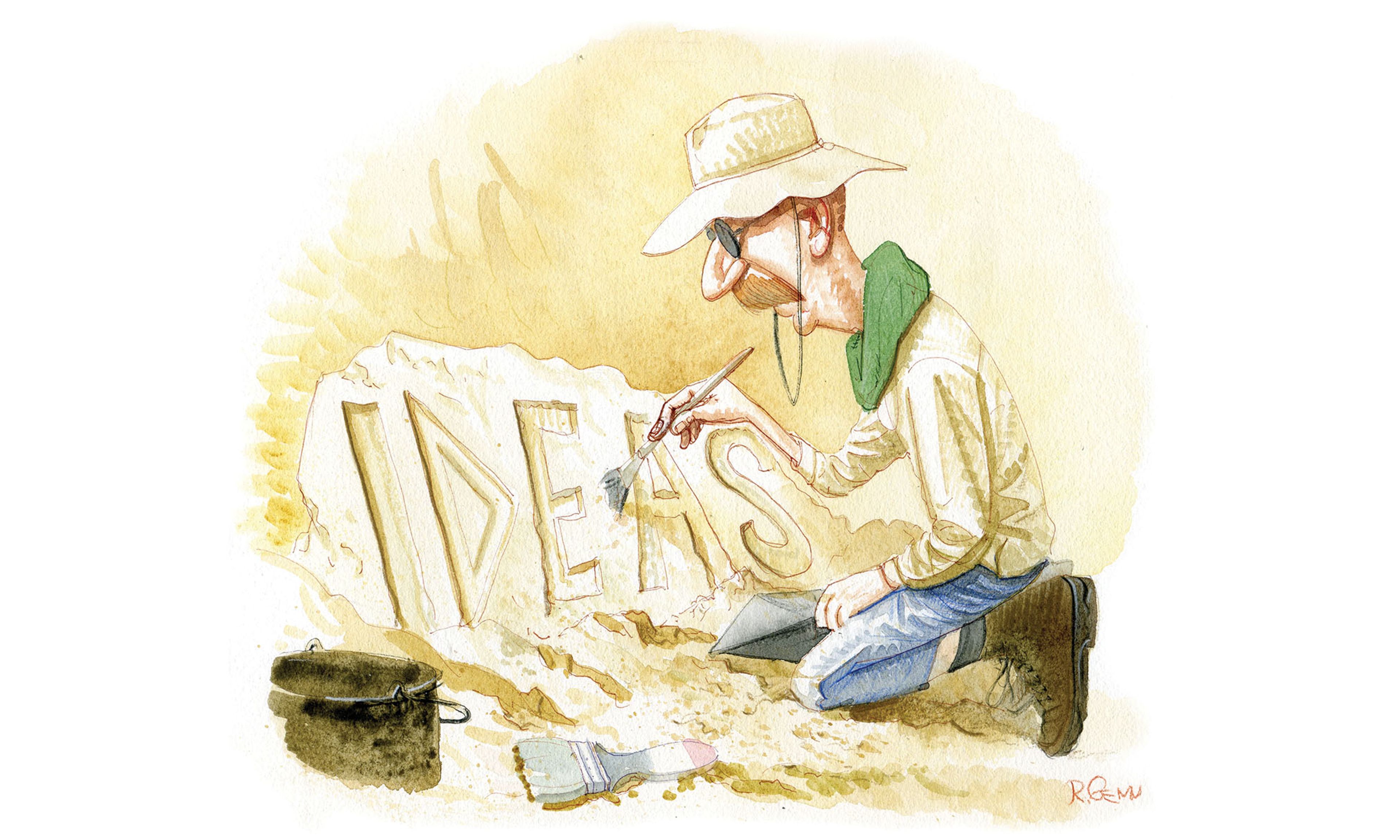
Much of the early work of this magazine was a sort of intellectual archaeology, digging up old or buried ideas and deciphering their language for a new age. The very process of thinking through what was and was not a conservative idea, and which ideas could exist together, helped inspire a younger generation of conservatives to go forth and see whether those ideas could be sold anew to the voting public and formulated in scholarship. In time, many of them were.
Do ideas still matter in conservative politics? Some who despair of the populist turn of political and social conservatives under Donald Trump say no. Some who celebrate that turn may feel the same. The day of intellectual magazines is over, we are told; we should simply observe where the people are going and follow them. But the power of ideas in politics is foundational and eternal, and no nation’s politics are so traditionally driven by ideas as America’s. “Ideas,” in this context, means both the big, thematic ideas that move hearts and the specific, concrete policy proposals that turn philosophy and rhetoric into law, organization, philanthropy, and governance. Both types of ideas still matter.
America is itself an idea as well as a people and a place. The Declaration of Independence ensured that Americans would, from the very beginning, define ourselves by what we believe. Ideas have always been the font of power in America. In the words of Abraham Lincoln: “With public sentiment nothing can fail; without it nothing can succeed. Consequently, he who moulds public sentiment, goes deeper than he who enacts statutes or pronounces decisions. He makes statutes and decisions possible or impossible to be executed.” Andrew Breitbart offered his own pithy summary for our own time: “Politics is downstream of culture.”
Even cynics understand the galvanizing force of ideas. In 1853, the frustrated German liberal Ludwig von Rochau penned a study of the failure of the idealistic, urban, liberal constitutional revolutions of Europe in 1848. Rochau coined in the process a new term: “realpolitik.” Today, we think of realpolitik as the opposite of the politics of ideas, but what Rochau really drove at was quite different. His Foundations of Realpolitik described four basic principles of state power: (1) Politics is dominated by “the law of the strong,” in which power — rather than law, rights, or legitimacy — is the basis of the state; (2) governments are more powerful when they incorporate and co-opt any class, force, or faction that is growing within a state, in order to harness rather than conflict with those forces; (3) ideas are powerful in politics because people believe them and are motivated by them, not because they are true; and (4) public opinion, in the form of the zeitgeist, has the power to overwhelm conflicting material interests and unite the strongest forces within the state behind an idea. In short, power may rule, but the components of power are formed when ideas bring separate constituencies together in common cause.
The idea Rochau had in mind was German nationalism, which over the next two decades would sweep away 38 of the 39 German states and many ancient crowns. This was not done at the ballot box, but neither was it dictated from a throne room, nor imposed on the field of battle. The complex and simultaneous processes of unifying Germany and unifying Italy in Rochau’s day were partly a feature of the opportunities presented by the diplomatic posture of the European powers, but they were also a testimony to how the flood tide of an idea seeps into every crevice of a multipolar system of forces, wearing away resistance to its current.
Ronald Reagan’s presidency is recalled as the high-water mark of the intersection of conservative ideas with political power. Reagan was known as the “great communicator” not only because of his stock of jokes, folksy stories, soaring rhetoric, anecdotes, and statistics, but also because the listener came away from a Reagan speech knowing exactly what Reagan proposed to do and why he believed it was right. Reagan’s communications were not simply experiences; they always had a point. If Reagan’s words were the product of years of conservative argument about ideas, his agenda was likewise the product of years of preparation to turn those ideas into practical reforms, ranging from supply-side tax cuts to missile defense. The process of disputing ideas at the level of policy meant that Reagan’s election was met with ready-made proposals and shock troops to implement the Reagan Revolution.
When crises arise for which no one has prepared, the strongest ideas rush in to fill the vacuum. Consider the aftermath of the September 11 attacks. Why did the George W. Bush administration embark on what came to be seen as a “neoconservative” project of regional change? It wasn’t personnel: Neither Bush nor Dick Cheney nor Donald Rumsfeld nor Colin Powell nor Condoleezza Rice would have been identified, before 2001, with neoconservative thinking or policy. But the neoconservative narrative of American triumph in the Cold War was built around a powerful idea that gained currency even among many more-conventional foreign-policy thinkers after 1990. In this telling, the central element of American victory was the appeal of the American way of life (civil, political, economic, and cultural) to the masses of people living under the jackboot of Soviet Communism and its satellites around the globe. Once people saw that they could have a better life our way, they preferred to join us rather than follow leaders who wanted a fight. Islamist extremism was bred in so many countries where the leaders denied the people those opportunities. Why not offer them the same lesson?
The prudence of what followed remains hotly debated, but this much is not: Nobody else had an idea that could compete. The war in Afghanistan was, in its origins, punitive and retaliatory. The war in Iraq aimed at unfinished business and disarmament. But both took on the character of an effort to convert the local population to aspects of the American system because that was the most powerful idea on offer.
No better illustration of the power of ideas exists in American politics today than the conservative judicial project to staff the courts with adherents of constitutional originalism and statutory textualism. These, too, were old ideas fallen into disuse, which is why originalists and textualists find so much support in the arguments of Hamilton, Madison, and Lincoln. But it took a generation of scholars and jurists to turn those arguments into a coherent philosophy of judicial legitimacy and a workable framework for judging. And the wit and insight of one man, Antonin Scalia, transformed that philosophy into something that operated on Lincoln’s deeper level. Today, even the critics of originalist legal argument must play on its terms. The power of the idea was such that even Trump’s populist revolution within the Republican Party, which challenged so many other entrenched positions, adopted wholesale the originalist project.
Ideas are not, however, confined solely to elite legal and foreign-policy circles. Consider Trump’s “border wall,” which captured the imagination of voters who had lost faith in the political class’s will to enforce America’s borders. What Trump understood was that the granular details of border control required a galvanizing idea, and that idea required a tangible symbol: the wall. As with so many of the ideas and slogans of Trump’s populist boosters, the wall fell short in practice because not enough hard work was done to make those granular details workable. Some fencing was built, and Mexico did not pay for it. But the rallying cry of “Build the Wall” was less about the wall itself than about the idea it embodied: getting genuinely serious about controlling the southern border. Many of the voters who rallied to the wall judged it on those terms.
Republican and conservative health-care proposals over the past two decades have suffered from the failure to marshal the power of ideas at both ends. There are many areas of general agreement among conservatives on health-care principles, and there are plenty of specific ideas that have long been discussed. Popular interest is high, and in 1994 and 2010 there were grassroots movements around the simplest idea of all: “No!” But nobody has yet figured out how to fuse general principles, specific proposals, and grassroots sentiment into Rochau’s zeitgeist.
Populist movements often sweep away an old consensus, but they rarely last for long. Whether they succeed or fail typically depends on whether the motive force of their general ideas can be translated into more-specific actions that can be carried out by practical politicians. As the fuse of the Trump revolt burns down, we can see more starkly the fields it has cleared for a generational rethinking and relearning of the big conservative ideas, from how we balance state power with limited government, to the uneasy relationship between faith and consumer materialism in our culture, to how we handle the new tyrannies and the new pitiless orthodoxies of the 21st century. If it seems strange that the work of hashing through those ideas and inspiring a new generation to take them seriously — the task begun by National Review 65 years ago — must be begun again, well, there are some old conservative ideas about the permanence of human nature and the fragility of order and liberty that we may need to rediscover along the way. The job of conserving is never over.












Comments