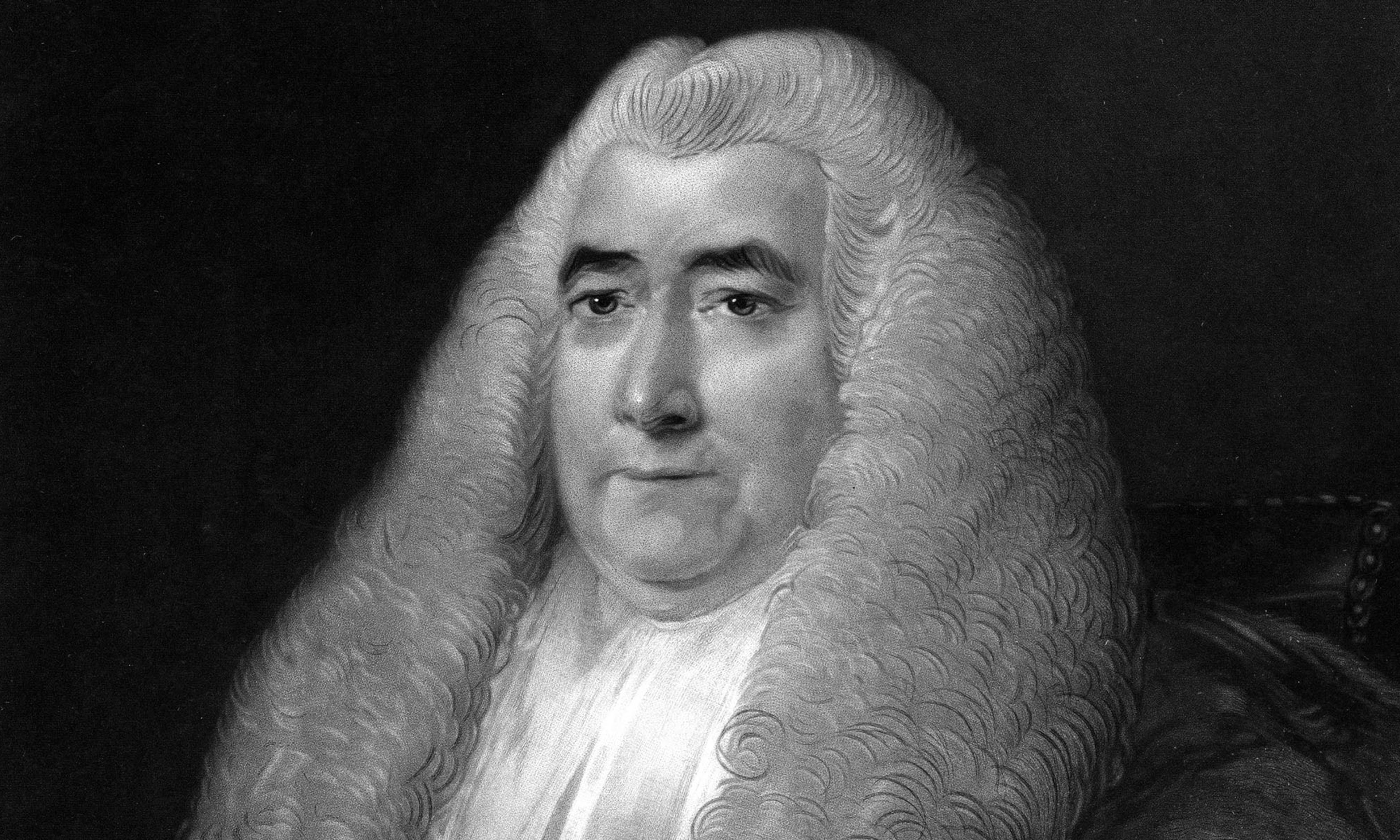
‘Begin with Blackstone’s Commentaries.” So replied Abraham Lincoln to J. M. Brockman, who, in 1860, asked the future president about “the best mode of obtaining a thorough knowledge of the law.” Lincoln was referring to William Blackstone’s multivolume Commentaries on the Laws of England. Blackstone (1723–1780) composed the work from his Oxford lectures on English law — the first of the sort ever given at an English university. Published between 1765 and 1769, the Commentaries has become the most influential legal text in American history. The Federalist twice cites the “judicious Blackstone.” Future Supreme Court chief justice John Marshall read the work four times by the age of 27. In the 19th century, the Commentaries formed the cornerstone of legal education for American lawyers, including Lincoln.
Today, Blackstone’s Commentaries retains some influence in the legal profession, especially among originalists. Since 2000, opinions in more than 1,000 state and federal court cases have cited the work, often when discussing the original meaning of older legal terms and concepts.
Outside of the legal profession, Blackstone seems little read, much less revered. But the Commentaries deserves a wider audience. It offers more than historical artifact or technical legal training. Blackstone provides a truly liberal education, one directed to cultivating liberty through a knowledge and practice of justice grounded in the rule of law.
Blackstone does so by articulating what he calls the science of law. The science of law pursues justice, in which liberty is grounded. To accomplish that pursuit, this science requires wisdom to understand, power to carry out, and goodness to desire justice.
The science of law seeks wisdom to understand by trying to “distinguish[] the criterions of right and wrong.” Laws in our statute books do not determine justice. These criterions instead originate in God, Blackstone wrote. The Creator communicates His will through two means — the “law of nature” and the “law of revelation.” These means teach man’s duties to God as well as his rights and duties in relation to others. By observing them, a person exercises his own freedom and respects that of his fellow man.
All proper human laws, then, must conform to these divinely instituted standards. In man’s laws, we find the power to carry out justice. Regarding right and wrong, the science of law seeks “to establish the one, and prevent, punish, or redress the other.” The making and enforcing of law does so through protecting rights and punishing their violation. These rights include “absolute” or natural rights to personal security, personal liberty, and property, as well as “relative rights” dependent on citizenship and social relationships.
Finally, the science of law concerns the goodness needed to pursue justice and liberty. Many legal theories see law as mere restraint, liberty as the lack of such restraint. Not Blackstone’s. The “theory” informing his science involved “the noblest faculties of the soul.” “In its practice,” he declared, the law trains one in “the cardinal virtues of the heart.” Therefore, while the law does concern actions — stopping violations of rights and enforcing performance of duties — it also develops virtue in souls.
Thus, the Commentaries approaches law as a cultivation of humanity and citizenship. It educates the mind to reason rightly. It instills the heart with “endowments of loyalty and public spirit, of honour and religion.” In short, it constitutes “an highly useful, I had almost said essential, part of liberal and polite education.”
We can see why Blackstone saw this science as “universal in its use and extent.” All persons could learn from it. It certainly educates the lawyer. In fact, Blackstone laments that legal education had “dropp[ed] all liberal education, as of no use to students in the law,” and replaced it with training only “in the mechanical part of business.” But this science also educates and guides the legislator in the right construction of human statutes. It instructs the gentleman to freely, justly participate in politics. Even the lowest peasant should learn law, for it teaches him the extent and right use of his liberty.
The Commentaries does contain much English legal history and sundry rules for technical practice. This material appears tedious, daunting, or both to most readers. Even these sections, however, hold valuable lessons for all free citizens. Blackstone understood the science of law to involve more than universal principles. The justice declared in the laws of nature and revelation must be applied to particular polities — to regimes with their own national character, experiences, and circumstances.
England adhered to the universal. Concurring with the French political thinker Montesquieu, Blackstone described England as the only country “in which political or civil liberty is the very end and scope of the constitution.” England also showed that one might apply these broad principles to a specific people. Beyond statutes passed by Parliament, the greatest lesson lay in England’s common law. Blackstone provided coherence and system to this long-developing, often confusing mesh of unwritten customs and judicial decisions. In the Commentaries, he grounded the common law in reason and natural justice. It applied these to the circumstances of its own country. It refined them as time and practice taught; it solidified them by the constant renewal that tradition adds to natural right. Blackstone thus praised the common law as “excellently adapted to the genius of the English nation.”
Blackstone similarly defended the tedious discussions of English legal rules, jurisdictions, and procedures. Each applied principles of liberty in ways developed to better realize those principles in practice. The interaction between common law and equity courts sought to respect both the law’s letter and its spirit. The various procedural protections for judicial process, such as trial by jury and habeas corpus, aided courts in justly protecting rights and punishing wrongs.
Other nations could not copy England’s laws or procedures verbatim. They could, however, learn from her example. They could observe her exercise of wisdom, emulating for themselves her conversion of universal principle into particular practice.
Our own time often divorces justice from nature, liberty from virtue, and law from all of the above. We are the worse for it. In response, we would be well advised to follow Lincoln’s advice and “begin” again — “with Blackstone.”












Comments