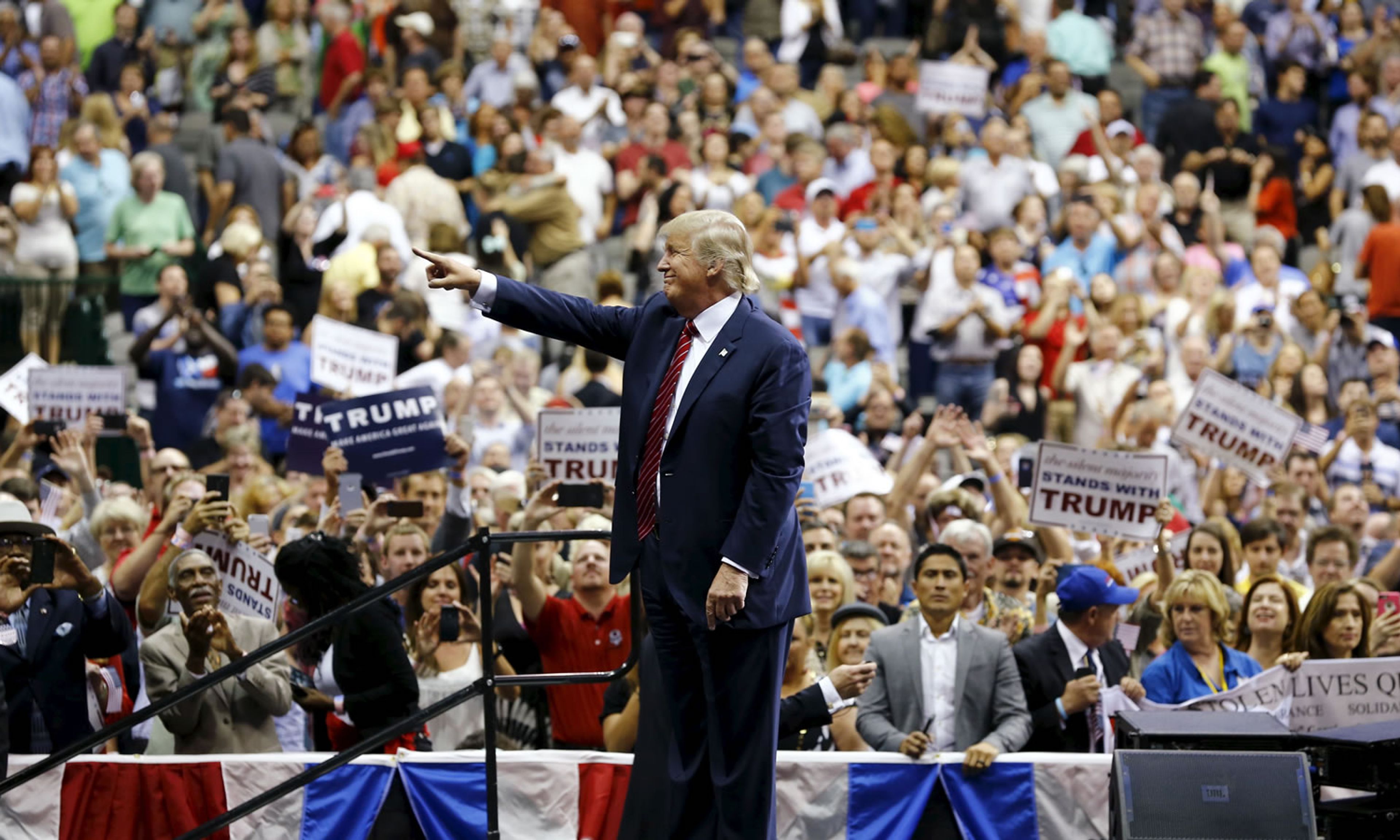
Depending on your point of view, Donald Trump’s presidency either promised or threatened to be a hostile takeover of the Republican Party by the ghost of Pat Buchanan. Although he often hedged in other directions, the thrust of Donald Trump’s critique of previous Republican orthodoxy focused on trade, immigration, and foreign policy. It held that the Republican Party was wedded to an abstract commitment to free trade that cut against the actual interests of the American people and their government. It accused the Republican Party of indulging a utopian foreign policy and proposed to end America’s endless wars. It accused the GOP of being too soft-minded to maintain America’s borders and proposed an immigration system that would put the nation’s people and social cohesion above the interests of low-wage employers.
Donald Trump’s improbable 2016 run through the Republican primary and into the White House shocked the conservative movement and the entire political class. It changed everyone’s view of what could be accomplished in campaigns. Conservative populists and nationalists can take some pleasure in Trump’s presidency, as it helped them assert themselves within the coalition as a force that needs to be reckoned with. It demonstrated that these views had a real constituency in the party. But in the end, the Trump administration simply neglected any attempt at seriously implementing a populist-nationalist agenda.
A status quo on free trade. Populists and nationalists advocate using trade policy to achieve multiple goals, some of them not so easy to reconcile with the others. Some demand that our trading arrangements take American security and self-sufficiency more into account. They say our trade should not allow essential supply chains to be controlled by hostile or rival powers, whether it be for medical-grade protective equipment needed in a pandemic or the silicon chips that control America’s advanced weaponry. Countries facing a crisis or war may have to rely on ancient measures such as the Defense Production Act of 1950, but these are a dead letter if the factories simply don’t exist in American territory.
Some populist-nationalists go even further and believe that trade and industrial policy should seek not only to have American companies produce the essential goods for national security, but also to retain a workforce with the essential skills needed to preserve our global preeminence. Apple’s CEO, Tim Cook, said that by now his company no longer saw China as a cheap-labor pool, but instead as a skilled-labor pool. “In the U.S., you could have a meeting of tooling engineers and I’m not sure we could fill the room,” he told one audience. “In China, you could fill multiple football fields.” For nationalists, this is a cause for alarm about America’s ability to stay ahead technologically. The race for nuclear and space supremacy was won by having the best engineers. What is the next race, and can our economy support the effort needed to win it?
Finally, some nationalists want to retool trade policy primarily for domestic political harmony and coalition-building. As the industrial portion of the American workforce shrank, many regions of the country became less viable economically. In those vacated spaces, social pathology rose dramatically: illegitimacy, drug use, deaths of despair, and a shrinking life expectancy. Without more breadwinning salaries for men without college degrees, faith in the American dream dies, and our politics become more eruptive and vulnerable to left-wing cranks and demagogues.
President Trump’s primary interest was the least important one: fixing the trade deficit. But rhetorically, he embraced all the arguments nationalists make for revising our trade agreements, particularly those with China. He emphasized national competition, national greatness, and good jobs in struggling regions. By doing so, he very likely changed what it is politically acceptable to advocate in Washington, D.C.
The results in policy, however, were mostly a waste of effort. The strong economy under Trump did lead to an increase in manufacturing jobs, and corresponding increases in wages at the bottom of the income scale. That was fantastic. But the renegotiation of NAFTA into the United States–Mexico–Canada Agreement and Trump’s agreement to cease trade hostilities with China did not alter the status quo in a way that would meaningfully advance any nationalist-conservative ends. In fact, they were, by the lights of most free traders, modest and incremental improvements on the status quo Trump had so vociferously attacked. (Trump reportedly asked the Chinese government to make larger soybean purchases that would help his reelection campaign in some rural swing states.)
A nationalist must look at China’s slightly increased commitments to American agriculture as half a win and half a loss. It is good for American agricultural interests, but it can also be seen as further Chinese investment in pushing America down the value chain of production, a long-term play aimed at making us more like a remarkably efficient Third World economy. The same can be said of negotiations with the EU. It is good that some tariffs on U.S. exports were eliminated, but arguably Europe got the better of the deal. The U.S. will sell more lobsters abroad; the EU. will send more glassware and cigarette lighters here. Donald Trump’s free-trader critics could have advanced the very same policies.
Immigration unreformed. Needless to say, Mexico has not sent the United States a cashier’s check for Donald Trump’s promised wall on the southern border. Trump and his administration did get some minor wins on immigration, but the administration’s moves to counter the Obama administration’s overreaching executive amnesties were mostly thwarted by the courts. Still, the Trump administration did end a developing crisis on the border by smartly and toughly negotiating a new policy with the Mexican government that has dissuaded caravan-style immigration and the use of America’s asylum system as an alternative route for those jumping the line on immigration.
However, ending that border crisis had a serious moral and political cost. The child-separation policy was the administration’s way of reconciling existing rules about children who cross the border illegally with a tougher pattern of law enforcement against the adults who had learned under the previous administration that crossing with a child eased the path to gaining entry. Child separation caused real emotional distress in children who are not guilty in the same way as their parents. Trump eventually signed an order ending these separations in 2018, though to this day some children have not been reunited with their families.
The child-separation policy, combined with Trump’s sometimes hysterical and bigoted remarks on immigration, has arguably caused American public opinion to shift in favor of freer immigration. This has disappointed the Right’s immigration restrictionists and reformers. They came to agree on a set of priorities — namely, making America select more of its immigrants based on skills, and ending familial chain migration. Republicans controlled both houses of Congress for two years, but there was no attempt at durable reform. Many of Trump’s executive orders on immigration policy will be swiftly undone by his successor.
America first, with some exceptions. In foreign policy, populist-nationalists advocate a variety of views, ranging from a more volcanic Jacksonianism to a policy of restraint. What unites them is a hostility toward the “D.C. blob” of policy experts who were wedded to a decaying consensus. Trump gets some good marks for boldly challenging a few of their orthodoxies, such as moving the U.S. embassy in Israel to Jerusalem. This was supposed to be unthinkable, an affront to Arab states generally. It did not hamper American relations with any Arab state. Trump leaned toward his Jacksonian side, which prefers in general not to enmesh itself in new conflicts but is willing to inflict swift and terrible violence against its enemies. Trump loosened rules of engagement in America’s continuing conflicts and ordered the assassination strike on Iranian general Qasem Soleimani.
But here again, Trump failed to deliver on his oft-repeated promises that the troops were coming home from Syria and Afghanistan. He did not cease assisting Saudi Arabia’s long war in Yemen; Obama’s dirty little war is now being passed on by Trump to Obama’s former vice president. In small numbers, American troops are still stationed and pursuing anti-terror missions on the ground in several African countries that most Americans do not even know are active theaters, such as Niger, Nigeria, Djibouti, and Somalia. Trump could have used his administration to build the résumés and experience of policy thinkers who challenged Washington’s consensus. But largely he stuck with telegenic or combative voices he thought he could control. The only major exception was his late nomination of Will Ruger to be ambassador to Afghanistan. Ruger is an advocate of the restraint school, active in libertarian and conservative circles.
Trump’s major policy legacies came from the conservative movement as he found it — tax cuts and a conservative judiciary. The party had been moving in a culturally populist direction for some time, and Trump’s victory enhanced that. The Republican Party is now the natural home of those who suspect that America’s expert class lacks real expertise. Trump also showed that Republicans can make even more electoral gains in rural areas and economically struggling regions, and among minority voters, with a populist and nationalist message.
In some ways, Trump enhanced the role of populists and nationalists in the GOP by driving their intraparty antagonists — including many upwardly mobile, educated white voters — toward the Democrats and their more cosmopolitan ethic. The Democratic Party has been filling up its store of these wine-track voters for decades. They now demand tax cuts and expansion of trade and immigration as a matter of course.
This is likely to keep populist and nationalist voices relevant and in contention to lead a fractious GOP coalition going forward. By leaving his party in decent fighting shape, Trump has done better than the last Republican president, whose policy and political failures tended to discredit the factions of conservatives most aligned with him. For populists and nationalists, Trump’s term was defined by wasted opportunities. But with several major Republican figures now bidding for their affection, Trump has given national conservatives and right-leaning populists a future.












Comments