At the end of December 1796, Thomas Jefferson, who had just lost the first contested presidential election in American history, sat down to write a letter to John Adams, the man who had beaten him. The election had been bitter, with clashes over foreign policy and taxes, social class and the structure of government. Yet the two men had known each other for years, serving together in the Continental Congress in the earliest days of the Revolution, and again as diplomats in Europe after the war, where Jefferson charmed Adams’s wife, Abigail, and won the affection of Adams’s eldest son, John Quincy.
“The public and the public papers,” wrote Jefferson, had indulged in rancor, yet he was sure “we have felt less of it ourselves.” He prayed that the new administration “be filled with glory and happiness,” and assured Adams of his “solid esteem.” He then sent the letter — to James Madison.
Jefferson had known Madison almost as long as he had known Adams, and had worked with him more closely. Madison was a protégé, a neighbor, a sounding board, and an adviser. He now gave Jefferson some advice: Don’t send this letter to Adams. Suppose it leaked; what would your supporters — “the zealous and active promoters of your election” — think? Would they feel “depreciated”? Suppose Adams, at a time of future strife, released the letter and its admiring words himself? “Real embarrassments” would ensue. But if you do decide to send the letter on, Madison concluded, better post-date it, to explain the delay (that is, the interval during which I have been trying to talk you out of doing so). Jefferson never sent the letter to Adams.
So passed a turning point in American politics, and in the presidency. We all live, Madison was saying, in a partisan world. Partisanship downplays personal relations and qualities in favor of group loyalty and unity. We work with each other, and we work together. Everyone in a party has his own role to play, and the party works for the same thing. That thing may be a bundle of compromises, or a theme as nebulous as MAGA or the New Frontier, but every party cobbles together something or other. In this scheme, a presidential candidate or even a president is one actor among many, albeit the most prominent. Ambition and other passions are the wild cards in a party system, as in any other, but this is the ideal.
Partisanship pulls for mediocrity, a drawback. Character and ability count less than solidarity. At the same time, partisanship formalizes rage and thus blunts it, an advantage. We all know how the game is played, so no hard feelings. The duels that killed Alexander Hamilton and injured Andrew Jackson were survivals of a pre-partisan age, or personal and regional cultural anomalies.
The application of partisanship to the presidency is at war, however, with another late-18th-century fact, which is that George Washington rode a horse.
He did not just ride a horse; he was “the best horseman of his age, and the most graceful figure that could be seen on horseback” — the judgment of Jefferson, an excellent horseman himself. On horseback was where most Americans saw him, as he made a point of touring every state during his presidency. Peter Henriques’s new book on Washington, First and Always, details the care he took of his presidential mounts, making sure their teeth and hooves were polished, their coats sleek. His troops during the Revolution saw him most often on horseback too, reviewing, scouting, and, in battle, leading on the field. There are many descriptions of Washington the centaur in letters, memoirs, and pension applications made by veterans in their old age. The one that has always struck me most forcefully comes from John Howland, who as a teenager served during the Trenton/Princeton campaign of 1776–77. Everyone knows of the crossing of the Delaware on Christmas night and the defeat and capture of the Hessian garrison in Trenton the following morning. Fewer know of the British counter-attack a week later, which sought to nab the Americans in turn. Washington, anticipating it, had posted his army across a creek just outside town. He sent some units, including Howland’s, into Trenton, to harass the enemy advance, which came as early darkness fell. Lit by the flash of muskets and artillery, Howland’s unit retreated to the creek across which, via one bridge, lay their comrades, and safety. This is what Howland recalled, years later. “The bridge was narrow, and our platoons were, in passing it, crowded into a dense and solid mass, in the rear of which the enemy was making their best efforts.” They were not alone. “The noble horse of George Washington stood, with his breast pressed against the west rail of the bridge, and the firm, composed, and majestic countenance of the General inspired confidence and assurance in a moment so critical. In this passage across the bridge, it was my fortune to be next the west rail, and arriving at the end of the bridge, I pressed against the shoulder of the General’s horse and in contact with the boot of the General. The horse stood as firm as the rider, and seemed to understand that he was not to quit his post and station.” Washington was where he had to be; so was his horse; so was Howland. That touch, still palpable after almost 250 years, joining two men and an animal, is the touch of leadership.
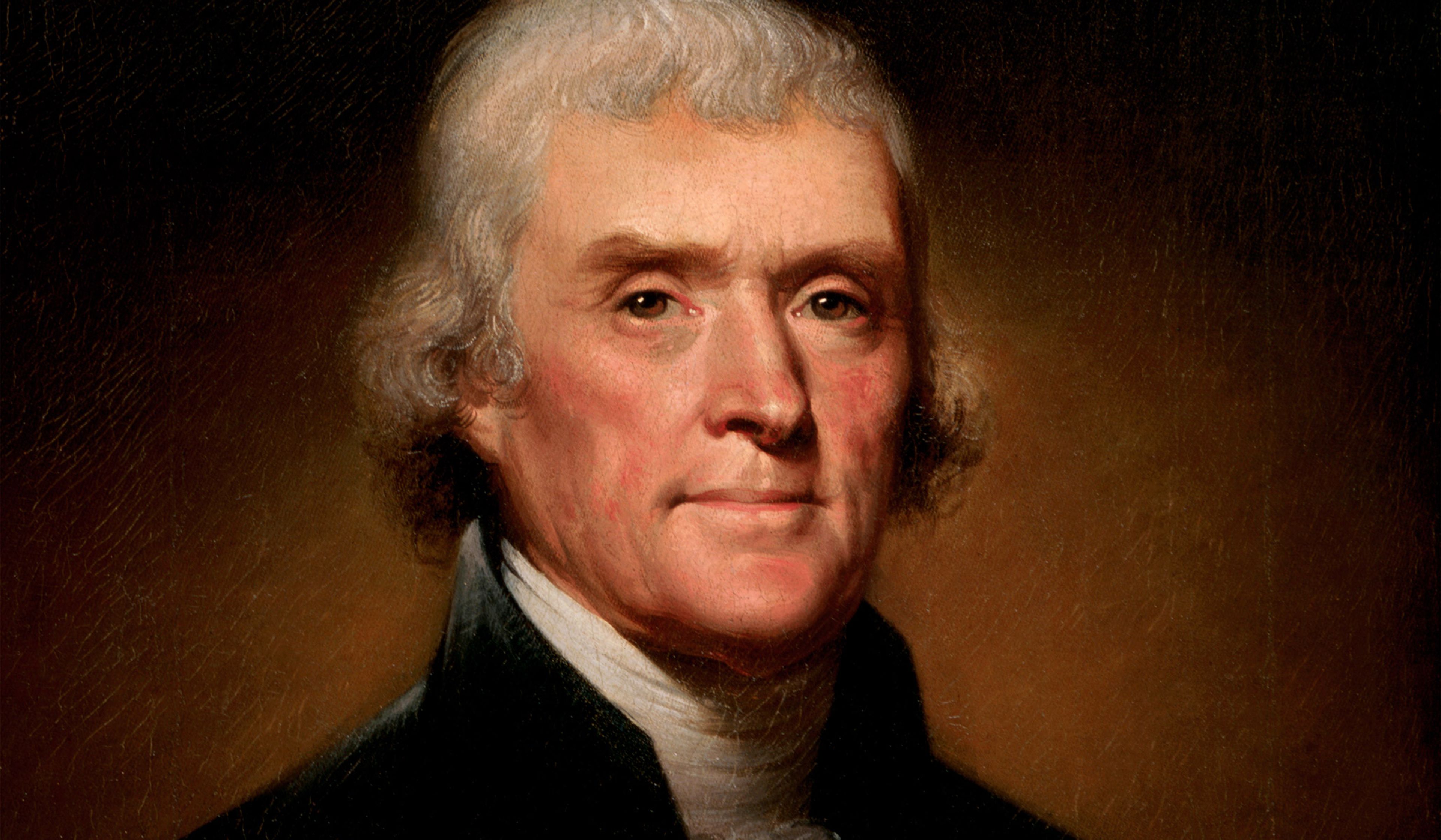
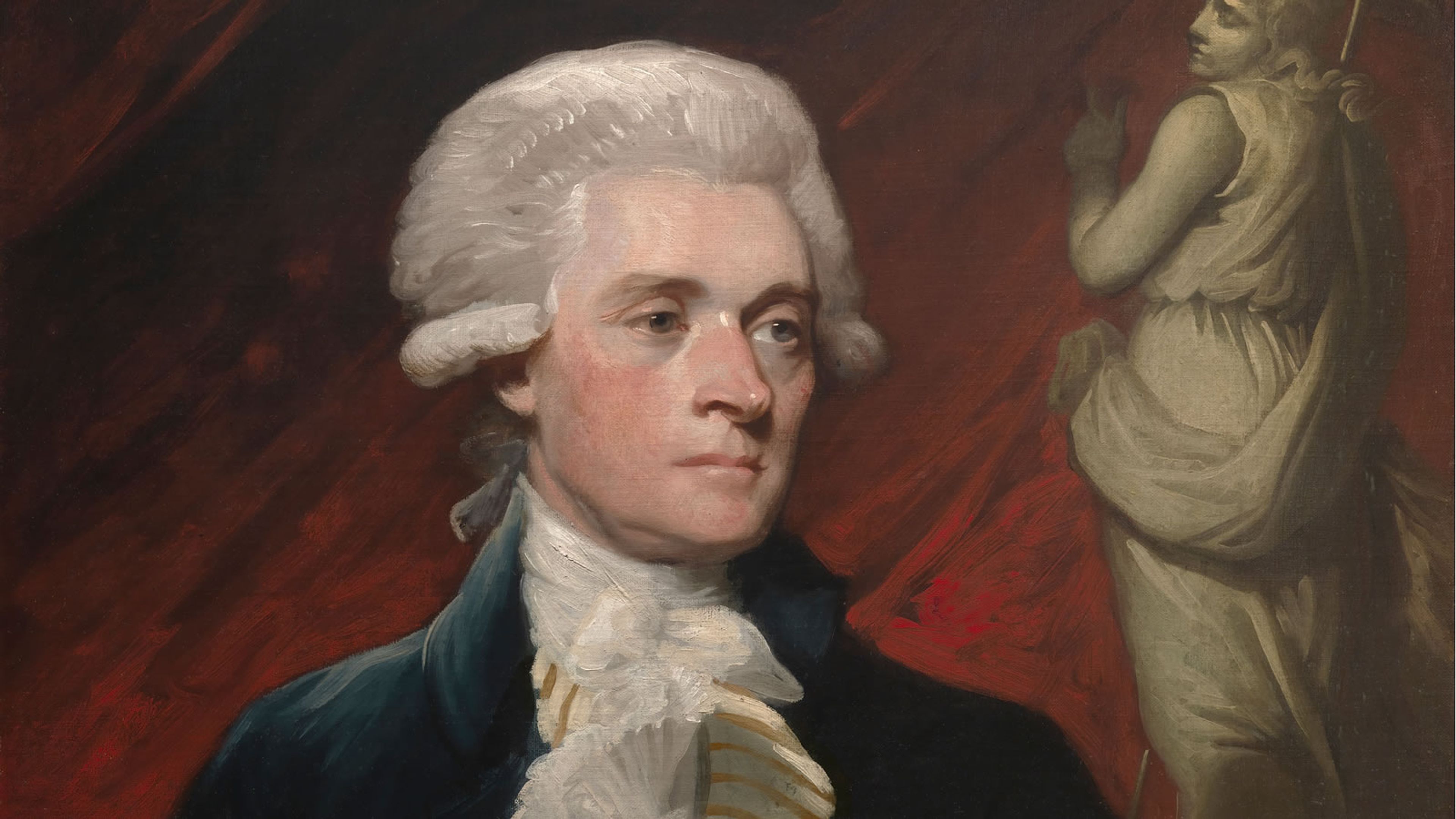
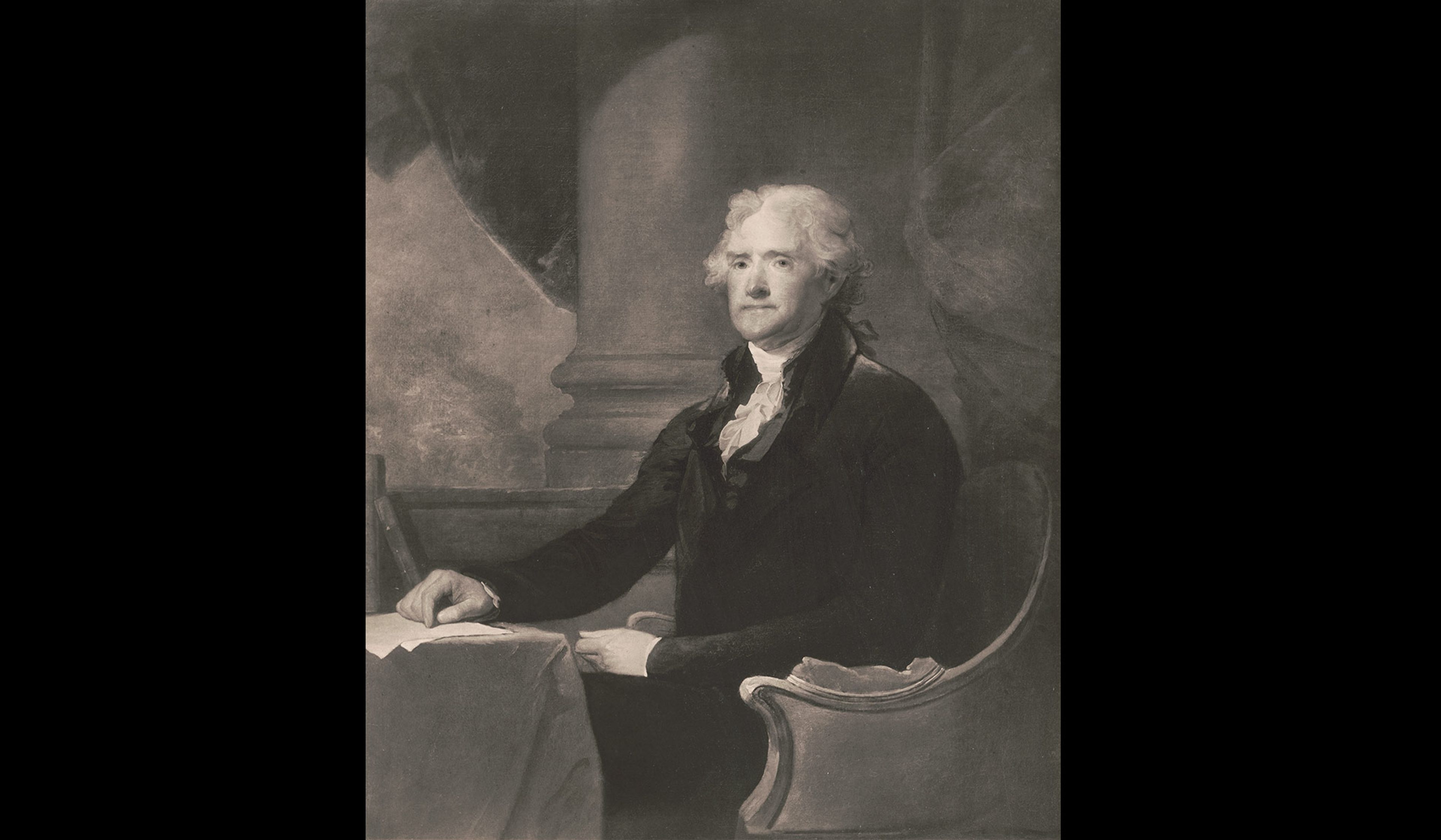
Detail of portrait of Thomas Jefferson by Rembrandt Peale, 1800
Wikimedia
This is what Americans got from the father of his country. And this is what, childlike, we still look for from presidents. It can be a dangerous yearning. Kings, and usurpers — Napoleon crossing the Alps — also ride horses. Modern leaders descend in choppers. Washington himself tried to moderate the feelings he aroused (and employed), dressing at presidential receptions in plain black, closing out every job by going home to Mount Vernon. Jefferson, in his last letter, warned against the man on horseback, declaring that “the mass of men had not been born with saddles on their backs, nor a favored few booted and spurred, ready to ride them.”
The idea of the president-as-leader pulls the job away from the middling level of partisanship. It calls on aspirants to be inspiring, which can mean asking them to be wise, virtuous, principled. But inspiration can take other paths; we can draw it from figures who have a compelling life story or check an identity box; who are entertaining, aggressive, aggrieved. So Barack Obama, the half-black outsider, became the Lightworker, and Donald Trump, master of TV, Twitter, and rock-concert rallies, made his supporters feel great again. For such leaders their flaws — Obama’s too-cool-for-school hauteur, Trump’s turdliness — are features, not bugs.
Sometimes a leader who rises by the low road shows other qualities. Abraham Lincoln won his first presidential election as the Railsplitter, the log-cabin candidate of western swing states. It turned out he was tough, tragic, and humane. Score one for democracy in its most demotic form.
A president is a hack, or an X, and X can be a hero, or something else. Keep a close watch.












Comments