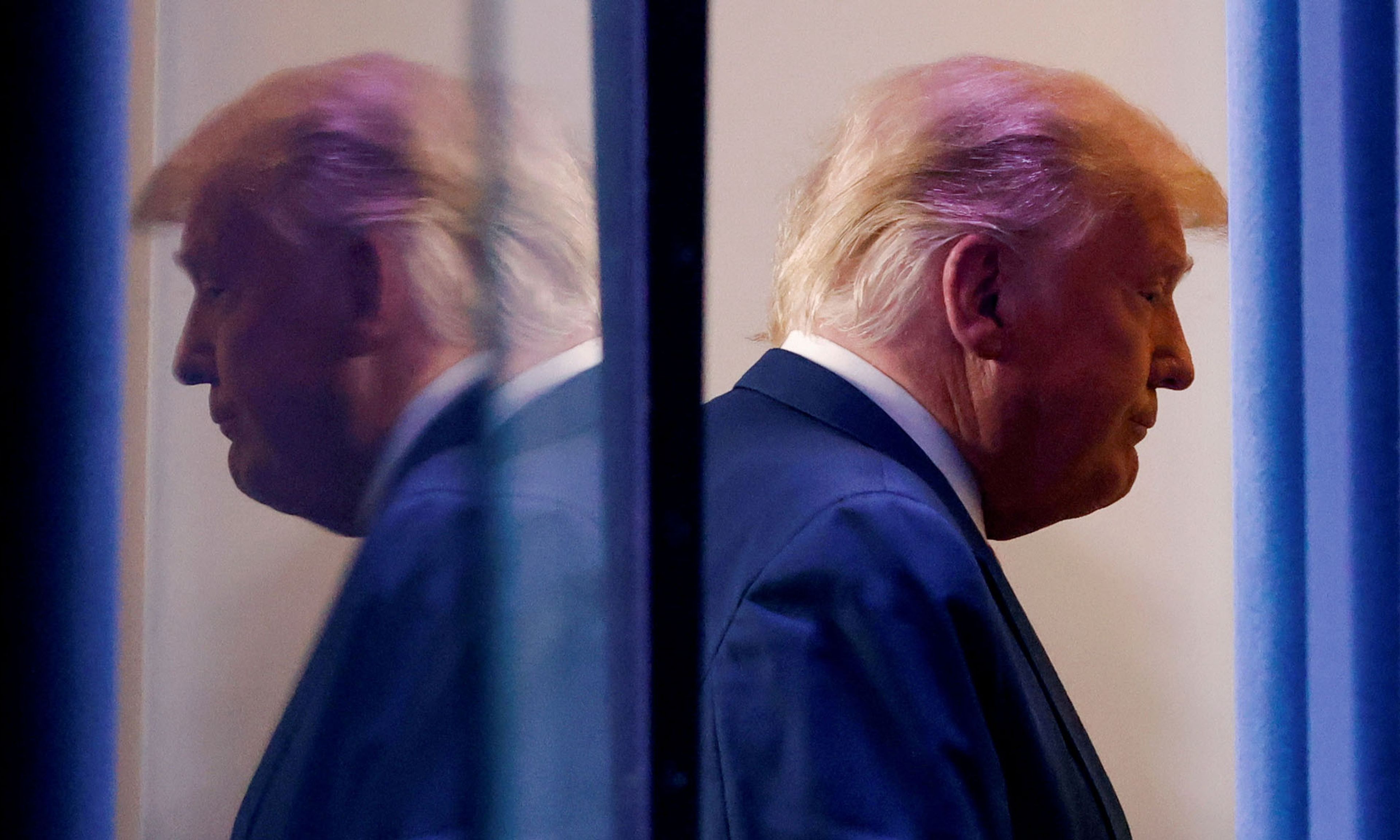
Trump will obviously be remembered less as a policy maven than as a cultural warrior.
This is one reason that his tenure has been so controversial. We can disagree about Medicare reimbursement rates, but cultural issues cut much deeper, involving questions of, to quote the title of the influential Samuel Huntington book, “Who are we?”
Trump reoriented the main lines of battle in the culture war away from issues related to religion and sexual morality and onto the grounds of populism, nationalism, and political correctness. Trump’s culture war is fundamentally the people versus the elite, national sovereignty versus cosmopolitanism, patriotism versus multiculturalism, and fearlessness versus PC pieties.
The underlying premise, made most explicit in Trump’s teleprompter speeches, is that the national community can be held up as a source of identity and belonging over and above class and race.
This doesn’t mean that the old cultural issues have gone away, of course. Abortion is still fiercely contested, and Trump has been a rock on it. The Obama administration insisted on forcing nuns to bend to the contraception mandate, and Trump has vindicated their conscience rights. If the president didn’t have the posture of an orthodox social conservative on such issues, he’d never have been nominated or won in 2016. But clearly there’s a large transactional element to Trump’s actions in this area — certainly, no one is ever going to mistake him for a “theocrat.”
It’s the new matrix of issues, though, that fundamentally motivates Trump and has driven so much of the debate over the last four years.
A characteristic moment from the 2016 primary debates captured the Trump phenomenon in a nutshell. Asked by a moderator what he made of former Mexican president Vicente Fox’s saying that Mexico wasn’t going to pay for “that f***ing wall,” Trump said, “The wall just got ten feet taller.” This is the kind of Trumpian sentiment that his supporters adore — utterly defiant and unapologetic, and about a proposal that symbolized his willingness to defy every critic and naysayer to defend America’s border.
No other Republican would or could speak in these terms, which accounted for Trump’s unique political power.
Of course, there are enormous downsides to Trump’s approach. With regard to the wall, the promise that Mexico would pay for it was always manifestly absurd and unrealizable, not to mention needlessly demeaning to an ally.
Trump flew in the face of the advice of the RNC’s “autopsy” after Mitt Romney’s defeat in the 2012 election, which read like a distillation of the dubious conventional wisdom of the Republican political class — because it was. The autopsy counseled downplaying cultural issues — “when it comes to social issues, the Party must in fact and deed be inclusive and welcoming” — and insisted that “we must embrace and champion comprehensive immigration reform.”
The autopsy took it as a given that the Republican Party could succeed — and diversify — only by reaching out to social-moderate voters inclined to support its free-market economics.
Trump turned the advice on its head, finding new working-class white voters in 2016 and making gains among nonwhite voters in 2020.
His electoral coalition is obviously too narrow — he barely eked out a win in 2016 and barely lost in 2020 (barring some extraordinary reversal). But Republicans should take on board the lessons of Trump’s cultural politics and build on what is sound.
First, Trump showed that social conservatives are the strongest part of the Republican coalition (he could cross free-traders and deficit hawks and get away with it, but not pro-lifers) and that the party’s cultural conservatism is more naturally appealing to working-class voters than its economics are.
Next, he demonstrated that the GOP must be the unabashedly anti-woke party. Trump’s fearlessness and anti-PC rhetoric resonated, and for good reason. In 2016, it wasn’t clear why, say, a voter in Wisconsin should have feared political correctness unless he was a member of the University of Wisconsin faculty, but the cancellations over the last year have reached down to ordinary people who have said “the wrong thing” on social media.
A recent Cato Institute survey found how widespread fear is in this era. Overall, 62 percent of Americans are frightened to say things they believe. A majority of every ideological group except strong liberals report that they have to watch what they say, and even 42 percent of strong liberals say that they self-censor. The share of conservatives who fear speaking their mind is 77 percent. The numbers have increased across the board since Cato last asked these questions, in 2017.
The ever-shifting standard of what’s permissible drives people crazy. This became an issue in the Amy Coney Barrett hearings when Barrett used the phrase “sexual preference” and was instantly attacked as anti-gay, even though the phrase had been routinely used by progressives and even gay publications.
Trump also demonstrated the power of defending American patriotic symbols and the country’s history. Prior to the overwhelming woke tide in professional sports prompted by the death of George Floyd this year, Trump’s fight with the NFL over kneeling during the national anthem was crude and bumptious but politically effective. His speech at Mount Rushmore staked out unassailable ground defending the country’s Founders and heroes and yet triggered an avalanche of criticism — exposing the radicalism of the media and the Left on elemental questions about the nature of the American founding and our nation.
Finally, Trump’s position on immigration, at bottom, represented a commonsensical insistence that, as Trump repeatedly put it, we can’t have a country without borders and that we should put our national interest first in making immigration policy. These beliefs alone constituted an affront to the Left, although there was much to criticize in Trump’s shambolic and at times callous attempts to put his restrictionism into effect. Nonetheless, after Trump, it’s hard to see how “comprehensive immigration reform” will soon again be orthodoxy within the Republican Party.
A Trump-style cultural politics was put on most appealing display at the Republican convention last summer. It was Nicholas Sandmann, the graduate of Covington Catholic High School, recounting getting smeared by the media over his encounter with protesters on the steps of the Lincoln Memorial; the partially paralyzed North Carolina congressional candidate, Madison Cawthorn, painstakingly standing for the flag at the end of his remarks; and a litany of ordinary people, often members of minority groups, extolling the wonders of America.
But all of that was scripted and controlled, as presentations at political conventions always are. Trump himself is usually unscripted and uncontrolled.
He hurt himself, understandably and rightly so, when he was seen deliberately fanning racial flames. In 2016, Trump’s numbers against Hillary in the RealClearPolitics polling average tumbled after controversies involving Judge Gonzalo Paul Curiel, whose objectivity Trump called into question because of his Mexican background, and Gold Star father Khizr Khan, a Pakistani immigrant Trump blasted after his Democratic-convention speech. Trump’s approval rating as president took a brief dive in the month after the Charlottesville protests and a more sustained hit with the onset of the George Floyd demonstrations.
He was almost always incapable of rising to the occasion and hitting some grace notes or adding appropriate and truthful nuance to his defenses of statues or the police. If the promise of a more nationalist politics is a “one nation” appeal to all Americans, Trump’s talk of people coming from “sh**hole” countries, his call for members of the Squad to go back to the countries they came from, and his attacks on West Baltimore (“No human being would want to live there”) were exclusionary and insulting to fellow Americans.
The trick for Republicans going forward would seem simple — pick up what has the best potential in Trump’s cultural politics, while rejecting the dross of his indiscriminate combativeness and heedless racial divisiveness.
This would mean a robust posture against the media and other elites, a willingness to court controversy, a complete rejection of the woke Left, an unremitting defense of American history and its patriotic rituals, holidays, and traditions, and an unapologetic making of the national interest — not the welfare of the globe or international opinion — the test of every policy, including policies on immigration.
The question is whether a more careful version of Trump, with a defter touch, would lack the sizzle of the original — in other words, whether Trump’s outsized person and rough-hewn handling of these questions were a feature, not a bug, for his voters.
One way or the other, Republican candidates in 2024 are going to set about finding out — and they should.












Comments