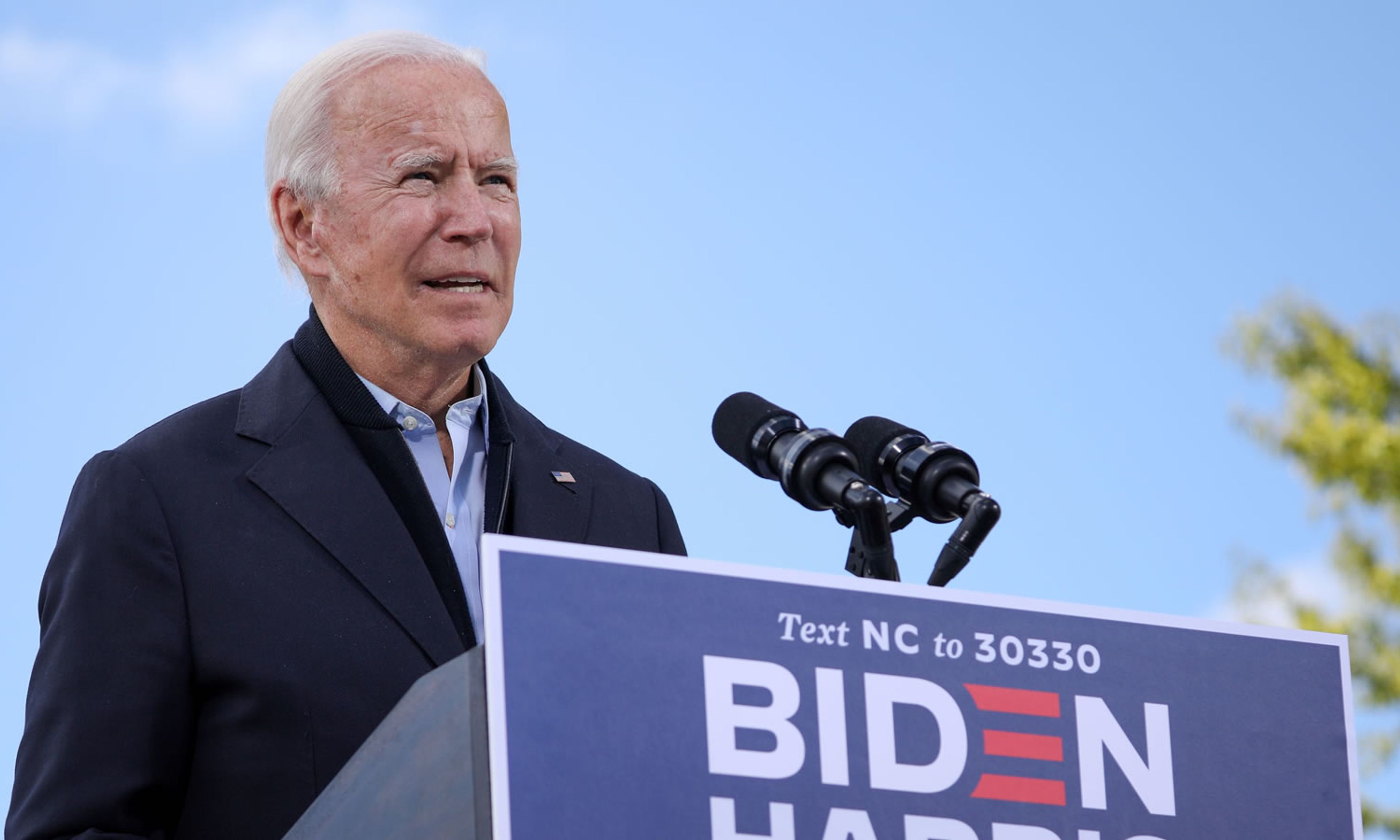
Sometimes, history is made by a man rising to meet the moment. Not so for Joe Biden, who made history by shrinking to his moment.
No new American president in living memory has won election by offering so little of himself and his agenda to the public. Even Jimmy Carter in 1976, with his famously vague platform and his promise to be the anti-Nixon who “will never lie to you,” was at least a man in the prime of his life who represented something distinct and new: a born-again Christian son of the Deep South, ready to turn the historical page on a period of civil-rights conflict and usher in an earnest new era of clean politics.
What is new or vivid about Joe Biden? He’s old: at 78, older on his first day in office than any prior president on his last. Most new presidents are relatively fresh faces on the national scene; Biden has been in federal office for most of the past 48 years, and first ran for president 33 years ago. The best jokes about his presidential ambitions were told by Johnny Carson. He entered the Senate when Bill Clinton was still a law student and Saturday Night Live wasn’t on the air yet. He was in Washington before Watergate, and was a familiar face on Capitol Hill when Gerald Ford was the House minority leader and Carter was still “Jimmy Who?” He was such an unremarkable fixture of the Beltway scene that he withdrew from the Democratic presidential race in 2008 after getting 0.9 percent of the vote in the Iowa caucuses. He’s the first president who plied his trade on the political stage of a state so small it has only one House district.
Biden’s once-voluble personality is shriveled, as age has robbed him of his quick Irish tongue and the mischievous twinkle he once brought to spinning out a new load of blarney. His touchy-feely style as a retail politician was cramped by Me Too charges of invading women’s personal space, and then obliterated by social distancing. Even his hair plugs are white and thinning. He navigates sentences like a man with a walker on a broken sidewalk.
Biden did not win the Democratic primary by making a big impression, presenting a new or exciting message, or having a big moment. He drafted off his connection to Barack Obama, which cemented his relationship with southern black voters. He acted as a foil to Bernie Sanders and other enthusiasts of socialist economics and wokeness, arguing mainly in the negative that Democrats should stay where they already were. Yet he also caved to left-wingers on long-held positions such as his former support for the Hyde amendment. He all but disowned the 1994 crime bill, his signature achievement as a lawmaker, and regretted he could not have done more to make the 1991 Clarence Thomas hearings more hostile to Thomas — even though Biden himself chaired the hearings.
Shrinking from center stage proved an effective tactic. Biden was roundly mocked by the pundit class after finishing as an also-ran in the first three contests, in Iowa, New Hampshire, and Nevada. His comeback was due not to a groundswell of enthusiasm for him but to the zealotry of Sanders, the consolidation of the Democratic establishment around a familiar figure (resulting in pressure on Amy Klobuchar and Pete Buttigieg to drop out and endorse Old Joe), and voters’ seeking the safest “electable” alternative to Donald Trump. It was enough. From that moment on, Biden was done being Not Bernie Sanders and could return to the message he had begun his campaign with: I am Not Donald Trump, and I am running to make Trump go away.
The central theme Biden presented on the Democratic debate stage was that the Sanders agenda was unaffordable and impractical and would make Democrats unelectable. Yet, as soon as he locked up the nomination, Biden began negotiating the terms of his surrender to the Sanders wing, signing a 110-page document full of “Biden-Sanders Unity Task Force Recommendations.” This was, at last, an enormously ambitious agenda. Biden scarcely mentioned it on the trail. His party, without clear direction from above, ran on mixed messages. Some embraced progressive triumphalism and drastic change; others renounced “Medicare for All” and “Defund the police.” Biden assumed the cats could be herded after the election.
When controversial issues came up, he was evasive. Court-packing? A radical proposal Biden had opposed in the past, but after several attempts to refuse to answer, he said he would . . . appoint a blue-ribbon commission to study the matter after the election. Riots? He issued some vague denunciations of disorder, but never pointed fingers at any perpetrators on his own side. Fracking? He would ban it, yes. He would not ban it, but would only ban it on public land. He would “transition from the oil industry, yes,” he said, when Donald Trump asked, “Would you close down the oil industry?” No, his campaign “clarified,” he would not. He defensively insisted “I am the Democratic Party” when asked about the positions of others, yet when pressed at the first debate about whether he had told local Democrats in Oregon to take steps to stop disorder in their jurisdictions, he lamely offered the excuse that “I don’t hold public office.” He would stand for one clear thing only: not being Donald Trump.
Old candidates in the past, such as Bob Dole in 1996, had their campaign-trail stamina carefully scrutinized for vigor. Biden spent much of the year hiding in his basement. He took weeks’ worth of days off the trail and out of view in the fall, sitting on his lead. His campaign and defenders offered various excuses — he was preparing for debates, he was avoiding events that would spread the coronavirus, why campaign when you’re ahead? — but some Democrats admitted that they were probably better off with less Biden in view. He did few interviews and fewer press conferences (at which he openly took only pre-scripted questions). He never let his running mate hold a press conference. Perhaps his best line of the year was when he told Trump, “Get off Twitter.” He promised to make politics boring again. The man who once shouted down Paul Ryan in a vice-presidential debate won his first presidential debate because Trump would not shut up. He was most eloquent when enduring interruptions.
Biden’s choice of running mate further marked him as a follower, not a leader. He promised a female vice president on the debate stage; he was then pressured by demands that it be a black woman. There being only one black woman among senators and governors, he chose her, even though Kamala Harris had basically called him a segregationist in a nationally televised debate and then failed miserably as a presidential candidate in her own right. Biden and Harris never showed any real rapport, in contrast with Biden’s celebrated “bromance” with Obama. She was mostly relegated to low-profile campaign appearances where she could do little harm. A small leader needs a smaller sidekick.
Many people voted for Biden not only because of his pledge to make Trump go away but because Biden himself was promising to go away. He hinted that he might serve only one term and would be a “transitional” figure to the next generation of Democrats. To Sanders-Warren-style progressives, Biden’s age was a selling point, a promise that the old man could not stand in their way for long. A man who for decades had sucked up all the available air in any room had become a human placeholder.
Again, it worked. It was enough, but no more. Biden wrested away a handful of states that Trump had won in 2016, but mostly by margins of less than a point. Having no distinct, widely known message besides not being Trump, he had no coattails. Democrats made a net gain of just one Senate seat on Election Day, lost several seats in the House (where they unseated no Republican incumbents), lost a governorship, lost multiple state legislative chambers, and generally did nothing to make it easier to implement an agenda. Ousted or endangered House Democrats complained at having been pilloried as socialists and anarchists, a charge they might have shaken with a more vigorous and voluble leader. If Republicans win one of the two Georgia Senate seats going to a January 5 runoff, Biden will be the first president since George H. W. Bush, and the first Democrat since Grover Cleveland, to take office without a Senate majority. His agenda will be dead on arrival, but who will notice? He’ll still be Not Donald Trump.
What, then, will Joe Biden do? He did not spend five decades climbing the greasy pole to be a figurehead. He will spend money, which everyone in Washington delights in doing, and will cut deals on that basis. He will try his hand at managing the COVID-19 crisis, although this mostly will consist of hoping a vaccine arrives soon, nagging people to wear masks, and otherwise keeping himself out of the picture. Many Americans will welcome the sense of calm that could come with a Biden administration that tries to offer the sobriety and even keel that his predecessor so often lacked, but the less Biden says and does, the more the vacuum will be filled by the loud, impatient voices on his party’s left. That may lead him into imprudent ventures with executive power to keep them happy. And foreign events will not take a holiday. Donald Trump was too much; the American people voted for something less, and Biden can coast for a while on the contrast. But eventually, being too little will carry its own risks.












Comments