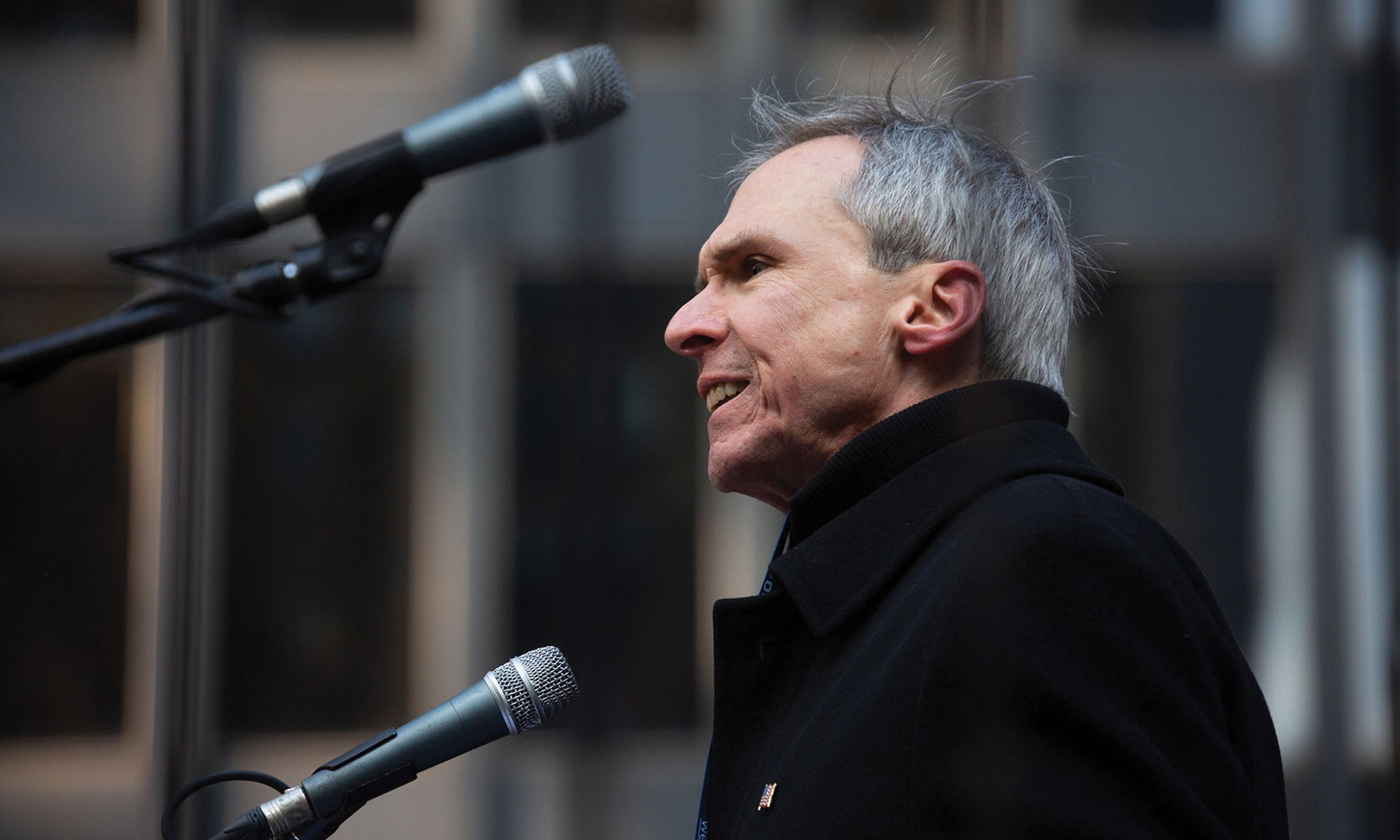
Flossmoor, Ill.
‘I’m from Chicago,” says Congressman Dan Lipinski. “When you’re from Chicago, you’re going to be a Democrat.”
And when you’re a Democrat in the House of Representatives, from Chicago or elsewhere, you’re likely to be a few other things, such as a supporter of unions, gun control, and the impeachment of President Trump. This pretty much describes Lipinski’s voting record, too. So far, so predictable.
Another safe bet is that you’re going to favor abortion rights — unless you’re Lipinski, one of America’s last Democratic officeholders who are strongly pro-life. When the House convenes with its new members in 2021, however, Lipinski won’t be among them, for the first time in nearly two decades. In a bitter primary last March, his party expelled him.
On November 6 — three days after the general election and shortly before a deadline to clear out his congressional office in Washington, D.C. — Lipinski and I met for a long lunch at a brewery near his home to discuss his career, his beliefs, and his concerns about the future of his party and the prospects of the pro-life movement.
A Lipinski has represented the third congressional district of Illinois since 1982, when Dan was a boy and his father Bill Lipinski was elected to the job. The son enjoyed the spectacle of politics, but he chose to study mechanical engineering at Northwestern University and also took a master’s degree at Stanford. Only later did he drift back to the family business, at least partway, by earning a Ph.D. in political science from Duke. Lipinski planned to teach politics in a classroom rather than practice it in a public office.
Lipinski says that when he was a professor at the University of Tennessee in 2004, he received an unexpected phone call from his father, who already had accepted the Democratic nomination to run again for Congress that year. Suddenly, the elder Lipinski wanted to quit. “I decided to jump in,” says the son, who inherited the nomination without the messiness or uncertainty of a primary. This transfer of office reeked of Chicago’s machine-style politics, but also presented a problem for the new pol: “It put an extra burden on me to prove that I could be a good representative,” he says. “Every son wants to outdo his father.”
He was good enough to win that first race in a solidly Democratic district that encompasses the ballpark of the Chicago White Sox but mostly stretches south and west of the city. Six reelections with little more than token opposition followed. “When I first ran, I knew I was pro-life and that I wouldn’t change, but I didn’t run because I was pro-life or make it my issue,” he says. With each election cycle, however, Lipinski saw fewer pro-life Democrats return to Congress. Some bartered away their principles to stay in their party’s mainstream. Others retired or suffered defeat. Amid the attrition, Lipinski started to look like a last man standing: “I wound up becoming the pro-life Democrat.”
It was a matter of conscience, not calculation: “I was first pro-life because as a child that’s what I was taught in church, in Catholic school, and in the home,” he says. “So it starts with my faith, but I also believe science shows that life begins at conception. The DNA is all there. If you truly believe that life begins at conception, you have to protect that life.”
For Lipinski, that meant more than casting an occasional vote. He crusaded for the cause, co-sponsoring bills to block taxpayer funding of abortion and trying to remove pro-abortion provisions from the Affordable Care Act. “I don’t think we’ve gotten anything done legislatively,” he says. “I wish there was something.” That’s a little too harsh. Pro-life members of Congress have defended the Hyde amendment, which stops Medicaid funds from paying for abortion. Lipinski, however, suspects that his main accomplishment is less tangible: “Mostly what I provided is a witness to standing up for the unborn.”
At some point, Lipinski noticed that the media had started to label him differently: “I’m constantly referred to as a ‘conservative Democrat’ simply because I’m pro-life — and this was used against me politically to say I was a Republican and not a Democrat.” Yet he insists that he’s the same Democrat that he’s always been. “I believe there are things government should do to help people who can’t do it for themselves.” He ticks off a familiar list: Social Security, Medicare, and “protections for consumers and workers.” He voted against the 2017 tax cuts. He earned high marks from the League of Conservation Voters, a liberal environmental group, and low marks from Heritage Action, a conservative outfit.
What changed, he says, was his party: “Democrats became more woke in the Trump era.” He noticed it at every level, from his colleagues in the House to the staff in his own office: “It became hard for me to hire because the young people who work on the Hill are so progressive.”
In 2018, Lipinski faced his first truly competitive race, when pro-choice groups spent lavishly in a bid to defeat him in the Democratic primary. Lipinski survived, but barely: He beat challenger Marie Newman by only two percentage points. Earlier this year, the same groups targeted him again. This time, they got a different result: Newman squeaked past Lipinski, ending an eight-term congressional career. Lipinski takes an odd consolation from the loss: “If the other side wanted to get rid of me that badly, then I must have been doing something right.”
Yet he’s worried about the state of the pro-life movement. Lipinski wasn’t the only pro-life Democrat to lose in 2020: Representative Collin Peterson of Minnesota fell to a Republican, and at press time Representative Ben McAdams of Utah was in a dead heat with his GOP rival. It’s possible that in January the House will have just a single pro-life Democrat: Henry Cuellar of Texas, who narrowly won his primary in March against a well-funded pro-choice challenger.
“Pro-life Democrats in office are becoming an endangered species,” says Lipinski. “You can still win in a few places, but pro-choice groups are well organized and they will come after anyone who runs in a Democratic primary.” He mentions Governor John Bel Edwards of Louisiana and Senator Joe Manchin of West Virginia as pro-life allies. He admires Katrina Jackson, an African-American lawmaker in Louisiana. “There’s also Bob Casey,” he says, referring to the senator from Pennsylvania. Then he pauses and adds, “sometimes.”
The pro-life movement risks failure by turning into a subsidiary of the Republican Party, warns Lipinski: “It’s a 50–50 nation. We need pro-life Democrats because if this becomes a completely partisan issue, it will be tough to convince people.” It could render pro-lifers less effective in other ways as well. “Without pro-life Democrats, it’s easier for Republicans to take pro-lifers for granted.” Lipinski describes a possible scenario: “If the Supreme Court overturns Roe v. Wade — and I don’t know that it will — the battle gets difficult. We’ll have to go state by state. I keep warning my pro-life friends, the Republicans who have been with us when it’s easy may not be with us when it’s hard. Some of the people who are with us now won’t be with us then.”
He views Trump as a pro-life paradox: “There’s never been a president who did more for the pro-life cause. I’m shocked that he stuck with it. I give him a lot of credit for it.” Yet it has come with a cost: “He’s been detrimental to the movement. He became its face. In the long run, he’s going to make it harder to win hearts and minds.”
Lipinski refuses to discuss his history of presidential voting except to say that he hasn’t voted for Trump. He also declines to say much about President-elect Joe Biden: “I have a lot of respect for his political career. He’s always been a moderate who wants to compromise to get things done.” He thinks the 2020 elections hold a lesson for Democrats: “Defunding the police and socialism are not good issues.” Yet he’s anxious about partisan divisions. “Nuance doesn’t work anymore,” he says. “You have to fire people up.” He echoes a theme from a commencement address he delivered in May at Ave Maria University, a Catholic school in Florida: “We’ve become tribal. Many people cannot understand someone who doesn’t fit neatly into either the Left or Right tribe. Each of these has its own distinct set of social and political beliefs. And the two tribes are becoming increasingly hostile to each other.”
Lipinski may be correct, but his own district possibly offers a small piece of contrary evidence. A close look at its latest election reveals two things: Newman won, as expected; Lipinski routinely won by 30 points or more, and she carried it by much less. It raises a question: Would he consider a new run for public office? “I’m not planning on it,” says the Chicagoan, who is 54. “But I also know never to say ‘never.’”












Comments