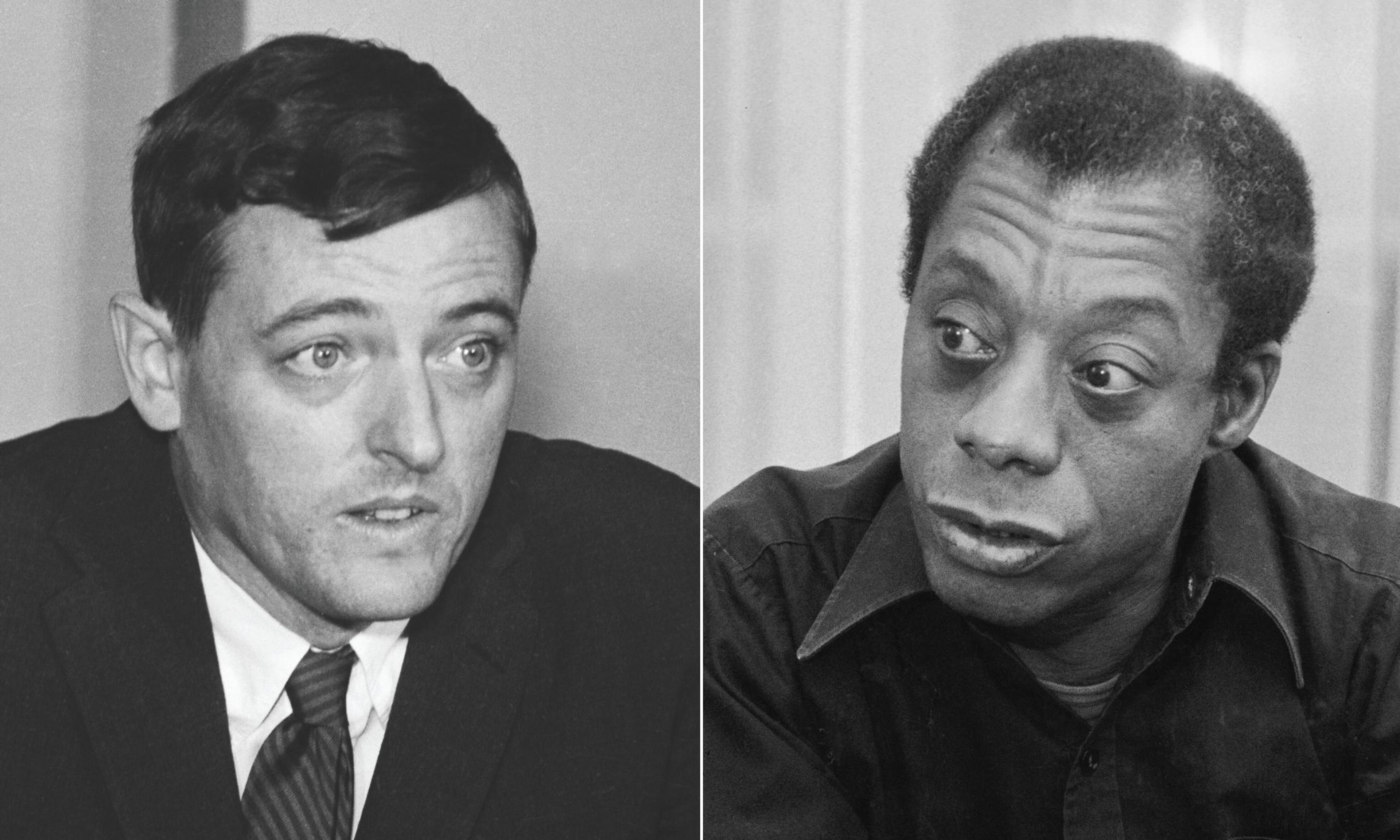
‘Are You a Racist?” was the provocative title of William F. Buckley’s April 15, 1965, syndicated newspaper column. In it, he complained that using the term “indiscriminately” had “diluted” its meaning and force. Over the ensuing 60 years, Buckley himself was accused, with increasing frequency and disdain, of being either a racist or racist-adjacent. Upon Buckley’s death in 2008, Timothy Noah, then with Slate, wrote, “Buckley was not himself a bigot, but he was at best blind and at worst indifferent to the bigotry all around him, and there can be no question that he stood in the way of racial progress.”
In The Fire Is upon Us: James Baldwin, William F. Buckley Jr., and the Debate over Race in America (2019), political scientist Nicholas Buccola concludes that the clashes between these two thinkers — in print, during a heated television roundtable, and in a formal debate at Cambridge University in 1965 — revealed that “when it mattered and from a position of great influence in American political culture, Buckley resisted just about every step forward in the black liberation struggle.” Buckley’s “assumption of white supremacy” was the key reason, says Buccola. At one point he approvingly discusses Baldwin’s view that Buckley’s culpability for the injustices visited upon blacks exceeded that of a brutal segregationist like Bull Connor, since a man of Buckley’s education and intellect ought to have known better. Buckley’s opposition to the civil rights movement was a dominant motif in the 2024 PBS documentary The Incomparable Mr. Buckley and is sure to figure no less prominently in Sam Tanenhaus’s Buckley biography, to be published in June 2025 after a quarter century’s gestation.
The first issue of National Review appeared November 19, 1955, two weeks before the beginning of the Montgomery, Ala., bus boycott, which means that the 20th century’s conservative movement and civil rights movement launched almost simultaneously. The indictment against Buckley rests heavily on his writings during NR’s first decade, years that also encompassed the 1963 March on Washington, the 1964 Civil Rights Act, and the 1965 Voting Rights Act. The most notorious single article was an unsigned 1957 NR editorial, “Why the South Must Prevail.” It held that the “central question” posed by civil rights activism and legislation was “whether the White community in the South is entitled to take such measures as are necessary to prevail, politically and culturally, in areas in which it does not predominate numerically.” Yes, the editorial asserted, “the White community is so entitled because, for the time being, it is the advanced race.” In other words, the South “perceives important qualitative differences between its culture and the Negroes’, and intends to assert its own.”
“Why the South Must Prevail” was hardly an outlier. To take another instance from a distressingly ample inventory, Buckley wrote a 1961 editorial that urged readers to withhold judgment of Southern whites who had beaten up Freedom Riders from the North, on the grounds that, though “Jim Crow at the bus stations strikes us as unnecessary, and even wrong,” this is “irrelevant” because it “does not strike the average white Southerner as wrong.”
Even Buckley’s admirers find nothing admirable about this facet of his career. Buckley and NR, the late Lee Edwards wrote for the Heritage Foundation in 2010, “did not acquit themselves . . . well on the issue of civil rights, taking a rigid states’ rights position that equaled, in the eyes of many liberals and almost all black Americans, a stand in favor of segregation and therefore racism.” Alvin Felzenberg, author of the sympathetic 2017 Buckley biography A Man and His Presidents, called “Why the South Must Prevail” a “nakedly racist editorial.”
The dispute over Buckley’s reputation pits those who, like Felzenberg, believe that by the late 1960s Buckley had moved beyond his hostility to the civil rights movement against those who, like Buccola, think that Buckley spoke more circumspectly over his final four decades but never truly recanted the positions on racial issues that he took from 1955 to 1965. Felzenberg’s critical review of The Fire Is upon Us, which appeared in these pages in 2019, criticizes Buccola for ignoring or dismissing numerous instances after 1965 when Buckley made clear his regret for positions he had taken and formulations he had employed in NR’s first decade.
It is less important to add one more voice to that argument than to make two interrelated points about how Buckley treated civil rights issues in the decade after 1955. First, though Buckley was frequently obtuse, intellectually and morally, about civil rights, he was not singularly so. His writings on racial questions during that period tell us less about the essence of American conservatism than they do about the era’s general climate of opinion. Situational moralism keeps the memory of Buckley’s worst utterances alive while it encourages us to forget and effectively forgive comparable transgressions by others, whose errors are of no help in discrediting conservatism.
Consider Adlai Stevenson, the Illinois governor who became the Democratic presidential nominee in 1952 and 1956, losing each election decisively to Dwight Eisenhower. Readers who remember Democrats swooning over Barack Obama during his 2008 presidential campaign will have some sense of how liberals reacted to Stevenson in the 1950s. “Your greatness is the property of the nation, but to you it is a prison,” the novelist John Steinbeck wrote in an open letter, published in the New Republic, beseeching Stevenson not to return to private life despite his defeat in 1952. “You have given us a look at truth as a weapon, at reason as a tool, at humor as a method, and at democracy as a practical way of life. We would be crazy if we let you go.” After Stevenson’s death in 1965, the theorist of international relations Hans J. Morgenthau, a scholar not given to florid prose, wrote, “His promise was ours, and so was his failure, and the tears we shed for him we shed for ourselves.”
For our purposes, what matters about such panegyrics is that they were delivered even though no American liberal could have been unaware that Stevenson was notably dubious about the civil rights cause. In America in Black and White (1997), Stephan and Abigail Thernstrom note that “in private correspondence Stevenson worried about the ‘extremism’ of ‘Negro leaders’ and fumed about ‘NAACP stubbornness.’” In public, “Stevenson’s efforts to placate southern whites led him to denounce ‘the reckless assertions that the South is a prison in which half the people are prisoners and the other half are wardens,’ and to boast that his grandfather, as a congressman from Illinois, had voted against Republican proposals to use troops to protect black voters during Reconstruction.”
Notwithstanding adulation in liberal publications like the New Republic, the fact remains that all the Electoral College votes Stevenson ever secured came from Southern or border states. Since Stevenson left the choice of a vice-presidential nominee up to the 1956 Democratic convention, the one running mate he did select, in 1952, was Alabama senator John Sparkman, a reliable defender of Jim Crow. Sparkman was one of the 101 Southern congressmen who would sign the 1956 Southern Manifesto, which denounced the Supreme Court’s Brown v. Board of Education ruling against de jure school segregation. The manifesto accused the Court of “destroying the amicable relations between the white and Negro races that have been created through 90 years of patient effort by the good people of both races.” Among the 19 senators who signed it were J. William Fulbright of Arkansas and Sam Ervin of North Carolina, neither of whom suffered lasting reputational damage. On the contrary — over two subsequent decades in the Senate each man became a liberal hero: Fulbright in the 1960s as the Vietnam War’s leading critic, and Ervin in the 1970s as chairman of the committee that investigated Watergate.
In “The New South,” a 1952 campaign address delivered in Richmond, Va., Stevenson said that while “insensitive observers” had attributed the South’s racial tensions to prejudice, it was the region’s poverty that had set poor whites and poor blacks against one another. Happily, he said, “as the economic status of the South has risen, as the farms flourish and in the towns there are jobs for all at good wages, racial tensions have diminished.”
The resemblance between Buckley and Stevenson rests not on their shared hostility or indifference to blacks but on their belief that the central domestic issue was the New Deal, which became the lens through which both men viewed race relations. Stevenson, like Franklin Roosevelt before him, felt that interventionist economic policies would banish the poverty that fueled racial animosity, obviating more purposeful, and politically incendiary, measures against Jim Crow. Buckley, like New Deal opponents before him, viewed it as a stage on the road to serfdom and rejected the civil rights agenda as yet one more basis on which to expand the power of the state at the expense of individuals’ freedoms. In 1961 he expressed the hope that “when the Negroes have finally realized their long dream of attaining to the status of the white man, the white man will still be free; and that depends, in part, on the moderation of those whose inclination it is to build a superstate that will give them Instant Integration.”
The Fire Is upon Us condemns Buckley for being “philosophically absolutist but operationally relativist. It was important to him to maintain the facade of belief in universal moral truths, but on civil rights matters these commitments fell by the wayside.” Buccola’s criticism disregards the possibility of Aristotelian prudence, exercised in the vast terrain between absolutism and relativism where political actors strive to honor fundamental principles amid murky, changing exigencies. To contend, for example, that Winston Churchill betrayed the insincerity of his many condemnations of socialism by joining a wartime alliance with Joseph Stalin would be simply juvenile, an application of graduate-seminar standards to a statesman’s fight for his nation’s survival. Prudential judgments can always be proven wrong by subsequent events, as was Stevenson’s judgment that the South’s racial problems could have been solved without ever being directly confronted. And as was Buckley’s judgment that Jim Crow could remain tenable, as both a practical and moral matter, for as long as it took to resolve what he believed to be the more pressing challenges of big government at home and communism abroad. To feel smug because we, unlike the characters on-screen, know how the movie ends is the cheapest kind of vanity.
The second point about Buckley from 1955 to 1965 is that, not only was he obtuse about race relations in ways that were common, but he was also prescient about the civil rights movement’s implications in ways that were rare, and remain so. In his Cambridge debate with James Baldwin, Buckley ascribed the woes disproportionately borne by blacks to two causes: “the dreadful efforts to perpetuate discrimination” and “the failure of the Negro community itself to make certain exertions, which were made by other minority groups during the American experience.” He cited sociologist Nathan Glazer’s finding that the number of black physicians in the United States had increased negligibly between 1900 and 1960, even as the black population doubled, and despite expanded opportunities for black students to pursue careers in medicine. Similarly, in his “Are You a Racist?” column, Buckley argued that there was nothing malicious about stating — accurately — that blacks’ out-of-wedlock birth rate was higher than other groups’, which suggested — plausibly — that this disparity contributed to blacks’ socioeconomic disadvantages. And yet, he said, those who had the temerity to make such observations were increasingly castigated as racists.
In other words, Buckley had discerned at an early point that the civil rights movement was embracing the position that assigning black people moral responsibility, or even stipulating their moral agency, compromised the overriding imperative: to blame whites solely and entirely for blacks’ problems. The extent of this commitment was made clear by James Baldwin himself when he asserted that black gunmen assassinated the black activist Malcolm X in 1965 because of . . . white racism. “Whatever hand pulled the trigger,” Baldwin wrote, “did not buy the bullet. That bullet was forged in the crucible of the West, that death was dictated by the most successful conspiracy in the history of the world, and its name is white supremacy.”
Buccola’s book maintains that Buckley’s desire to uphold “racial hierarchy” caused him “to argue that some of the blame for inequality should be aimed at oppressed groups themselves.” But some is the sensible option here, given that the alternatives to it are either all or none. Buccola cites Pew Research reports showing that blacks have lower levels of income, wealth, and educational attainment than other groups, then treats as self-evident the proposition that such disparities happen “because all of us allow them to happen.” This callousness manifests the shameful reality that “some lives matter more to us than others.”
But a 2021 Pew report, “Jewish Americans in 2020,” complicates this picture. It found that 23 percent of Jews lived in a household with an annual income of at least $200,000, compared with 4 percent of all Americans, and 54 percent had a household income of at least $100,000, compared with 19 percent of all Americans. Fifty-eight percent of Jews had a four-year college degree, as against 29 percent of all American adults, and 28 percent had a postgraduate degree, compared with 11 percent of all American adults.
The point is not that antisemitism has had the same form or virulence as anti-black racism. It is, rather, that Buccola’s framing of the question follows the “anti-racist” thought of Ibram X. Kendi, who maintains that “the only explanation for racial disparity between groups is that there’s something wrong with our policies, practices, or the conditions that certain people are forced to live under.” But no such postulate accommodates the fact that some groups thrive despite having suffered discrimination. The Pew data and Buccola’s argument can both be correct only if America has been secretly but fanatically philosemitic throughout its history, operating on the principle that Jewish lives matter far more to us than all others. To reject that absurdity is to conclude that Buckley was right where Baldwin, Kendi, and Buccola were wrong: blacks do possess the capacity and therefore the duty to cultivate dispositions and habits, and take actions, that reduce the disparities that disadvantage them vis-à-vis other groups in America.
To say that white racism explains less than 100 percent of black misery does not make discrimination any less dreadful, to use Buckley’s term. Nor does it diminish the imperative to oppose discrimination and counteract its effects. But the reduction of all problems afflicting blacks to a single cause points to a second way in which Buckley discerned an aspect of the civil rights movement that was inchoate 60 years ago but unavoidable today: the claim that black suffering indicts not just white people but Western — that is to say, European; and that is to say, white — traditions, institutions, and principles. This claim is central to the unfalsifiable proposition that pervasive systemic racism is at the core of our racial inequalities.
The resolution that Baldwin and Buckley debated was, “The American Dream is at the expense of the American Negro.” After the debate, Buckley wrote that he would have declined to participate if the question at issue had been something like, “Resolved, That the American Negro, though he has contributed to the realization of the American dream, has not been permitted to participate in it.” The crucial distinction, then, was between the proposition that blacks’ disadvantages showed the insufficient realization of America’s principles, a contention with which Buckley had no quarrel, and the proposition that blacks’ disadvantages revealed the falsity and perniciousness of those principles, which he rejected strenuously. At Cambridge, Buckley reasoned by analogy. Did prohibiting Jews and Catholics from voting until 1828 demonstrate that “English civilization ought to have been jettisoned”? The stronger argument, he claimed, was that “precisely the reason they did get the vote was because English civilization was not jettisoned.”
But as Buckley realized in 1965, the view ascendant among civil rights advocates was not that black immiseration resulted because the realization of the American experiment had been partial and protracted. It was instead that black immiseration was a direct and intended consequence of that experiment. This was the belief Susan Sontag expressed in 1967, when she called the “white race . . . the cancer of human history,” one whose depredations were redeemed neither by Shakespeare, Mozart, women’s emancipation, nor parliamentary government. And it was the view expressed by the New York Times’ 1619 Project, which contended, “Out of slavery — and the anti-Black racism it required — grew nearly everything that has truly made America exceptional,” including its “economic might,” “astonishing penchant for violence,” and “the endemic racial fears and hatreds that continue to plague it to this day.” Such views make clear that Kendi’s anti-racism is really anti-Americanism and, moreover, is the distillation of a once latent but increasingly dominant precept of the civil rights project. The simplest, least tendentious explanation for Buckley’s rejection of this idea is not a fondness for racial hierarchy or white supremacy. Rather, it is his devotion to, as he phrased it in National Review’s mission statement, America’s “tradition of fixed postulates having to do with the meaning of existence, with the relationship of the state to the individual, of the individual to his neighbor, so clearly enunciated in the enabling documents of our Republic.”












Comments