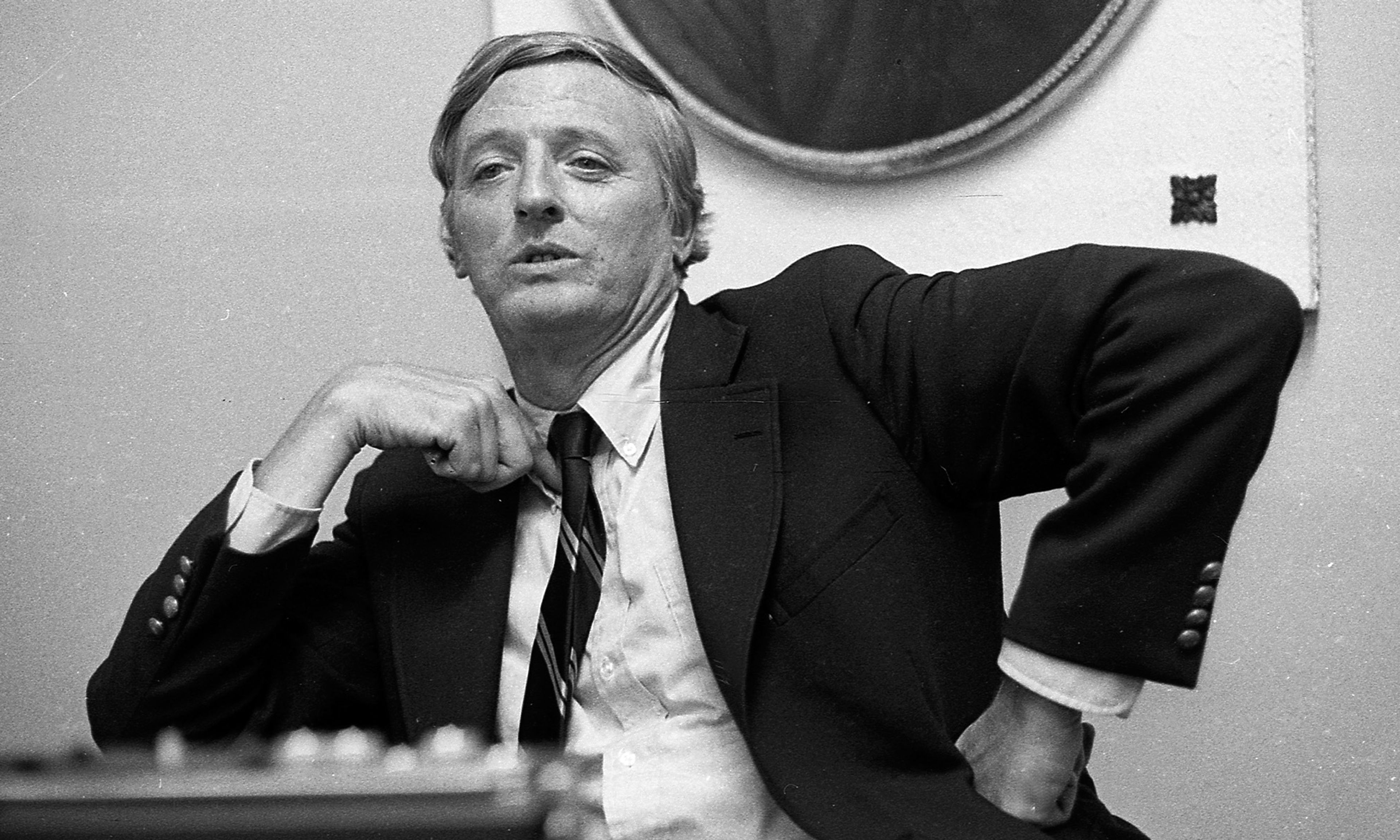
The letter writer, signing himself (surely not herself) merely as “Fellow Conservative,” had a grievance with William F. Buckley. The year was 1977, nearly 50 years ago, long before conservatives began making grievance their daily meat.
“You are one of the leading conservatives in this country,” this Fellow began his letter, “but you wear your hair like a way-out liberal hippy.” The incongruity between Buckley’s lapidary political views and his untidy appearance was simply too much for the letter writer to square. “If you really are conservative,” Fellow concluded, “why don’t you make yourself look like one?”
Buckley replied with a wryly ironic humble-brag — “If I were also good looking, don’t you think it would be just too much?” — and the letter was duly reprinted in NR’s “Notes and Asides” department. At the time, I was a way-out liberal hippy myself, though we members of the way-out wing of hippiedom preferred the -ie suffix, even in the singular. Anyway, all of my way-out liberal hipp(ie) friends who gave the matter any thought agreed with Fellow Conservative: This Buckley, so unavoidable on television and in the newspapers, was hard to figure.
Watching him on Firing Line all those years ago, we couldn’t stop wondering, “Does he try to look like that?” The hair, sometimes long, sometimes short, was never combed the same way twice, as though a rotation of barbers, each with a different tonsorial philosophy, lined up to take a whack at it from week to week. His everyday dress was conventional enough, except in its execution. In those days he was walking proof of a once undisputed principle — that if one is to be untidy, it is more appealing to be untidy in a suit and tie than in a T-shirt and cargo pants. (If nothing else you got points for trying.) The tie, knotted casually in a four-in-hand, never failed to be tugged akimbo, emerging from the button-down collar at varying angles and directions, and knotted either too loose or too tight. The suit may or may not have been ill-fitting; it was hard to tell, as we viewers mostly saw it and him as he lay recumbent in his infinitely reclinable host chair, nearly parallel to the floor.
The style wasn’t tweedy enough for “absent-minded professor,” nor was it self-conscious enough for “pre-postmodern novelist,” and it definitely wasn’t Wall Street banker, not even in aspirational form. It was sui generis, but it wasn’t easy to guess what this sui’s particular generis was. While his sentences, in print and on the air, appeared with unmistakable precision, machine-shopped pieces of argument fitted together like the innards of a Swiss watch, he looked as if he’d got dressed in a closet with the light off.
The question of William F. Buckley’s style, I mean, was a question throughout the arc of his fame, and one began to suspect, as he became a fixture in our national life, that the style was deliberately confounding.
There are all kinds of style — or rather a man’s style expresses itself in all kinds of ways, and it’s unfair to ask for a foolish consistency. Buckley was author of perhaps the pithiest formulation of political populism ever made, the one about how he would rather be governed by the first 2,000 names in the Boston phone book than by the faculty of Harvard. The remark is notable not only for its cleverness but also for its incongruity. For all the sartorial untidiness, Buckley’s style of life was as far from populist as it is possible to be. He rode in a custom-made limousine, wintered (no populist turns a season into a verb) in Switzerland, sailed most of the seven oceans in his own sailboats, and split his time stateside between a mansion in Connecticut and a rather nice “maisonette” on the Upper East Side of Manhattan.
We have since learned, of course, that committed populists themselves have no trouble squaring their political impulses with a leader who lives a non-populist life. The style of such a leader might, for example, include a personal 757, endless rounds of golf on courses he’s named after himself, an eye for porn stars, and a Palm Beach mansion tricked out like an Edwardian bordello, and none of his followers will utter a peep. With Buckley the contrast between populist aspiration and populist reality seemed truer and more discordant; you got the idea that, matters of governance aside, he would much prefer a weekend with a group of Harvard professors than with those 2,000 Bostonians.
Back in 1980, the hugely popular — indeed, era-defining — Official Preppy Handbook placed Buckley at the pinnacle of preppiness, a god of the Prep Pantheon, alongside such stalwarts of the J. Press oxford button-down as George Plimpton and George H. W. Bush. The Handbook took particular note of Buckley’s accent, which it identified as New England Nasal Nip. No doubt the accent was easily imitable. (One comedian, a man named David Frye, built a career from it in the 1970s.) But it was also untraceable to any known region, or traceable to several regions at once — a trained ear might discern a touch of the Carolinas, smatterings of Upper Class England, prep school in New York’s Dutchess County, university at Yale. As his longtime friend and book editor Sam Vaughan pointed out (in a wonderful collection of Buckley’s stuff, The Right Word), what his critics took to be an affected style of speaking was in fact a consequence of a motley upbringing.
“Buckley spoke no English until he was seven,” Vaughan wrote. “Spanish was his first language and French his second.” Before Buckley reached his teens, his father, a wealthy oilman from Texas, complained that his own children couldn’t enunciate properly and sent his young namesake off to boarding school in England with the goal of curing a bad case of the mumbles. The boy stayed only a year or two, but you never know what will come from elocution lessons. In Buckley’s case it was an indelible marker.
Television made him a celebrity — not only Firing Line, which, when it went off the air, was the longest-running TV talk show with a single host, but also such mass-market fare as the Johnny Carson show and Laugh-In. But he was a writer above all, and it’s unlikely that those of us who still talk about Buckley would be talking about him were it not for the way he impressed himself upon the world with words. His prose style was his own, and no one else’s: steeped in his early mastery of Latin, tending to abstraction, ornate more often than not, yet always open to the unexpected eruption of a snappy joke or a bit of populist diction to keep the reader on his toes. For all its formal elegance, it seemed to flow from him effortlessly. Among his fellow writers he was notorious (I choose the word carefully) for being able to write a 700-word column in 20 minutes.
He could be a fierce polemicist. And yet, as his fellow columnist James Jackson Kilpatrick wrote, even when Buckley was on the attack you would “never see the red eye of anger or the coarse voice of rage. This is style.” Part of the charm was his generous capacity for appreciation. It was never constrained by political tribalism. To cite random examples from my recent dip into his published writing: Even as NR treated the New York Times as its favorite “pincushion” for its frequently tendentious reporting, Buckley didn’t hesitate to admit in print that it was (as it still is) a very great newspaper. His two favorite columnists, Wilfrid Sheed and Murray Kempton, were liberals and then some. He knew that the leftish political reporter Richard Reeves was nevertheless the best at what he did, that the clownish novelist Norman Mailer was capable of work of great beauty, that John Kenneth Galbraith was a failure as an economist but a master as an essayist. He was happy to share these assessments with readers who might otherwise reject them on grounds of reflexive partisanship. He never made his political associations essential to his sense of himself. This is style, as Jack Kilpatrick said. It’s also part of what it means to be a conservative.
It wasn’t to everybody’s taste, Buckley’s prose. The sentences, written in haste, could be unduly serpentine. The populists among his readers complained — for decade upon decade! — about his use of long and unfamiliar words, to which he always made the sensible reply that if the words were unfamiliar this was a problem not with the words but with the reader, whose difficulty, moreover, could be easily solved with a trip to the dictionary. Who wouldn’t welcome the occasion to expand the range of their learning so painlessly? (Nowadays, with a comprehensive dictionary loaded into every pocket or purse, there’s even less excuse.) He revered words, all kinds of words. “They are useful, dangerous, salvific,” he once wrote.
That last word in the trinity, salvific, tells. He explained his life of restless labor, of constant motion, with another epigram: “Industry is the enemy of melancholy.” His own work consisted of generating words, speaking them, editing and writing them. He took words seriously; their deployment had a high purpose, not incidentally as an enemy of his own melancholy and ours. Words served to convey meaning, true and real things, as a rope thrown across the abyss from one mortal human being to another. They were a means of connection and a stay against solitariness. And if he could offer aesthetic pleasure in the bargain — if he could do it with style, as he always did — so much the better. The haircut could wait.











Comments