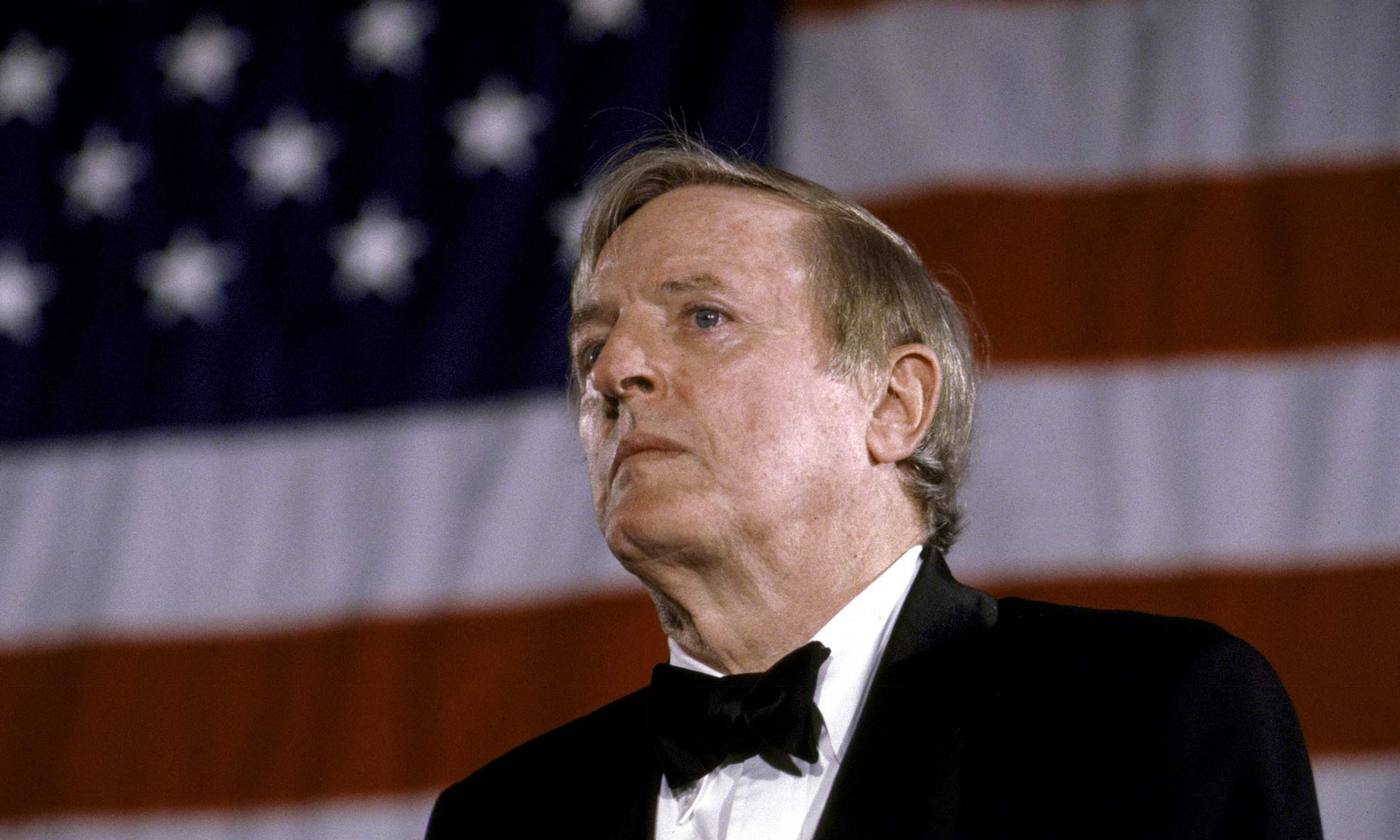
If William F. Buckley Jr.’s single contribution to humanity had been National Review, his place in history would be assured. But like the Founding Fathers, whose experiment in American democracy he worked so tirelessly to preserve, Bill was a Renaissance man whose dedication to his cause would lead him to shape his country’s history in wide-reaching ways.
It wasn’t just his mastery of words both written and spoken. His lengthy stint as host of Firing Line and as writer of a thrice-weekly newspaper column, as well as of countless articles and lectures, is impressive, to put it mildly. His reputation as a polysyllabic wordsmith who could lob witty barbs and drive a point home with relentless logic is well deserved.
But Bill’s true genius lay elsewhere.
I’m referring to his ability to coalesce the various strands of conservative thought and blend them into a potent political force capable of effecting change on a national and global scale. It’s a rare talent, and one that’s needed just as much today as it was 70 years ago.
It’s the reason that historian Lee Edwards called Bill “the St. Paul of the modern American conservative movement.” Like the apostle, he was prolific, impassioned, and indefatigable in his efforts to grow a nascent faith that might otherwise have collapsed into internecine squabbles.
He didn’t invent conservatism, of course. Great thinkers on the right, such as F. A. Hayek, Russell Kirk, and James Burnham, were producing important books in the early to mid 20th century. But the political winds then were blowing strongly in the Left’s favor, and the prevailing liberal orthodoxy went largely unchallenged.
That’s where Bill’s apostolic skills truly came in handy.
National Review made a splash among disaffected conservatives who appreciated how it unapologetically applied to current affairs the principles that animated Hayek, Kirk, and Burnham, and did so in a fun and urbane way. But it’s easy to overlook something else that NR’s founder provided: an eclectic choir of voices that enabled conservatives to think through issues more carefully. As Edwards notes, the magazine provided a forum for “libertarians and Burkeans, free marketeers and Southern Agrarians, Madisonians and European monarchists.”
Had Buckley, an enthusiastic sailor, charted a “purist” course, NR might have been little more than a footnote today. Instead, he created a “big tent” conservatism that helped the movement grow — and attract the attention of individuals who would play parts big and small in its future.
“I’d be lost without National Review,” Ronald Reagan wrote to Buckley in 1962. That was two years before the future president delivered his landmark “A Time for Choosing” address in a last-ditch effort to elect Barry Goldwater as president. Considering the effect NR had on the man who would play an indispensable role in ending the Cold War, it’s fair to say we’d all be lost without National Review — and its skipper.
Yet Bill knew that for conservatism to thrive, it had to last from generation to generation, long after popular politicians had passed on. This meant building institutions for the long term. And that’s exactly what Bill did.
It took a lot more than providing encouragement in the moment. It required planning for the future, another area where Bill excelled. To me, and to countless others toiling in the fields of public policy debates, his great achievement was as an institution-builder — the founder of a conservative movement that continues to be a force in American politics and policy to this day.
He served as the first president of the Intercollegiate Studies Institute. He hosted the inaugural meeting of Young Americans for Freedom at his family’s home in Sharon, Conn. He co-founded the New York Conservative Party in 1962. And he helped create the Philadelphia Society in 1964.
It was in that last endeavor that I came to know Bill. In December 1963, I met Bill at an ISI lecture in Detroit while I was studying for an MBA at the Wharton School in Philadelphia. While at Wharton, I got to know both ISI’s president, Vic Milione, and his key colleague, Don Lipsett. We discussed ISI’s role in presenting and promoting the idea of modern American conservatism to students in higher education around the nation.
But what happens when educated conservative students graduate? It was fine to have them read National Review, but there was no organization to hold the rising generation of principled conservatives together.
The answer, we believed, was a new organization that would “recharge the intellectual batteries” of future conservative leaders. So that fall, Don Lipsett asked me to come to New York with him to meet with Buckley, Milton Friedman, and Frank Meyer, National Review’s ex-Communist book editor.
This was truly a meeting of the minds, as Buckley, the leader of traditional conservatism, Friedman, America’s most prominent libertarian, and Meyer, who would become the conservative movement’s foremost advocate of “fusionism,” compared notes with their two younger colleagues from Philadelphia.
We outlined the prospective programs to bring different intellectual strands of conservatism together, as Bill was doing so effectively at National Review, where he enlisted traditional conservatives such as Kirk, European conservatives such as Erik von Kuehnelt-Leddihn, and so many others.
On the spot, Don proposed that we name the new group “the Philadelphia Society” in honor of our nation’s Founding Fathers. And Bill wrote a personal check for $100, payable to the newly formed society so that Don and I could open a bank account when we returned to Philadelphia.
Over the decades, Bill remained committed to the Philadelphia Society, speaking on several occasions and giving the keynote address to its 40th-anniversary meeting in 2004 in Chicago.
“I have been with you from the beginning,” he told his listeners. “And my investment of $100 in our society, I insist — and I tell this to our cherished bankers — has surely yielded a historic harvest. I am in your debt, and so is the republic.”
By giving both his imprimatur and the initial seed capital to this infant effort, Bill helped create another bedrock institution of the modern conservative movement. And he proved his talent for encouraging the small beginnings of new institutions and the coming together of all believers in liberty.
From that 1964 encounter with Bill, I learned a life-changing lesson about how to grow the conservative movement. I went on from my graduate studies to work at a think tank in Washington and as a staff aide on Capitol Hill. In these roles I observed the labyrinth of organizations — real institutions — that the liberal-Left had established throughout Washington.
Yes, we had ISI. But the Left had Students for a Democratic Society and the Brookings Institution and a host of others. So the late Paul Weyrich and I developed the plan for what would become the Heritage Foundation. We found conservative business leaders willing to support it, with Bill Buckley willing to lend his prestige and speak at its early meetings.
While I was a staff aide in the House of Representatives, I saw that the Democratic Study Group was bringing together so-called progressives among the Democratic House members. But there was no conservative Republican counterpart.
I worked with a cadre of activist conservatives — both staff aides and House members — to develop a plan to form the Republican Study Committee to give House Republican members the intellectual ammunition to stay true to their conservative beliefs. Decades later, it still holds the lamp of liberty high among members inside “the People’s House.”
There was also a national network of state legislators who worked together to introduce companion bills in various state capitals, but invariably with an establishment/leftist tilt. Several of us convinced a handful of conservative state legislators that they, too, could band together, and thus the conservative American Legislative Exchange Council was formed, to provide a new national network for conservative state legislators.
The State Policy Network soon followed, a network of state-based conservative think tanks — each unique, but each developing and sharing ideas, personnel, and strategic insights with sister organizations in other states.
Reflecting on these various components of the modern conservative movement’s infrastructure, I can still hear Buckley’s encouraging words back in the early 1970s: “Ed, if you want to start a new conservative think tank in Washington, go for it, and I’ll help you any way I can.”
It’s almost ironic that Bill is famous for declaring that “a conservative is someone who stands athwart history, yelling Stop.” Because he was far more inclined to yell “Start” to leaders willing to defend the role of freedom and faith in the public square.
Future leaders who consult his writings will find many of his observations surprisingly applicable to current problems. Consider this from God and Man at Yale: “Democracy can itself be as tyrannical as a dictatorship, since it is the extent, not the source, of government power that impinges on freedom.” We need more of that kind of clarity today.











Comments