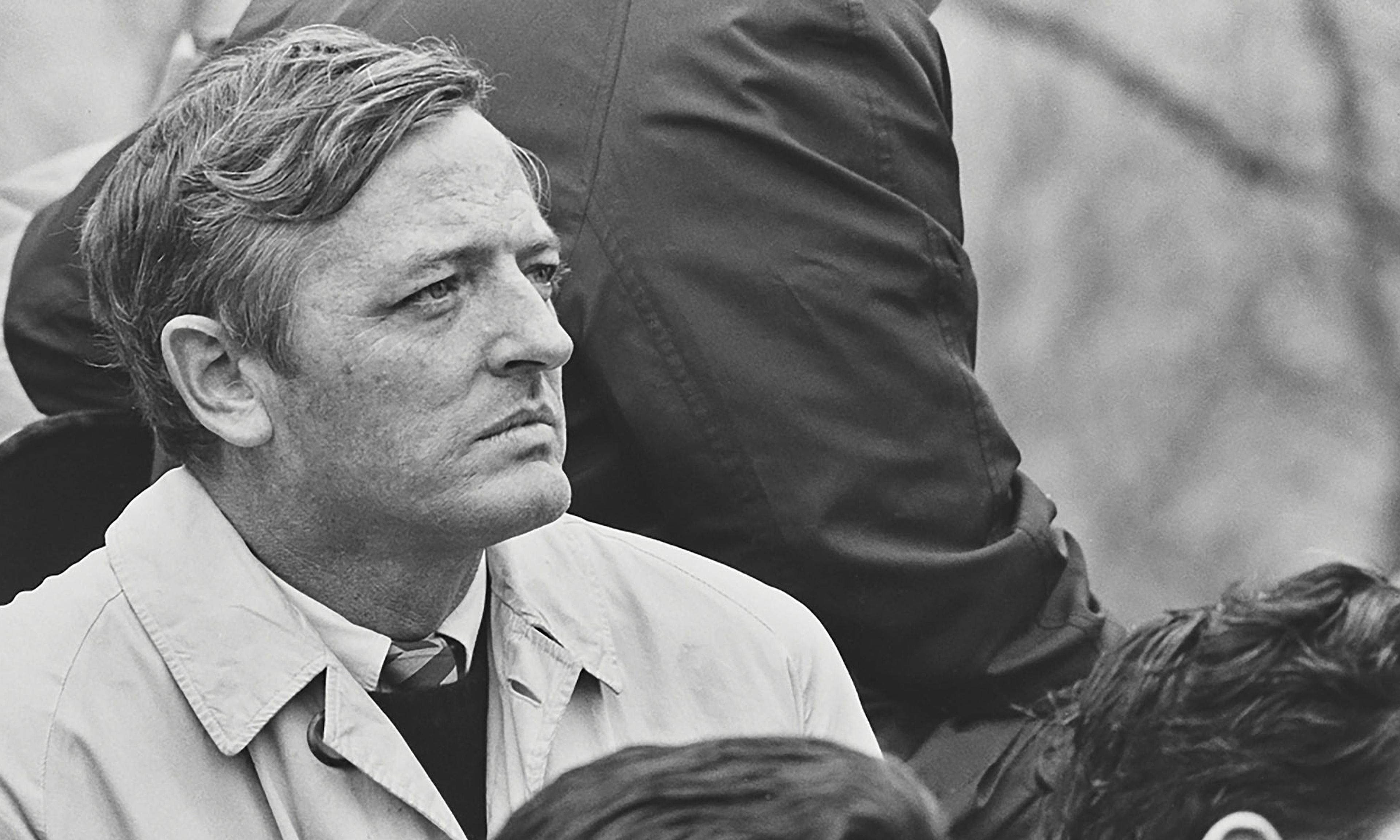
Though I didn’t realize it at the time, my appointment as editor of National Review in July 1988 marked an important moment in the life of William F. Buckley Jr. Not because of any qualities of mine, as will shortly become clear, but because it was the start of Bill’s long transition from America’s leading intellectual celebrity to the deceptively humbler status of a Christian soul seeking the mercy of God.
I did say it was a long transition. It lasted 20 years, until his death in February 2008, but it was a steady progress from public controversy to private devotion that began with handing over what (in my view) he considered to be his single most important achievement — namely, the magazine he created, which was also the foundation of a self-conscious American conservative movement. It may seem odd that he handed it to an English conservative journalist, however pro-American and however conservative. But there was both reason and guile in his decision.
First — and most enticingly — the guile. The editorship of NR turned out to be a slightly more precarious position than I knew then, or even later. Rick Brookhiser had held that position in all but name for two decades until he received a letter from Bill that decisively disappointed his expectations. As Rick revealed in Right Times, Right Place, his wonderful memoir of that era at NR, he seethed at the generous welcome (with trumpets) that I received. I was blind to this. Rick’s impeccable courtesy led me to surmise that he would be a loyal as well as brilliant colleague. Happily, that proved to be the case, and we soon developed a genuine friendship that continues today.
Nearly ten years later, I received a similar letter from Bill. Naturally, I wasn’t pleased, but I accepted that it was Bill’s indisputable right to bid me move on. I had enjoyed a good run, and my successor was more than acceptable to me. But why then? If you ask me now, I believe that Bill had decided that indeed I wasn’t quite the American conservative editor that he wanted to guide his creation into the future; Rich Lowry, whom I had recruited, was. But Bill (and I, and Rick) all had ten good years in finding that out.
So much for the guile; but what was the reason for handing over NR to me in the first place, and then to Rich? My strong instinct is that 1988 was the moment when Bill felt that he had done as much as he could reasonably hope to achieve in the arena of politics. It was the moment when President Reagan was strolling amiably toward a triumphant conclusion to his presidency. He had presided over an economic recovery that lasted two decades; begun the technological modernization of the U.S. economy by, inter alia, deregulation; advanced a bold mixture of rearmament and diplomacy to push the Soviet Union to end the Cold War; and enjoyed popular support at home so overwhelming that even the media had to acknowledge it. Recall that Reagan’s world victory tour that summer and autumn included a visit to Moscow University, where he was cheered by young Russian students who saw him as at least as responsible as Gorbachev for the reforms of glasnost and perestroika.
In fact, the full measure of Reagan’s achievement was not generally understood until the Soviet empire imploded a year later, in 1989, followed by the collapse of Soviet communism itself in 1991. Bill saw those events firsthand in 1990 when he led an NR delegation of U.S. conservatives to Eastern Europe and the Soviet Union, then in the grip of these sweeping historical changes. Initially he found it hard to credit that this anti-communist revolution — for which he, James Burnham, Whittaker Chambers, and the early intellectual recruits to NR had agitated almost alone — was actually happening.
When Bill spoke in a grudgingly skeptical tone about Russia’s democratic prospects, it left some in our delegation dismayed. I was asked to say something warmer. I did so. But then one of the women who had served as our official translators confided in me that she too held a nervous and sadder version of Bill’s skepticism. That proved a farsighted judgment by both. At the time, however, as democratization unmistakably took hold and swept away the particular evil and long-feared specter of Soviet communism, Bill returned to America convinced at least of Reagan’s (and his) historic success.
For Bill was undoubtedly the philosophical godfather of the Reagan revolution(s). His establishment of NR and his constant fundraising for it from 1955 onward; his willingness to throw the magazine’s endorsement behind the Goldwater campaign that publisher Bill Rusher had helped craft in order to weaken the Eastern establishment’s hold on the GOP; his 1965 campaign for the New York mayoralty that both made him a national figure and revealed a national constituency for his sophisticated brand of Goldwater conservatism; his conduct as the grand inquisitor of Firing Line who subjected both anti-conservative ideas and their most distinguished proponents to withering and serious but always good-humored cross-examination and who won enough of these debates to make conservatism look like a plausible public philosophy; and the apparently infinite succession of policy polemics, thrice-weekly newspaper columns, Blackford Oakes thrillers, and lively personal accounts of his Stakhanovite social life with Pat Buckley in New York, Gstaad, and at sea, the lot saturated with both conservative assumptions and “that slam-bang-tang reminiscent of gin and vermouth” — over time, all these together prepared the political and cultural ground for Ronald Reagan to enter the lists and win the 1980 election and pursue a policy of reviving the U.S. economy and the American spirit, to succeed in both, and to defeat the Soviets and win the Cold War.
Bill would have been less than human if he had not felt something like postpartum depression at all this success attributed by the world to someone else. He doesn’t seem to have done so — he and Reagan were too close for that — but I know he was grateful to George Will for saying of these world-historical victories that NR was “the most consequential magazine in history.” He liked to repeat it. In 1990, when Will delivered that judgment, Bill was 65. He had seen the fulfillment not of all his hopes but of most of the ambitious anti-communist political and economic program he had set out in the 1955 manifesto launching NR. He had stood athwart history, yelling Stop. And history had to some extent complied. It was highly unlikely that he could launch another such manifesto with any realistic expectation of seeing it through to the finish. As far as grand political projects were concerned, therefore, he would rest content on his laurels.
That is why Bill embarked on the gradual transfer of his various responsibilities to others in the next decade. One by one they went. In addition to stepping down as NR editor, he reduced his columns from three to two and then to one per week, and he trimmed Firing Line from an hour to a half hour until he ended it altogether in 1999. And though he still seized any chance to try something he hadn’t done before — in the 1990s, he wrote a play that was performed at a theater festival and played a concert of Bach’s harpsichord works — he was steadily moving from high politics into cultural, philosophical, and, ultimately, religious territory.
Some of that movement reflected his view that the most intractable political problems had grown worse since the 1950s — e.g., the spread of the “abortion right,” runaway spending on entitlements — because they were rooted in the decay of moral restraints in the electorate. In his columns, he took the voters’ corruption of themselves seriously, but his book Gratitude was a positive attempt to curb that corruption by suggesting a civil version of the draft for young people. Policies of that kind, though, in order to work, require a moral reformation in social leadership, as in Victorian England. As the 1990s wore on, Bill encouraged such reformation in himself by an increasing concentration on the things of the next world.
Bill had always been a Catholic, and a devout one, though insistent that NR itself was not a Catholic magazine. He hired only distinguished non-Catholics as its religion editor until the Lutheran pastor Richard Neuhaus frustrated his rule by converting to Catholicism once on board at NR. Most of NR’s coverage of Catholicism, moreover, dealt with those things in which faith was mixed with prudential secular considerations, which allowed the magazine to criticize papal encyclicals without risking heresy — and any temptation to do that evaporated as the papacy of John Paul II gradually moved in a friendlier direction under the influence of thinkers including NR contributors Michael Novak and Father Neuhaus.
But in his 1997 book Nearer, My God: An Autobiography of Faith, Bill’s writing became more candidly personal and devotional. In it, he revealed that he needed his Catholic beliefs and devotional practices to help him bear the disappointments of his secular political hopes for America. That sounds depressing, reminiscent perhaps of H. G. Wells’s Mind at the End of Its Tether. But in the last lead article he wrote for NR under my editorship, “To Be a Pilgrim” — an account of a visit to Lourdes, an explication of the shrine’s history, and a cool, unembarrassed defense of its reality as a source of medical transformations inexplicable by science — he was his old, cheerful, feisty self in full fig.
Even so, Bill’s seeming loss of interest in the present world led some of his friends to worry that he might be too fixated on the next. That thought prompted me — in an extempore speech at his last great birthday dinner — to suggest that he should think of God as an editor like himself. Like all experienced editors, God might be suggesting a much earlier deadline than he really had in mind. He might have more for him to do. I doubt my words had an impact, but Bill did seem to recover his verve, as many older people do — Hayek once told me he had tried old age but gave it up disappointed — and he continued to be active at a slightly less hectic pace. Bill’s beloved witty wife of 57 years, Patricia Buckley, died in April 2007, and Bill followed her less than a year later, having then disposed of most worldly concerns apart from family affections, especially his attachment to his son, Christopher, who had forged a career in letters outside movement conservatism.
One responsibility he never entirely laid aside. That was his desire to ensure an enduring future for NR. Since 1955, it had relied financially on Bill’s elegantly doom-laden letters to subscribers and friends across the country begging for subsidies. But he knew that he was mortal and that a similar letter, whether from me or Rich, was not likely to have the same necessary effect. So he asked for suggestions and gratefully embraced the proposal for a National Review Institute, hatched poolside in Palm Beach by Gay and Stanley Gaines; Wick Allison, then NR’s publisher; and yours truly. For the quarter of a century since its incorporation, NRI has provided a secure future for NR and for a wide range of political, social, and cultural programs across America sustaining and spreading the Buckley legacy.
But how secure is that legacy in today’s postelection political climate? Some of Trump’s most trenchant critics, usually but not always on the left, argue that his rise shows that Bill’s principal achievement in building a respectable and electable conservative movement has either failed or was always illusory. Others more sympathetic to Bill see instead a decline of conservatism from his elegant polemics to the verbal crudities of a Trump or a Rush Limbaugh.
Leave aside the question of how accurate these comparisons are (Limbaugh was in reality a thoughtful polemicist who made complex arguments simply and vividly); there’s an important point hiding inside them. In the first paragraph above, I described WFB as America’s leading intellectual celebrity, a label that, once stripped of its dismissive tone, means famous for being culturally famous. That was true for WFB, who became a celebrity with the publication of God and Man at Yale and never stopped being one for the rest of his life in and out of politics. It meant he never had to beg for an audience. Before his first election, Trump too was a celebrity because of his reality-TV success on The Apprentice. He overshadowed all the other Republican hopefuls simply by descending an escalator. And it is also true for Argentina’s Javier Milei, who has succeeded politically so far because he had earlier established a popular following from a reality-TV show in which he explained his unorthodox (i.e., orthodox) economic theories before anyone else had a chance to distort them. In short, all three emerged from popular culture to dominate politics because they enjoyed a celebrity status earned elsewhere.
Does that mean they are all the same? Not at all. Indeed, they are all very different, because they emerged from very different popular cultures. WFB emerged from a conservative popular culture composed of great books programs, respect for learning, crossword puzzles and anagrams, Broadway and Hollywood popular movies, and much else derided then and later as sterile and middle-class. Trump emerged from a 1980s culture that mixed conservative economics with progressive social liberation in an ambience of glossy excess, but he sensed that much of it was resented by its supposed beneficiaries. Milei grew up in a suffocating, failed left-nationalist Peronism against which he is now leading a popular rebellion.
And is the difference between the dominant Trumpism and the supposedly defeated Reaganism all that vast? When I look at the issues that define Trumpism in practice — migration control vs. open borders, patriotism vs. cosmopolitanism, family support vs. gender ideology, free speech vs. censorship of “disinformation,” parental rights vs. professional expertise, and above all national democracy vs. supranational technocracy — they strike me as issues that Reaganites, Reagan himself, and Bill Buckley very often wanted but never got round to delivering because they had to win the Cold War first. My own judgment of the new political situation is that the Right (broadly defined) still has to win and that it is more likely to do so if it unites in a new fusionism that — to adapt Bill’s famous remark — is all the stronger because it’s being forged by the first 2,000 names in the phone book rather than by the Motion Picture Academy and the U.N. General Assembly.
It ain’t over until it’s over — and as long as NR and the NRI are still in the game, it won’t be lost without a fight.











Comments