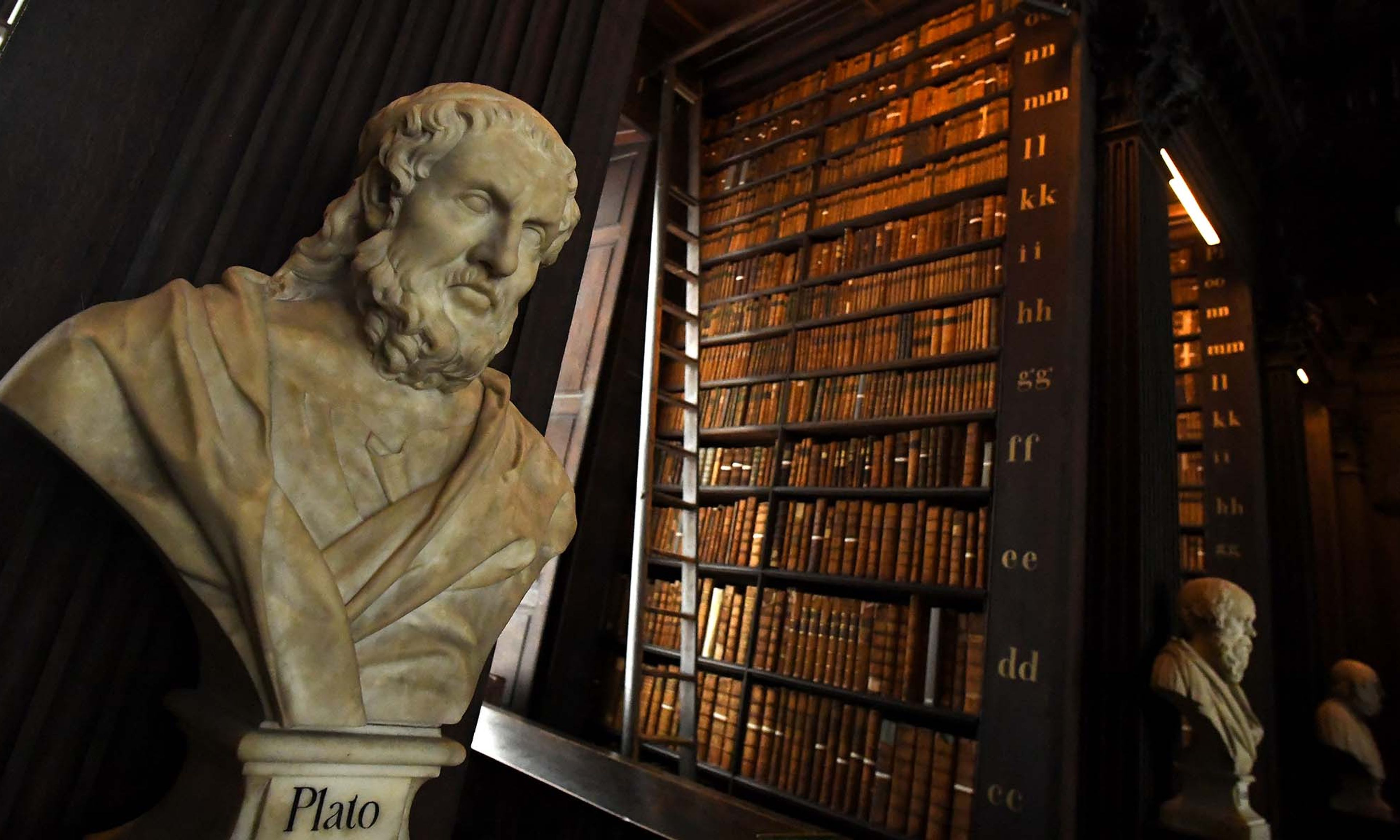
It’s hard to say something new about the liberal arts. People have been discussing them since at least Seneca’s time, when he wrote in a.d. 55 that the liberal arts teach us how to live virtuously, even if they cannot make us virtuous. (The only way to become so, Seneca argued, is to practice virtue.)
This was more or less the standard view of the liberal arts until Nietzsche argued in On the Genealogy of Morals (1887) that the so-called virtues recommended by ancient philosophers, and by Judaism and Christianity, were simply personal preferences imposed on others for the benefit of those in power. We see this view today among academics who argue that works of philosophy and literature written by white men are oppressive and must be removed from the curriculum.
Allan Bloom, for his part, argued in his surprise best seller The Closing of the American Mind (1987) that the liberal arts teach us primarily how to reason well and so to smash the shackles of ignorance fastened on us by our parents or upbringing. Martha Nussbaum, however, wrote in Not for Profit (2010) that literature and the arts primarily teach us empathy. Other thinkers have argued that works of literature and art are like games — they have arbitrary rules that produce a frisson in those who know those rules. Still others have made the case that the liberal arts teach us the tools of survival — such as persuasion and cooperation.
There’s nothing new in John Agresto’s book on the liberal arts, The Death of Learning, but there is plenty of good sense. In fact, it is one of the best defenses of a liberal-arts education I have read in a long time, avoiding both the tub-thumping and the overworked prose that one usually encounters in such works. Agresto is the former president of the liberal-arts institution St. John’s College, and he offers a defense of the liberal arts that is both realistic (there are no pie-in-the-sky promises that the liberal arts will make us nicer, for example) and nonpartisan.
Until recently, to receive a secondary or undergraduate education in the United States was to receive a liberal-arts education. Most courses and programs were in English, history, philosophy, modern and ancient languages, religion, math, and the hard sciences. Today, Agresto notes, the five most popular undergraduate majors are business, education, computer technology, engineering, and the health professions. What happened?
The short answer is that the liberal arts have looked increasingly useless, despite varied defenses of them, to both students and parents. The specialization of work and the triumph of technology in the 20th and 21st centuries have played a major role in creating this impression. Wrongly or rightly, work seems more complex now than in the past, and most students and parents have little patience for courses that do not contribute directly to vocational training.
Agresto argues that defenders of the liberal arts have done little to address this perception or have addressed it poorly. They have argued that the reason to study the liberal arts is to improve students’ “soft skills,” among them critical thinking, which has all sorts of practical applications. Agresto doesn’t deny that the liberal arts can teach students to think, but he argues that the kind of thinking the liberal arts teach is far larger than the kind of thinking one uses to determine which stock to buy.
But defenders of the liberal arts have also overpromised. “How often have I heard,” Agresto writes, “my humanities confreres say that a liberal education makes us finer people — more sensitive, more concerned, more humane? Pretentious platitudes such as these, expressed in today’s egalitarian age, are an excellent way to lose one’s audience.”
In The Death of Learning, Agresto tries to find a middle road. He argues, for example, that one reason to study the liberal arts is that they free students from being enslaved to other people’s opinions as well as to their own. They foster the ability to make wise decisions. This is more than mere critical thinking. It is thinking that is oriented towards truth — to the degree that the truth of something may be known — and that makes distinctions between small and large matters.
This ability benefits not only students themselves but society at large. The capacity to evaluate one’s own biases and to see one’s own faulty reasoning is important for any society, but it is particularly important for a democracy, and it is very much lacking today. Cooperation is impossible without it, and without cooperation, there is no civilization.
The turn towards multiculturalism on campus in the 1970s and ’80s was supposed to make biases clearer and improve cooperation. It’s evident now that the goal was not mutual understanding but the death of Western culture and the eradication of dissent. A true liberal-arts education, Agresto writes, “has aways been particularly multicultural.” It teaches students that: “First, they must know their own. Second, they must also know what is not their own.” The multicultural movement on campus, “which began as a call for inclusion,” he writes, quickly devolved “into the separation and then politicization of distinct interests and worldviews.” Courses in the Western tradition were excluded because they challenged multicultural ideas or asked questions that the multicultural movement, which understands everything in terms of power, preferred to ignore. Agresto’s point is that a true liberal-arts education is not opposed to multiculturalism. It is multicultural in the best sense of the word.
Put another way, a liberal-arts education rightly understood is both conservative and radical. A liberal-arts education acknowledges that certain works of the past are worth conserving. Reading them doesn’t just teach us specific skills. It teaches us something worth learning. But a liberal-arts education also teaches us to question those ideas. “The freedom to think, to imagine, to question, and to dissent is part of what it means to be a free man or woman,” and this freedom is one of the things that a liberal-arts education attempts to nourish, however partially, in students.
While Agresto, like Seneca, believes that the liberal arts teach virtue, even if they cannot make students virtuous, he argues contra Seneca that vocational studies can also teach virtue. This is one of the most welcome perspectives of the book. Defenders of the liberal arts, Agresto writes, need to stop acting as if they had a monopoly on moral instruction. A variety of virtues are learned from vocational training as well, not least of which is the value of work. “But what all might this devotion to work actually entail?” he asks:
How about some truly admirable habits of mind and character, habits we would have hoped the liberal arts might themselves impart. How about persistence in understanding? How about attention to detail? How about seeing the interworking of cause and effect? . . . How about order and discipline? How about knowing one’s capacities and limitations?
Agresto argues that rather than pitting the liberal arts and vocational studies against each other, the interaction between the two should “be mutual”: “Invite a professor of business to make presentations to your class on the morality of private enterprise and trade or a law professor to come talk . . . about the meaning of the rule of law.”
This doesn’t mean that there is no distinction between liberal and vocational studies. After all, the liberal arts are also about asking the big questions in life — Who am I? What is there? Does God exist? What in life is worth living for? They teach us to know ourselves and to live in light of that knowledge. What could be more useful?












Comments