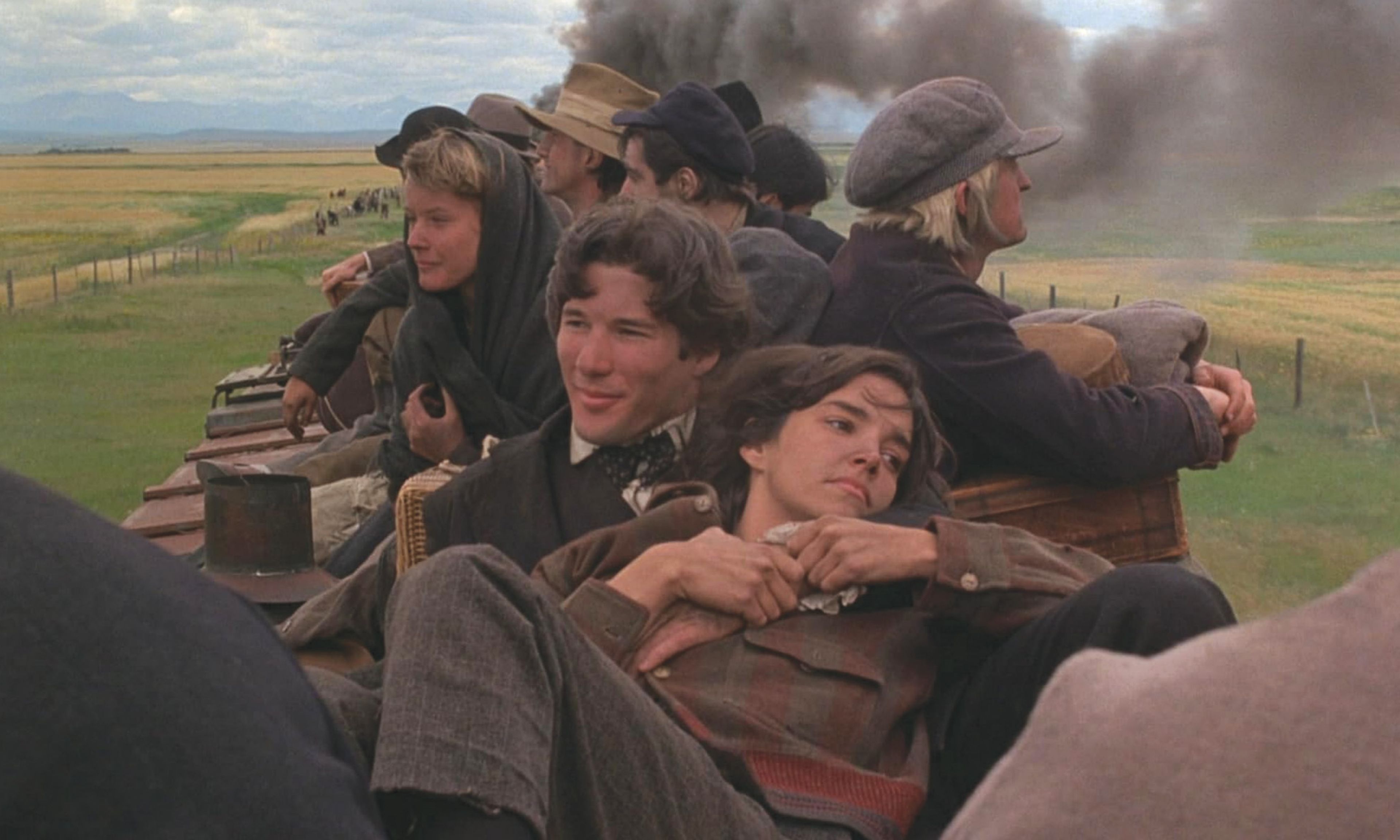
The moviemaker Terrence Malick is 81 years old, and if tomorrow the Academy of Motion Picture Arts and Sciences, which has never honored him with one of its competitive Oscars, announced that he had been selected to receive a Governors Award for lifetime achievement, the tribute reel that might accompany the prize would undoubtedly include some of the following scenes.
The montage might open with Malick’s 1978 masterpiece, Days of Heaven. In an extraordinary scene, Linda (Linda Manz), the youngest but most philosophically minded of an ersatz family of farmworkers in World War I–era Texas, says so long to her slightly older, not necessarily wiser female friend who is leaving upon the completion of the season: As Linda’s friend hurries toward the retreating train, Malick’s camera keeps pace with her, and the parallel movement — of Linda’s friend and the camera — creates the sort of kinetic, poetic effect for which Malick is known. We might also see the final scene from his 1973 debut film, Badlands, in which Holly (Sissy Spacek) narrates the unhappy fate of her now apprehended serial-killer lover Kit (Martin Sheen) while the two of them are transported by plane in the custody of the authorities — as though they have momentarily found refuge, in the peaceful heavens, from the carnage they caused and its consequences. And maybe the tribute would conclude with the scene in his striking 1998 adaptation of James Jones’s World War II novel The Thin Red Line, in which Private Bell (Ben Chaplin), navigating the tall grasses of Guadalcanal, allows his mind to wander to images of the young wife he left behind: her face, her touch, the way the curtain in their home shimmied in the wind.
By the time Malick made The Thin Red Line, his third film as writer and director but his first produced work in two decades, his status as a legend — a kind of prophet, even — was secure. As someone who was an adolescent cinephile at the time, I can affirm that few modern art movies were as earnestly anticipated: Those of us who had experienced Badlands and Days of Heaven only on videotape, and had wondered about the whereabouts of their seemingly hermetic creator, considered the release of this new film to be akin to the discovery of an unearthed religious text. Or so we hoped.
Alas, Malick has spent the 27 years since then showing he is something less than a seer. Sloughing off his reputation as a slow, intermittent, monk-like director, Malick has conjured no fewer than eight feature films — from The New World (2005) to the forthcoming The Way of the Wind — in the new millennium. Yet, with each film, Malick’s reach for spiritual significance seems flimsier, hastier, more strained, more canned, and less sincere. In The Tree of Life (2011), a majestic scene in which various deceased characters are shown in communion with one another, captures the hope for eternal life, but in so many other films, Malick tries no harder for the transcendent than vaguely theological voice-over narration and National Geographic–esque shots of the natural world. As film critic Stephanie Zacharek said of The New World: “Terrence Malick may not care much for people, but he never met a tree he didn’t like.”
Now, Malick is the subject of a biography that, while generally admiring, brings him further down to earth than ever before. In The Magic Hours: The Films and Hidden Life of Terrence Malick, John Bleasdale works hard to challenge certain Malickian myths. For example, Days of Heaven did not take an inordinately long time to shoot, and a rumored five-hour version of The Thin Red Line never existed: “It was simply the usual assembly cut prepared by the editors, which included much of what was shot, coverage and alternate versions of scenes, but was never intended to be the finished film.” The author also offers sensible explanations for his subject’s supposedly eccentric behavior: When Malick is said to be, rather enigmatically, “walking to Oklahoma” to watch birds, Bleasdale reckons that this is nothing more exotic than “a hiking holiday” and certainly not “a quixotic quest”; and when Malick is characterized as a recluse, Bleasdale counters that he has “a wide collection of friends and acquaintances with whom he communicates on a regular basis,” including, from time to time, journalists.
Ironically, the book does its subject a favor by diminishing him: By stressing that he is merely a working filmmaker who has good days and off days, moments of inspiration and times when his gifts fail him, Bleasdale makes Malick’s many lesser films easier to comprehend, if not to admire.
None of which is to deny the unique reserves of ambition and intellectual curiosity contained within Malick, who was born in Ottawa, Ill., in 1943 and raised in the state with which he has become closely associated, Texas. Though not without flaws, his parents, Emil and Irene, created a rich environment for their three sons, including their eldest, Terry. “The Malick house was full of exciting, interesting things,” Bleasdale writes. “Culture and art mixed with science and civic duty, alongside his mother’s Catholic and his father’s Episcopalian faith.” A stint, from age twelve onward, at St. Stephen’s Episcopal High School, a boarding school in Austin, was no less formative. His time was divided between performing arts and chemistry, musical theater and varsity football.
Malick devoted himself to philosophy at Harvard, where he became expert in the work of Martin Heidegger and conversant with the teachings of Lutheran theologian Paul Tillich, whose class he took in his freshman year. “Terry spent most of his time drinking coffee and talking about Wittgenstein and Husserl,” said former Massachusetts governor William Weld, a classmate.
The world was Malick’s oyster — he translated a work by Heidegger, found employment at Newsweek and Life, and taught at MIT — but the eagerness with which he jumped at an opportunity to study at the American Film Institute and pursue a career making movies suggests something less than an absolutely first-rate mind. Malick’s reputation has long rested on the alleged illumination to be found within his films — not merely their poetry and inventiveness, undeniable in his first three movies, but their deep perceptions. Yet it is fair to observe that he sounds far more at home negotiating the studio lot than the groves of academe. Bleasdale presents him as a savvy operator, picking up lucrative assignments as a rewriter of scripts (including, improbably, Dirty Harry) and making phone calls to inquire about the reputation of future mover and shaker Mike Medavoy, who became Malick’s agent and later his producer.
Indeed, the book is at its most useful when making clear that Malick’s films arrived not via divine inspiration but through workaday decision-making and plain old happenstance. For example, Bleasdale notes that in Days of Heaven, the startlingly evocative narration by Manz came about when the teenager, then staying in the home of the devout wife of the assistant film editor, began retelling stories from the Bible in her own particular patois, leading to lines like this: “The people that’s been good, they’re going to go to heaven and escape all that fire. But if you’ve been bad, God don’t even hear you.” The director’s religious background unquestionably makes him a rarity among his peers, though, like so many Baby Boomer artists, he has strayed from orthodoxy: Bleasdale notes Malick’s comfort with “switching his deity’s pronouns” in the narration to his documentary Voyage of Time (2016). His involvement in the counterculture, including his fascination with Che Guevara and friendliness with radical chic producer Bert Schneider, comes as a disappointment.
Yet perhaps it should not. On several occasions, Malick is shown to be all too human: He permitted himself to fall into the orbit of the amateurish and underfunded initial producers of The Thin Red Line; he put himself in a position to be sued by a financier who had backed the much-delayed Voyage of Time but who was exasperated by the director’s interest in other, concurrent projects, leading to the comical Guardian headline “Terrence Malick Taken to Court for Forgetting to Make Film.” Actors in his films expressed confusion and dismay over his uncommunicative working methods and riddle-like pronouncements, which generally come across as the products less of an inscrutable genius than of an indecisive eccentric perhaps too aware that his reputation precedes him; why call a shot of nature a “Tao shot,” as Malick reportedly does, rather than, well, “a shot of nature”? Bleasdale works overtime to argue for the merits of the filmmaker’s later efforts, but it is clear that Malick has been tapped out for some time. His recent set of films, each bearing annoyingly ambiguous titles — To the Wonder (2012), Knight of Cups (2015), and Song to Song (2017) — could be counted on for distractingly drifting camera work, a spiritually questing tone, and content-free performances. “From mystery, Malick had become utterly knowable,” Bleasdale concedes.
His 2019 film A Hidden Life, about Franz Jägerstätter, a Catholic conscientious objector to the Nazis, was a modest return to first principles. Will The Way of the Wind, about the life of Christ, mark a return to the authentically numinous heights of his earlier films? Or will it further confirm his decades-long descent to terra firma? Either way, Bleasdale establishes, with his expert research and clearheaded tone, that Malick is decidedly a man and not a god — not even a cinematic one.











Comments