One week before the superpowers were due to meet in October 1986, in Reykjavik, Iceland, Mikhail Gorbachev assembled his Politburo and delivered the following warning:
Our goal is to prevent the next round of the arms race. If we do not accomplish it, the threat to us will only grow. We will be pulled into another round of the arms race that is beyond our capabilities, and we will lose it, because we are already at the limit of our capabilities. Moreover, we can expect that Japan and the FRG [West Germany] could very soon join the American potential. . . . If the new round begins, the pressure on our economy will be unbelievable.
Over the previous five years, Reagan had shifted the balance of power against Russia. NATO had deployed intermediate-range nuclear missiles to counter Soviet SS-20 missiles threatening Western Europe. The U.S. and other Western economies had recovered robustly from a deep recession. Western defense spending had surged. And Reagan’s Strategic Defense Initiative signaled a new space-based arms race that Gorbachev feared.
Gorbachev did not come to Reykjavik a free agent. He had to do something because the Soviet Union was on the verge of falling permanently behind the West.
This is solid evidence, at the very top of the Moscow food chain, that Ronald Reagan’s Cold War strategy of comprehensive military and economic pressure to close off Soviet options outside negotiations, and to end the Cold War through peaceful means inside negotiations, was paying off. Yet some journalists and historians continue to ignore this evidence and deny that the end of the Cold War had anything to do with Reagan’s policies.
That’s the case with Max Boot in his new book, Reagan: His Life and Legend. In his 800-plus-page work, impressively researched over ten years, Boot does not cite Gorbachev’s foreboding message to his Politburo colleagues. Instead, Boot argues that
Gorbachev was not driven to reform the Soviet system because he wanted to compete more effectively with the Reagan military buildup. Just the opposite. He was genuinely worried about the dangers of nuclear war, and he was appalled by how much money the Soviet Union was spending on the military-industrial complex. . . . This was not a reflection of a Reagan-induced crisis that threatened the bankruptcy of the Soviet Union but rather a product of his own humane instincts.
Gorbachev, Boot concludes, was a “true black swan” who emerged unanticipated to become the factor largely responsible for ending the Cold War.
Reagan, Boot insists, contributed mostly by compromising. “One theme that strongly emerged from my research, much to my surprise,” Boot writes, “was [Reagan’s] pragmatism.” Reagan was not the idea-driven leader that many assumed. He was in fact the ultimate pragmatist: “The Great Communicator was also the Great Compromiser. His entire life was characterized by a series of deals.”
Boot contends that on almost every issue — budgets, social issues, foreign policy, etc. — Reagan abandoned principles to make deals. As governor in California and as president in Washington, he raised, not lowered, taxes. On social issues, especially HIV/AIDS and abortion, he traded silence for conviction. On civil rights, he was a subtle racist, exploiting white bigotry for political gain. And on foreign policy, he talked tough on terrorism but traded arms for hostages and ultimately negotiated and compromised with the “evil” empire.
In chapter after chapter Boot cuts Reagan down to size. Reagan touts family values but is himself divorced and has completely dysfunctional relationships with his children. He hawks patriotism but never serves in combat. He champions moral clarity yet seldom goes to church. He identifies with the common man but makes “sweetheart deals” with wealthy elite friends to maintain his lifestyle. Reagan talks in congressional hearings about the right to dissent but acts as an informant for the FBI on communist violence in Hollywood.
Boot’s portrait of Reagan is nothing new. It is the old “instant history” version of Reagan purveyed by commentators during and immediately after his presidency. Reagan, the story goes, confused fact with fiction, was bored by details and manipulated by staff, employed ghostwriters for his presidential speeches, and succeeded largely because of his colossal charm and favorable circumstances such as Gorbachev’s leadership.
Other Reagan biographers, even skeptical ones, have long since reassessed this early portrait (among others, see Lou Cannon, John Patrick Diggins, Richard Reeves, Iwan Morgan, H. W. Brands, and Sean Wilentz). While some are still reluctant to attribute Reagan’s success to conservative ideas, they acknowledge that Reagan was the conservative counterpoint to Franklin Roosevelt and the New Deal, the yin and yang of American politics in the 20th century.
The historian Andrew E. Busch gets it right. “Reagan was a practicing politician,” he writes, “but his politics were driven by a clear set of interlocking ideas, supported by an even more fundamental set of moral and religious convictions.” Reagan developed these ideas over time and documented them in thousands of handwritten letters, speeches, radio addresses, newspaper columns, memos, note cards on which he copied pithy passages by great statesmen and intellectuals, and speech cards written in shorthand that he shuffled from one talk to the next from the 1940s on. Even in his second term, Reagan wrote initial drafts of key speeches in his own hand on legal pads. When he left the stage in November 1994, he penned a farewell address to the American people that in prose and pace equaled his best compositions — and without a single scratch-out.
Boot is preoccupied with the process of compromise, how deals get made, rather than with the content of compromise, how deals advance one set of ideas over another. Repeated compromise effectively eviscerated Gorbachev’s ideas about reforming communism. Even Boot concedes that Gorbachev did not know where he was going, “how radical a reformer he would turn out to be.” On the other hand, Reagan’s ideas in favor of free societies and market economies swept across the planet; after 1980, over 60 countries, including Russia for a while, became more democratic. To attribute this outcome primarily to Gorbachev is to ignore the overwhelming reality that communist ideas wound up on “the ash heap of history.”
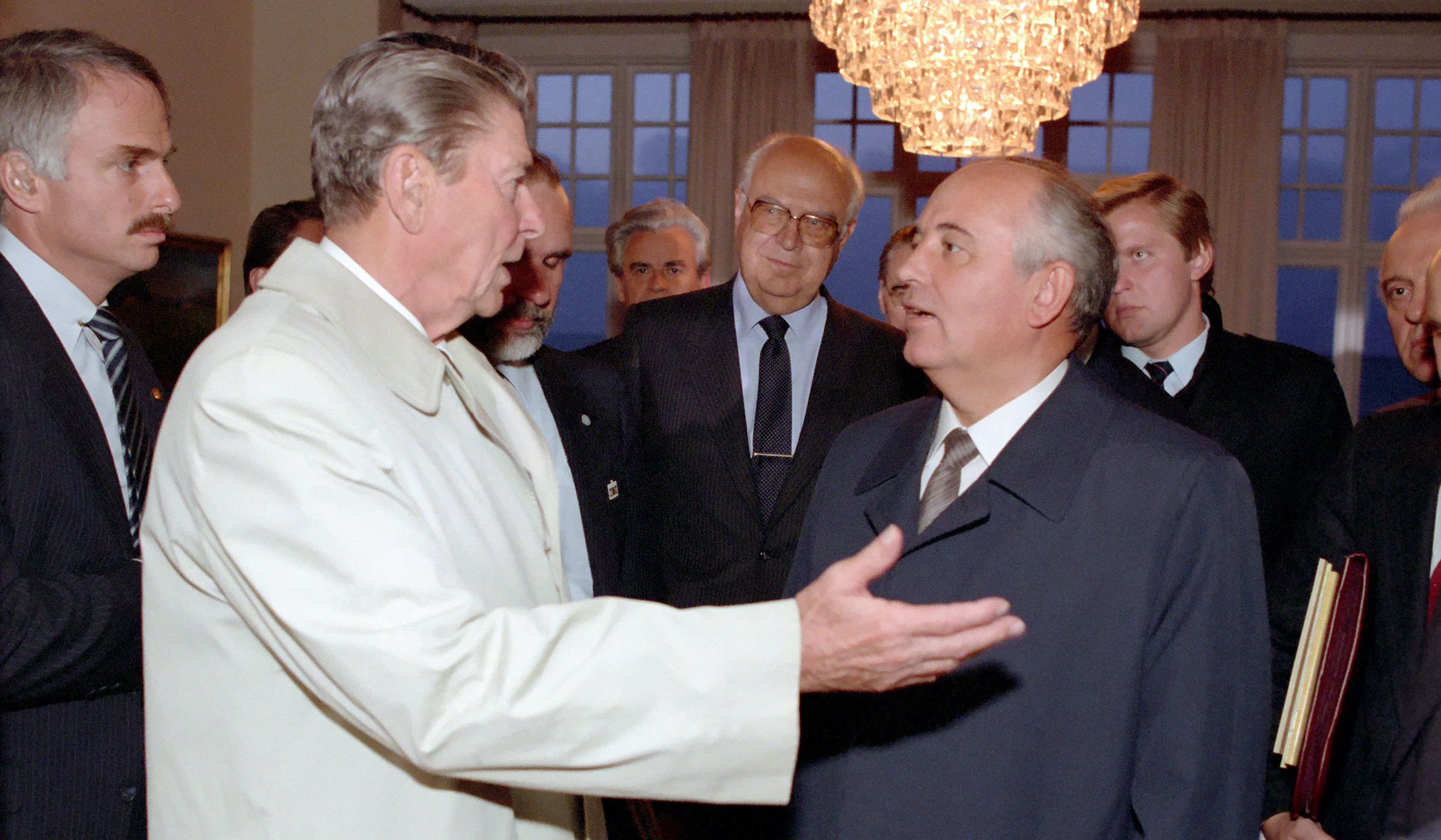
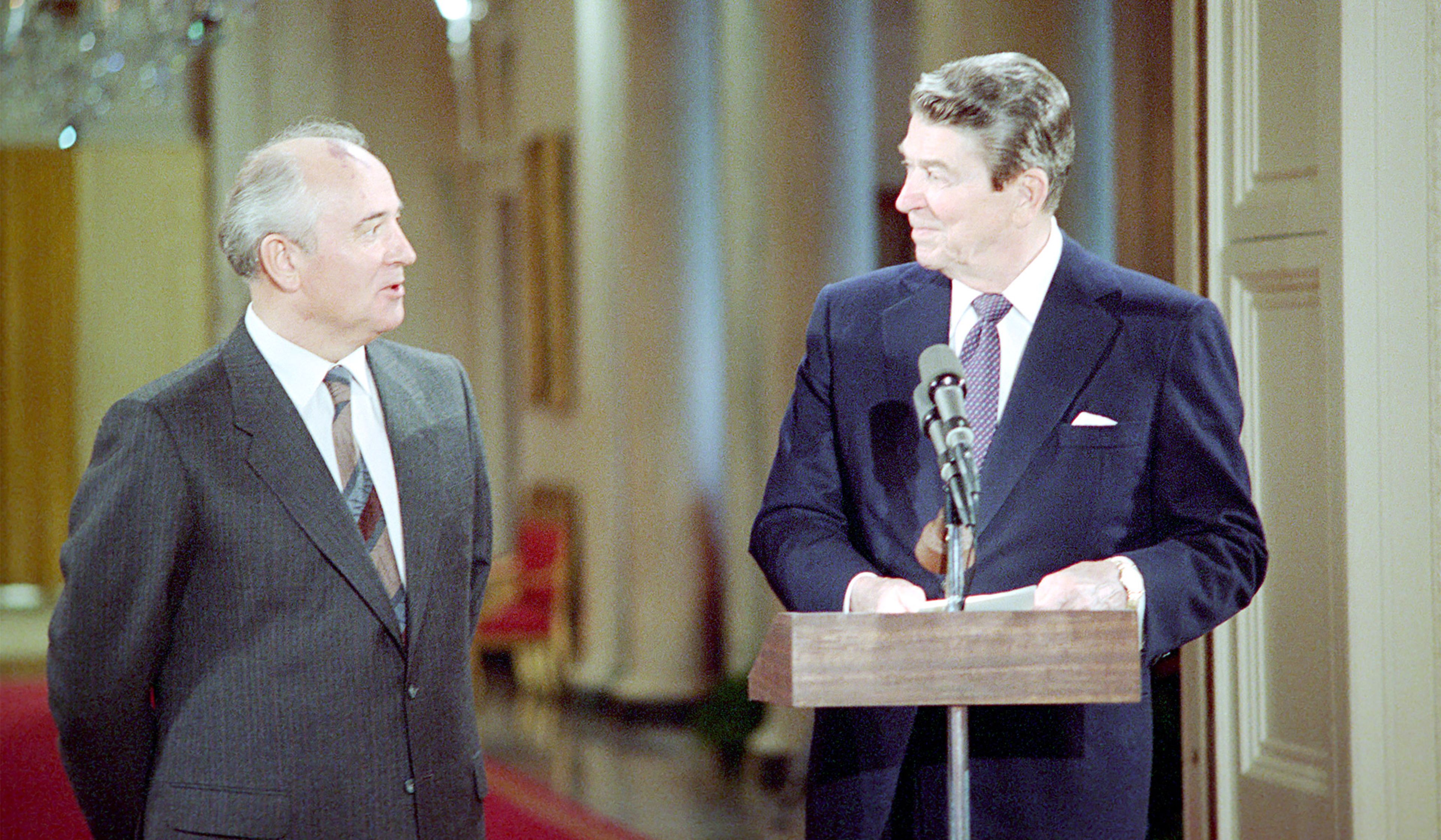
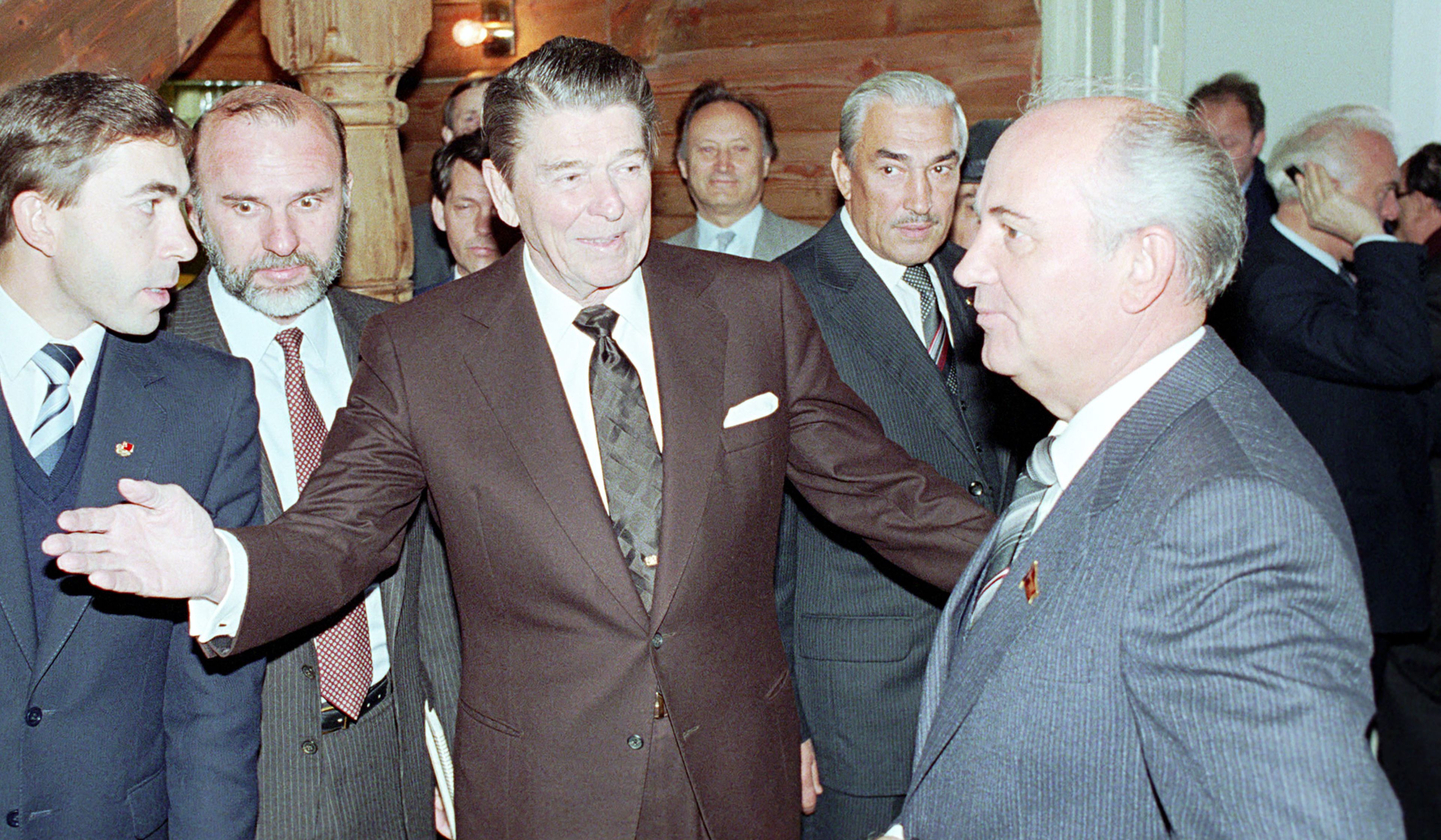
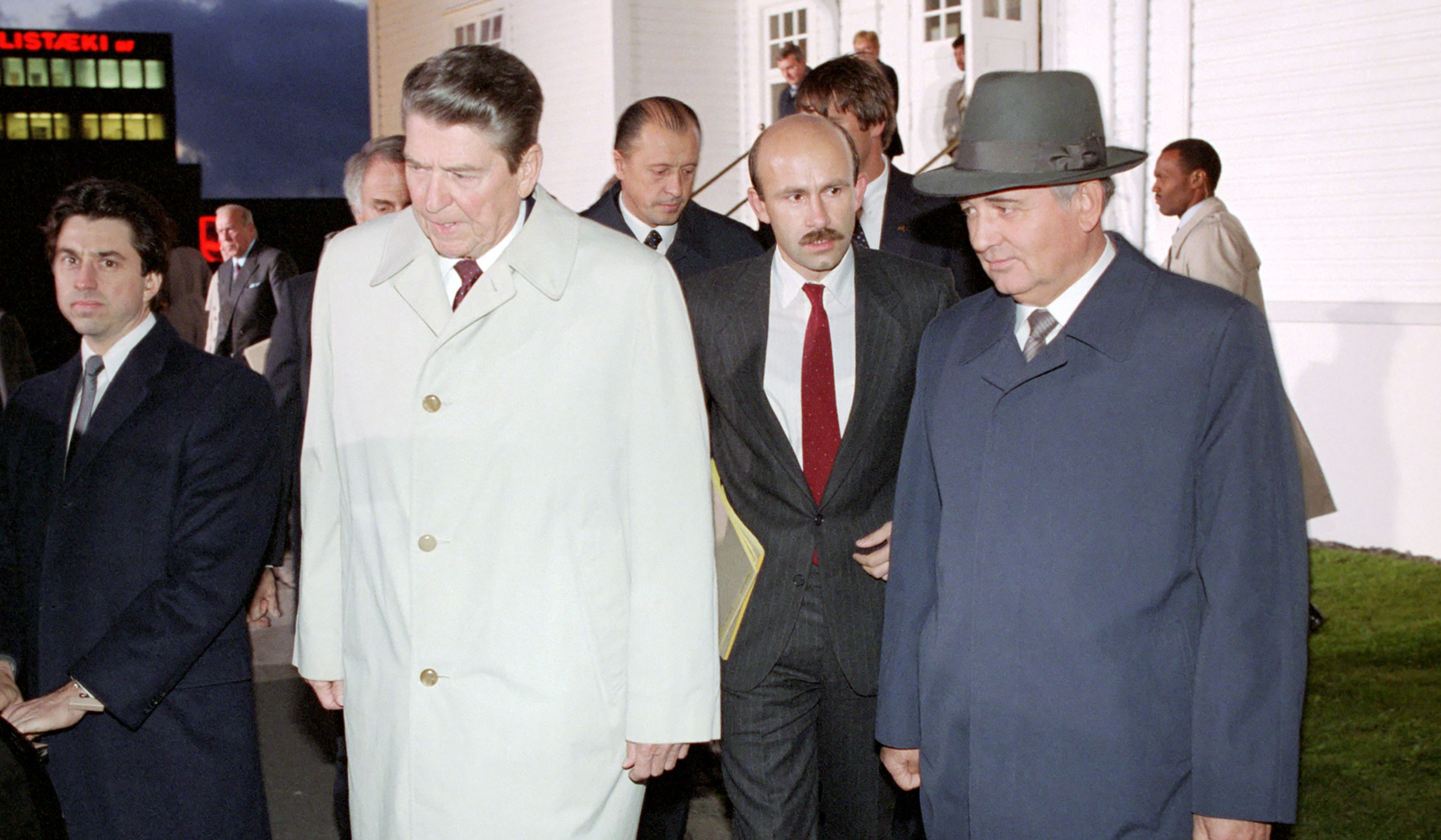
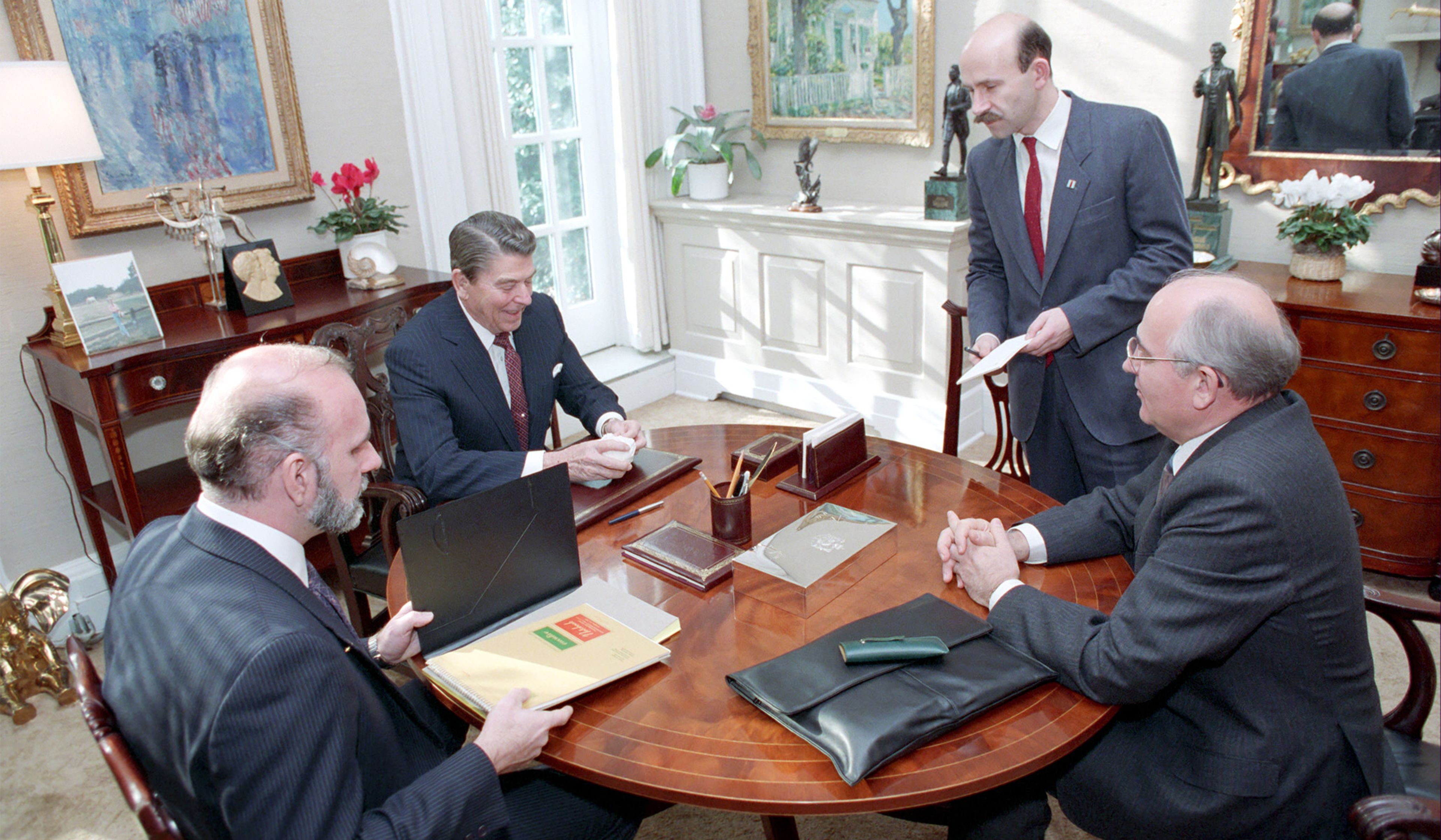
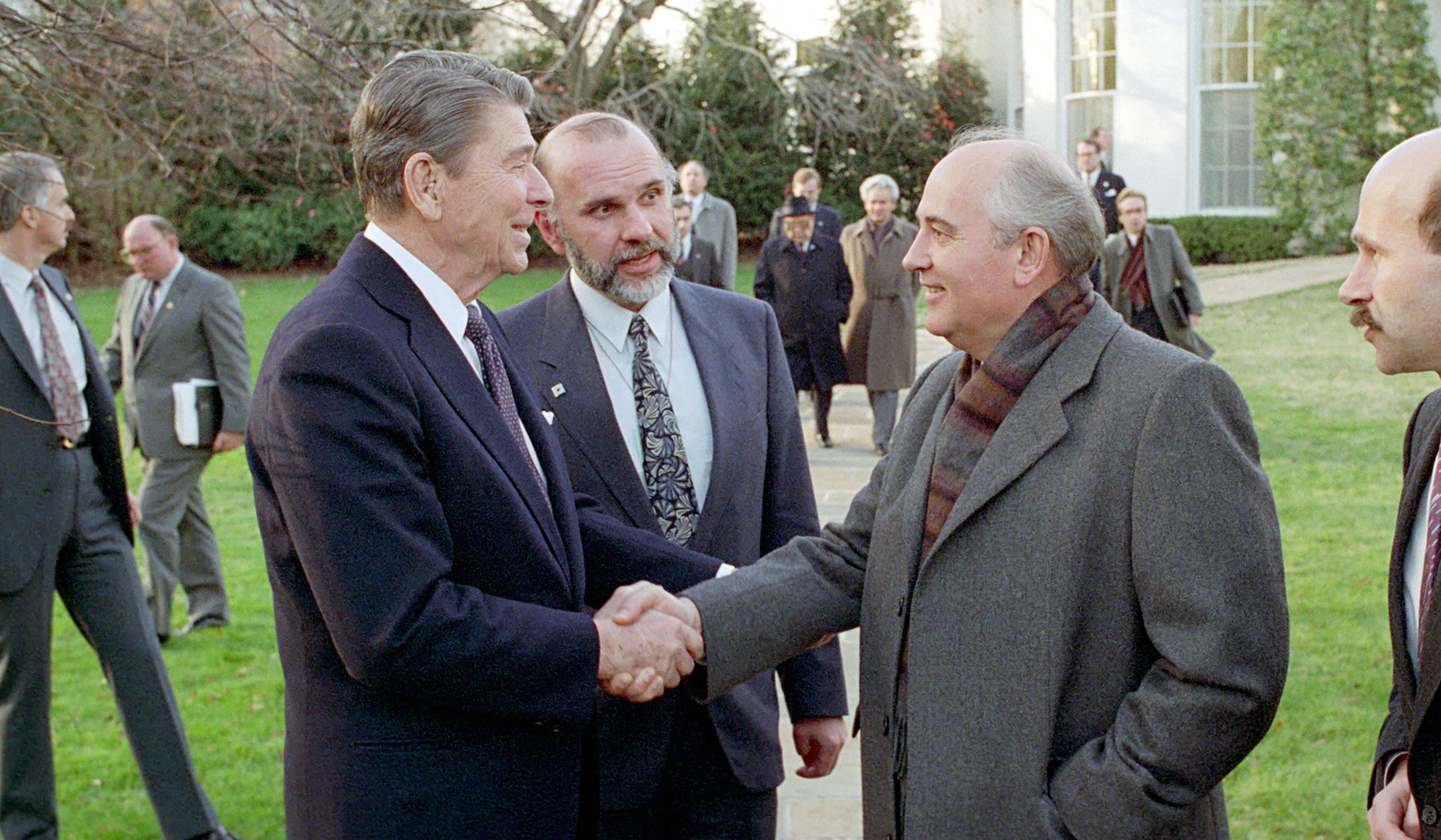
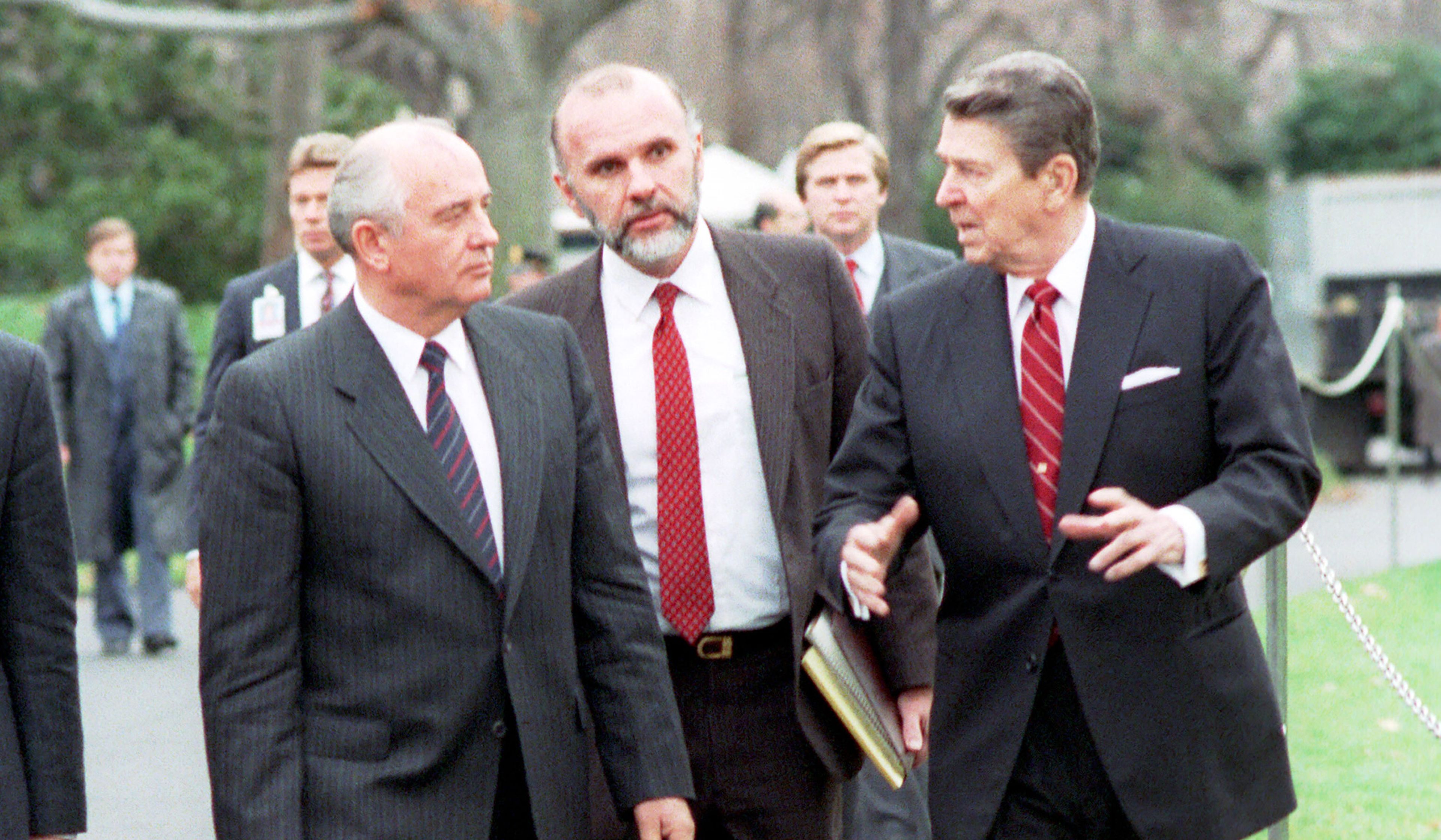
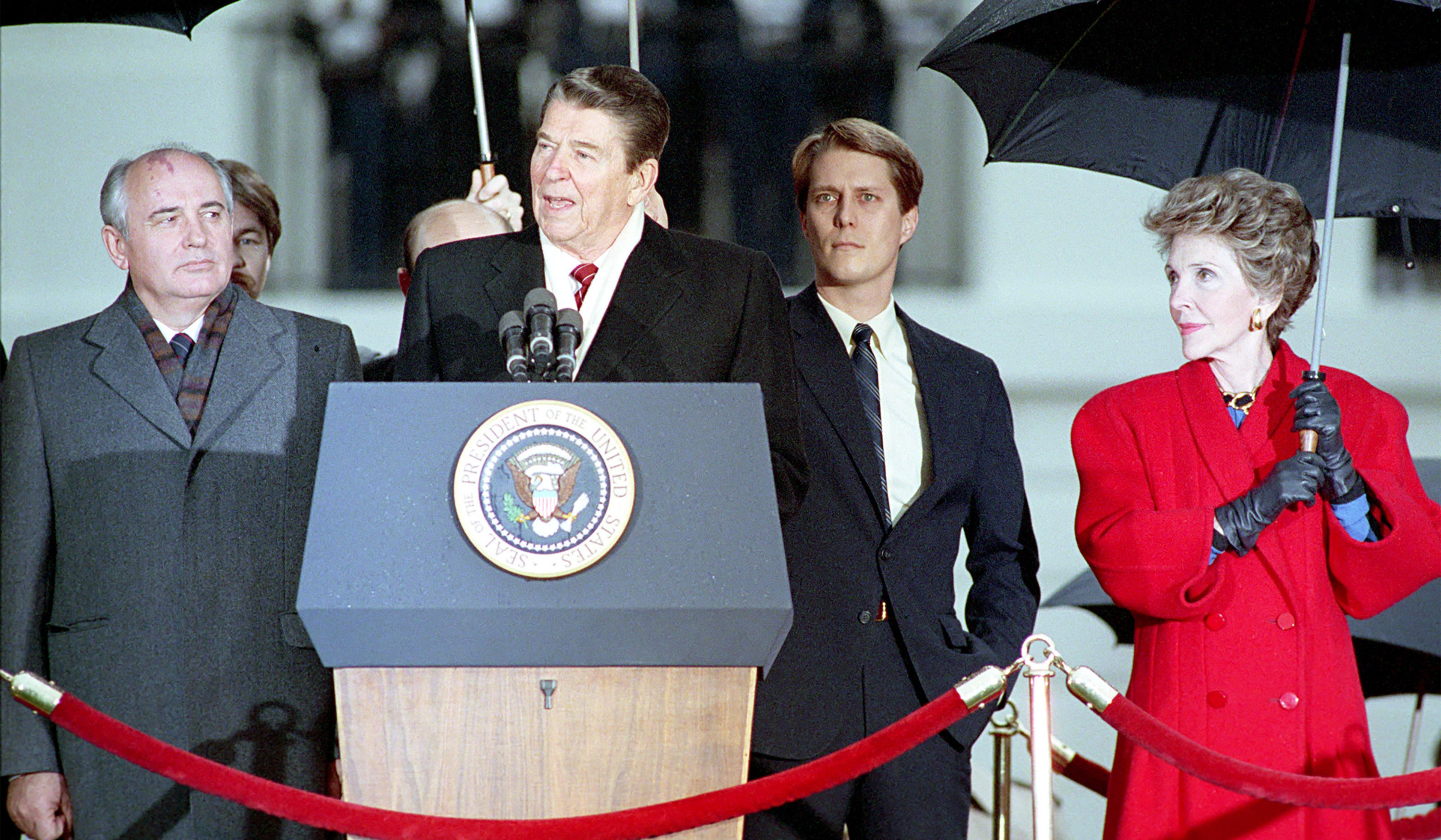
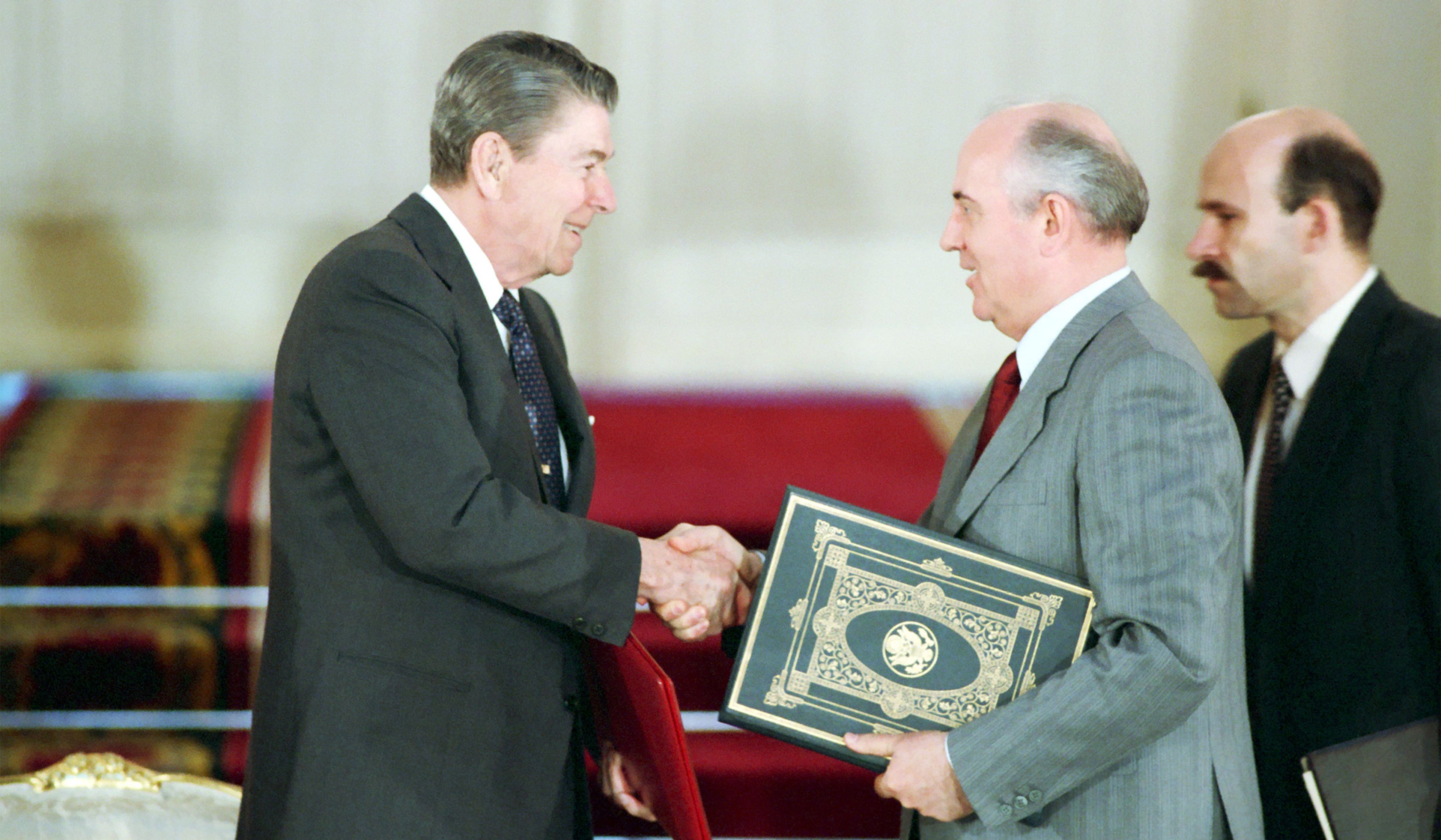
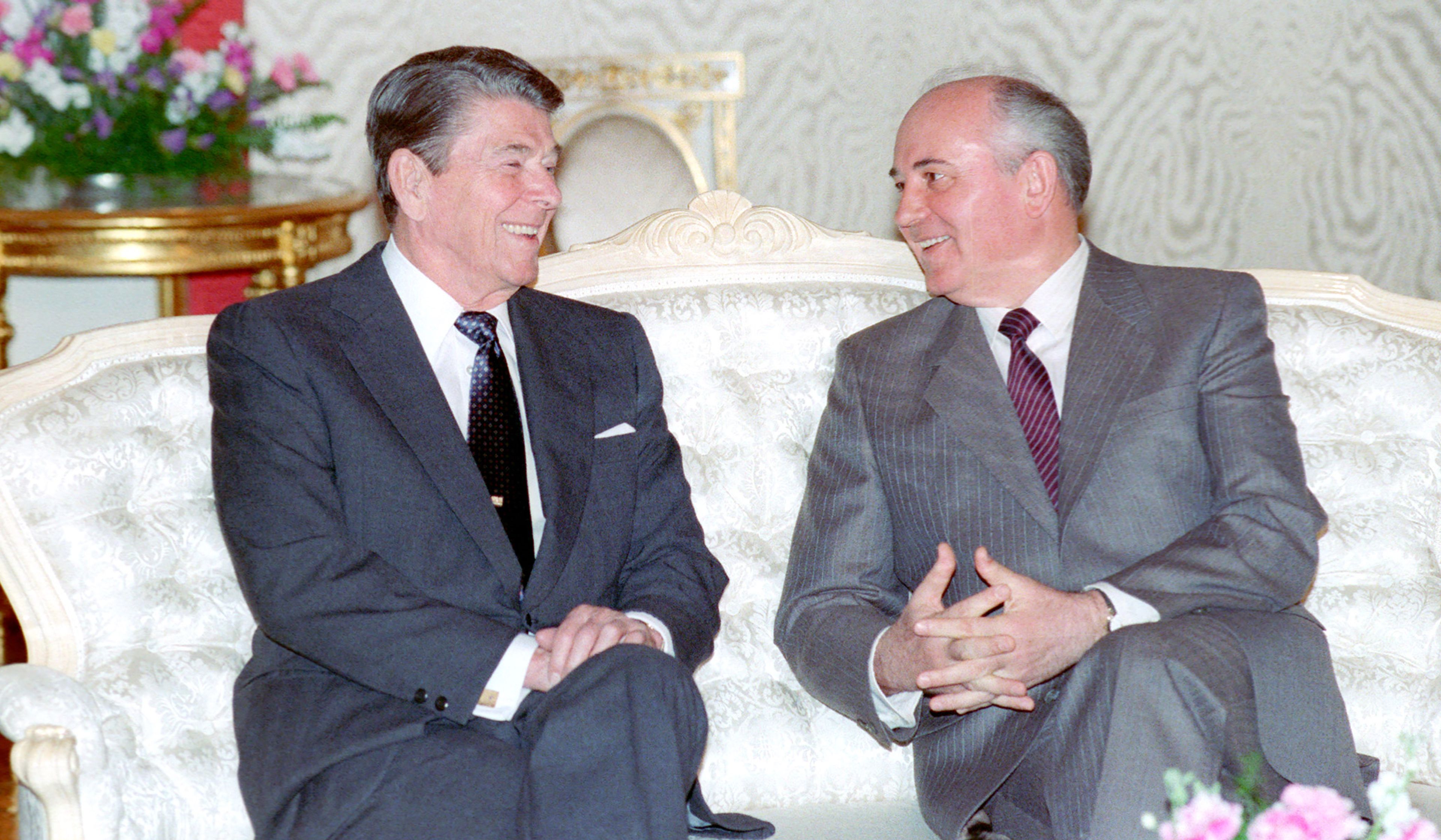
President Ronald Reagan says goodbye to General Secretary Mikhail Gorbachev after the last meeting at Hofdi House in Reykjavik, Iceland, October 12, 1986.
Ronald Reagan Presidential Library/National Archives
In many ways Reagan is the gold standard for strategic consistency and timely intervention. The voluminous archival records now available clearly show the evolution of his major ideas. Musing on the Cold War in 1963 — yes, even before he entered public life — Reagan drafted the following memo, later published in the collection Reagan, in His Own Hand (2001):
If we truly believe that our way of life is best aren’t the Russians more likely to recognize that fact and modify their stand if we let their economy come unhinged so that the contrast is apparent? . . . The only sure way to avoid war is to surrender without fighting. But accommodation is based on wishing not thinking. . . . The other way is based on the belief . . . that in an all out race our system is stronger, and eventually the enemy gives up the race as a hopeless cause. Then a noble nation believing in peace extends the hand of friendship and says there is room in the world for both of us.
Twenty years later Reagan detailed this strategy in top-secret national security directives. One such directive, NSDD-32, issued in May 1982, called for sustained competition with the Soviet Union in “all international arenas to discourage Soviet adventurism.” In January 1983, NSDD-75 stressed the need “to promote, within the narrow limits available to us, the process of change in the Soviet Union toward a more pluralistic political and economic system in which the power of the privileged ruling elite is gradually reduced.”
Did Reagan’s memo and subsequent NSDDs make a difference? Boot says no because too many events intervened between those ideas and outcomes. But does that mean that ideas have no effect on outcomes? Did NSC-68, the 1950 U.S. strategy document that arguably initiated the Cold War, also have nothing to do with what followed? Boot is right that you can’t prove a “direct” connection between plans and outcomes. But, for the same reason, you can’t rule it out either. You have to keep doing research, to pursue truth without ever claiming to have found it.
In the same 1963 memo, Reagan mentioned a fictitious Soviet citizen, Ivan, who appeared again in a Reagan radio address in 1977 and eventually in his speech to the nation on January 16, 1984. That last speech, according to Boot, signaled Reagan’s conversion from a first-term hawk to a second-term compromiser. But, in fact, Reagan used the imagery of Ivan and his wife, Anya, as well as Jim and Sally, their American counterparts, to reflect on his long-standing moral objections to nuclear deterrence based on Mutual Assured Destruction. These couples and millions of citizens like them should not be held hostage to the threat of nuclear Armageddon. In a previous speech, Reagan had asked, “Wouldn’t it be better to save lives than to avenge them?” Wouldn’t it make more sense to develop a nonnuclear deterrent such as the Strategic Defense Initiative (SDI)?
Reagan showed similar foresight in a 1967 debate with Robert F. Kennedy. He called for tearing down the Berlin Wall:
We don’t want the Berlin Wall knocked down so that it is easier to get at the throat of the East Germans. We just think a wall that is put up to confine people, and keep them within their own country instead of allowing them the freedom of world travel, has to be somehow wrong.
These are typical examples of the crystallization and constancy of Reagan’s ideas over time. If ideas have any power in history, Reagan biographers, and biographers in general, have to pay more attention to this phenomenon.
Reagan was also adept at choosing the right moment to compromise. As Boot argues correctly, Reagan was ready to start negotiations with the Soviets already in April 1981. But he was not ready to make a deal. He rejected the “walk in the woods” deal in the summer of 1982 and said in February 1983 that the time to restart negotiations would be when NATO had deployed the Pershing missiles. In private meetings later that year, he exuded confidence that by 1984 the economic recovery and missile deployment would be in place to back up his negotiations. And if that didn’t happen, Reagan added, he’d be happy to go back to the ranch, acknowledging that he may not win reelection. This was clearly not a man doing anything to get a deal.
On all the major issues — tax cuts, inflation, defense spending, missile deployment, SDI, the evil empire, and “tear down this wall” — Reagan acted mostly alone against the opposition of his staff. And in every instance history proved him right. The novel question, then, is not why Reagan compromised but where he got the imagination to pursue unconventional ideas in the first place and the judgment to know when his leverage had peaked. What “inner man,” a term he used in letters to his son, was he consulting?
Other biographers tell us more about Reagan’s “inner man.” Paul Kengor studies his deep and abiding faith. Lee Edwards, Steven Hayward, Craig Shirley, Peter Schweizer, and Paul Lettow grasp the power of his ideas. Martin and Annelise Anderson and Kiron Skinner document his daily statesmanship. And William Inboden, who also scoured the archives for ten years, concludes that Reagan “saw the Cold War primarily as a battle of ideas,” not as a great-power competition or endless drama of diplomatic dealmaking.
Boot has made an ambitious and noteworthy contribution to the continuing fascination with Ronald Reagan. Like all of us, however, he cannot avoid his biases. He was once an ardent supporter of Reagan but now sees unwelcome parallels between Reagan and Donald Trump, both primarily transactionalists. I served Reagan on the National Security Council in his first term and believe that he stands in a class of truly exceptional American presidents. What no biographer should claim, as Boot does, is that his or her accounts are “strictly factual.” As David Byrne, another Reagan biographer, suggests, “The writing of history is very personal, often revealing more about the writer than the subject.” Facts are always selective, because we cannot consider them all, and the facts we select are always subject to interpretation, because we are studying ourselves not the natural world. We learn most from additional facts and competing interpretations; and, if you give the people enough facts, as Thomas Jefferson and Reagan believed, they will usually do the right thing.











Comments