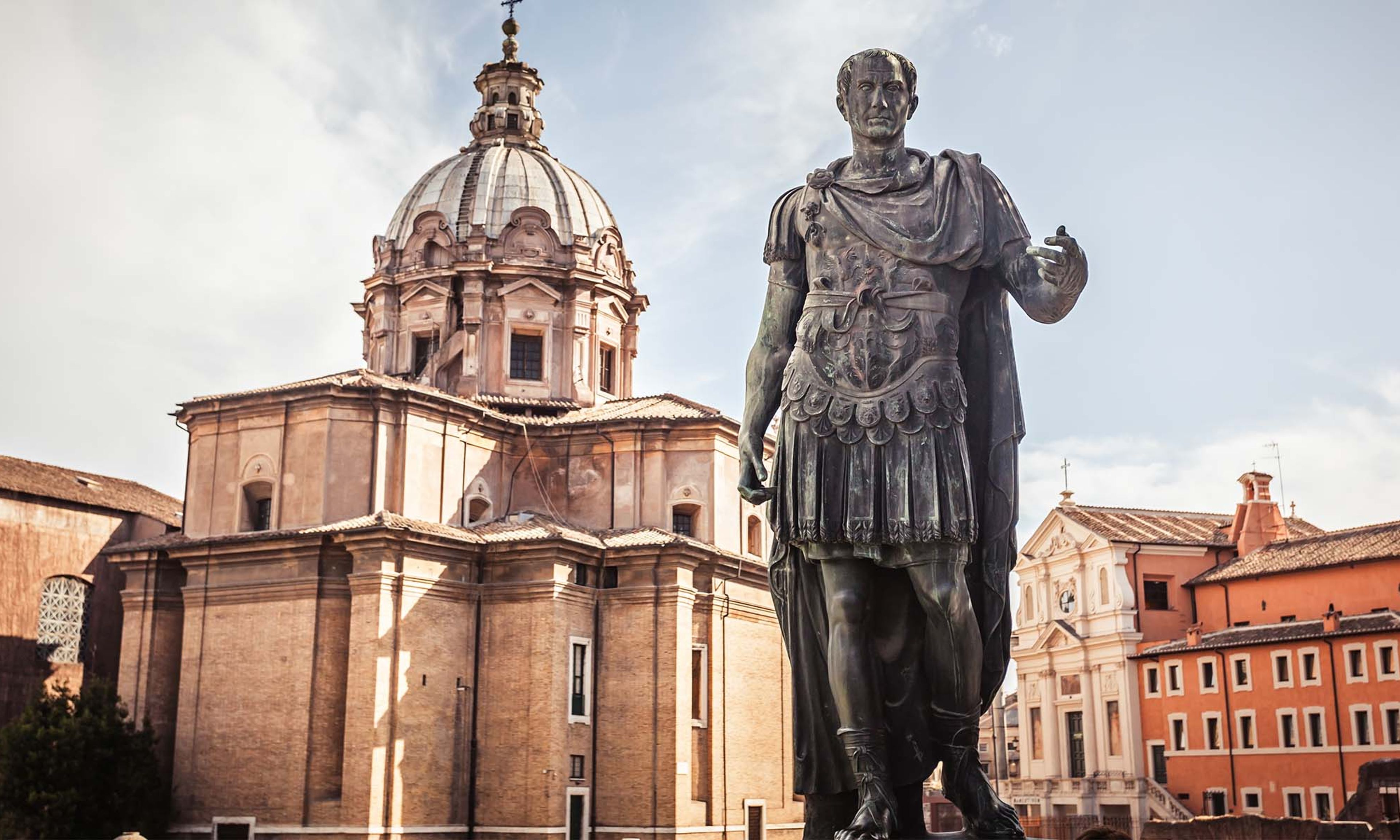
Ine her previous book, SPQR (standing for the Senate and People of Rome), the classical historian Mary Beard writes that “the characteristics of individual emperors did not matter so much as the biographical tradition tries to insist.” That tradition includes Tacitus, Suetonius, Cassius Dio, Plutarch, and other historians of the Roman Empire. In Emperor of Rome, Ms. Beard takes up these emperors, just under 30 of them, as part of her ongoing pursuit of the unending question: “How, and why, did an ordinary little town in central Italy grow so much bigger than any other city in the ancient Mediterranean and come to control such a huge empire,” one that lasted for roughly 700 years?
Mary Beard is that rare scholar whose writings are both authoritative and yet eminently accessible. She has been able to do a number of television shows for the BBC — on Julius Caesar, on Caligula, on the Roman plebs — playing Roman history for its entertainment value without demeaning either the subject or herself. Along the way she has developed a colloquial style that never descends into vulgarity. As a review of her work in the Guardian has it: “She’s pulled off that rare trick of becoming a don with a high media profile who hasn’t sold out, who is absolutely respected by the academy for her scholarship.”
Beard made the wise decision in Emperor of Rome not to treat the emperors one at a time in order of their succession, but instead to organize her book along themes, filling in material on individual emperors where their reigns illustrate the larger points she wishes to make. Among these themes are how emperors dined, their palaces, their role in religion, their military duties, their imperial staffs, their wives and lovers, how they traveled, their deification, and more. Violence is present throughout; there were, as she notes, “few emperors without any blood on their hands.” The office of emperor in Rome knew no term limits, and one of the principal means of succession was, from Julius Caesar on, assassination or enforced suicide. In Rome, in Beard’s words, “the corridors of power were always bloodstained.”
Not that, strictly speaking, Julius Caesar was ever emperor. He was instead a dictator, a Roman office called into being during times of emergency, yet such were his power and ambition that he declared himself “dictator for life.” The declaration was the cause of his assassination, for the Romans had a deep antipathy toward kingship. Yet Caesar’s assassins, though they could not have known it, “had, indirectly at least, brought about the very thing they claimed to be fighting against: permanent one-man rule.” Julius Caesar, as Beard writes, “managed to change the face of Roman politics in radical and controversial ways that established the pattern for later emperors.”
The last of the seven Roman kings was Tarquinius Superbus, also known as Tarquin the Proud, who reigned from 534 to 509 b.c.e. He was tyrannical in every respect, and his rule, in Beard’s words, “led to revolution, to the end of monarchy and to the establishing of ‘liberty’ and the ‘free Republic of Rome.” Two consuls serving terms of one year replaced kings, and a chain of offices (quaestor, praetor) below that of consul, along with a powerful senate, ruled republican Rome. The Roman Republic ended with the reign of Augustus (27 b.c.e.–14 c.e.) but remained the great days for many Romans, much as the days of our Founding Fathers are viewed.
When Octavian Caesar, the grandnephew and adopted son of Julius Caesar, came to power, he was careful never to refer to himself as king or emperor. He was instead princeps (first citizen), or primus inter pares (first among equals), and took on the name Augustus, meaning, Beard notes, “something close to Revered One.” As Julius Caesar, in reforming the calendar, arranged to have a month (July) named after himself, so would Augustus bestow the month of August on himself. Nice, sometimes, to be emperor.
“I am trying to shine a light, from different angles, on Roman emperors,” Beard writes, “whether benevolent elder statesmen or juvenile tyrants, would-be philosophers or wannabe gladiators, famous or forgotten — and trying to face such basic questions as why so many of them ended up… dispatched by an assassin’s knife or a poisoned mushroom.” Along the way she takes up the more everyday matters of keeping an empire running. Her hope is that, “overall, readers will go away from this book not frustrated by how little we know about these rulers of two thousand years ago, but amazed by how much.”
Mary Beard allows that she has come away from writing Emperor of Rome “increasingly to detest autocracy as a political system.” Little wonder, given the character of the majority of Roman emperors covered in her book, which runs from the rise of Julius Caesar (48–44 b.c.e.) to the death of Alexander Severus in 235 c.e. A strange, not to say weird lot, they ranged from the judicious Augustus to the perverse Tiberius to the nutty Caligula to the murdering Claudius to the deeply illusioned Nero through the three different emperors (Galba, Otho, Vitellius) who served in the year 68–69 c.e. to the tyrannical Domitian to the soldierly Trajan to the restless Hadrian to the 14-year-old emperor Elagabalus (assassinated at 18), who attempted to transgender himself and who may have invented the whoopee cushion, ending with Alexander Severus, assassinated while on military campaign.
One comes away from Emperor of Rome with different views of Rome’s emperors than one had before reading Mary Beard on them. Marcus Aurelius, for example, commonly thought of as the philosopher emperor, turns out, if the rumors be true, to have had an adulterous wife and to have raised, in his son Commodus, one of the worst of all Roman emperors. In The Decline and Fall of the Roman Empire, Edward Gibbon called the period between the emperors Nerva (96–98 c.e.) and Marcus Aurelius (161–180 c.e.) a time when “the condition of the human race was most happy and prosperous.” One suspects Gibbon would have felt differently had he been alive to read Emperor of Rome.
Beard sets out three requirements for a Roman emperor: “He should conquer, he should be a benefactor, and he should sponsor new buildings or restore those that have fallen into disrepair.” Different emperors performed differently in each of these three realms. Augustus, for example, claimed to have “found Rome brick and left it marble.” The Romans, Beard informs us, had no Latin word for “economy” and hence no economic policy. Nor had they anything resembling a set military policy; matters of war were ultimately determined by the ambition of the emperor in power or by the uprisings occurring during his rule. In her judgment of emperors, Beard warns that they did not fall into “simple categories, any more than modern monarchs, presidents or prime ministers do. No ruler pleases everyone; good in whose opinion, we should always ask; or bad by what criteria.” She reminds us in this regard of the old maxim that “history is written by the winners.”
“The image of Roman emperors that has come down to us is a complicated and multilayered construction,” Beard writes, “a glorious combination of hard historical evidence, spin, political invention and reinvention, fantasies of power and the projection of Roman (and some modern) anxieties.” She is particularly good on what we know and do not know about the intricacies of Roman rule. Turns out that much of the hard evidence we do have goes soft on closer inspection.
Uncertainty plays throughout the pages of Emperor of Rome. Beard writes that “the relationship between the emperor and his office job remains tantalizingly elusive.” She notes, à la the Tolstoy of War and Peace, that “it is now almost impossible to recreate the experience of an ancient battle (probably much smaller-scale and messier than the grandiose ancient accounts suggest, with more dying days later from infected wounds than struck down on the field itself).” Nor can we be altogether certain about the behind-the-scenes maneuverings over imperial succession attributed to Augustus’s wife Livia or Nero’s mother Agrippina, and to other Roman women behind the thrones.
We cannot even be sure we know what the emperors looked like, despite all the statues and coins with imperial heads upon them now in our possession. (Beard’s writing on sculptures and busts and coins is supported by several pages of excellent photographs.) Almost all Roman paintings of emperors have been lost. So, too, have the “enormous statues of Roman rulers and their family members, sometimes ten or fifteen times life-size, [which were] once a common feature of cities across the empire.” Beard reports that the heads of Roman statues were often changed, and the bodies retained, with the change of emperors: “What was a Caligula has been turned into a Claudius, a Nero into a Vespasian, a Domitian into a Nerva.” As Marcus Aurelius had it, “same play, different cast.”
The moral of Mary Beard’s story in Emperor of Rome is the sham that was Roman autocracy. Toward the close of her earlier book SPQR, she writes, “I no longer think, as I once naively did, that we have much to learn directly from the Romans — or, for that matter, from the ancient Greeks, or from any ancient civilization.” She modulates that view slightly in Emperor of Rome, writing that studying Roman autocracy has not only helped her to understand the political culture of Rome better, but has opened her eyes to “the politics of the modern world too.”
Emperor of Rome raises the question of how much we can learn from history. Apparently not all that much that is directly useful. Santayana said that “those who cannot remember the past are condemned to repeat it.” But one wonders if those who remember it aren’t also condemned to repeat it anyway. History, then, is a game, in which real people move about on a board of actual events, with many checks but no checkmate — an endless game but also, when played by as talented a historian as Mary Beard, an exquisitely entertaining one.










Comments