This book is, for the most part, superb — provocative and unnerving — but I can’t, in good conscience, recommend it to those readers who, for instance, deplore Catch-22 for being a subversive, meretricious assault on the United States military. Sailing the Graveyard Sea, which is about an alleged mutiny in the American Navy and its designated perpetrators, makes Joseph Heller’s novel look as gonzo and perfidious as the Top Gun movies.
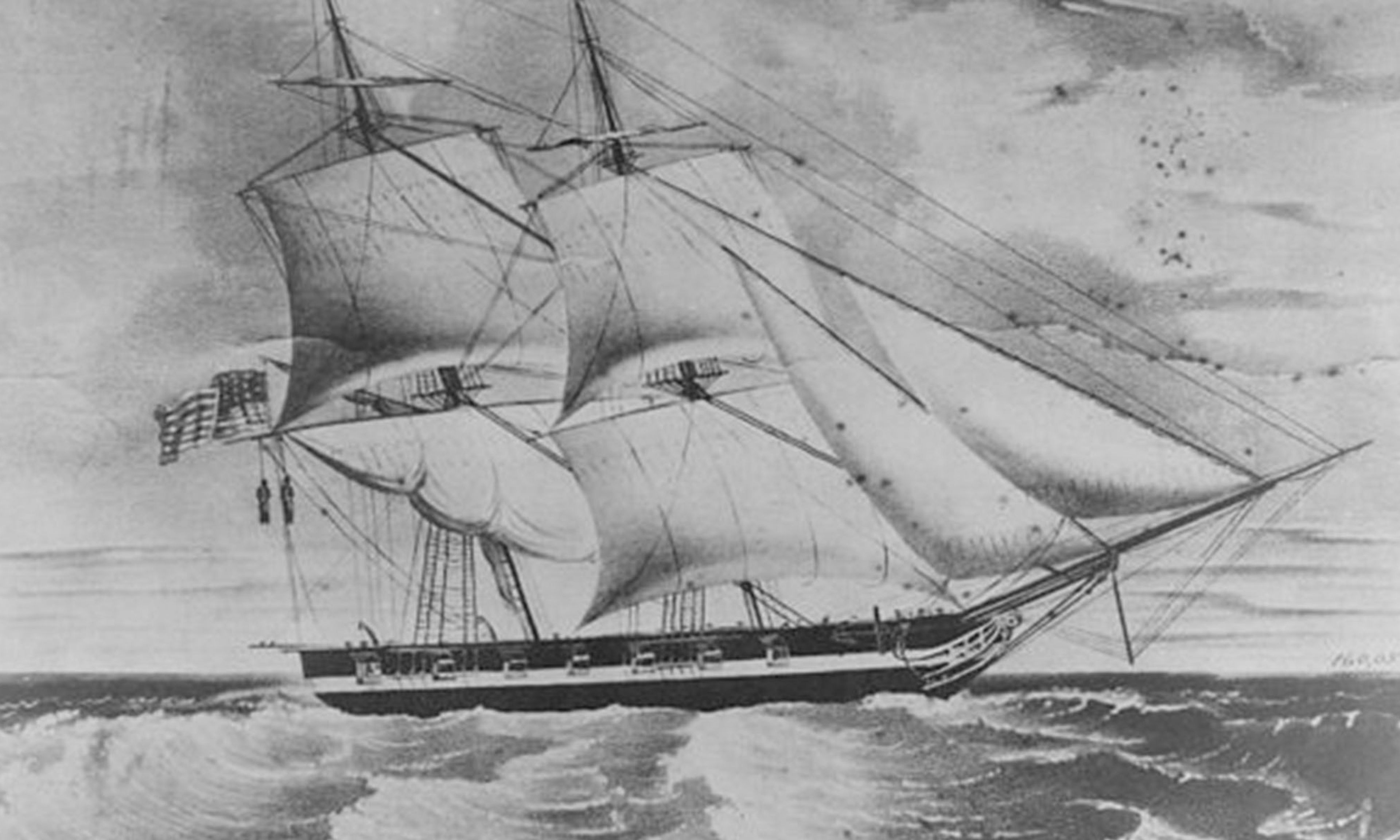
The time was 1842. The Somers, an American brig-of-war powered by sails, “a new ship, and an uncommonly handsome one,” was ordered to carry dispatches to another naval vessel off the coast of Africa while the Somers’s officers trained midshipmen (officers-in-training) — very young midshipmen: “Of the 120 souls aboard, only some 30 were out of their teens; the rest were nineteen or younger, 45 of them between the ages of thirteen and sixteen.” One of those youngsters was 18-year-old Philip Spencer, the son of John C. Spencer, President John Tyler’s secretary of war.
If anyone was not a good candidate to become a naval officer it was Philip Spencer. The American Navy at the time (and now, presumably) required of its officers and crewmen respect for the chain of command, discipline, and a good work ethic. Spencer was a ne’er-do-well — he left college after three years, still a freshman — a loner (not the best attribute on a ship as small as the Somers), and, perhaps worst of all, a wise guy. He became an acting midshipman in 1841, probably through the influence of his father; on his first ship he punched a superior officer, but it was hushed up because the powers that be didn’t want to anger the secretary of war. Spencer’s next ship was the Somers, which he joined in August 1842. It was commanded by Alexander Slidell Mackenzie.
Commander Mackenzie isn’t a member of the pantheon of American naval heroes either. He “truly did love his service,” but wasn’t fond of the human race; he combined the sadism of Captain Bligh and the lunacy of Captain Queeg without those gentlemen’s charm. Moreover, he reeked of sanctimony, was a humorless prig and a religious hypocrite, and believed that anything he did was right because he did it. I’m describing a monster, but the book is quite credible about Mackenzie’s iniquity. His sadism (“Here and there… he shows a relish for violence that approaches the prurient”), for instance, was heightened, to my mind, by his justifying it with cant. On the Somers, the crew — the non-officers — had to fear Mackenzie’s “enthusiasm for the lash,” which was inflicted with the cat-o’-nine-tails or its “ugly little sibling, the colt” (officers couldn’t be whipped). Flogging was a constant of shipboard life, administered to even 13-year-olds and wielded for the most trifling of offenses: “spitting and throwing tea on the deck… blasphemy and ‘skulking,’” and the like.
It was inevitable: “When Philip Spencer — insolent, sullen, scornful of hierarchy — joined [Mackenzie] aboard the Somers, the boy was putting himself in at least as much danger as he would have faced had his father let him become a dragoon” in the American West. Spencer was a “vexation” to Mackenzie “from the very start,” a state of affairs exacerbated by their being members of a “populous, close-knit community” that incubated rumors and in which Spencer was very much an outsider.
Spencer, I think it’s fair to say, was not particularly bright (remember his flunking out of college; and his daydreams about the grandeur of pirates were inane — and helped get him into disastrous trouble), and it is more than fair to say that he flagrantly lacked common sense. On a ship that contained a number of Mackenzie’s friends and relatives, it wasn’t wise to insult the commander, even behind his back; but that’s what Spencer heedlessly did. He also socialized (when he socialized) more with the crew than with officers and the other midshipmen, apparently a flagrant faux pas on a naval ship at the time.
When the Somers set sail for Africa, James Wales, the Somers’s purser’s steward, was the beneficiary of Mackenzie’s “uncharacteristic reprieve” after some misconduct, and, determined to remain in the commander’s good graces, and knowing of his antipathy toward Spencer, he “began to pay close attention to the midshipman.” In brief, he became a spy. And “unaware of Wales’s scrutiny, Spencer became increasingly indiscreet about his piratical fantasies” and thoughts of mutiny. One night, Wales would later report, Spencer told him that he and about 20 other crewmen planned to mutiny and turn the Somers into a pirate ship. The uncooperative would be slaughtered. A day later — November 26, 1842 — Mackenzie learned what Spencer had purportedly told Wales. The commander confronted the midshipman and asked him point-blank whether he intended to take control of the vessel. Spencer replied that what he told Wales was a joke. But Mackenzie, believing the worst of Spencer, ordered the young man “ironed” — shackled in chains. Papers were discovered that Mackenzie believed further incriminated Spencer, and the latter tendered a highly ambiguous confession (readers can draw their own conclusions).
Mackenzie, who at this juncture seemed to be becoming more and more paranoid and self-righteous, notified his officers that he wanted their opinions on what he should do next. “Mackenzie had said he was simply seeking advice, but… the meeting he desired would have all the trappings of a court-martial.” He had no legal right to convene a court-martial, but the officers, nevertheless, went ahead with one. “Everyone on the ship knew what [Mackenzie] and his officers wanted said,” and the “witnesses” gave them what they coveted. And inevitably, the officers adjudged that Spencer and two putative co-conspirators among the crew were guilty of planning a mutiny and should be hanged. Mackenzie “concurred in the justice of this opinion” — unsurprisingly, since before the officers completed their inquiry, he was planning the staging of the executions.
Mackenzie “certainly did not have the [legal] power to kill anybody.” That didn’t stop the commander, “that connoisseur of executions,” from ordering the men to be hanged. The Spencer affair wasn’t the Navy’s finest hour.
The same can be said for two subsequent formal naval investigations, both in the United States, of what transpired on the Somers. The first, a court of inquiry, contained suspicious testimony, including a written statement of Mackenzie’s that even “one of [his] own legal counselors called… a diabolical document.” Just the same, “the court gave Mackenzie a complete vindication,” ruling that he “was not bound to risk the safety of his vessel… in order to secure to the guilty the forms of trial.” Which seems an odd determination from a court of inquiry about the shipboard officers’ council, which was fairly clearly a kangaroo court.
The second naval investigation was a real court-martial — of Mackenzie, a trial that, according to Snow, he requested and in which he pleaded not guilty. (The author claims that the commander wanted to be tried in a military court to preclude a criminal trial in a civil court.) The charges: murder; oppression; illegal punishment; conduct unbecoming an officer; cruelty and oppression. The judge advocate (the prosecutor), William M. Norris, was a civilian and “was going blind into the trial,” but he’s one of the very few individuals in this book who come off well. Norris was as well prepared as possible and was a forceful and shrewd advocate. The result: Mackenzie was acquitted of all charges. It’s hard not to suspect that the Navy was protecting one of its own, and its reputation.
I mentioned at the start of this review that the book is, “for the most part, superb.” I qualified my praise because while Snow’s frequent sardonic asides intimate that he believes the executions and legal and pseudo-legal hearings were travesties of justice, he never explicitly states whether he believes that Spencer and the other two hanged crewmen were actually guilty of mutiny (though I think he implies that they weren’t). I found Snow’s reluctance to elucidate this issue frustrating. His comprehensive research and canniness (he is the author of nine previous books) indicate that he could have provided a measured, cogent assessment of the question of guilt or innocence if he had directly addressed this crucial question.
The omission is important, but Sailing the Graveyard Sea is still something of a tour de force. Its author has impressively smooth control of his depraved, devastating material — black humor without the humor. That is, the relevant incidents are grotesque, most of the people written about (including two of the three victims) are at best petulant and at worst despicable — and even Joseph Heller couldn’t have infused this tale with the saving merit of tenebrous, albeit illuminating, laughter.
Near the end of the book, Snow writes, “So the Somers sails on through the squalls of an argument that cannot be settled.” I find this more poetic than persuasive because, among its other virtues, Sailing the Graveyard Sea is ultimately, despite what its author might believe, a brief for the innocence of three unjustly murdered men.











Comments