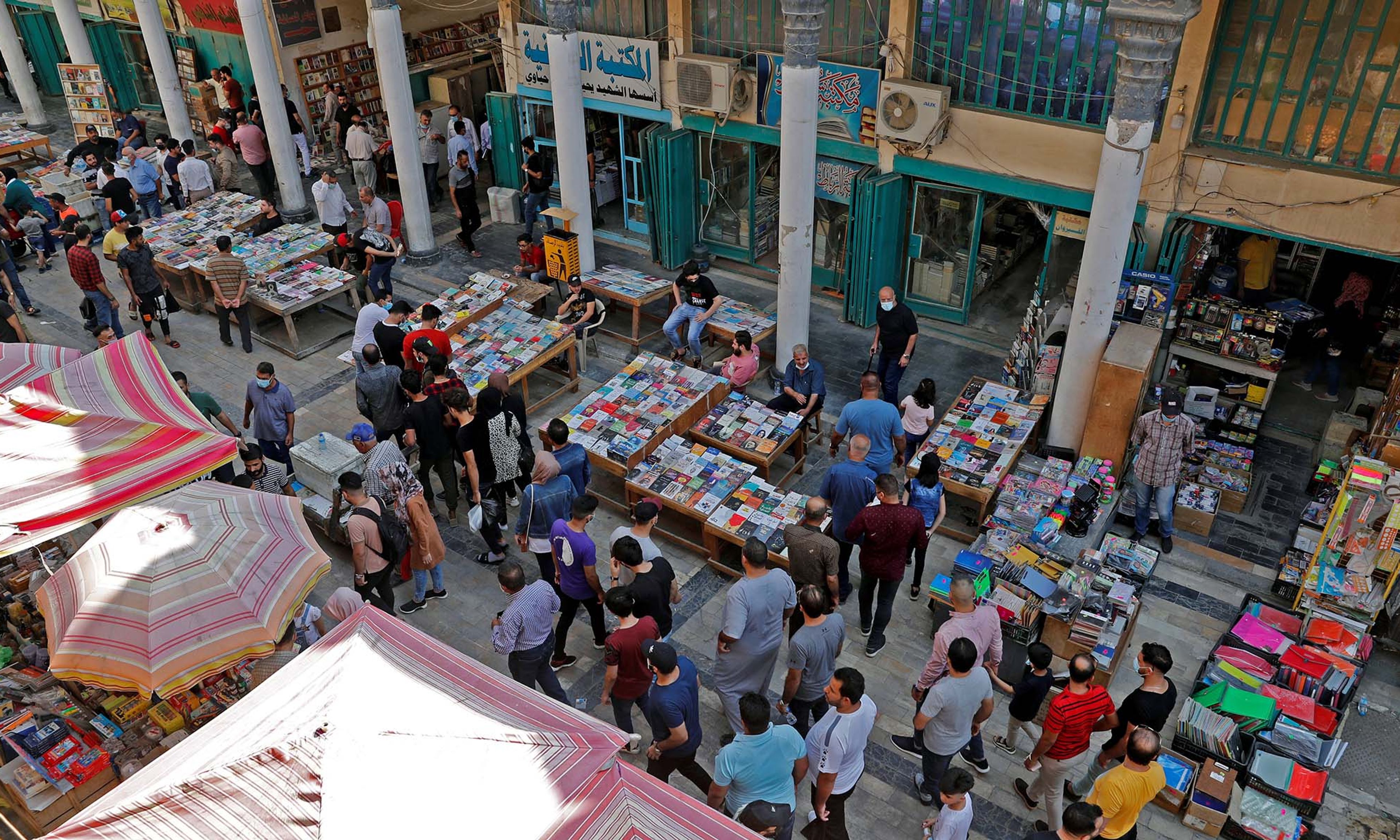
It is safe to say that Iraq’s security situation is the best it has been since the U.S. invasion of 2003. After years of violence, the capital, Baghdad, almost feels normal. With an American passport, one can land at the airport, get a two-month visa on arrival, get in a taxi, and go to a hotel in the city without any hassle. Traffic is one of the biggest problems facing anyone trying to get around the city. In fact, the city has become a destination for social-media influencers whose shtick is to go to places off the beaten path or considered unsafe. They film themselves wandering the streets of Baghdad without harassment or bother, benefiting from the very real Arab hospitality that Iraqis quickly offer to guests.
Another clear sign that Baghdad is more stable than it has been over the past two decades is the number of Syrians in the city. After 2003, millions of Iraqis fled to Syria, where the government of Bashar al-Assad welcomed them openly, a fact attested to by Iraqis of all stripes. When I studied Arabic in Damascus in 2010, the city was full of Iraqis fleeing violence in their country. Now, the roles have reversed. In both Baghdad and Erbil, the capital of Iraq’s Kurdistan Region, upscale cafés are full of young Syrian men waiting tables while avoiding compulsory military service. At a stoplight in the middle of Baghdad, my taxi driver and I watched as two East Asian gentlemen crossed the street. The driver turned to me and said that their presence, as well as mine, was reassuring to Iraqis, who saw us as signs that security had gotten better.
Iraq is emerging from two waves of sectarian violence, the first in the years following the U.S. invasion, and the second when ISIS, in reality a new manifestation of what had been known as al-Qaeda in Iraq, took and controlled vast swaths of primarily Sunni-majority areas from 2014 to 2017. The Iraqi army collapsed in key areas, including the city of Mosul, and the response to the ISIS threat spawned a conglomeration of Shiite militias — al-Hashd al-Shaabi, the Popular Mobilization Forces (PMF) — to combat the Sunni terrorist group. The PMF now functions much as Hezbollah does in Lebanon, forming a sort of parallel state while also being integrated with the state itself.
As relative stability takes hold, some of the worst consequences of the sectarian violence are being reversed. For example, a Roman Catholic church in Baghdad’s Shorja neighborhood, one of the city’s oldest standing churches, is being restored after it was used as a storage facility by militias for years after the 2003 invasion. Father Anastas the Carmelite, a central figure of Iraq’s Christian history in the early 20th century, is buried at the church, and a new statue of him has been erected in its courtyard. As I walked into the building in early March, two Iraqi Muslim women clad in black abayas preceded me. Assuming I was somehow involved with the church, they asked whether it was open for a visit. They wanted to pray for the intercession of the Virgin Mary (Maryam al-adhra). A young Christian man working on the church’s restoration invited them inside.
But to say all is well, or that sectarianism is a thing of the past, would be a gross exaggeration. One of the most common themes in my conversations with Baghdadis is their warning to me as an American to watch out for my safety, advice I take seriously. In November 2022, an American, Stephen Edward Troell, was assassinated outside his home in the busy Karrada district on the east side of the Tigris. Troell was a Protestant missionary and English teacher. Chatter among Westerners in the city was focused on his missionary work, which, they assumed, somehow got him on the wrong side of the wrong people. But despite official statements to the contrary, there is no indication that the Iraqi government or the U.S. embassy in Baghdad wants to reveal who the killers are or what the motive was. Security cameras are ubiquitous in Iraq. It is unlikely that the killers have not been identified or that they don’t have powerful protectors. The case is a reminder that, notwithstanding the glossy images posted by adventurous travelers on YouTube, the security situation is still tied to unstable political arrangements.
The 20th anniversary of the U.S. invasion is not on the top of most Iraqis’ minds. As one Iraqi TV journalist mentioned to me in casual conversation, it’s a bigger deal for foreign journalists than it is for most Iraqis. That said, talk of the “former regime” (al-nidhaam al-saabiq) is mentioned quickly whenever the political situation comes up in conversation. A distinct theme soon emerges in conversations with taxi drivers in Baghdad: Most of them are Shiite; most say that life was better under Saddam Hussein, a Sunni Muslim; most say that the Shiite regime in Iran is the cause of Iraq’s problems; and most say that they think the U.S. should play a stronger role in sorting out Iraq’s current situation. It feels sometimes that they have all memorized the same script.
Ibrahim, for example, from the Shiite stronghold of Sadr City, told me as we navigated Baghdad’s traffic that he would prefer that no outside country interfere in Iraq’s affairs but that the U.S. is the better alternative if he had to choose between it and Iran. He said that under Saddam there was a proper government with rules that everyone had to follow. Now there are no new infrastructure projects, and the state is unable to solve the problems facing everyday people. No one, including the powerful cleric and politician Muqtada al-Sadr, after whose father Sadr City is named, is offering a better alternative, he said.
Perhaps surprisingly to some, a similar theme is common in Iraq’s autonomous Kurdistan Region, where many people — though perhaps fewer than in Baghdad — insist that life was better under Saddam than it is under the two ruling parties that now govern the region. In Erbil, the Kurdish taxi driver who drove me from the airport began talking about the situation in the region. On a scale of one to 100, he said, he would rate the legal system in Kurdistan less than zero. Unless you’re well connected, there is no rule of law, he explained. Our conversation turned to Saddam Hussein and his eyes lit up. “Saddam Hussein was our father,” he said. “He was the protector of Iraq’s prestige.” Since then, he added, no one on the world stage takes Iraq seriously.
In such discussions, it’s hard to distinguish between rhetoric, wistful nostalgia, and serious opinion. There are plenty of dissenting opinions, of course. Sitting in a taxi back in Baghdad, I watched a traffic cop talking on his radio rather than directing traffic. My driver sounded a familiar tune. There used to be a nidhaam, he said, meaning a system or a regime or, in this context, a functioning state. Under Saddam, at least the traffic cops did their job. I was anticipating the usual refrain about how life was better in those days, but as we continued to drive through the Shorja neighborhood, along the east bank of the Tigris, he said that life was better now. He acknowledged the chaos that has ensued since then but said that under Saddam everyone was poor. Now, if you want to work for it, you have opportunities to make money — as we rode through Shorja, he pointed to the myriad shops selling everything from clothing to car parts.
The view that the U.S. should play a bigger role in Iraqi politics is common. Last fall in Baghdad, I attended a demonstration commemorating the start, in October 2019, of anti-government protests that spawned the Tishreen (October) movement, as it came to be called. Among the demands of demonstrators was an end to foreign intervention in Iraq. One leader shouting over a loudspeaker railed against Iranian and Turkish influence. I asked a few demonstrators whether the foreign intervention they opposed included that of the U.S. Mostly they said no. One young demonstrator said that the U.S. deposed the last Iraqi regime, that of Saddam, and now needed to help Iraqis depose the current one.
The problem, of course, is that the U.S. set up the current regime, which, moreover, has been elected. The U.S. had a chance to fix the problems facing Iraq and generally failed. What makes many Iraqis think the U.S. would do better a second time around? And if elections can’t bring about the desired results, what system could?
A key success of the protesters was the adoption of a change to the electoral law for the 2021 parliamentary elections. It broke provinces into smaller electoral districts. Previously, parties competing for multiple seats on the provincial level used lists of candidates who won seats in proportion to their parties’ vote tally. That allowed bigger parties to win most seats and left little room for newer or smaller parties to compete. After the reform, which the government has considered repealing, provinces are broken into smaller districts, which allowed smaller parties or independent candidates to win by appealing to a smaller constituency.
The results of those elections still failed to bring a significant number of protest-backed reformist candidates to parliament. And the view that the U.S. should help Iraq extract pro-Iranian elements is of course not universally shared. Not only do the pro-Iranian elements have their own base of support, but plenty of Iraqis do not want American help even if they also oppose the Iranian presence. “We are still occupied,” an elderly Iraqi from an important political family told me. “Ain al-Assad,” where the U.S. has troops stationed, “is still there.” The Americans “didn’t build anything. They destroyed the infrastructure and manufacturing in Iraq.”
For most Iraqis the issue of electoral reform is abstract. More tangible is the fluctuation in the value of the Iraqi dinar against the U.S. dollar over the past several months. Until recently, the dinar was officially exchanged at a rate of 1,450 to the dollar, but the street rate jumped to 1,700 in January in some areas before settling closer to 1,530 now. The Iraqi government in February lowered the rate to 1,300 dinars to the dollar. The official market did not respond to the move, and the black market remains unchanged. In Baghdad, many currency traders will not sell dollars at any rate, official or black-market (but buying dinars with dollars is not a problem). The imbalance between the official and the black-market rates renders banks, forced to use the official rate, useless.
A primary driver of uncertainty in the currency market seems to be U.S. efforts to crack down on the smuggling of dollars to Iran from Iraq. Iraq relies on the U.S. Treasury to receive payment for its oil sales, and the U.S. is pressuring the Iraqis to comply with the international SWIFT banking system and curtail the smuggling of dollars out of the country, a key source of currency for Iran. This has made dollars more valuable on the exchange market: bad news for the dinar and those who don’t have easy access to dollars. Import prices are set in dollars, and Iraq depends heavily on imports from Turkey, Iran, and elsewhere for consumer goods of all kinds, so an increase in the dollar rate often accompanies an increase in consumer prices. For many Iraqis, the currency issue recalls another source of resentment toward the U.S.: the sanctions imposed on the country in the 1990s after the Gulf War. A newspaper vendor I visit frequently in Baghdad told me that, in both cases, American measures meant to punish the government end up hurting the poorest people first. Even so, he said, U.S. involvement is all that prevents Iraq from descending into total chaos once again.
Twenty years on, it is difficult to assess the U.S. invasion’s effect on Iraq. It so fundamentally changed the country that Iraq today barely resembles what it was before 2003. The war’s scars, literal and figurative, are everywhere. Conditions now are better than they have been for much of the past two decades, and Iraq is no longer a threat to its neighbors. Now it is the playground of regional and international interests, primarily Iranian, American, and Turkish. Despite the regular occurrence of relatively free and fair elections, citizens feel disenfranchised. Authoritarianism of all stripes continues to appeal to people, particularly those far removed from the political class, who seek a remedy to the chaos. We’ll never know what Iraq would look like today if the U.S. hadn’t invaded it. But for now, the vision of a democratic, stable Iraq can be seen only through rose-colored glasses.


Comments