The Left has never found it difficult to explain the catastrophe of Iraq. They are free to blame the disastrous course of our war on deception and malice. The man of the Right, who sees himself as neither a liar nor a criminal, has a harder time explaining where his movement went wrong. Younger rightists dodge the war-taint by blaming everything on a ghoulish cabal of neoconservatives whose Wilsonian phantasmagoria once held their party in thrall.
This is a comforting narrative. Trump, after all, exorcised the neoconservatives. With their unholy influence gone, the shame of Iraq need not haunt us any longer. But this story is worse than self-serving: It is false. The neoconservatives were too small a movement to control American foreign policy. Democracy promotion was a central motive for staying in Iraq, but never for invading it.
Moreover, blaming the neocons leaves a crucial question unasked: How could a gaggle of Wilsonian dreamers convince the rest of us that this venture was worth it? More important than the harebrained schemes of Paul Wolfowitz were the emotions that led us to excuse those schemes altogether. War felt right. To understand how we slipped so easily into invasion, we must understand the origins of that feeling.
The place to start is the late 1990s. For intellectuals, this was an age of sterile prosperity. Dilbert captured the white-collar zeitgeist by depicting the wealthiest society in human history as a corporate hellscape. The picture was particularly glum for men. Over the decade, one magazine after another ran cover stories pondering whether a digital economy required men at all. A spate of turn-of-the-century films (The Matrix, Office Space, American Beauty, and Fight Club were all released in 1999) portrayed the white-collar man as a feminized worker drone whose anesthetized and atomized existence lacked dignity and grandeur.
For conservative intellectuals, politics offered no reprieve from humdrum modernity. By century’s end, the great battles had all been won. In the year 2000, William Buckley and Irving Kristol sat down with a young scholar to share their revulsion at victory. “The trouble with the emphasis in conservatism on the market,” said Buckley, “is that it becomes rather boring. . . . The notion of devoting your life to it is horrifying.” Kristol found it “disgusting that the presidential politics of the most important country in the world should revolve around prescriptions for elderly people.” David Brooks had voiced similar thoughts a few years earlier, declaring that “our politics has become degrading and boring,” the American people have “slid into nihilistic mediocrity,” and the American Right gave more attention to “the petty concerns of bourgeois life” than to “aristocratic virtues and transcendent truth.”
So despaired American conservatives right up to 9/11.
“Does anyone but me feel upbeat, and guilty about it?” David Brooks asked a few weeks after the attacks. “There’s so much to cheer one up.” William Bennett would provide a list of reasons for conservative good cheer: “Everything petty, self-absorbed, rancorous, decadent, and hostile in our national life seemed to have been wiped away. . . . Suddenly, we have heroes again.”
The kind of heroes was important. David Brooks happily informed readers that in “an age of conflict bourgeois virtues like compassion, tolerance, and industriousness are valued less than the classical virtues of courage, steadfastness, and a ruthless desire for victory.” “From the ashes of 9/11,” declared a headline on one Peggy Noonan column, “arise the manly virtues.” She may have been reflecting on a New York Times article reporting that “since the September attacks, the firefighter coated with ash and soot has provided a striking contrast to the now prehistoric-seeming male archetype of such a short time ago: the casually dressed dot-commer in khakis and a BMW.”
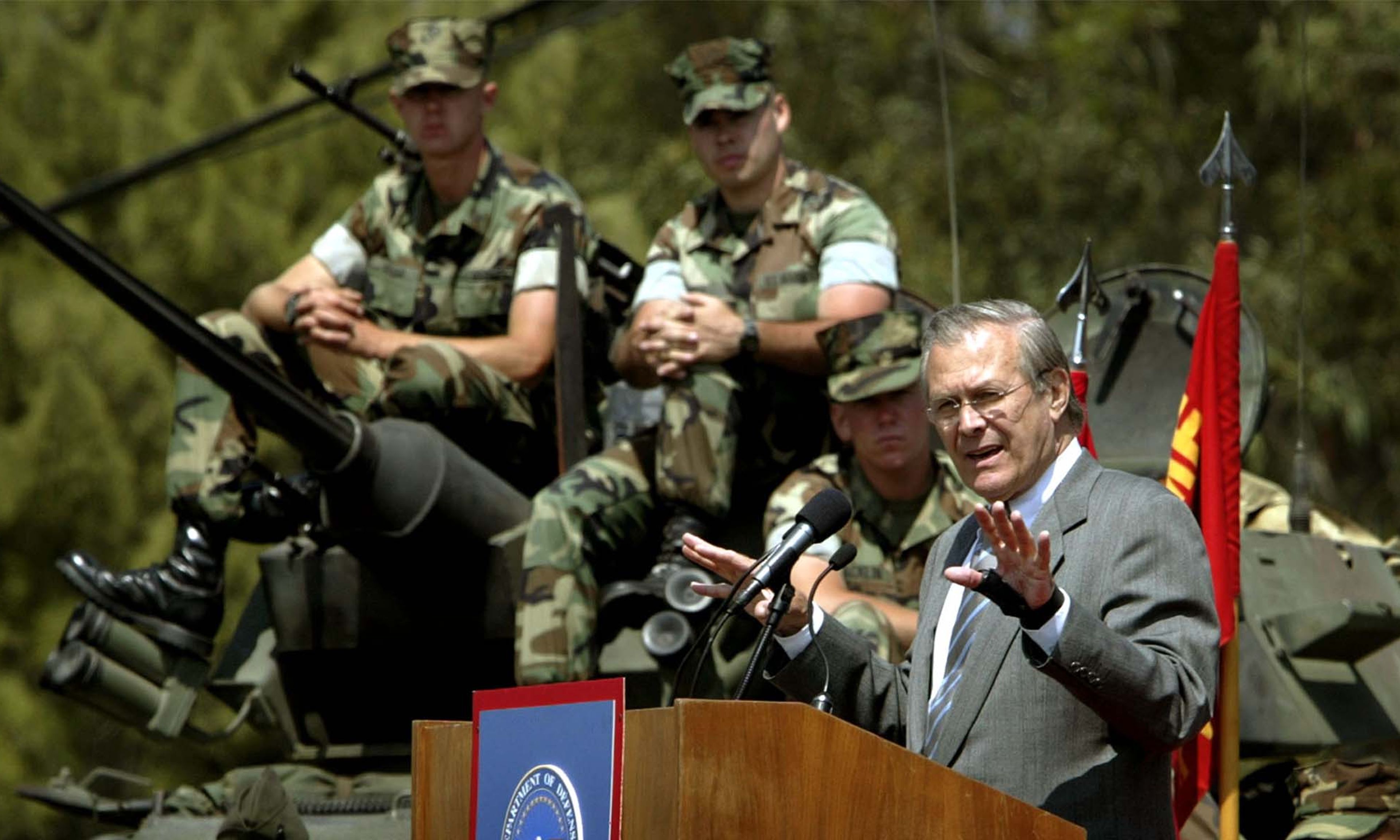
Phil McCombs made a similar argument in the Washington Post, where he celebrated the victorious “comeback of the alpha male” by describing who qualified for the title. “Real men,” “hairy-chested guys,” and “Cheney and Wolfowitz” stood on one side of the ledger; on the other stood “shaved-and-waxed male bimbos,” “touchy-feely sensitive males,” and “Hans Blix.” In a similar fashion, Max Boot hailed the replacement of Iraq proconsul Jay Garner with the calamitous Paul Bremer on the grounds that the former was “soft-spoken” and the latter “tough-talking.” No one was a tougher talker than Donald Rumsfeld. Midge Decter in her hagiographic 2003 biography of Rumsfeld attributed the septuagenarian’s leadership success to one trait: “manliness.”
Confounded by the relativism of American society, emasculated by American office life, and forced to play partisan hardball in a world where politics did not much matter, the American Right began this century adrift. Conservatives yearned for something — anything — that would ground their politics and their manhood in something more meaningful than the stock ticker. For a brief, shining moment it felt as if the Manichaean stakes of the War on Terror might provide that grounding. Here was an escape hatch from unwelcome modernity. Little wonder so few of us slowed down to ponder where that hatch might open up to.
If we look at the Iraq War as the young rightists do, as a project conceived in secret by a cabal of neoconservative officials hell-bent on promoting democracy abroad whatever the costs, then the conflict’s historical lessons are obvious and have largely been realized. But if we see the invasion of Iraq through a different lens, the lens of civilizational stakes, vitalist drives, and a class of enervated urbanites who yearn to restore meaning and manhood through heroic state action — well, then it is not clear to me we have learned any lessons from our experience in Iraq after all.











Comments