Those with memories of the early 1990s in the United States likely recall the era at least somewhat fondly. With renewed political and cultural confidence, America had vanquished Soviet Communism and stood unchallenged on the world stage. The economy had emerged from its stagflation miasma. Faith in institutions seemed strong. “It should have been a moment of triumph,” John Ganz writes in his new book, When the Clock Broke.
It would be simplistic to reduce Ganz’s thesis to: It wasn’t. That is part of it, certainly. But Ganz makes a far more interesting and challenging argument. On Unpopular Front, his must-read Substack, Ganz, a man of the Left, writes with accessible erudition about both fascism in the early 20th century and the fringe Right of the late 20th and early 21st centuries. When the Clock Broke attempts to bridge these two subjects by casting the discontents and turbulence that lurked beneath the surface of American life — and sometimes noxiously belched into full view — during the early 1990s as signs of “a crisis of hegemony” (in the phrase of Italian Marxist thinker Antonio Gramsci) for a political order that, as in Europe in the 1920s, was inadequate to the moment. Agents of reaction took advantage of (and fomented) the chaos in ways we are still dealing with today.
The bulk of the book is set in 1992, with the presidential election as a through line. The story that Ganz tells of “a period whose significance hasn’t been fully understood” is also a “history of the losers” who sought, in their dissatisfaction with the emerging politics of the post–Cold War era, “to recast American democracy around the ‘negative solidarity’ of knowing who you hated or wanted to destroy.” They were purveyors of a “politics of national despair.”
It is a concept Ganz credits (in a foot‑note) to historian Fritz Stern’s The Politics of Cultural Despair, an account of the pre-Nazi German Right. Stern focuses on figures he describes as “disinherited conservatives, who had nothing to conserve” and therefore “aspired to destroy the despised present in order to recapture an idealized past in an imaginary future” and to “smash the whole machinery of modern culture.” Stern’s perspective and Ganz’s both map imperfectly onto American politics of this or (one hopes) any era. And Ganz’s book has other faults. But his story is well researched and skillfully told; conservatives ought to reckon with his arguments even if we might disagree with many of them. Vergil-like, Ganz guides us through some of the period’s most dramatic episodes: the Gulf War, the L.A. riots, the Gotti trial, Ruby Ridge. (If he occasionally displays a passionate historian’s tendency for niche digressions, they are at least informative and entertaining enough to be indulged.) But his account is not entirely event-driven. He surveys social trends, such as the rise of divorce, crime, and anomie. His characterizations of the emerging culture are sweeping and thought-provoking. Consider, for example, the contrast he draws between the public-facing, therapeutic world of daytime television and the medium of talk radio:
The shows presented two different models of the republic: on TV, a town square packed with a small but vocal and engaged public; on the radio, a far-flung empire peopled with autonomous, equal citizens, each with a sense of his own right to be heard and redressed. Women were from Athens; men were from Rome.
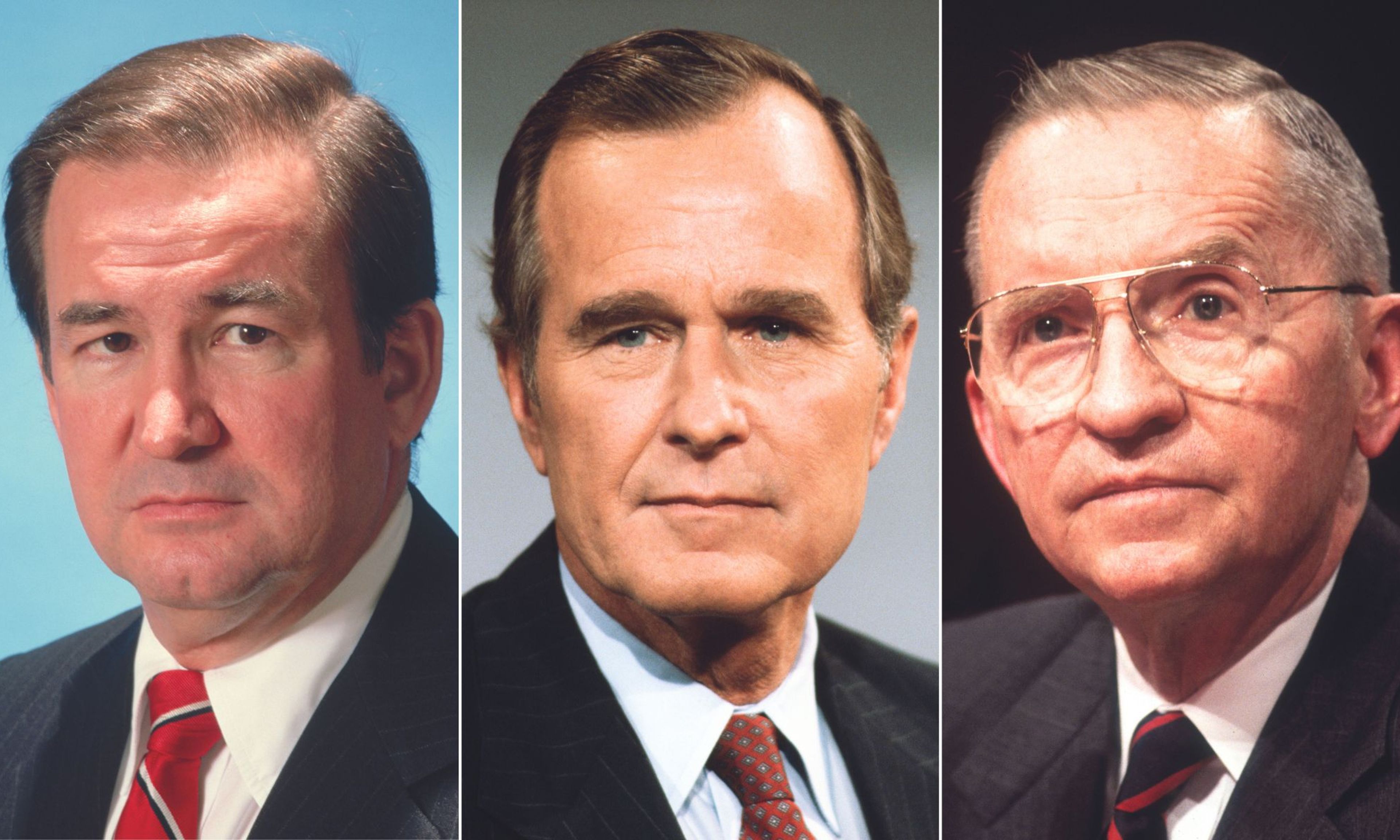
He is a skillful character portraitist as well, bringing the bumbling George H. W. Bush, the eccentric martinet egomaniac H. Ross Perot, the telegenic Beltway insider Pat Buchanan, and others vividly to life. The wild politics of Louisiana are a particularly rich vein. He applies a description of neo-Nazi David Duke’s book of sex tips (yes, he wrote one) — that it was “too hard-core for the right wing and too soft-core for the perverts” — to Duke himself. And of Edwin Edwards, Duke’s ethically challenged (and ultimately victorious) opponent in the state’s 1991 gubernatorial election, Ganz writes that he “may have laissez-ed a little too bon of a temps.”
Ganz has an agenda beyond often witty and entertaining narrative history, though: to figure out how, in his view, “elements that were still inchoate in the period of this book” eventually crystallized in the person of Donald Trump, and how “the politics of national despair . . . have now taken hold of the Republican Party.” In this, Ganz resembles others on the left who have looked to America’s past for clues as to how we “got” Trump. Ganz outdoes them in important ways. In favorable contrast to Nicole Hemmer’s Partisans: The Conservative Revolutionaries Who Remade American Politics in the 1990s, he does not simply recount the activities of certain figures on the right in the ’90s with zoological contempt but attempts to understand their character and ideas. Occasionally, in contrast to Stern’s advice, he over-relies on materialist explanations for social trends and individual behavior. Fortunately, he does not ignore the “cultural, spiritual, and psychic factors” that, Stern stressed, a historian must investigate. Even more fortunately, given the book’s focus on the era’s rudderless post-Reagan conservative movement, Ganz speaks conservatism at least passably, at times even fluently. He correctly identifies the “churning elite conflict” and “bitter factional warfare” over Reagan-era spoils. Ganz’s picture in this regard is quite similar to Matthew Continetti’s description, in The Right: The Hundred-Year War for American Conservatism, of the early-’90s “conservative institutional and media superstructure” created in the Reagan-Bush years.
As Ganz’s account makes clear, Reagan’s departure from the political scene, and the inadequate leadership of George H. W. Bush, left the Right hostage to a steady succession of unstable leaders and dubious causes. The accretion of institutional heft in D.C. had its benefits for conservatism. But it also proved corrupting and helped divorce the Right from those on whose behalf it ought to speak. And a failure on the part of conservative elites to fully appreciate the importance of national identity and other forms of positive solidarity (families, associations, localities) contributed to their atrophying.
Two figures on the fringes of the conservative movement loom large in Ganz’s study. One is the libertarian Murray Rothbard. An antagonist of this magazine (which he believed may have been “in essence a CIA operation”), Rothbard sought common cause with the Left against the Vietnam War, advocated the privatization of lighthouses, and was ejected from the Cato Institute despite his co-founding it. By the early ’90s, he had found allies among other castoffs on the right by promoting a strategy of populist onslaught, led by a charismatic leader, against existing institutions; at the time, he had Pat Buchanan in mind. Rothbard delighted a crowd of allies that he addressed (they were “ready to storm the capital,” one attendee reported) in the 1992 speech that gives Ganz’s book its title: “We shall break the clock of social democracy. We shall break the clock of the Great Society. We shall break the clock of the welfare state. We shall break the clock of the New Deal. . . . We shall repeal the 20th century.”
The other figure is Samuel T. Francis. A portly creature (a friend described him as “alarmingly well-fed”) of the conservative movement — he worked in a Senate office, for the Heritage Foundation, and as a columnist for the Washington Times — Francis came to hold it in contempt, deeming its institutional grandees “beautiful losers.” He instead articulated a kind of right-wing Marxism, purportedly influenced by former National Review editor James Burnham. It would eschew incremental political action through established political channels in favor of activating the grievances of people he called “Middle American radicals,” who were outside centers of power, as a kind of modern proletariat. Ganz gives plenty of evidence that mobilizing this proletariat, as Francis conceived of it, would depend on appeals to racial animus, something that became more obvious as Francis moved further to the fringe. Since elements of today’s Right are heralding Francis as a kind of prophet of Trumpism, Ganz studies him closely, almost obsessively.
But Ganz’s analysis of Francis, while useful and often insightful, is flawed in a revealing way. He describes one Francis column as “copping to the fact that liberals were ‘dead right’ about their belief that ‘David Duke represents the logical culmination of the conservative resurgence of Ronald Reagan.’” Francis’s racialist obsessions make it clear why he would want to believe this. But to the extent that Ganz agrees with him — as he sometimes seems to — it hampers his understanding of conservatism.
It is not the only instance of Ganz’s limitations. The thesis of his book depends on understanding Reagan’s presidency as a “failure.” He argues that America “has always been a nation enchained by great inequalities and ruled by an unrepresentative system designed largely to keep those chains in place.” (Stern, for his part, lumped National Review in with McCarthyism and Poujadism as proof that the “conservative revolution” out of which Nazism emerged is not dead.) Ganz also seems unwilling to describe how the Left may have invited some kind of response from the Right. Consider, for example, his dismissive assessment that the spate of conservative critiques of academia in the late 1980s and early 1990s (such as Allan Bloom’s The Closing of the American Mind) were merely media “bait” intended to spur “sensational coverage of the P.C. ‘controversy’ on campuses.”
Ganz gives hints here and there of understanding important distinctions in conservative thought: He favors Russell Kirk’s charge (borrowed from T. S. Eliot) to “redeem the time” against Rothbard’s exhortation to “break the clock,” and Harry Jaffa’s praise of the Union cause over Pat Buchanan’s Confederate sympathy. But snatches of true insight are outweighed by, for example, Ganz’s supplying such figures as Jerry Brown and Harris Wofford as “more hopeful alternatives” to his chosen villains of the era. This Vergil can take us only so far.
With an incomplete understanding of conservatism and of the tradition that it defends, Ganz is left without much to offer in place of or against Trump. I surely don’t need to tell Ganz that the kind of extra-constitutional, tit-for-tat partisan combat we have lately witnessed benefits only the extremes of a nation’s polity.
Ganz would no doubt scoff at the assertion that Trump, at his best, advanced America’s constitutional order. But he might consider that the preservation and restoration of that order is America’s best hope against any aspiring strongman. It is the unique power of the American founding and its principles that have allowed us to guard against and defeat infernos of the type that engulfed the Continent. Until or unless Ganz and others like him realize this, conservatives will be alone in attempting the urgently necessary “rediscovery of America,” as Continetti calls it in The Right. If we fail, we’ll likely face an era far worse than the 1990s.












Comments