Revolutions begin with mutual discovery of the ideologues and the Jacobins: the first happy to have come upon compatible souls, the second to have found dupes.
On accession to power, the ideologues become apparatchiks, thrilled with their ability to control events. This brief phase culminates with their murder by their former partners.
The ideologues, in their brief illusion of authority, are happy to invent new names for themselves (Citizen, Comrade), and for every other thing under the sun (his-her-ze-they-them); they are let free to run through the big-box store of culture, effacing and changing the labels, that is, controlling speech.
The penalty for opposition, as we see, rises almost on the instant. First as the expression of opinion is characterized as dissent, then calumniated, and dissent (now called “aggression”) is re-identified as lack of active assent.
Those seeking to avoid, first, discord, then censure and the loss of income, find, quickly, they have nowhere to hide and must choose active endorsement of ideas repulsive to them, or blacklisting.
After the inevitable Night of the Long Knives, the threat of blacklisting is upgraded to that of imprisonment or death.
These are the lessons of History, which is to say, they are the record of one of the functions of human nature: to guide the individual to power. The urge is checked by the benefits of religion (and, so, morality); by the benefits of a constitutional state: the freedom to strive therein, guaranteed by law; and by the reasonable fear of punishment for its transgression.
Absent the individual’s subscription to these, we have that anarchy which, we see even now, leads to the normalization of crime. What is more delightful to the weak human soul than the prospect of criminal indulgence not only allowed but endorsed? Here the human sex-trafficking of Epstein Island and the rioters’ destruction of the cities share Hitler’s stunned joy at the taking of France: Nobody’s going to stop me.
We human beings are a bad lot. Unchecked we divide into predators and food.
We know the checks of honor, of morality, of family loyalty, of the fear of punishment. Civilizations are kept in order (for good or ill) by the carrot and the stick.
Our crowned good, in America, was the rewards of life, liberty, and the pursuit of happiness. But what of the death wish? What of our envy for those better-off, impelling us to amalgamate in search of companionship or camouflage, in fear of the night? In associations’ benign form, we have the sewing circle and the bowling league; progressed into anarchy, associations, we find, occupy, and, then: the carmagnole and the guillotine.
Each knows himself to be evil — to have done evil, or to have evil thoughts and, perhaps, plans. Mob mentality deals with our self-hate by blaming it on others: racists, Israelis, “haters.”
Religion deals with unwelcome self-knowledge by offering confession, consolation, and prayer. Healthy culture addresses the condition with art. Great paintings and music can inspire, suggest, soothe, thrill, but they cannot teach. Neither can the theater.
The arts exist, as does religion, to touch those portions of the human soul beyond the corruption of consciousness.
We all know our consciousness is corrupt, and a long life, examined, brings the burden of regret, shame, and, indeed, horror at our own actions, which, at times, becomes scarcely bearable.
The theater, and tragedy particularly, offers a median between outright confession and conscious, rational (which is to say, flawed, or, at least, untrustworthy) understanding.
The tragedy, like the story around the campfire, and just like the joke, frees us from rational consideration: Listening, we are transported into another world. And “once upon a time,” just like “there were these two guys,” not only reassures, but instantly bypasses our necessary quotidian concerns for our own position, well-being, and self-image.
In hearing these mystic incantations we relax, as we know the story is not going to be about us. Should we suspect, in our unprotected state, that we are actually listening to a cautionary tale (that is to say, to an advertisement), the spell is broken, and we bring (and must bring) our self-protective capacities to bear.
Here we are like the radio listener when the host, describing the humiliation of some public figure, segues unannounced into a commercial for Internet-image protection.
And we thought we were getting a bedtime story.
The bedtime story exists to address the child’s fear of the night, and his understanding of his own frailty. He is not called upon to face it, and to deal with it through reason (“There are no such things as monsters”), but he is soothed by a mechanism bypassing his frail consciousness, and his equally frail capacity to be soothed by the same. Which frailty the child shares with us all.
To address his fears by saying, “So remember, never be changed into a wolf,” is to make the same error as putting on plays with a “message.” These are a terrible misuse of the theatrical moment.
As free speech disappears like Jimmy Hoffa, producers, and the theatergoers, are left with fear. Not only has the mechanism for its relief been suppressed, the art form has been pressed into service of the repressive mechanism.
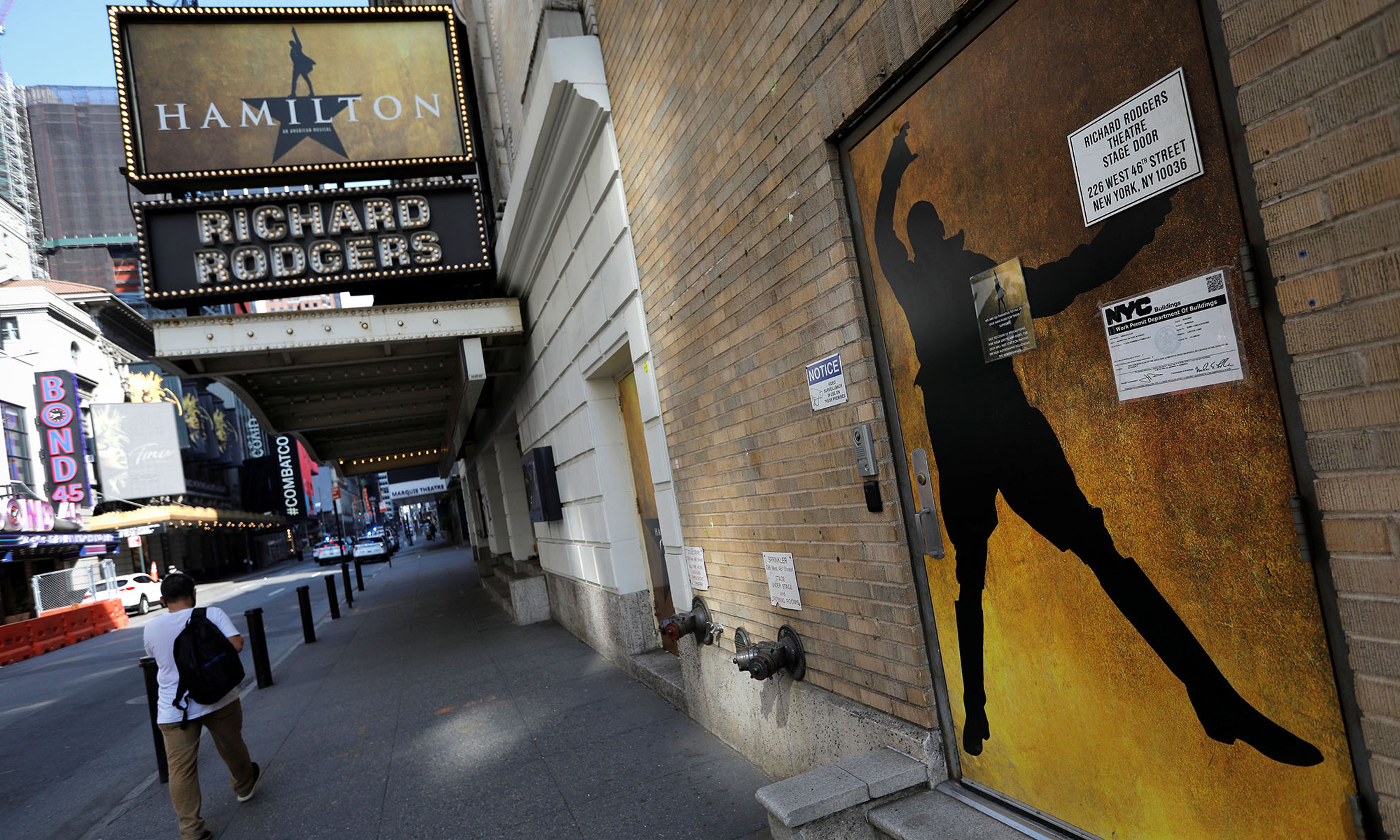
The theater has long been turning, and, now, on its (potential) revival, will be found to have turned into an arena for the proclamation of right-thinking. The proclamation, that is, of the reign of the goddess Reason, that is, mob rule.
We have seen, on Broadway, the usual forms of comedy, drama, and tragedy supplanted by the pageant. A pageant is a celebration of human accomplishment, intelligence, grace, or luck — finally of human power over nature or circumstance. It exists to celebrate a person (the birth of Galileo), a place (the founding of Des Moines), or an idea (National Agriculture Week, the Nuremberg rally). It is a perfectly reasonable excuse for a performance and addresses our need for togetherness, as did the Women’s March. But it is the opposite of the drama. We attend to applaud the notion presented in the pageant’s title. We will not and cannot experience either those emotions or, then, that catharsis for which the theater has always existed. We will not leave the pageant cleansed, calmed, surprised, laughing, weeping, thoughtful, or disturbed.
And we will not leave having had the burden of our consciousness, momentarily, laid aside.
We know that who rises refreshed from his prayers, his prayers have been answered. Our prayers have, similarly, been answered in leaving the magnificent ballet, concert, or, indeed, the football game: Our burden had been lifted for a time. But the pageant answers not our prayers, but the prayers of others.
They, for good or ill, for whatever reason, civic pride, the hope of gain, the quest for adherents, have staged what is, finally, a demonstration. The pageant has long supplanted the drama on Broadway, for the reasons following. Seventy-five percent of the Broadway audience are tourists. They come, legitimately, seeking an experience. They come to Broadway exactly as they come to Disneyland. As in that happiest place, they do not come to risk their hard-earned cash on a problematic event. They might not like the new play; they might just want a break after a day of shopping. But no one need doubt that the teacup ride will function as advertised.
The knowledgeable Broadway audience, from the days of Odets, Miller, Williams, et cetera, are long in their graves and their grandchildren basking in Scottsdale. The middle-class New Yorkers (and the working class) supported the growth of the American drama. The tourist is not paying to do so, any more than he would pay to go to an amusement park with thought-provoking roller coasters.
Most plays are no damned good.
The only way to write a play is to write a lot of plays. One learns through putting it on in the garage, in the storefront, off-Broadway, et cetera, trying and failing in front of a paying audience. There is no other way to learn how to write a play.
Off-Broadway, off-off-Broadway are no more. The regional theaters have long devoted themselves to: developing a subscribership, “outreach,” “social consciousness,” and other means of destroying the possibility of attracting actual, ardent audiences.
No one says to his or her spouse, “Look online and see if there are any plays supporting the notion that fill in the blank are people, too.” Or, “Get dressed, because though you wanted to stay home and have a beer, it is the third Tuesday in the month, and we have to go use our subscription tickets to see such a play.”
(By the way, what greater pleasure than recognizing, of whatever event, that one is, at the moment, happier at home, and the tickets, whatever they cost, can go hang?)
Finally, to write a good play requires talent. There is not a lot of it around. And it was, I believe, Milton Friedman who, stunningly, said that the free market must exist to entice the able to reveal their abilities.
If one has no possibility, in the theater, of doing anything but staging platitudes, the talentless will (and do) step up; but the inspired have no reason to do so. The reward of the talented is unfettered creation.
The painter or composer may work in solitude. The creation of the dramatist is complete only with the addition of an audience. He is writing for them; and to create, in them, a transformative experience (the laugh, the gasp, dead intent silence, or tears) is the greatest of thrills.
The hack is unaware of the existence of talent. He may happily take his pointless facility to producers happy to put on a show of no more actual worth than the monochrome canvases beloved of museum curators.
The New York Times, our newspaper of record, and the liberal media, in conjunction with the schools and colleges, insist that nothing shall be said or staged that does not express “right-thinking,” that is, statism.
Outreach, education, diversity, and so on are tools of indoctrination. So, for example, are Marine bootcamp and the bar mitzvah.
But art is the connection between inspiration and the soul of the observer. This insistence on art as indoctrination is obscenity, denying and indicting the possibility of human connection to truths superior to human understanding, that is, to God.












Comments