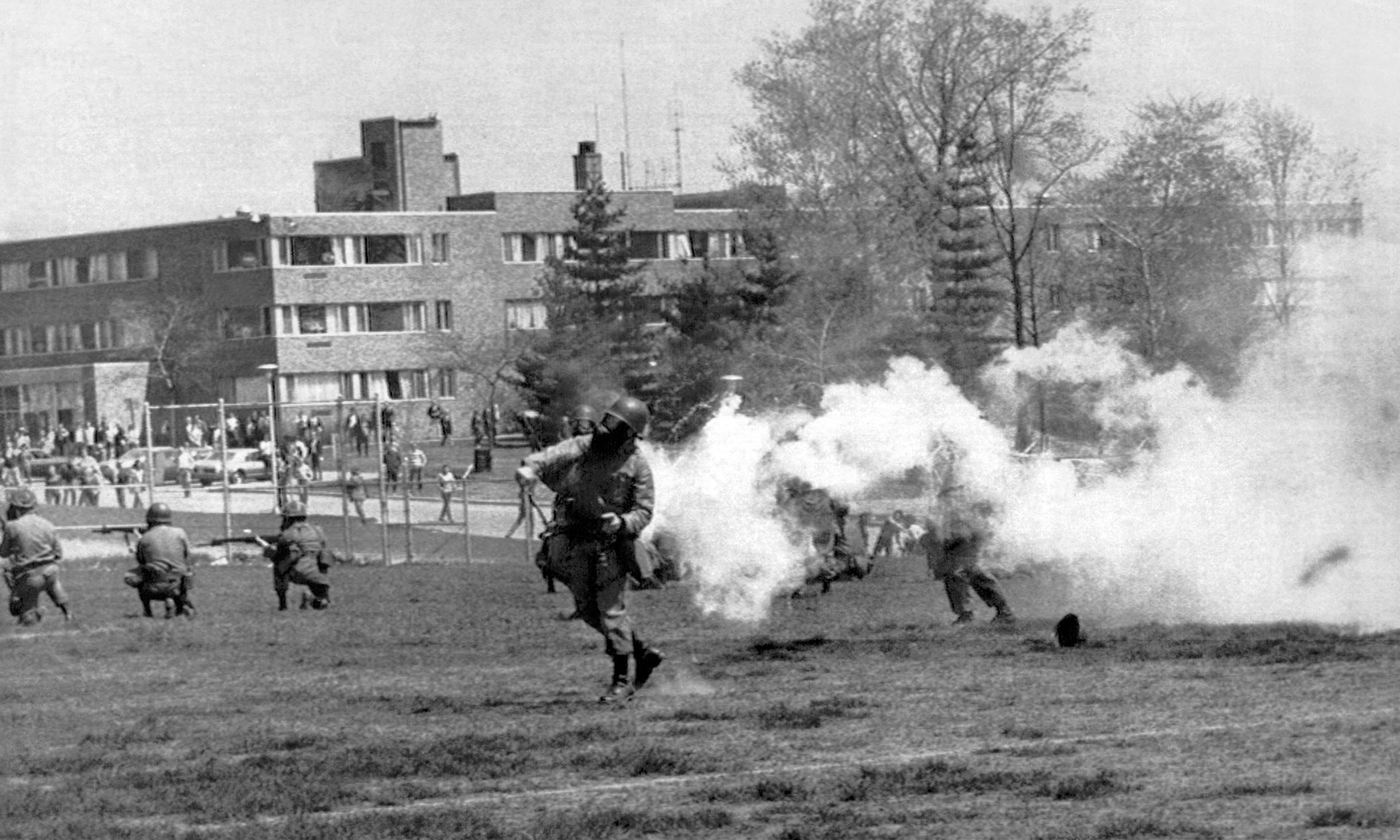
Many books have been written about the May 4, 1970, shootings of Kent State students by the Ohio Army National Guard. Students had gathered to oppose President Richard Nixon’s April 30 expansion of the Vietnam War into Cambodia. As the confrontation with the Guard intensified, four unarmed students were killed and nine wounded, one paralyzed from the waist down. Nixon’s decision and the subsequent shootings set off the largest student-protest movement in American history, shutting down campuses across the nation. A book by the popular novelist James Michener, Kent State: What Happened and Why, was published just a year later. Michener concluded that “the Guard was in no mortal danger at the time of the firing. . . . No student performed any act on May 4 for which he deserved to be shot.” In September 1970, the Scranton Commission, set up by Nixon to study widespread protests and violence on college campuses, had come to the same conclusion. Quoting the Justice Department’s summary of the FBI investigation, the commission found that the shootings were “indiscriminate, . . . unnecessary, unwarranted and inexcusable.” The guardsmen were not in serious danger; no student was closer to them than 20 yards.
In Michener’s judgment, the shootings were “an accident, deplorable and tragic.” Sadly, many Americans, including J. Edgar Hoover, thought the protesters “got what they deserved.” Vile letters were sent to the parents of slain students. At that point in the long saga of U.S. intervention in Vietnam, most Americans were convinced the war was a mistake; the only thing they disliked more were anti-war protesters and the counterculture they seemed to represent. Nixon’s 1972 electoral landslide should have brought home that fact, even to the most fervent opponents of Nixon’s “peace with honor” strategy.
Now, more than 50 years after Kent State, U.S. Naval Academy historian Brian VanDeMark has investigated the shootings again and in noteworthy detail. VanDeMark is a co-author of former secretary of defense Robert McNamara’s Vietnam memoir, In Retrospect, as well as the author of two other books on the war in Vietnam. In Kent State: An American Tragedy, he is willing to apportion blame. The last thing authorities should do, VanDeMark argues, is send the National Guard to confront unarmed protesters. At Kent State, Ohio National Guard brigadier general Robert Canterbury was especially culpable for “gross negligence” and “denial of command responsibility.” Ohio governor Jim Rhodes, a strident law-and-order politician hoping to influence voters in his Republican primary for a Senate seat, was equally blameworthy for ordering the Guard onto campus. Guardsmen were experienced in confronting urban rioters, not in handling unruly student demonstrations, VanDeMark writes.
On Friday night, May 1, anti-war protests and vandalism broke out in downtown Kent. The city’s mayor requested that Rhodes send in the Guard. On Saturday night, Kent State’s ROTC building was burned down just as the troops arrived in force. Rhodes flew into Kent the next day. At a news conference, he called protesters “worse than the Brown Shirts and the Communist element,” and vowed to “eradicate” the problem, not “treat the symptoms.” Nine hundred Guardsmen in jeeps and armored vehicles, armed with M1 rifles and reinforced by Ohio State Highway Patrol helicopters, occupied the campus and town. Rhodes ordered Canterbury to “use whatever force necessary to break up a protest on campus.” What began as demonstrations against the invasion of Cambodia became outrage over the Guard’s takeover of the campus, VanDeMark writes.
Late on Monday morning, May 4, the Guard confronted a crowd of roughly 300 protesters who heckled the soldiers on the campus commons. Rocks and even bags of feces were thrown at the troops. Several thousand curious student onlookers soon lingered nearby. Tear gas was deployed but failed to disperse the crowd. Canterbury ordered his troops to break up the protest. Soldiers advanced with loaded rifles and fixed bayonets but also wearing gas masks, which limited vision and increased the soldiers’ confusion and fear. The students were driven from the commons to a parking lot near several classroom buildings and dorms. In this maneuver, some guardsmen found themselves isolated on a nearby football-practice field. Pursued up a hill by a small number of rock-throwing students, the guardsmen stopped, turned, kneeled, and aimed their weapons at protesters, ostensibly to frighten them. Proceeding farther up the hill, the guardsmen stopped again, turned in unison, kneeled, and leveled their weapons. This time they fired 67 shots in 13 seconds. Those hit by the high-velocity rounds were from 20 to 250 yards away. Of the four students killed, two were mere onlookers.
Even after the shootings, with the dying and wounded in desperate need of medical care and chaos engulfing the campus, Canterbury was prepared to send troops back into the fray. VanDeMark writes that further bloodshed was avoided by the arrival of the Ohio State Highway Patrol, who were experienced in handling protests in a less confrontational manner.
Investigations by federal and state law enforcement, two criminal trials, and several civil suits failed to determine who, if anyone, gave an order to fire, or to hold any guardsman accountable. How serious was the threat posed by the protesters? “We have some reason to believe,” the FBI reported, “that the claim by the National Guard that their lives were endangered by the students was fabricated subsequent to the events.” No soldier, in fact, suffered any life-threatening injury.
VanDeMark acknowledges the FBI’s report. However, he emphasizes how politically tumultuous and violent the late 1960s were, the chaotic situation at Kent State, how frightened and exhausted the guardsmen were, the vulgar belligerence of many protesters, and, crucially, how badly the soldiers were led by Canterbury. Those facts have been noted in other accounts. What sets this book apart is the confession made to VanDeMark in 2020 by retired Ohio National Guard sergeant Michael McManus. When he saw fellow guardsmen kneeling in unison and leveling their weapons “almost like dominos” the second time, McManus instinctively knew something horrible was about to happen. To prevent the carnage, he ran toward the line of soldiers shouting, “Get the weapons up! Get them up!” Placing his shotgun on his hip “pointing directly up” he yelled, “Fire one round in the air! Fire in the air.” He then fired his shotgun. It is McManus’s contention that by firing the first shot in an effort to prevent bloodshed, he unintentionally set off the deadly volley. VanDeMark presents a raft of testimony, drawn from myriad sources, that seems to corroborate McManus’s story.
McManus’s sincerity and VanDeMark’s intentions need not be doubted. McManus comes across as a sympathetic figure. Still, as VanDeMark acknowledges, McManus had previously lied or distorted the truth to avoid responsibility and legal consequences. In court, he testified that he fired his weapon only after the shooting started. Despite his desire to set the record straight out of respect for the dead and wounded and to salve his conscience, his confession seems a bit too exculpatory. Remembering the details and timing of events that happened half a century ago, even traumatic events, is notoriously difficult. The chaos on the hill and disorder within the Guard’s ranks are a textbook example of “the fog of war.” Noise from the angry and shouting crowd was disorienting and threatening. In testimony given shortly after the shootings, a fair number of soldiers remembered that an order to fire into the air was given; others did not. VanDeMark quotes eyewitnesses who say they heard a shot or perhaps two shots fired from small-caliber weapons before the deadly M1 fusillade, seemingly confirming McManus’s story. But this all took place in seconds, making such fine distinctions suspect. Concerns about “fabricated” alibis aside, isn’t it likely that some of those quoted to corroborate McManus’s story were influenced by what others said at the time? Most of the testimony was given more than 50 years ago. More perplexing, McManus’s shot, ricocheting off a tree, wounded a protester standing 375 feet away. Presumably that is indeed what happened, but it is hard to reconcile with his claim that the gun was “pointing directly up.”
The guardsmen lowered and pointed their weapons twice. Why did they fire the second time but not the first? Perhaps they finally panicked, but there is little evidence they were in any greater danger. Some admitted to targeting specific students. The more likely reason would seem to be that a direct order to fire was given. Or perhaps in the cacophony and heat of the moment many thought they heard an order. A tape recording made by a student in a nearby dorm and discovered years later is thought by some survivors of the shootings to capture a voice issuing a direct order. VanDeMark cites recent technological assessments dismissing the recording as “unintelligible.” But isn’t it possible that both versions of events are true? Perhaps a direct order was given and McManus’s plea to “fire in the air” happened simultaneously. In short, there are too many variables, both human and evidentiary, for a sure verdict to be rendered.
As far as I can tell, Kent State: An American Tragedy is a scrupulously researched account of those awful days in May 1970. VanDeMark seems to have read everything and gone through every archive. In his retelling of events, he mixes and matches eyewitness accounts, newspaper reports and books, trial testimony, interviews he conducted, and much else. He uses testimony from different sources, sometimes given 30 or even 50 years apart, to establish the same facts. Yet eyewitness accounts can be wildly mistaken, while actions recollected after decades often take on an imaginary life of their own. For a lay reader like me — someone who was a freshman in college when the shootings happened and who joined the protests afterwards — VanDeMark’s density of quotation can be a slog. “We look for the beach,” wrote the critic Joan Acocella of an overfilled biography, “but all we see are the pebbles.” More beach, fewer pebbles would have helped this reader take the deep dive VanDeMark offers. But he can be commended for trying to establish the truth when doing so may be an impossible task.











Comments