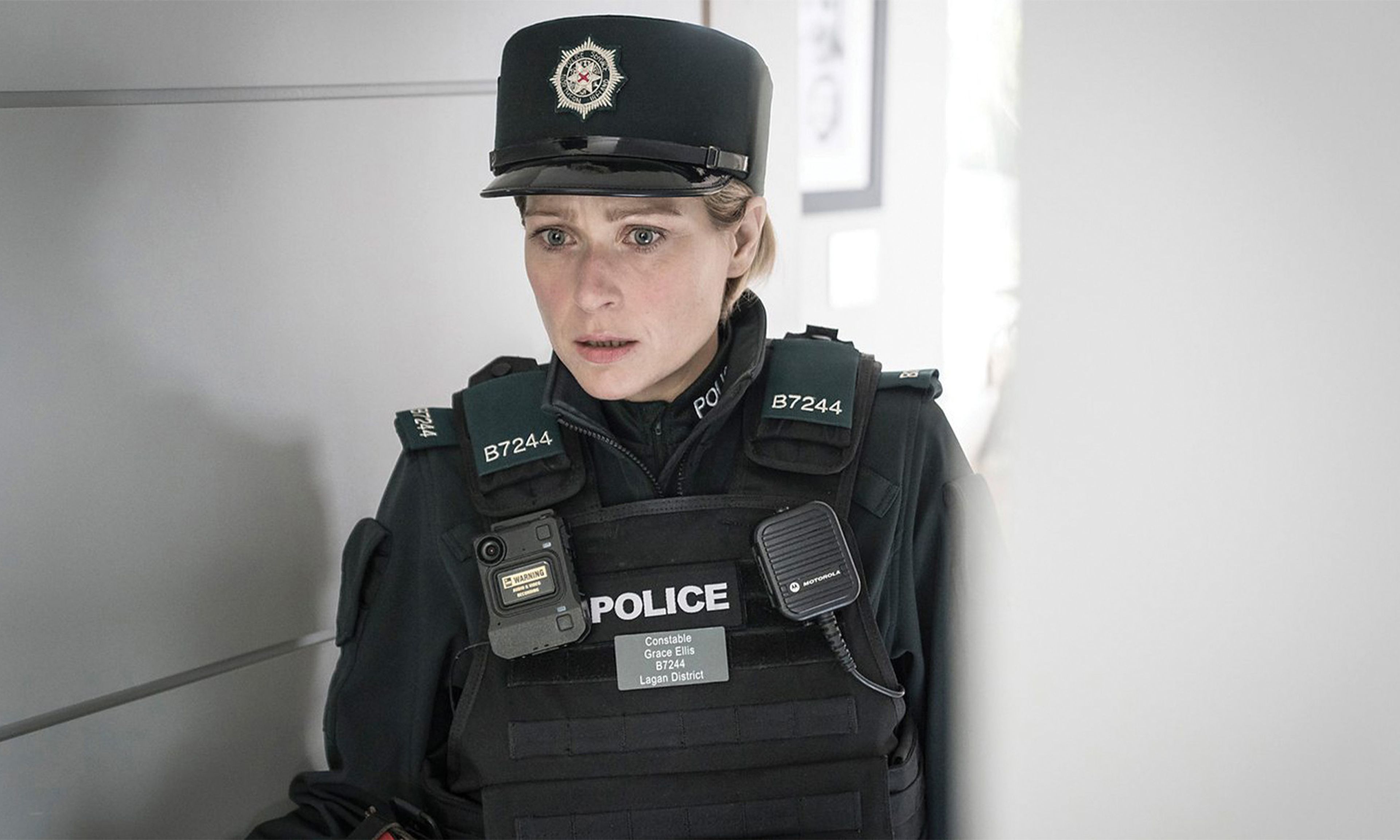
Can a 41-year-old social worker become a good cop? Louise Gallagher, a film and TV producer in Northern Ireland, pondered that question a few years ago when a friend quit her job with social services to sign on as a “probationary constable” (rookie) with the Police Service of Northern Ireland (PSNI) in Belfast. For Gallagher, a veteran of the BBC, the answer was to recruit a gifted, Belfast-born team to make Blue Lights, one of the finest series of any kind, not just police dramas, that I have seen in quite some time.
The lead character is Grace, the former social worker, played with great subtlety by Siân Brooke. Grace does not fit the Hollywood stereotype of the “strong woman” proving her worth by being more macho than the men. The skills she brings to the job are gentler, and while they fail at times, they succeed at others. If you’ll pardon the expression, Grace’s womanly approach complements the manly approach of Stevie (Martin McCann), the reticent constable she is assigned to ride with. Watching these two gradually drop their guard is one of the chief pleasures of the series, because it does not reduce the complexity of attraction to the juvenile cliché of “Will they or won’t they?”
The same avoidance of banality enlivens the rest of the cast, which includes two other probationary constables, Annie (Katherine Devlin) and Tommy (Nathan Braniff), both in their 20s and total greenhorns. Annie is paired with Jen (Hannah McClean), a constable with two years’ experience who has managed to avoid the dangers of the street, first by being the daughter of the district commander, Nicola (Andrea Irvine), and second by seducing the senior investigator, Jonty, (Jonathan Harden) into assigning her loads of desk work. Sheltered and evasive, Jen is no help to Annie, who joined on a whim but has more than enough moxie for the job of policing Blackthorn, the fictional district of Belfast where the series takes place.
Tommy is paired with Gerry (Richard Dormer), a streetwise constable in his 50s, whose path to promotion was blocked years before by his habit of telling it like it is. That habit persists, and because of it he is deeply loved by his wife Sandra (Andi Osho), a Londoner from a Nigerian-immigrant background who works as the custody officer in the Blackthorn station. Gerry is also the rare “peeler” who is respected, if not loved, throughout the district, which includes two impoverished public-housing estates: Carrick View, the predominantly Catholic setting of season one; and Mount Eden, the predominantly Protestant setting of season two.
American viewers may find it hard to tell these estates apart, because the writers do not clearly label them by religion, and many people on this side of the pond still assume that the Troubles, the quasi civil war that killed or injured about 50,000 people between 1968 and 1998, was about religion. In fact, religion is only one aspect of the long and bitter history of English attempts to conquer and colonize Gaelic Ireland.
One of the few bright spots in that history was the Good Friday Agreement of 1998, which ended the bloodiest phase of the Troubles. But in retrospect, it seems that by reinforcing the political and physical separation of Catholics (better known as republicans) and Protestants (better known as loyalists), the agreement’s power-sharing system cemented in place what journalist Mary O’Hara has called the “self-imposed apartheid” of the Troubles.
Yet the Blue Lights team seem united in their desire to portray their city in a kindlier light. It is worth noting that in the past few years there has been a rise in mixed marriages, presumably stemming from greater integration of a few schools — and more than a few workplaces. One such is the PSNI (the only armed police force in the U.K.), and a fascinating aspect of the series is how much of the interaction between the characters occurs in the mobile, neutral, occasionally becalmed space of the squad car.
As a BBC-commissioned show, Blue Lights is subject to the 2017–27 Royal Charter, which calls for programs that “accurately and authentically represent and portray the lives of the people of the United Kingdom” in order to increase “social cohesion and wellbeing.” That sentiment is echoed nicely by Dormer, the celebrated actor who plays Gerry. Born in the factory city of Portadown, where loyalist marches through republican neighborhoods sparked considerable violence in the 1990s, Dormer averred in a BBC interview that
as a nation, we survived all that we went through with a sense of humor, strength, and fortitude. . . . I didn’t take television roles for 20 years because I didn’t want to play a terrorist. . . . I [still] don’t want to play characters that remind people of the Troubles, which is why Blue Lights is a big step forward.
Yet, however much the audience may want to take that step, there are people on both sides of the Troubles whose lives are too scarred to do so. Repeating the slogan “truth and reconciliation” is one thing, living it another. In some situations, reconciliation may come more easily if the truth remains hidden. To their great credit, the creators and main writers of Blue Lights, the Belfast-born duo of Declan Lawn and Adam Patterson, do not avoid this daunting question. On the contrary, they include an impassioned argument about it in the penultimate episode of season two.
The argument is between Jen, the risk-averse constable mentioned earlier, and her mother, Nicola, the formidable district commander. By now we have seen Jen summon the courage, first to risk her life for the sake of Gerry, and second to quit the force and become a researcher for a solicitor. In that capacity, she launches an unofficial inquiry into the 1971 bombing of a loyalist fish-and-chips shop by a republican paramilitary group, in which several people were killed. It is a powerful scene between a daughter who believes sunlight is the best disinfectant and a parent who fears opening old wounds. And because it does not end with a tidy resolution, I am already looking forward to seasons three and four (recently greenlighted by the BBC).
That prospect may be equally daunting, though. The topics of race and immigration are touched on lightly in the first two seasons, but given the anti-immigrant riots that were making headlines throughout the U.K. this summer — and the seeming inability of both the British and Northern Irish governments to acknowledge that, alongside the prejudice, there are genuine grievances involved — Lawn and Patterson have their work cut out for them.
Lawn recently expressed the hope that “the ghosts of the Troubles” will eventually be banished and “some young writer a generation after us [will come] along and [write] a Curb Your Enthusiasm that has nothing to do with the Troubles.” That would be nice, but I for one would much prefer to see this superb ensemble curb their enthusiasm and get on with the job of making Blue Lights the sober classic it promises to be.











Comments