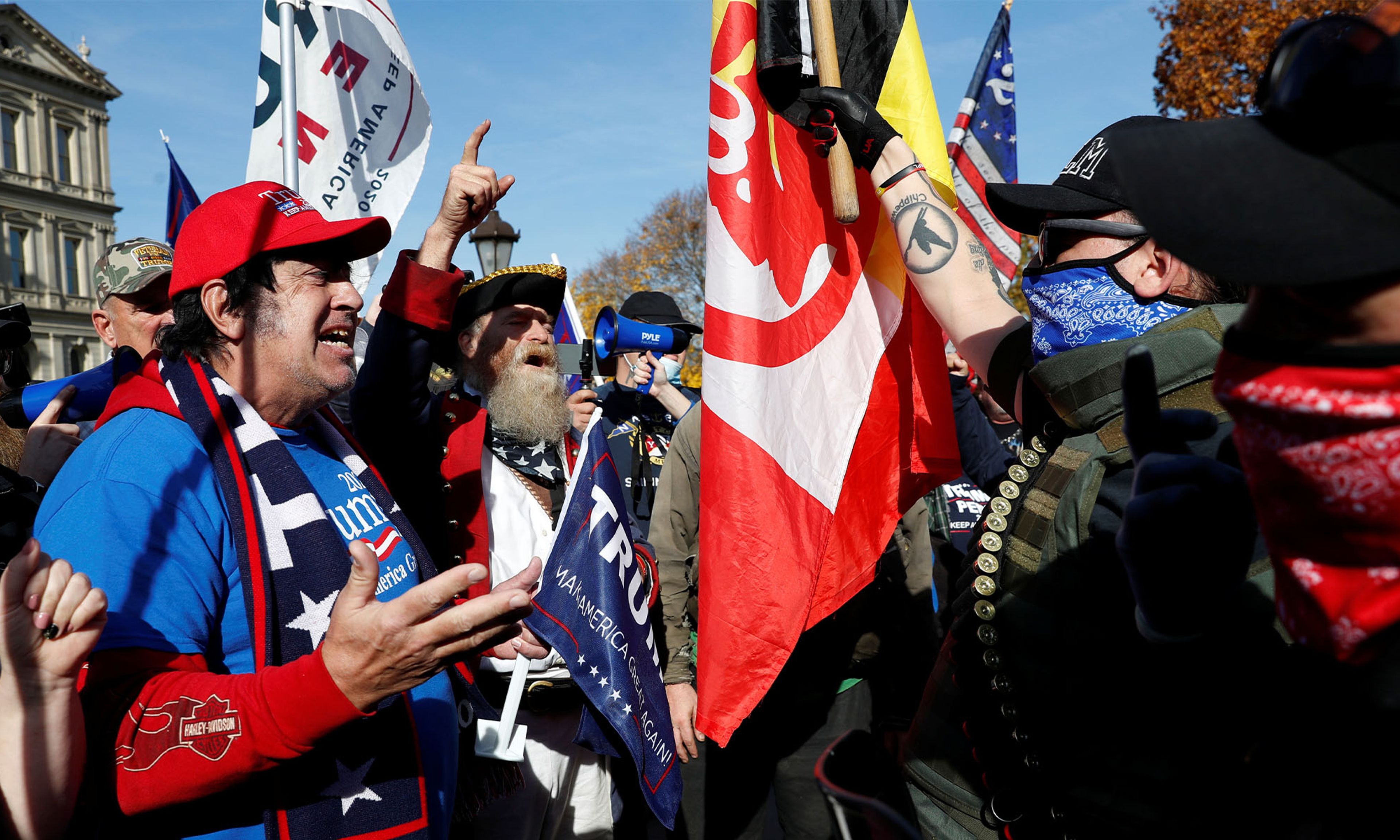
Like a captain steadying a ship in turbulent waters, moderation in Aurelian Craiutu’s judgment is necessary today to temper the heated extremes of the radical Left and radical Right in American politics. In Why Not Moderation?, Craiutu, a professor of political science at Indiana University Bloomington, furnishes a distinctive and earnest defense of this concept, framing it as a “strong and muscular virtue” in an age of political radicalism. Yet his argument leaves the reader desiring further clarity on its guiding principles.
Craiutu is quite aware of the principal objections to moderation: It lacks conviction, elevates pragmatism over principle, and flinches in the face of existential danger. Yet he persuasively argues that, far from being supine and indecisive, moderation embodies a “fighting creed” that softens the passions, recognizes the complexity of society, diffuses a spirit of compromise in a polity, and prioritizes prudence over moral-purity tests.
What is moderation in Anglo-American political practice? Liberal democracy, the rule of law, free speech, pluralism, checks and balances, and social tolerance — in a word, liberal civilization. Craiutu contends that if Americans wish to preserve the fruits of this rich liberal inheritance (some aspects of which, we should note, predate the birth of liberalism as a political identity), moderation is an indispensable political virtue and habit of mind.
One refreshing quality of Why Not Moderation? is the flavorful structure of its analysis. Writing for a general audience, Craiutu weaves into his commentary a running dialogue with two young radicals, “Rob” and “Lauren,” representing the far Right and far Left, respectively, who emit fumes of distrust toward moderation. Craiutu aspires to convince these radicals that moderation is the best course to pursue between the contemporary excesses of conservatism, exemplified in the book by Michael Anton’s article “The Flight 93 Election,” and those of progressivism, inflected by identity politics and democratic socialism. The overall picture that emerges from this conversation is a classical-liberal defense of moderation that incorporates notions of human fallibility, epistemic modesty, value pluralism, the open society, and free speech, all blended with an appreciation of the inherited achievements of liberal civilization.
Craiutu shrewdly observes throughout this discussion that the complicated texture of society often forces men and women to pick between imperfect options in political life, yielding few choices that do not generate at least some negative consequences. The political moderate — or what he calls the “radical moderate” — is therefore able to distinguish between circumstances in which there is a stark choice between good and evil (cue Hitler) and many others in which there is not. This acute sensitivity to the inherent nature of trade-offs in a political community is a vital aspect of the moderate temperament.
In one of the strongest chapters of Why Not Moderation?, Craiutu, invoking George Savile, First Marquess of Halifax, explains that “trimmers” — prudent statesmen seeking to promote the common good — strive to maintain proportion and balance in a polity by providing stability against the gusts of ideological factions. These statesmen refrain from grand theories of social experimentation, instead preferring to facilitate the causes of human well-being and justice on steady grounds through preservation and reform over time. They typically support fine-tuned adjustments to existing practices rather than wholesale destruction, like a gardener cautiously pruning an overgrown shrub by removing its damaged parts rather than ripping it out by the roots. Without trimming, there can be no moderation; and without moderation, there can be no civilization.
Yet Craiutu’s analysis requires sharper elucidation on crucial questions in order to blunt the charge, which he certainly anticipates, that moderation is hazy about its first principles and policy platform. To restore moderation in American political institutions, he recommends, among various proposals, reviving federalism and subsidiarity while bolstering the rule of law and upholding the integrity of elections. To transform young radicals into political moderates, he counsels them to read a variety of intellectually diverse news sources and engage in meaningful dialogue with political adversaries while resisting stiff-necked assertions of absolute truth (more on this later). To implement a moderate approach to political economy, he endorses a freemarket system while accommodating a disciplined welfare state.
These general suggestions are sensible enough, but they leave the reader craving deeper elaboration on the pragmatic substance of moderation. This is especially so for a book that addresses contemporary politics, since a trace of ambiguity lingers throughout the chapters that at times obscures what a moderate policy platform consistent with Craiutu’s approach would actually look like. To his point, moderation doesn’t always supply precise prescriptions to difficult political and social questions. Still, how might moderates respond substantively, if not precisely, to thorny controversies (some of which he briefly alludes to) surrounding critical race theory, pornography, gender-reassignment surgery for adolescents, abortion, and same-sex marriage?
The radical moderate might counter that such questions produce no single answer. Craiutu’s call to revive federalism and decentralization would ostensibly allow different states to enact disparate policies harmonious with the preferences of their respective populations.
This is a credible line of reasoning as well. To push further, however: If a moderate was in fact living in a state in which the legislature was debating, say, whether to ban the sale of pornographic materials or restrict access to porn websites by age, where would a moderate stand? Are there any things that for the political moderate should not be up for compromise beyond the ones Craiutu lists as characteristic of liberal democracy (and, of course, Hitler), such as the rule of law, pluralism, free speech, civil equality, the independence of the judiciary, and election integrity? Are there any universal truths that moderates can affirm beyond these important features of liberal order? Indeed, Craiutu’s emphasis on epistemic humility, while well argued and eloquent, sporadically flirts with the radical skepticism of Hayekian epistemology that conveys grave suspicion of any transcendent standards of justice and right accessible to man.
On a similar note, whereas Craiutu sprinkles references to the common good, happiness, and justice throughout his analysis, his conception of moderation leans heavily toward what we might call procedural moderation. But what about teleological moderation — that is, moderation as an expression of the substantive moral aims and ontological basis of a commonwealth? Many of the thinkers Craiutu ably cites in support of his argument located their defenses of moderation in broader religious, metaphysical, and ethical frameworks: Aristotle understood the order of the universe to derive from the unmoved mover; Cicero grounded his republicanism in the moral natural law; and Burke recognized the complexity of society and counseled imperial restraint but ultimately preferred Christian civilization. Their conceptions of moderation didn’t even include free speech as we understand it today, much less liberal democracy. What are the deeper religious, moral, and social foundations of a stable and prosperous society that moderation comprehends beyond liberal democracy and pluralism?
Additional questions arise throughout Why Not Moderation? First, the evolution of political, moral, and social mores changes what qualifies as “moderation” over time. To take a glaring example, the privatization of religion in American jurisprudence in the latter half of the 20th century may be considered a turn toward moderation according to 21st-century sensibilities — but this pattern (slightly soothed by recent Court rulings) was a sweeping departure from the general Founding-era understanding that religion should be part of the public square. Moderation, if not fastened to enduring religious, moral, or social commitments that transcend circumstance, could thus end up defending positions and stances that might actually be quite radical. Is there a limiting principle, beyond the protection of liberalism, to the idea that moderation should adapt to changing conditions, especially if those conditions drastically (if incrementally) transform the settled practices of society? This consideration is similar to the chief question conservatives have asked in recent years: What if policies seemingly neutral on their face — such as free speech and value pluralism — tend to benefit extreme progressive causes more than conservative ones? What if some aspects of moderation serve as an unintended accomplice to radicalism?
Second, although Craiutu identifies “liberal democracy” as the sine qua non of moderation, this idea was of course considered to be radical throughout most of human history on grounds antithetical to his reasoning in praise of it: It would inflame the populace, render existing political institutions unstable, and promote license over order. A more effectual term to capture the species of political moderation Craiutu endorses in practice — checks and balances, federalism, subsidiarity, and decentralization — might be “constitutional republic.” This phrase lays an even heavier accent than “liberal democracy” on the notion, which the author agrees with, that the exercise of liberty must be anchored in a constitutional foundation and that the voice of the people should be channeled through representative and deliberative institutions. Additionally, while Craiutu does not mention this quality specifically, dispassionate statesmen with long views (such as trimmers) and institutional checks on democratic majoritarianism embody an aristocratic ethos that is required to achieve the kind of political stability he rightly desires in a liberal democracy.
The final question is perhaps the most important one: Would a young radical actually be receptive to the arguments in the book? Craiutu offers a number of suggestions to embrace moderation that hinge on the sunny premise of reasoned discourse, such as participating in grassroots workshops and initiatives dedicated to rebuilding trust in democratic institutions.
Yet perhaps the ultimate source of moderation in one’s private and public conduct lies in deeper grooves and can be found by returning to Aristotle. For Aristotle, virtues of character that struck the golden mean between excess and deficiency — including temperance, courage, and liberality — developed from habits inculcated by social associations, spanning from the family to friends to the state. Drawing on this line of Aristotelian reasoning, we should expect that the person most likely to practice moderation today would be one who had been taught lessons of self-restraint, forbearance, and gratitude in the early phases of his or her social and intellectual development. Character education, I suggest (and as Craiutu briefly hints at), is crucial to nourishing the temperate orientation of the individual, much as the aforementioned aristocratic safeguards are crucial to securing the cooling restraint of moderation in a liberal democracy.
In the end, young radicals would certainly do well to read Why Not Moderation? Although it does not elaborate on the transcendent religious, metaphysical, or moral sources of moderation, and its general positions on contemporary political debates remain a touch vague, it provides a sturdy vindication of the concept as a muscular virtue. It also serves as an instructive and timely stimulus for understanding the importance of humility, prudence, and complexity in building up and conserving the delicate achievements of Western civilization from which radicals and moderates of all stripes benefit. That message alone should warrant applause, especially in an age when there remains a zealous yearning to burn shrubs to the ground rather than trim their imperfections.












Comments