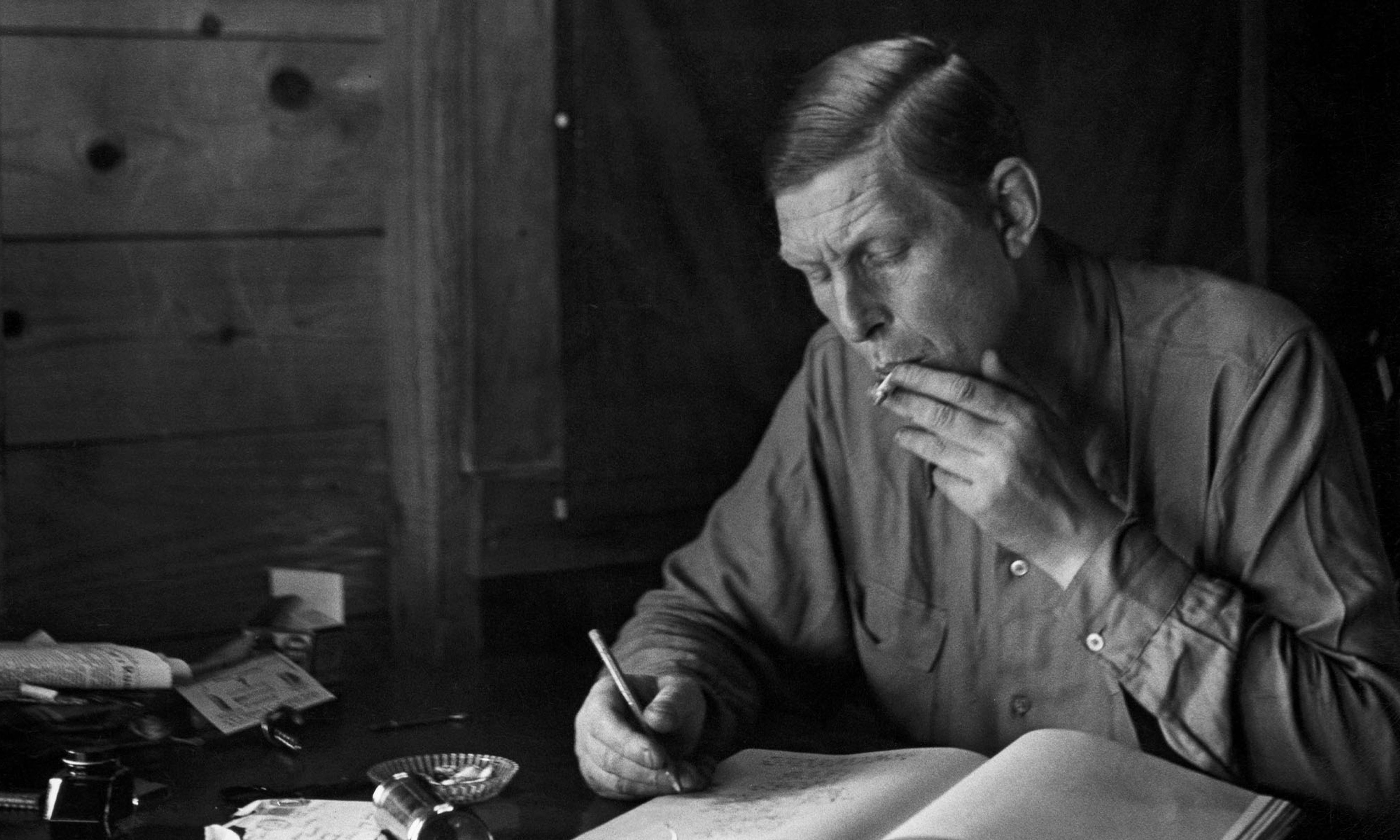
‘Poetry makes nothing happen” is remembered as W. H. Auden’s most inflaming line (and this is the man who once wrote 34 stanzas about a “day for a lay”). Hear it, however, not as a lament — though he speaks it during one — as much as a desire, a radically modest piece of self-directed advice: to write without the intention of making anything happen. That’s how he wrote during the second, American half of his life, which had just begun in 1939 when he penned that thorny line (in his elegy to W. B. Yeats), and which ended 50 years ago this September.
He wasn’t the last great American poet (if the English can claim T. S. Eliot, a son of St. Louis, then we can claim Wystan), but his was the last great American poetry. Of the major literary voices of the post-war period, his alone still cuts through the noise of the twin engines that have since principally driven much of American art: the private and the polemic. The first generated confessional poetry, which in the Fifties was a reaction to the eventfulness of the preceding decades and to the hung fire of the Cold War but has now retreated inward, into the province of personal trifle and conceit. The second induced a parallel narrowing: from the vague, adolescent activism of the Beat Generation, anti-war poetry, and the rallying hymns of the civil-rights movement to an obsession with the politics of anatomy — the sinister interest in the arrangement of the writer’s genetic matter rather than that of his sentences.
Having repudiated political attachments and never quite succeeded in keeping private ones (he had a long-standing but only briefly sexual relationship with the librettist Chester Kallman in New York, and he made a proposal of marriage — rejected — to Hannah Arendt in 1970), the aging Auden gave himself over almost ascetically to language. His best-known political poem, in the prophetic style of his youth — started on the day Germany invaded Poland in September 1939; recirculated widely after this country’s own black September, in 2001 — was arguably his last. Its best-known line, “We must love one another or die,” he decided was rubbish: Mandatory love rules out human agency. (And to so discount the concept of love is too great a sacrifice for someone in the word business to make.) Besides, he said, we must die anyway.
Auden abdicated his status as poet laureate of Labour at 32, by which time he had won the King’s Gold Medal for Poetry and a little crop of young writers (Oxbridge-educated, deeply read, and varyingly red) called the Auden Group had sprouted around him. Edward Mendelson, the executor of Auden’s literary estate and his premier editor, says that the poet tried to expunge some of his earlier works because he “distrusted their power to convince his readers that he and they were on the right side in the great struggles of the age, that they were ‘the just’ who exchanged messages through ‘ironic points of light.’” Auden became aware and wary of his control over the reader. In an anthology published in 1964, he insisted that a few of his works, including “September 1, 1939,” be reprinted with a disclaimer: “Mr W.H. Auden considers these five poems to be trash which he is ashamed to have written.”
If the crawl of the panzers sped up his disenchantment with the Marxian notion of History (purposive, progressive, unstoppable) — which, as a left-wing intellectual of another generation put it, allowed young radicals to feel as though they were strapped to the grand, unswerving locomotive of universal justice — the Holocaust shattered the spell. “The inconceivable had taken place. / Waking to find his wildest dreams outclassed / He felt his tongue must share in the disgrace,” wrote Clive James in “What Happened to Auden.” He went on,
His later manner leaves your neck-hair flat, Not standing up as Housman said it should When poetry has been achieved. For that, In old age Auden simply grew too good. A mortal fear of talking through his hat, A moral mission to be understood Precisely, made him extirpate the thrill Which, being in his gift, was his to kill.
Philip Larkin, too, thought that Auden’s vigor had been diluted in proportion to his distance from public life; that having rejected its activist character, the old master came to see poetry as frivolous and therefore produced frivolous poetry. (The “day for a lay” doggerel was published without his permission, twice. Auden could be light and flighty, but that wasn’t his cruising altitude.) And yet what kind of regard for art can be more serious than the refusal to pretend that it is anything other than art? “Secondary Epic” — his rebuke of the Aeneid’s architect, who mixed business with politics — for instance, is as lyrically spirited as anything he had written in the Twenties and Thirties. I put it to you to judge whether the later Auden sounds diminished in ability or unserious in manner:
As rhetoric your device was too clever: It lets us imagine a continuation To your Eighth Book, an interpolation, Scrawled at the side of a tattered text In a decadent script, the composition Of a down-at-heels refugee rhetorician With an empty belly, seeking employment, Cooked up in haste for the drunken enjoyment Of some blond princeling whom loot had inclined To believe that Providence had assigned To blonds the task of improving mankind. . . .
No, Virgil, no: Behind your verse so masterfully made We hear the weeping of a muse betrayed.
Or try it this way: Compare the augural “September 1, 1939” with the pithy, limpid brilliance of “August 1968” (“The Ogre does what ogres can, / Deeds quite impossible for Man, / But one prize is beyond his reach, / The Ogre cannot master Speech”). Auden’s rejection of the sermonic character of his early work didn’t extinguish his talent but redirected it towards what he felt was a higher employ: to shield language from corrosion and make the reader “more difficult to deceive”; to inoculate against propaganda rather than sweeten it. (Shakespeare’s Orpheus, who made trees and mountains “bow themselves when he did sing,” Auden would later say is the “archetype not of the poet, but of Goebbels.”) The only thing he took more seriously than language was his nondoctrinaire Anglicanism, which suffused his later work and whose charm, notice, was greatest when its presence was subtlest:
For given Man, by birth, by education, Imago Dei who forgot his station, The self-made creature who himself unmakes, The only creature ever made who fakes, With no more nature in his loving smile Than in his theories of a natural style, What but tall tales, the luck of verbal playing, Can trick his lying nature into saying That love, or truth in any serious sense, Like orthodoxy, is a reticence?
“You need not see what someone is doing to know if it is his vocation, you have only to watch his eyes,” recited Keir Starmer, the leader of the Labour Party, to flatter the working class during his 2021 party-conference speech. “How beautiful it is, that eye-on-the-object look.” (Besides Auden’s Horae Canonicae, he also invoked Fatboy Slim, so you can be sure that British progressivism has, I suppose, progressed.) But who among the luminaries of American literature now demonstrates that self-denying fidelity to language, the instrument and object of his trade? “A commitment to social justice always undergirds my poems,” says Natasha Trethewey, a recent poet laureate, and we’re sorry to hear it. Parochial vanities, whether partisan or personal, subordinate language to their narrow ends. Verse that is dictated by them cannot touch the universal: the nonnegotiable thing all lasting art must do. Language on second fiddle never makes for good music. If we can’t help ourselves, let’s do as Auden advises songbirds and leave words to our lonely betters. We must die anyway, but language needn’t.










Comments