I remember — it was years ago, when I was teaching undergraduates about the great monotheistic traditions — that I would darken the room and then ask the students to close their eyes. “Imagine the cosmos is a self-contained sphere,” I would say — roughly — and then, “imagine you are standing in the center of it.”
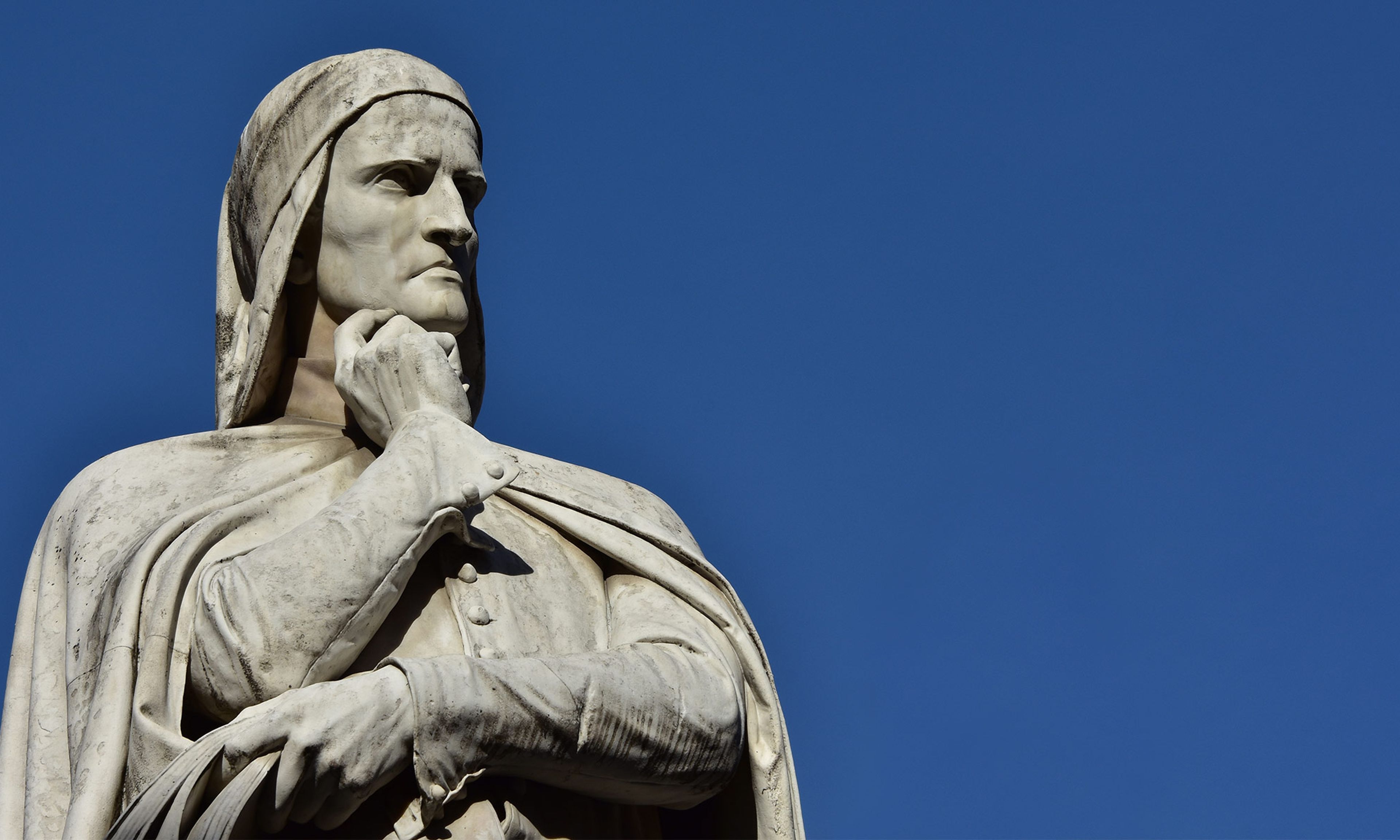
I thought of that exercise after I’d accepted the assignment to write on reading Dante Alighieri, who died 700 years ago on September 14. I suspect that the memory of the old teaching exercise occurred to me because I have been thinking a lot lately about how Dante inhabited a world very different from our own. He gave us a world of words that was the portrait of his world. We do well to remember that if — when — we attempt to read him:
Nel mezzo del cammin di nostra vita mi ritrovai per una selva oscura, ché la diritta via era smarrita.
In the middle of our life’s journey
I found myself about a dark forest,
For the right way was lost.
That’s how the Divine Comedy opens, followed by a painfully literal translation of my own making, which I offer because I want to dwell for a while with the question whether there is a life that is “ours” in any meaningful sense. Is there anything common, anything like fellowship for us in the present? What would it mean to “find oneself” in the middle of such a journey-in-company? What would it mean to tell one’s tale of travel to one’s fellows as Dante did?
The general, pretty much universally received understanding of the first line is that Dante is telling people he was halfway through his biblical allotment of three-score years and ten when he awoke to his desolation. I’ve no reason to gainsay that — I accept it — and anyway there’d be no reason for anyone to attend to my gainsaying it if I did. I’m no expert. I’m a guy who reads old books for fun, and it happens that these questions came to me and have stayed with me.
There is lots I’d like to do with those three lines and a few others, but let me first talk a little more about the teaching exercise of which I was reminded.
I would go on to trace for those students the contours of the world as the impossibly ancient peoples in the cradle of civilization would have received it and inhabited it. I’d introduce them to the great dance of heavenly spheres and the mundane riot of fecundity and the grim, gray un-life of the underworld of the dead. I would ask them to imagine a universe peopled by spirits — what we would have called gods and demons until a short while ago; and I would ask them to stay there for the rest of the semester.
The purpose of the exercise was to give my students a framework within which they could receive the stories we’d be reading precisely as stories. It was not the distillation of “world-building” story elements into propositions grossly running: “Now the ancient Hebrews believed . . .” followed by a request for them to rehearse the “similarities and differences” between the ancient Hebrews’ beliefs and their rough contemporaries’ or others’ or our own.
Frankly, belief had little to do with it. Those ancients believed in the firmament and the underworld and the spirits that trafficked among them and between them much as we believe in atoms and gravity and outer space.
There is almost no sense in which they believed those things at all, that is to say, because their world just was to them as ours just is to us.
I would take the students out on guided tours of the cosmos according to the ancient Egyptians, in which Pharaoh was Ra and Ra’s power was the power of heaven, so they could have a chance to grasp what it meant when the earthly representative of an obscure tribal desert deity met Pharaoh and — acting on orders — pitted the god of his people against Pharaoh, whose power was the power of Ra that was the power of heaven, and bested him.
It was not an entirely successful exercise, but it was fun for some of my students and certainly for me.
We receive the world we inhabit in ways very much like those in which people of any age receive the world. It’s ours — broad and mysterious, familiar as our living room — and we live in it mostly without noticing, but Dante took note of his.
Dante’s world was one in which angels and devils contended with each other for men’s souls, and saints were close companions as well as celestial allies, and there were wars and plagues and famine and strife, and the Church was a constitutive element of society, and worldly princes ate and slept and mucked about and shat and raped and murdered and built and tore down and fought and died.
It was, in other words, a political world — and in this, it bore some superficial similarity to our own — but it was political in the sense that the cosmos was a polis, a city ruled by an absolute monarch who was Himself at once infinitely distant and infinitely near; infinitely inscrutable and infinitely wise; infinitely terrible and infinitely good.
There’s lots to say about that, but I’ll save it for another time. For now, take the second line from Dante, about being lost in a dark forest. Who can’t relate to the experience of being lost, off the path, without clear sight of a way back (hence without clear sight of a way forward)? For Dante, being in the dark forest meant — whatever else it meant — being outside the city, cut off from human community, hence from the community of heaven and earth.
Dante’s world was a world of worlds mixed together, the true world of celestial Jerusalem mysteriously present and on pilgrimage in the world of history and time, in which we find and lose ourselves. Dante dramatizes the divorce of self from self — of self from the source of self and the community the source calls and gathers to itself — as the experience of being lost in the woods.
The dark forest is the place where worldliness reigns over Dante’s soul — reigns in his soul — and it is cold and acrid and filled with miserable reek. It is a place of disorientation, outside the cosmic city limits. It is a region of the soul, a place of disorder. “Death,” he says, “could hardly be more bitter than that place.”
Tant’ è amara che poco è più morte; ma per trattar del ben ch’i’ vi trovai, dirò de l’altre cose ch’i’ v’ho scorte.
“But,” he goes on to say, “in order to treat of the good, which I found there / I’ll tell of the other things that I saw there.” The world has changed since Dante gave us his in words. The trick to seeing what he wants us to see is to understand that seeing it requires us not only to learn about his world, but to inhabit our world as he inhabited his.
A way into Dante’s world — one of spirits and the dance of the heavenly spheres — and so into a new way of inhabiting our own, could be through lines from C. S. Lewis’s Voyage of the Dawn Treader, in which Ramandu — a star at rest on the edge of the world of Narnia — has this exchange with children come from another world to visit:
“The days when I was a star had ceased long before any of you knew this world, and all the constellations have changed.”
“Golly,” said Edmund under his breath. “He’s a retired star.”
“Aren’t you a star any longer?” asked Lucy.
“I am a star at rest, my daughter,” answered Ramandu. “When I set for the last time, decrepit and old beyond all that you can reckon, I was carried to this island. I am not so old now as I was then. Every morning a bird brings me a fire-berry from the valleys in the Sun, and each fire-berry takes away a little of my age. And when I have become as young as the child that was born yesterday, then I shall take my rising again (for we are at earth’s eastern rim) and once more tread the great dance.”
“In our world,” said Eustace, “a star is a huge ball of flaming gas.”
“Even in your world, my son, that is not what a star is but only what it is made of.”
If it was hard for Lewis’s original readers to ace the difference between the two questions — “What are we made of?” and “What are we?” — it is harder still for us, I think. Why that is the case admits of no pat answer.
The spirits and beasts that peopled Dante’s world are not gone from ours, but we have little commerce with them to speak of. They haunt us. Or do we, unawares, haunt a space that is theirs? There’s evidence to suggest the question haunts us.
I’m thinking of Nicole Kidman’s murdered family in The Others, but also of sci-fi tropes such as the one deployed in “The Next Phase” — episode 124 of Star Trek: The Next Generation — when a transporter mishap puts the chief engineer and a junior officer out of cosmic sync with everyone else on the (mortally imperiled) Enterprise, and they need to find a way back to each other and the ship and the crew, to whom they are dead.
Dante’s poem ends — spoiler alert — with a mystical vision involving stars in heaven and what moves them. The poet’s power of imagination fails. His desire for communion — for community — with the uncreated Power that makes and sustains him and all that is, fails as well. His desire for that desire remains, however, and a fulgor strikes his mind, and thanks to that strike his desire becomes capable of fulfillment.
The syntax of the slavishly literal translation — mine again — will be as unwieldy as Dante’s original is sublime. I hope the translation as given serves to show how Love at last is the motor of our desire and will, as it moves earth and heaven. Here are the lines:
A l’alta fantasia qui mancò possa; ma già volgeva il mio disio e ’l velle, sì come rota ch’igualmente è mossa,
l’amor che move il sole e l’altre stelle.
Here, the soaring fancy failed;
but already turned my desire and my
will,
just like a wheel is turned,
the love, which moves the sun and the
other stars.
Dante’s Comedy begins with the author lost in a dark forest, off the path, with no light by which to see. I think of a walk I took not long ago, late of an evening in New Hampshire, which took me no more than a few yards off an unlit road in the middle of a moonless night.
My light had failed, my eyes did not adjust, I could not see my hand before my face. I knew the road. I’d walked it countless thousands of times. It did not matter. I’d stepped off the way to take a shortcut home. I knew the short way, too. It did not matter. I did not see the stars above the tree cover. I imagined that I saw the eyes of beasts in the wood to my left and right — did I imagine it? — and all around me flashing lurid green and yellow, and then I spied a dim light at a hundred yards or so from where I stood, and knew it, and followed it home.
If you want to get into Dante — if you want to catch a small taste of what he’s on about — you can do worse than a reliable translation. You can do better than that, though. You can first take a walk in a wood at night when the moon is down. Bring a light with you.












Comments