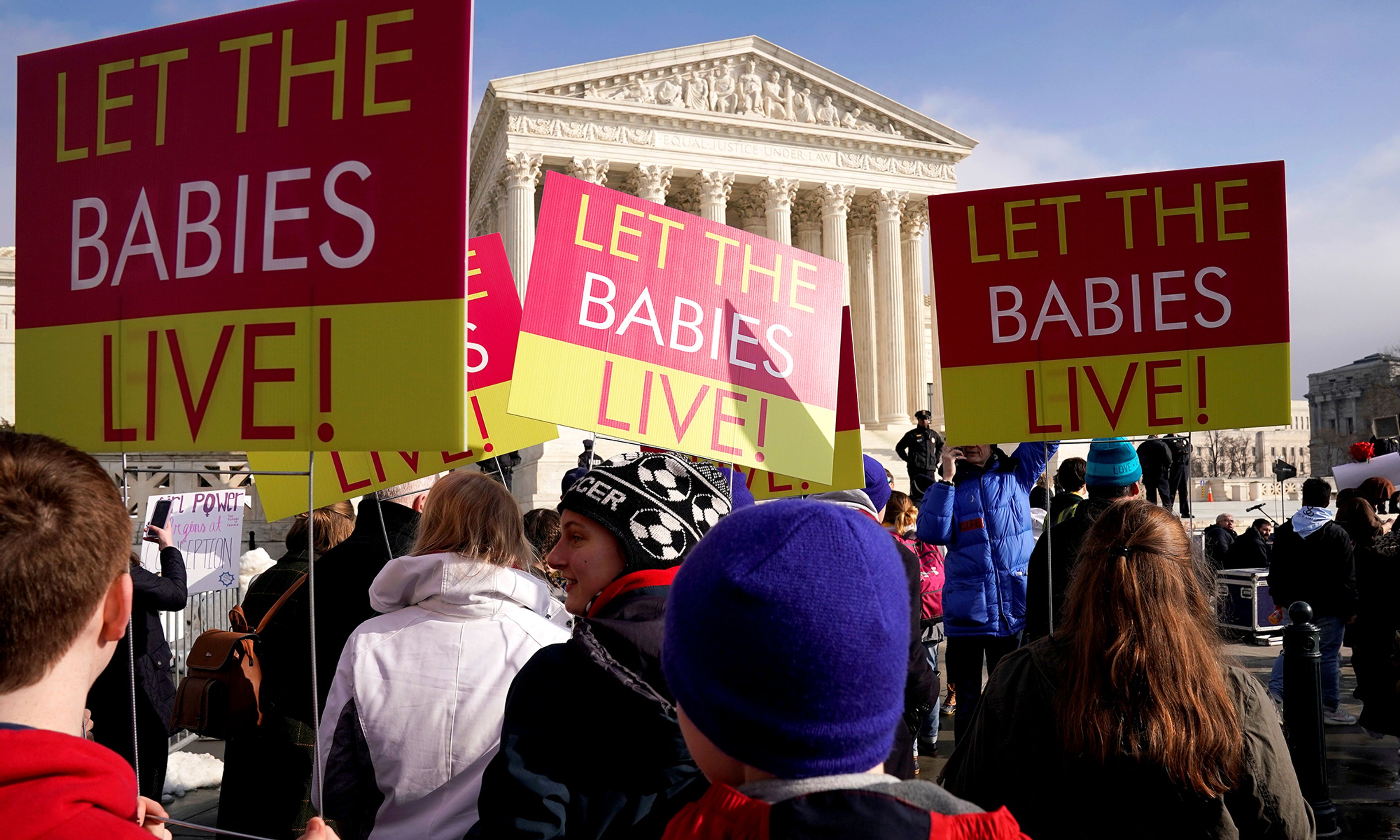
Some modern judges and academics have strayed from the traditional understanding of precedent that is rooted in the common-law maxim Stare decisis et quieta non movere. They tend to emphasize the first two words, Stare decisis (“Stand by things decided”), and ignore the rest, which means “and do not disturb settled points.” Settling the law is the primary justification for this doctrine’s application, but precedent is entitled to stare decisis respect only if it actually is settled. Roe v. Wade is radically unsettled because the Court has abandoned the original constitutional rationale for Roe and yet no majority of the Court has replaced it. Because Roe is unsettled, stare decisis doesn’t reinforce Roe; instead, it requires Roe’s reconsideration.
I’ll highlight just three of the numerous reasons why Roe is unsettled. First, Roe upended the American legal heritage protecting prenatal human beings, a principle that stretches back centuries and is increasingly reinforced by state law today. Second, the Court’s deliberations during 1971–72 planted defects in the Roe opinion that have never been resolved. And third, Justice Blackmun’s opinion for the Court in that case was so poorly reasoned that it has been subject to harsh and regular criticism by judges and scholars ever since. None of these problems were fixed by the Court’s decision in Planned Parenthood v. Casey (1992), which purported to settle the question once and for all.
The Court went off the rails in Roe because the justices evaded longstanding rules of evidence and procedure. The Court originally decided, in May 1971, to hear Roe and Doe v. Bolton to clarify an issue of federal/state jurisdiction, not to address abortion. But a crisis erupted in September 1971 when Justices Black and Harlan abruptly retired due to ill health. That reduced the Court to seven members and flipped its balance. A temporary majority of four justices — Douglas, Brennan, Stewart, and Marshall — willfully pushed to use the cases as a vehicle to sweep away abortion laws before the new justices, appointed by President Nixon, could take their seats in January 1972.
When the four saw the opportunity to decide the abortion question, they used two cases, Roe and Doe, without any evidentiary record on abortion, its nature, its risks, or its implications. Consequently, the facts were undeveloped and the constitutional issues were not thoroughly explored by the lower courts. The first round of arguments in the Supreme Court, in December 1971, was superficial and unfocused. (The original audio can be heard, and a transcript can be read, online at oyez.org.)
Justice Blackmun’s opinions in Roe and Doe papered over these basic adjudicative and evidentiary problems. Much of the Roe opinion rests on the assumption that abortion is safer than childbirth. This was never addressed in the lower court and was urged on the Court only through the amicus brief of Planned Parenthood, over the explicit objection of the attorney for Georgia. All of the “history” and the medical and sociological discussion in the Roe opinion was the result of Justice Blackmun’s personal research or was pulled from interest-group briefs filed for the first time in the Supreme Court. None of the premises and assumptions relied on in the Roe opinion were subjected to the adversarial process. The Court adopted the rule that states could not prohibit abortion before fetal viability even though viability was never mentioned once in two rounds of argument. No party or amicus urged the Court to adopt the viability rule.
Perhaps the most critical and consequential error of law made by the Roe Court was its misunderstanding of the common law, which protected the prenatal human being to the greatest extent allowed by existing medical knowledge, i.e., when there was sufficient proof that it was alive. This is made clear in Joseph Dellapenna’s encyclopedic treatment in Dispelling the Myths of Abortion History (2006).
The clearest evidence of this error is seen in the practical application of the so-called born-alive rule: If a child was aborted, at any time of gestation, and was born alive and died thereafter, the law treated that as a homicide. This is confirmed by Regina v. Sims (1601), Coke’s Institutes, Blackstone’s Commentaries (vol. 4, p. 198), and Regina v. West (1848). This proved the continuity between the entity inside and outside the womb. Disregarding the medical context, however, the Roe Court concluded that the born-alive rule meant that the unborn child was not a human being until after delivery at term.
Since 1973, Roe has increasingly conflicted with the advances that states have made in protecting the unborn child in prenatal-injury, wrongful-death, and fetal-homicide law. Earlier this year Wyoming became the 31st state with a fetal-homicide law that protects the child starting at conception.
Justice Blackmun’s poorly reasoned opinion couldn’t persuasively justify Roe as constitutional law. Blackmun couldn’t identify the textual foundation for the abortion right, couldn’t explain how Roe was based in precedent, and couldn’t present a coherent history that showed that an abortion right was deeply rooted in American history and tradition.
Criticism came from many directions. Within weeks, numerous constitutional amendments to overrule Roe and Doe were introduced in Congress. Before the end of 1973, Roe was attacked in a critical article by liberal law professor John Hart Ely. Though Ely’s assessment became the most influential, it was followed by many other critiques by major constitutional scholars in the 1970s and 1980s, and the scholarly and judicial criticism has continued regularly since then.
Contrary to popular myth, Roe hasn’t been reaffirmed many times; it has simply been applied many times. To reaffirm means to reaffirm on the merits, including the constitutional rationale. Roe has been reaffirmed only three times, and all three times — Akron v. Akron Center for Reproductive Health (1983), Thornburgh v. American College of Obstetricians & Gynecologists (1986), and Casey (1992) — have heavily depended on a rigid application of stare decisis — sticking with precedent because it was precedent.
Casey was a splintered decision, with the Court dividing 3–2–4. The plurality opinion by Justices O’Connor, Kennedy, and Souter was simply incoherent. They emphasized stare decisis but expressly overruled Akron and Thornburgh. They declined to overrule Roe due to political pressure but refused to acknowledge the political pressure on both sides. They suggested that abortion was sui generis even though there is a long tradition protecting prenatal life. They referred to the Constitution as a “covenant” but not the common-law protection for the prenatal human that historically preceded that covenant. They called on “the contending sides . . . to end their national division by accepting a common mandate rooted in the Constitution,” but never explained how an abortion right is rooted in the Constitution.
Forty-eight years has shown that the Court cannot settle the abortion issue. No justice has identified a coherent constitutional justification for the abortion right. The Court took control of the issue in Roe but can’t competently fulfill its self-appointed role as “the nation’s ex officio medical board,” as Justices White, O’Connor, Rehnquist, and Thomas have successively called it. Thrusting the Court to the center of abortion politics, as Roe did, has damaged the Court, our national politics, and the nomination process. Roe is a self-inflicted wound, and the Court should release its grip in the Mississippi abortion case (Dobbs), decentralize the issue, and return it to the states, where public policy can be better aligned with public opinion. With that huge legal obstacle out of the way, there is reason to be confident that pro-life sentiment, which has gathered tremendous momentum, will, with time, prevail.












Comments