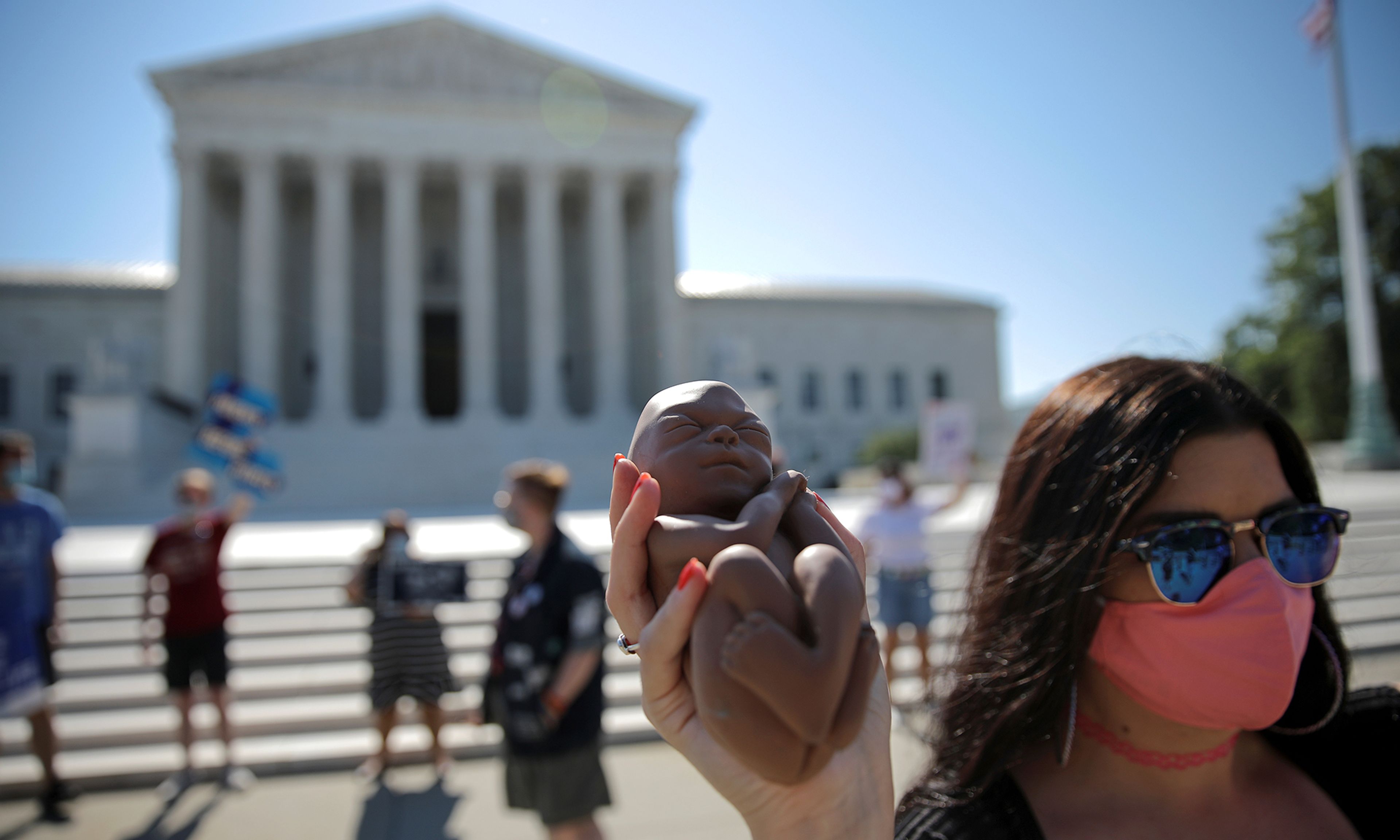
My wife and I landed in Washington, D.C., for the first time on June 7, 1965, searching for an apartment, and on that day the headlines were beaming the news: The Supreme Court had just opened a new era by proclaiming a constitutional right to contraception in Griswold v. Connecticut. While the case had been cast as a problem for withholding that freedom from married couples, it did not take long for it to be extended to everyone else.
Fast-forward a few decades: It’s March 2014, and I’m arriving at the Supreme Court to hear the oral argument in Burwell v. Hobby Lobby Stores. Under the sweeping force of Obamacare, the federal government had attempted to mandate that all private employers cover contraception and abortion in their medical plans — even employers with sincerely held moral and religious objections.
As I approached the Court, I encountered a striking scene: The landscape was overflowing with the shock of colors in a vast throng, and shouts of young women who were carrying signs that read: “My employer has no business touching my contraception.” On that point, their employers may well have agreed. But in a glance, one could take in the vast cultural shift that the Court had wrought: A generation of young people now considered the judicially invented rights to contraception and abortion the anchors of their personal freedom — ones that ran far deeper than the freedoms of religion and speech. These rights were so bound up with the way these young women saw themselves that they thought they deserved to have such services paid for, either by their employers or by the taxpayers next door.
* * *
The redoubtable Nick Nikas went into a federal court in Arizona in the fall of 1997 to defend a statute passed by the legislature that forbade the grisly procedure of “partial-birth abortion”: At the very threshold of birth, the skull of the child is punctured, and its contents removed, so that the dead child can be pulled from the birth canal intact, so to speak. Nikas made the argument to Judge Richard Bilby that the legislature had meant to “erect a firm barrier against infanticide.” What Bilby told Nikas now, in effect, was that it might no longer be decorous to cast up a “firm barrier against infanticide” if that would inhibit an abortion.
But infanticide could cease being a big deal only if homicide itself were no longer a big deal. And yet homicide cannot cease to be a big deal unless the “human person” himself has ceased to be that creature who elicits our special concern and reverence as a rights-bearing being, especially as seen through the lens of our religious tradition. As Lincoln had it: “Nothing stamped with the Divine image and likeness was sent into the world to be trodden on, and degraded, and imbruted by its fellows.”
But now we find judges and politicians feigning deep puzzlement over the question of who exactly constitutes a human being and when that life begins. In a telling contrast, James Wilson, among the American founders, saw that if we have “natural rights,” they must begin as soon as we begin to be. Which is why, as he said, the law casts its protection over the unborn child “when the infant is first able to stir in the womb.”
The bills on “partial birth” abortion were part of a strategy of breaking out to the public a fact that still comes as news: that under the law shaped by the Supreme Court, the right to abortion extends through the entire length of the pregnancy — and even to the moments after the child has been born.
The Born-Alive Infants’ Protection Act of 2002 sought to protect that child. The congressional Democrats were evidently averse to the law, but there was a fear of suffering serious embarrassment if they voted against it. The bill, brought to the floor by Senate minority leader Harry Reid, passed by voice vote without a “Nay” uttered in the chamber.
But then the dramatic change just 13 years later: Dr. Kermit Gosnell of Philadelphia was operating an abattoir, routinely killing babies who had survived abortions, with the local police averting their eyes. As this news came to light, there was an effort to return to the Born-Alive Act and restore the serious civil and criminal penalties that had been stripped from that original bill. Yet what the passage of just over a decade had revealed was a Democratic Party now cohesive in its defense of abortion at any time for any reason — a party that suffered no inhibitions about the killing of a child who had survived an abortion. When the act was brought to the floor of the House in September 2015, it passed by a vote of 248–177. Every Republican voting that day voted in favor of that bill, and all of the votes in opposition came from a unified Democratic Party, with only five Democrats defecting. This new cohesion was confirmed again when the same bill was brought forth in January 2018, with the votes of both holding firm in this cast.
The Republicans have become, then, through the years, ever more cohesive on the pro-life side; but in curious contrast, it is the conservative judges who have been obtuse. They have not yet even caught up with the rich, substantive argument that had been made by the lawyers in Roe v. Wade, when the Court first installed this new “right” to abortion.
The lawyers for Texas had drawn on the most updated findings in embryology, and they made the case that the child in the womb has been nothing less than human from its first moments; that the embryo or fetus is not really a part of the mother; and that the laws on homicide must ever be indifferent to the size and age of the victim. In this way, the lawyers sought to show that the legislature was amply justified in casting the protections of the law over the child in the womb.
And yet no dissenter in Roe — and no conservative justice since then — has drawn on that compelling brief. One senior conservative jurist put it this way: “There is of course no way to determine . . . as a legal matter [that the human fetus is more than potentially human]; it is in fact a value judgment. Some societies have considered newborn children not yet human, or the incompetent elderly no longer so.”
That term — “value judgment” — came into vogue in the writings of Nietzsche and Max Weber, as people began to lose their confidence in speaking of moral truths. Whether the law would cast its protections over unborn children or racial minorities would depend on how much the voters in any place “valued” those lives.
Lincoln had said that the crisis of his time turned on the question of whether the black man “is not or is a man.” For if he was a man, he, too, had a right to be governed by his own consent. As Professor Harry Jaffa would later remark, the question of whether the black man is a man, or a human being, cannot be a mere “value judgment.” It is unthinkable of course that we would put that question in the political arena to invite people to collect their “opinions” or “feelings” on the matter. And if that is the case, how could it make any more sense to invite people to offer their value judgments on the human standing of that creature in the womb, who has never been less than human?
In the movement, then, of our “culture” over the past 48 years, we find a vast portion of our people with college educations who affect no longer to be sure about just who counts as that “human person” whose nature forms the very ground of the law and the prime object of its protection. And with that shift, they no longer recall the natural ground of their own rights.












Comments