If it came down to just two individuals, we might say that the Civil War was a contest between John Brown of Harpers Ferry and Jefferson Davis of Davis Bend, one the relentless Fury who planned to destroy slavery by violence, and the other the self-righteous planter who could see in slavery no wrong.
But if it came down instead to just two states, we would be tempted to say that the Civil War was the conflict of Massachusetts and South Carolina. It was, after all, South Carolina that had been agitating from the 1830s onward for some kind of reconstruction of the Union that would perpetuate slavery, and it was South Carolina that eventually led the bolt from the Union in December of 1860 that put the armies in motion. It was Massachusetts, on the other hand, that was the first state to erase legalized slaveholding (in 1780), almost the first host to an anti-slavery newspaper, and the first to send its federalized militia to Washington shortly after President Lincoln’s call to suppress the Southern rebellion. Take these two out of the political equation, and perhaps we might not have had a civil war at all.
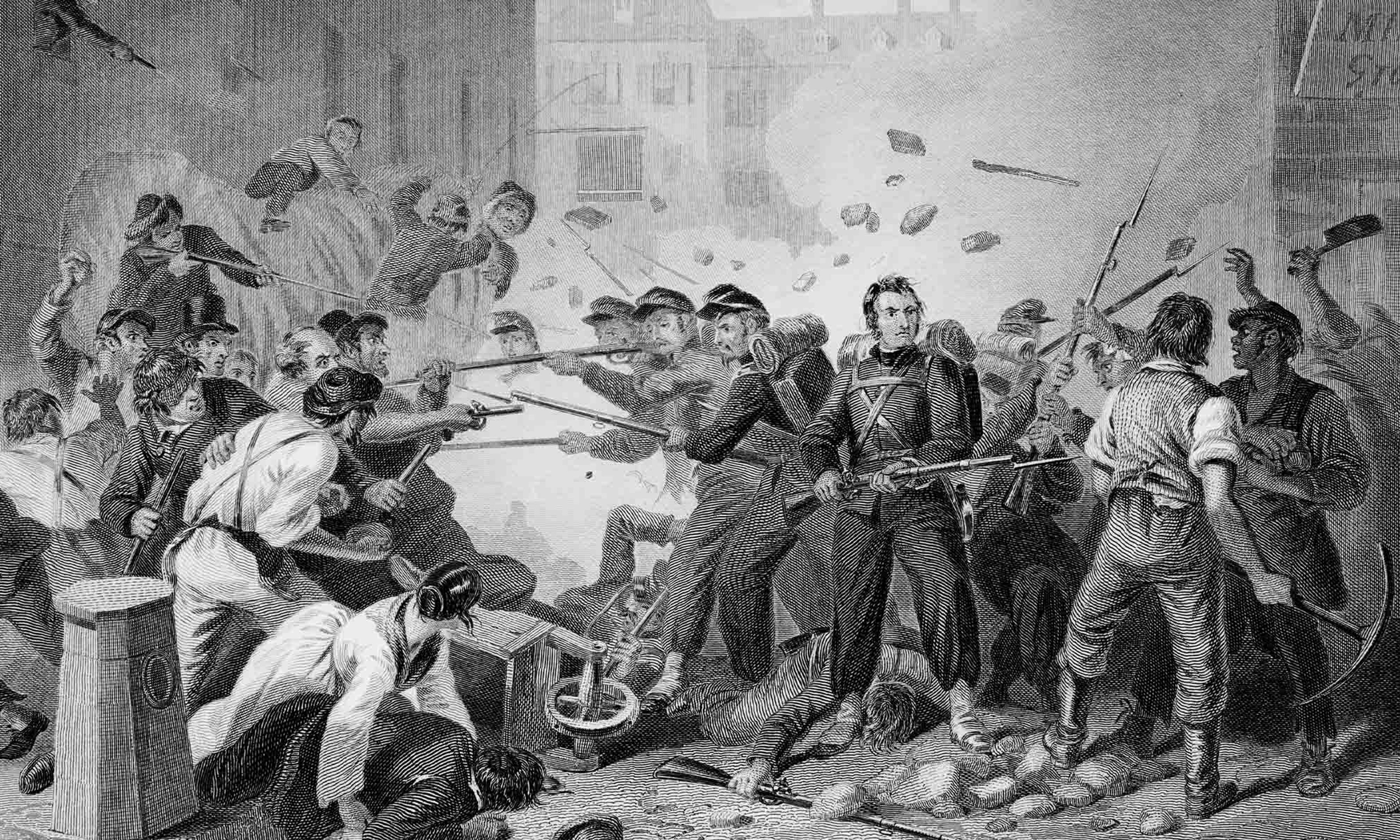
Which is, of course, wishful thinking. There were copies of Massachusetts and South Carolina all across the American republic in 1860. John Brown, remember, came originally from Connecticut, Davis from Kentucky; Pennsylvania militias were shoulder to shoulder with the Massachusetts regiments whom mobs attacked in Baltimore while they were in transit to defend the capital in 1861; the first anti-slavery newspaper was published in Ohio.
Nevertheless, no other states seemed to have louder bullhorns, or at least louder mouths, than Massachusetts and South Carolina. That rare political bird, the South Carolina Unionist James L. Petigru, remarked after South Carolina’s attempt at secession that the state was “too small for a republic, but too large for an insane asylum.” Much the same thing was said about Massachusetts — or at least Boston — by Amos Lawrence after the disgraceful surrender by the courts of the fugitive slave Anthony Burns: “We went to bed one night old-fashioned, conservative, compromise Union Whigs and waked up stark mad Abolitionists.”
Robert W. Merry is a veteran Washington journalist, a former correspondent for the Wall Street Journal and editor of Congressional Quarterly, and the author of five earlier books on subjects such as American journalists, American presidents, and American foreign policy. This is his first venture into the vast literature of the Civil War era, and from the first, Merry is convinced that Massachusetts and South Carolina really were the mutual harbingers of the war. Both states were home to some of the most radical political agitators of the conflict; together they embodied an American Kulturkampf between an uncompromising Puritan moralism and a swaggering, profit-eyed hedonism. “No two were as disparate in outlook, religion, moral precepts, or cultural sensibility as Massachusetts and South Carolina,” Merry writes, and each led the rest of the republic over the brink like the Pied Piper.
This juxtaposition is a colorful way of illustrating the ominous decade leading up to the war. Merry opens the book with the death of John Calhoun in 1850 and closes with the election of Jefferson Davis as the provisional president of the new Southern Confederacy in February 1861 (and the firing on Fort Sumter in Charleston Harbor two months later). Between those two goalposts, three prominent South Carolinians — Andrew Pickens Butler, Robert Barnwell Rhett, and James Henry Hammond — face off against three giants of Massachusetts Whiggery — Charles Sumner, Henry Wilson, and Robert Winthrop — on the political playing field of Congress.
Merry is at his best in building the conflict-portraits of these men, particularly Charles Sumner. It was Sumner’s sneering reference to Butler’s speech defect during the debate in 1856 over slavery in the Kansas Territory — Butler, he said, had “discharged the loose expectoration of his speech, now upon her representative, and then upon her people” — which got Sumner beaten nearly lethally to a pulp by Butler’s relative, Preston Brooks, on the Senate floor. But Merry is also conscious of how these banner-carriers for each state quarreled among themselves — especially the South Carolina triumvirate. Butler, Hammond, and Rhett enjoyed “a tight consensus . . . on the state’s need to defend its rights and protect slavery at all costs,” but they savaged one another without mercy over “the best tactical approaches in that defense,” and especially over whether breaking up the Union was the only way to perpetuate slavery.
There are a few areas in which Merry is less successful. First, his narrative is more about the prominent politicians of Massachusetts and South Carolina on the national stage than about the two states. Apart from his opening description of their deep-rooted cultural differences, we actually learn very little about the states themselves — their populations, their economies, the behavior of their state legislatures, their legal systems — and thus very little as to why we should regard these two states as emblematic of a clash of political civilizations. The upcountry of South Carolina was, and still is, a very different region from Charleston and the lowcountry; Boston teemed with “stark mad” abolition sentiment, but western Massachusetts was far less riled up. Samuel Bowles, the editor of the Springfield Daily Republican, did not much care for slavery, but he was not any more enthused about abolition, and he was convinced as late as February 1860 that “the disposition to trample on the Constitution and to disregard the rights of the Southern states, is confined to a very small fraction of the North, not representing probably one in a thousand of the population.” And even Boston was home to a particularly violent draft riot in July 1863.
There is a second problem, this one involving personalities. There is not much question about the prominence of Hammond, Butler, and Rhett in South Carolina (although Andrew Butler died in 1857, removing him from any role in the run toward civil war), but it is less clear who is speaking for Massachusetts. Sumner certainly deserves his post of celebrity. But Henry Wilson moved unsteadily from the Whig Party to the Free-Soilers and the nativist Know-Nothings. Wilson may indeed have been a “new breed of politician for a new and more complex era of politics in his state and region,” but it was his ability to bridge the gap between old-line Whigs and Know-Nothings, not his hostility to South Carolina, that got him elected to the Senate in January 1855. Only during the Civil War would Wilson move unequivocally into the company of the most Radical Republican opponents of slavery.
Robert Winthrop is even more unlike Sumner or, for that matter, Wilson. Burdened with the most famous colonial name in Massachusetts history, Winthrop was a model of the New England Whigs. He rose with them in the 1840s to become speaker of the House; he fell with them, too, losing a seat in the Senate to Sumner and failing in his bid for the governorship of Massachusetts in 1851. There was no question about Winthrop’s distaste for slavery. But he looked for a “just, practicable, and Constitutional mode of diminishing or mitigating so great an evil as slavery,” not its abolition. What, exactly, makes Sumner, Wilson, and Winthrop emblematic of Massachusetts?
In the end, it is not clear from Merry’s narrative that Sumner, Wilson, and Winthrop are actually as reflective of their state as Hammond, Butler, and Rhett are of theirs. There are numerous Massachusetts politicians who bob to the surface of Decade of Disunion only to sink again after a short time — the abolitionists Garrison and Lawrence, the Secret Six who funded John Brown’s raid in 1859. And there are others (such as Governor John Andrew) who make no appearance in the book but surely have as much claim as Wilson and Winthrop to be mirrors of Massachusetts.
This, in turn, throws into relief the original question of why we should regard Massachusetts and South Carolina as somehow more responsible than other states for the rush into civil war. The war was, at its foundation, not about whether slavery should be allowed to continue in the 15 Southern states where it was legal in 1860 — not even Lincoln in his first inaugural address contested that — but whether those states should be allowed to legalize it in the western territories and the future states those territories would become. It was Kansas that bled in the 1850s, not South Carolina or Massachusetts.
Merry has the story of the great American disunion to tell, and it is no fault of his that the story is too broad to be confined easily to two states. In fact, as much as Merry would like to make the coming of the war a collision of these two, he simply cannot resist how the tale of disunion lures him onto other stages and around other personalities. Stephen Douglas plays a major role in Decade of Disunion, despite having no connection to either Massachusetts or South Carolina; William Henry Seward has one of the longest entries in the index, but with nowhere else to call home but New York. And no book, no matter how devoted to the Esau-and-Jacob relationship of Massachusetts and South Carolina, can keep Abraham Lincoln of Illinois from playing an increasingly large part in the story.
Merry has a fine eye for the close political encounter. But he makes his share of mistakes (he uses the wrong vote tallies for the Lincoln–Douglas Senate race in 1858 and takes no notice of Charles Francis Adams’s bid for the presidency under the Liberal Republican banner in 1872). The book also includes more than a few stylistic infelicities (“the rap on Barnwell Rhett”; “it was a bit rich for Phillips”). Moreover, Decade of Disunion will need to justify itself alongside David Brown’s excellent new history of the Kansas-Nebraska Act, A Hell of a Storm: The Battle for Kansas, the End of Compromise, and the Coming of the Civil War, and classics such as Michael Holt’s The Political Crisis of the 1850s (1978), David Potter’s The Impending Crisis (1976), and, even further back, the first four volumes of Allan Nevins’s Ordeal of the Union (1947–50). Merry’s book is an easy and delightful telling of a difficult and depressing decade, but by no means the last word on it.












Comments