If you aspire to make a good left-wing movie, you have my sympathies. Your first challenge is that most people in contemporary Hollywood share your politics, and political movies made inside an ideological bubble tend to be crude, cardboard, and artistically inert.
Then your second challenge is that the big screen has a way of undermining the progressive intentions with which many films are made. You set out to make an anti-war movie and discover that the camera loves combat even if you’re trying to condemn its waste and horror. You introduce a right-wing bad guy and then watch him walk away with the movie, Gordon Gekko–style. You script an action movie where the hero is up against a set of Republican-coded villains, evil corporations or sinister defense contractors, and still the iconography of your story — the lone hero, armed and dangerous, taking the law into his own hands — may end up feeling more Gadsden-flag libertarian than conventionally liberal.
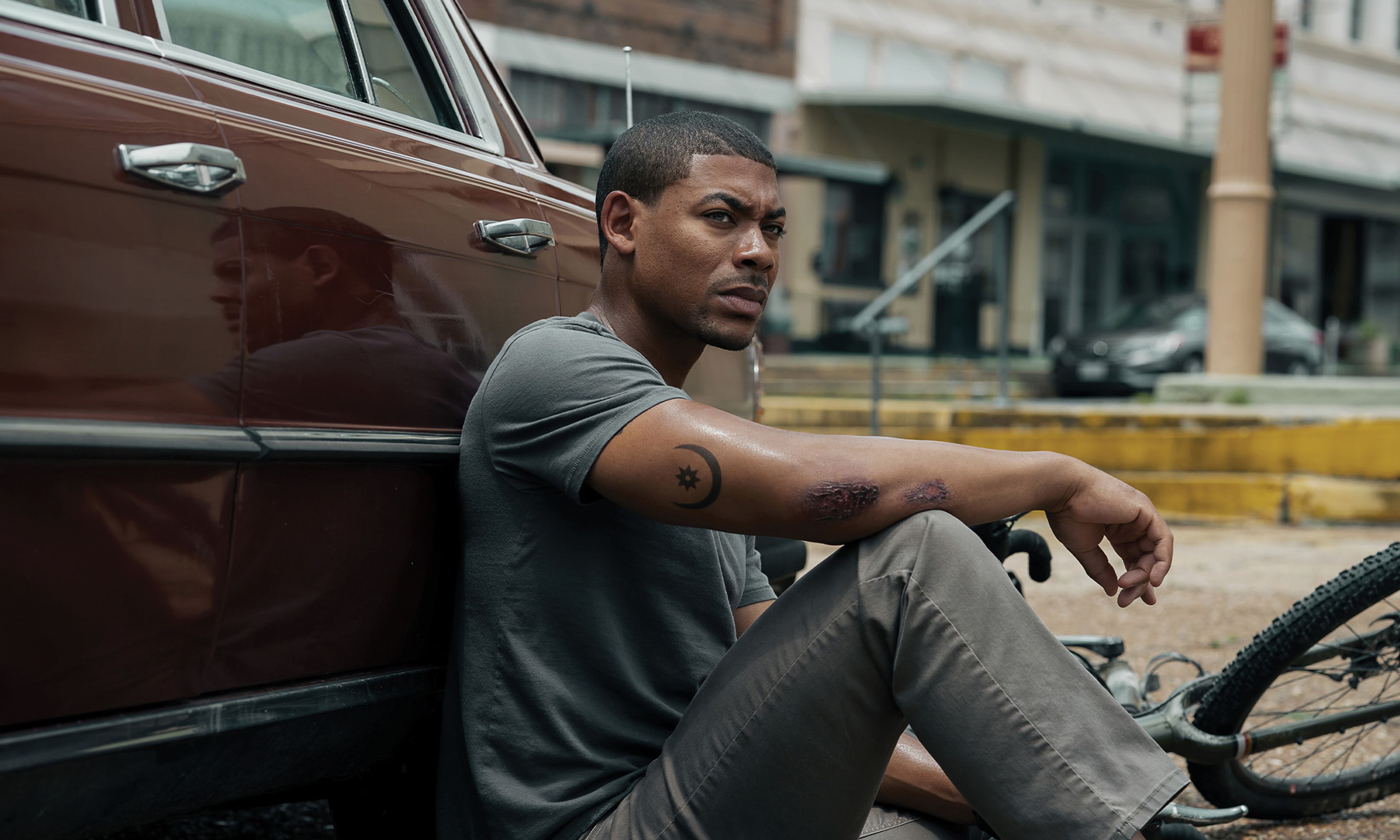
Rebel Ridge, the taut, slow-burn Netflix action movie starring Aaron Pierre as a black Marine Corps martial-arts instructor taking on the corrupt police force of a small Louisiana town, is an interesting illustration of what it takes to avoid these traps. It has a message that would be very much at home in the protests around Ferguson, Mo.: a story that indicts not just a few bad cops but larger power structures, a conflict that pits its black hero against a brace of bad white Southerners. With that description, it’s easy to imagine the movie playing as a thudding piece of anti-racist propaganda, or at best a guilty pleasure in the style of the Shaft movies.
But instead of thudding, the story moves more lightly. We start with Pierre’s character, Terry Richmond, getting run off the road by a police car while he’s biking to a small town to bail his cousin out of jail. (The cousin has served as a state’s witness in the past, and Terry assumes that if he’s sent to prison he’ll meet a snitch’s fate.) The cops claim he was evading them, search him, find a bag full of $36,000 in cash — the bail money, plus some extra to buy a truck and maybe start a hauling business — and come up with a trumped-up justification to confiscate it before sending Terry on his way.
Needing the money, or at least $10,000 of it for bail, Terry goes up the chain of command to reach the local police chief, Sandy Burnne, played by Don Johnson in full feudal-baron mode. Along the way he picks up an ally in a local courthouse functionary named Summer (AnnaSophia Robb), who helps clue him in on the larger pattern of corruption — involving a sweeping abuse of civil asset forfeiture, a favorite target of would-be police-reformers.
The police chief and the Marine don’t exactly hit it off, and Summer has her own issues with local law enforcement. So we get a series of increasingly violent escalations of the civil-asset-forfeiture debate, and eventually the one-man war that you’d expect. Though with the twist that Terry is more a hands-and-fists guy than a marksman, more a disarm-your-enemies type than a stone-cold killer — and a lot of the armaments that he ends up turning against the police are crowd-control technologies, meant to stun and daze and not to kill.
This attempt to avoid conceding too much to vigilantism doesn’t completely work, of course: The hero still deals out a lot of physical punishment that you, the viewer, are expected to cheer for rather than deplore. But it’s an interesting attempt to protect the movie’s formal moral vision against the usual action-movie slippage toward vigilante porn.
Similarly interesting is the work the film does to avoid playing as a simple anti-racist parable. Race and the region’s racist past are obviously crucial background to the story, but the forfeiture racket is about money first and foremost; Johnson and Pierre play their scenes as two alpha males in conflict, with the racial difference just one undercurrent, and even the good cops and bad cops aren’t precisely whom you would expect on identitarian grounds alone. You can infer a lot of political ideas from the script, but they’re there to be drawn out, not delivered as a lecture.
The exception, and the place where the movie is the weakest, is in the details of the underlying criminality: There’s no way to explain the logic of civil asset forfeiture without being a bit didactic, and the effort to invent and explain a larger conspiracy around the practice is cumbersome as well.
This is a fundamental challenge that remains for the left-wing filmmaker even when the obvious traps can be avoided. The strongest left-leaning arguments about society’s ills involve impersonal powers and structural forces grinding down the individual, and making structural evils cinematic requires more genius than even a good action movie can quite deliver.












Comments