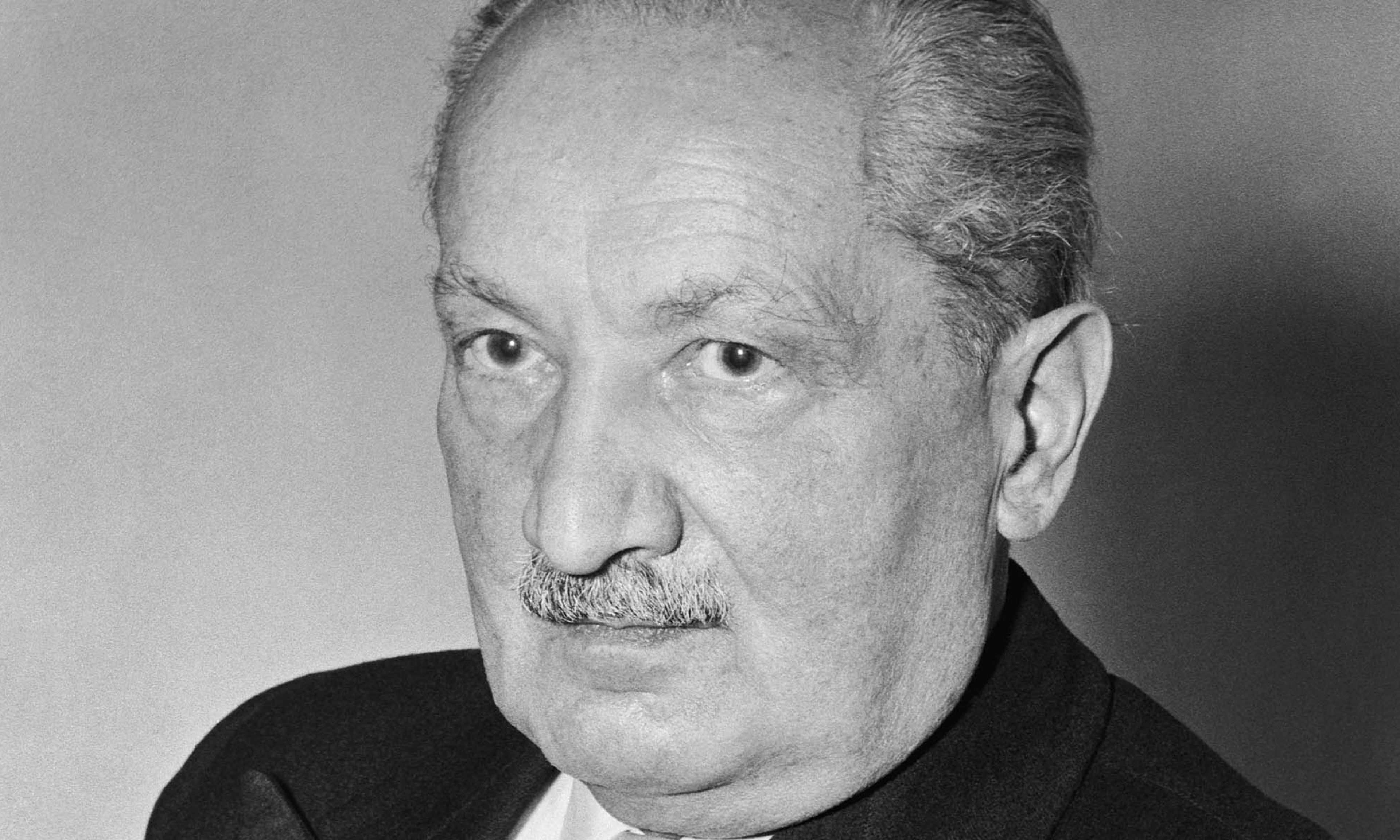
Martin Heidegger joined the Nazi Party in 1933, at the age of 43. He was formally inducted in a public ceremony, mere days after assuming the rectorship of the University of Freiburg. He grew a short, clipped moustache and began lectures with “Heil Hitler!” A year later, he abruptly resigned his administrative post and stopped going to party meetings. It seems the new regime had disappointed him in some way, but he retained his Nazi membership through the end of the war and showed no interest, even years afterwards, in denouncing Adolf Hitler or in repenting of his personal role in supporting the rise of the Third Reich. One searches his writings in vain for any regretful mention of the Holocaust.
Did Heidegger truly support National Socialism? If so, was it just a passing fad? For years these were fraught questions among Heidegger scholars, with some contending that he had made a pretense of embracing National Socialism for personal and political reasons, and others that he made a pretense of abandoning it for personal and political reasons. Richard Wolin, a professor of history at the CUNY Graduate Center, is a vocal member of the latter camp. His recent book, Heidegger in Ruins, contends that the German philosopher’s Nazi commitments were deep, enduring, and enormously influential on later far-right thinkers.
This last point may be his most distinctive, especially now. In 2014, the publication of the Black Notebooks shook even Heidegger’s more dedicated defenders. These were personal notebooks in which the philosopher recorded observations and privately worked through many of his ideas. By his own request, they were published posthumously, on a timetable that he dictated. The Black Notebooks, in which he laments the nefarious influence of “world Jewry” on modern life, present particularly strong evidence of his antisemitism and early support of the Third Reich.
At this point, therefore, Wolin is in good company in denouncing Heidegger. But he is still deeply frustrated that the scholarly community spent so many years downplaying, compartmentalizing, or even covering up Heidegger’s problematic views, and the book is dedicated to explaining how this happened, and to cataloguing the damage. The early chapters read as a kind of exposé, not just of Heidegger himself but of the various editors, blood descendants, and sympathetic scholars who worked over the years to conceal the extent of his Nazi commitments. The middle portion tracks the connections between Heidegger’s ideas and key elements of Völkisch thought. There are separate chapters on race (Rasse), work (Arbeit), and “earth (Erde) and soil (Boden),” all aiming to show that Heidegger really did not rise above the debased ideals of his troubled time. He was, in Wolin’s view, a product of that time, shaped by its prejudices and fully complicit in its ruinous errors.
The final section of the book discusses the grim contemporary consequences. In Wolin’s eyes, Heidegger was more than just another German intellectual beguiled by Völkisch delusions. He wanted to be the fascist philosopher par excellence, supplying a philosophical groundwork for the glorious new empire, and in a way Wolin thinks that he succeeded, despite the political failures of Nazism. Through Heidegger’s work, modern New Right thinkers have reentered the fevered conversations of Weimar Germany. Wolin discusses Heidegger’s influence on France’s Nouvelle Droite, the pan-European Identitarian movement, and the American alt-right. Viktor Orbán, Marine Le Pen, and Donald Trump unsurprisingly all get their mentions.
These final pages effectively underscore the importance of the topic. It is absolutely true that Heidegger has been a major influence on illiberal and neofascist thinkers; one need only read the opening pages of Aleksandr Dugin’s The Fourth Political Theory to find oneself eyebrow-deep in references to Dasein and authentic being-in-the-world (signature Heideggerian terms). It seems entirely fair to suggest that Heideggerian thinking has played a significant role in precipitating the ruinous and unjust war that is currently devastating Ukraine. So Wolin is raising very important questions, but unfortunately his grasp of the underlying philosophical ideas is inadequate to treat the topic effectively.
Before getting to that point, however, it is worth considering what Wolin does do. He presents sufficient evidence to make readers consider whether it is, in fact, reasonable to view Heidegger as the premier philosopher of fascism. This may be a hard sell for conservatives, who understandably become skeptical whenever anyone is accused of being a closet fascist. Wolin’s suggestion that Heidegger has managed to glide under the radar as Hitler’s emissary to the future may on its face seem risible. No one has ever denied that Heidegger was a card-carrying Nazi, but he was never one of Hitler’s intimates, or even a political theorist at all. Then there is the fact that exposing Nazi apologists has been a blood sport for several decades, periodically degenerating into a witch-hunting frenzy. How could a stalwart apostle of National Socialism have remained incognito for so many years?
In fact, the theory may not be as ridiculous as it initially sounds. Wolin painstakingly shows how Heidegger successfully papered over his National Socialist commitments, rewriting and “contextualizing” older texts in hopes of lifting the teaching ban that had been imposed on him after the war. Somewhat incredibly, Wolin explains, Heidegger and his descendants for many decades managed to forestall the release of critical editions of his manuscripts that might have revealed the extent of those changes. Until the Black Notebooks, it was possible for Heidegger fans to persuade themselves that he was not personally an antisemite.
There is a plausibility to Wolin’s narrative, in part because Heidegger is very much a philosopher’s philosopher, bewildering to the ordinary bookstore-browser but captivating to a certain subset of admirers. Both in his lifetime and after his death, he has been the sort of figure who tends to inspire cultlike devotion in a smallish cadre of people. Heidegger’s prose is packed with odd neologisms, which are ostensibly meant to rejuvenate a more authentic form of language but serve equally well to render him unintelligible to the casual reader. It is actually not so difficult to see how such a thinker could spread repugnant ideas fairly broadly without raising much alarm. Outsiders hardly try to understand him; insiders feel highly motivated to protect and defend his work.
Beyond that, there is the rather interesting fact that, Nazi associations notwithstanding, many of Heidegger’s greatest admirers are located on the political left. He had a profound influence on postmodernism, psychoanalysis, literary criticism, and many other fields of thought. Those contributions, combined with his hostility (especially later in life) to natural law and much of the Western tradition, may have inoculated him against the kind of criticism that his work merited. The fact that he had several devoted Jewish students (most notably Hannah Arendt, who was also his lover for a time) made it that much easier to give Heidegger a pass, though he may just have been the sort of unprincipled individual who didn’t allow his political convictions to interfere with his career (or his sex life). In any event, the people most excited about hunting Nazis have largely been unexcited about hunting Heidegger, at least until quite recently.
The story, then, would have to go something like this. Coming of age in an intellectually vibrant but deeply antimodern milieu, Heidegger absorbed its defining assumptions and questions and achieved a particularly captivating synthesis. His evident genius, together with that curious charisma that enthralled both students and select readers, enabled him to find a sizeable audience. But because the political applications were somewhat in the background (and were pushed there even more firmly in the post-war period), many people were drawn to his work without recognizing its more repugnant implications. Some, however, did see. Readers already warm to neofascist lines of thought discovered a thrilling touchstone in Heidegger, who channeled many of their own resentments and wild hopes. Thus, the fevered fantasies of the Weimar intellectuals were drawn forward into our own time, and we see figures such as Dugin openly admiring Heidegger’s arguments for German exceptionalism, now wanting to claim that mantle on behalf of Russia. Heidegger may stand supreme as history’s most successful dog-whistler.
How accurate is this narrative? It’s difficult to say, especially with a thinker of Heidegger’s stature. His influence cannot be easily disentangled from that of other intellectuals: Friedrich Nietzsche, Edmund Husserl, the members of the Frankfurt School, and many more. And his ideas are now so broadly diffused through different disciplines that it is impossible to assess their precise impact.
Unfortunately, Wolin seems particularly unsuited to the task of carefully distilling Heidegger’s thought, identifying more and less problematic strands. His book offers some tiny snippets of philosophical argument, but they are brief and underdeveloped, and even though he remarks unconvincingly in the introduction that he is not looking to cancel Heidegger, Wolin finds virtually nothing of value in his work. This is not really surprising, because Wolin seems entirely satisfied with liberal modernity. His paradigm is quite straightforward: The modern liberal order is good, and ideas or movements that threaten it are bad. For all its pleasant simplicity, this is hardly a helpful perspective from which to engage Heidegger, one of modernity’s most brilliant critics. Nor will it help us to tame violent, illiberal movements, on either the right or the left. It is always difficult for an author to offer a nuanced treatment of a subject that he hates, and Wolin does not transcend this limitation. At the end of the book, I found myself reflecting with amusement that for all of Wolin’s damning criticisms of Heidegger, it almost seems that the illiberalism stands in his mind as the worst, and perhaps the root of all other evils.
In fact, the liberal order does face serious challenges, and not only from a rebellious rabble who refuse to get on board. It struggles with loss of meaning. Its citizens are alienated. It is poorly equipped to explain and justify itself, and this makes it vulnerable both to external threats and to a kind of crushing self-loathing. Heidegger and his intellectual progeny were attentive to all of these problems, and it is neither prudent nor really possible to dismiss their insights because Heidegger was a Nazi. On the other hand, he does stand as a particularly strong example of the egregious errors that can follow when a thinker distances himself from the natural-law tradition.
Distinguishing a thinker from his work is always a perplexing challenge. This is particularly true of Heidegger, who was both brilliant and repugnant to an extraordinary degree. Wolin may have done a service by cataloguing Heidegger’s connections to Völkisch thought with a relentless thoroughness. To understand those connections more deeply, the relevant questions will need to be treated by someone with a fuller perspective on the ideas themselves. It will take a philosopher to pull Heidegger from the ruins.












Comments