Plus ça change: As both right- and left-wing populism have surged across the globe in recent years, as mercantilist economics and nationalist politics have returned, as authoritarianism of soft and hard varieties has gripped hitherto liberalizing states, and as international institutions have increasingly come under strain, it’s instructive to look back at a similar moment about a century ago.
Against the World, Tara Zahra’s penetrating study of the fall of internationalism between the world wars, does exactly that, examining the aspirations to economic self-sufficiency that characterized the 1920s and 1930s. While most surveys of the period focus on the rise of nationalism, Zahra’s centers on the explicit antipathy toward globalism expressed in the form of protectionism, agricultural settlements, and domestic production of food and other goods. A MacArthur and Guggenheim fellow and a historian of Central and Eastern Europe at the University of Chicago, Zahra defines anti-globalism during the inter-war period as the “political, social, and cultural movements that sought to insulate societies from the global economy by mobilizing against policies, people, and institutions associated with globalism and/or internationalism.”
Zahra contends that “popular anti-globalism arose with accelerating globalization itself in the late nineteenth century, but in the 1920s and 1930s, the demands of anti-global activists were increasingly taken up by political parties and states.” Indeed, at the turn of the century, the internationalist tide was rising — fast. Global trade exploded as mercantilist economic theories yielded to free trade. Borders blurred as tens of millions of migrants adopted new nationalities. And transnational associations proliferated: Zahra counts over 100 global organizations that arose around the turn of the century, ranging from feminist groups such as the International Women’s Suffrage Alliance to pacifist groups to promulgators of international law, including the Hague Conventions of 1899 and 1907. The International Bureau of Weights and Measures, the Telegraph Union, the Universal Postal Union, and the International Statistical Institute aimed to standardize global communications and measurements. The International Office of Public Hygiene, founded in 1905, was a forerunner of the World Health Organization.
But that tide receded nearly as rapidly amid and following the world’s determined effort to violently tear itself apart. Sounding like a 1915 version of Patrick Buchanan, the U.K.’s Anti-German League lamented that “we have alas permitted foreigners, particularly Germans, to dump their goods at the very gates of our great works, while our men have starved or emigrated. . . . We have driven our capital and labor abroad in enormous volumes and have left our ships to compete, unaided, against the subsidized vessels of other countries.” A decade later, the Empire Marketing Board urged Englanders to “buy British,” launching a campaign demonstrating that “most all human needs can be met by the resources of Britain and her dependencies.”
For their part, the Germans, following a war in which a comprehensive Allied blockade had caused scarcity and starvation, sought to establish food security via national self-sufficiency. In 1924, some 300,000 of them joined the Reichsverband der Kleingartenvereine Deutschlands, which cultivated urban gardens, while others formed agricultural farms in the countryside to grow badly needed crops as insurance against a future siege. “Urban gardens and rural settlements,” Zahra writes, “were intended to deglobalize the dinner table.”
Their neighbors to the south followed suit, as many Austrians, deprived after the war’s end of their once-sprawling empire, turned inward and cultivated their own gardens and settlements by the tens of thousands, prompting mockery from a liberal-internationalist Austrian publication. “It is difficult to imagine something more absurd,” Der Österreichische Volkswirt sniffed, “than aspirations for autarky in such an exceptionally interdependent country as Austria.”
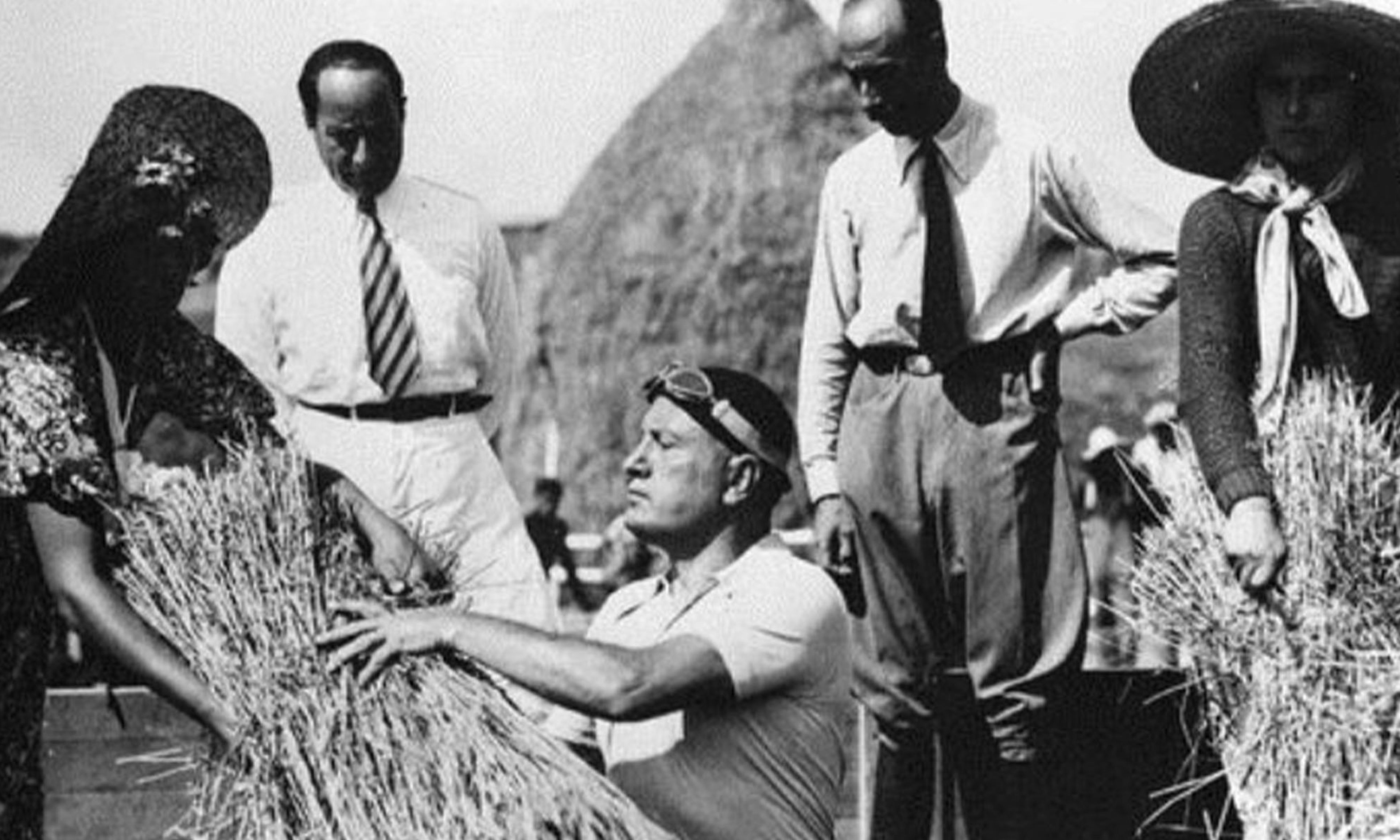
In Italy, Mussolini launched a “battle for grain,” replete with propaganda containing what Zahra memorably labels “iconic harvest porn.” Unsurprisingly, for a culture obsessed with its own cuisine, the Italians’ “alimentary autarky” centered on the notion, articulated in one contemporary guidebook, that “a people cannot be strong and dominate when it is dependent on others for food.” Agricultural settlements such as Littoria and Agro Pontino sprouted in the countryside, nourished by the fascist “new men and women” ideal.
Meanwhile, the United States witnessed both a revival of the Ku Klux Klan and the emergence of a militant return-to-Africa movement among some black citizens. In 1922, Marcus Garvey made common cause with the Atlanta Klan’s grand wizard in promoting racial separatism. An article published by the Indiana Klan was harshly critical of “those who favor inter-nationalism and who would make of the United States of America a polyglot nation.” The 1924 Johnson-Reed Act, which severely curbed immigration, and the 1930 Smoot-Hawley Tariff Act, which levied massive duties on foreign goods, further advanced American retrenchment.
Even the colonies of the slowly eroding British empire embraced self-sufficiency. Mahatma Gandhi promoted Indian independence through swadeshi — the practice of subsisting primarily, if not exclusively, on locally made products. “I do not want to depend on any country for my food and clothing,” he insisted, arguing that “India cannot be free so long as India voluntarily encourages or tolerates the economic drain” plaguing the country. And in the Emerald Isle, Éamon de Valera thundered that “our guiding principle will be to make Ireland as self-contained and as self-supporting as possible” as the sole avenue of building up “a spirited, self-reliant people.”
Around this time, the Spanish influenza of 1918 began circulating worldwide, further encouraging countries to close their doors. Variously known as the Naples Soldier, the German plague, the Hun flu, the Bolshevik disease, and the Turco-Germanic bacterial criminal enterprise, the virus reinforced a global wariness toward — and scapegoating of — foreigners. “The Spanish flu,” Zahra writes, “helped to launch a state of ‘quarantine’ from which the world would emerge only decades later.”
Generally speaking, right-wing anti-globalists believed that globalization threatened the sovereignty of the nation, while left-wing anti-globalists tended to depict “the worker rather than the nation as the primary victim of globalization.” Nevertheless, “right- and left-wing anti-global movements often adapted common tactics and strategies,” and, in a textbook example of horseshoe theory, occasionally found themselves collaborating. In 1920s Italy, for instance, “Fascists and Socialists alike proposed more deglobalization as the solution,” including land reform and the establishment of productive agricultural settlements.
The largely ineffectual League of Nations and the punitive provisions of the Treaty of Versailles bore a substantial share of responsibility for accelerating provincialism. During treaty negotiations, the German delegation implored the plenum not to insist on German economic ruination, lest “the world as a whole . . . become infinitely poorer,” and exhorted the victors — fruitlessly — to recognize that “what the world is in need of is international cooperation in all fields.” And by elevating the principle of self-determination above almost all others, the League helped to “reinforce national sovereignty rather than undermine it.”
But anti-globalism eventually ran its course, as experiments in agricultural and manufacturing self-sufficiency proved unworkable, especially in the soon-to-be-defeated Axis powers. It’s also worth noting that inter-war anti-globalism wasn’t all bad. It spawned “the development of technologies and practices that ultimately made land more productive and decreased global hunger,” and it “generated transformative new social programs and policies that aimed to reduce the precarity and pain caused by ups and downs in the business cycle.”
More important, the ultimate failure of 1920s and 1930s anti-internationalism served to bolster the new world order that emerged after the war, which transformed the world, almost entirely for the better, over the following 80 years. Bretton Woods, the International Monetary Fund, the Marshall Plan, the United Nations, the European Union, NATO — these international institutions first stabilized and then catalyzed global politics and economics for decades to come, breeding relative peace and untold prosperity throughout the world. Of course, Brexit, America First (the second time around), and national conservatism would later arrive to trim the sails of the globalists, in a sort of two-steps-forward, one-step-back process that appears to be repeating itself.
Zahra’s focus occasionally strays, and some of her claims, including that the inter-war establishment of Interpol represents a form of “illiberal internationalism,” lack sufficient development. The Japanese experiment in autarky is also notably absent from her analysis. And perhaps a more rigorous economic study of the inter-war era would have quantified the decline in international trade that characterized it.
But Against the World shines much-needed light on what appears to be a perennial problem of modernity: how best to balance the particular against the universal, the national against the international, the provincial against the cosmopolitan. The world may continue to flatten and shrink, the internet and social media may increasingly erode cultural boundaries, and global travel may become faster and cheaper, but, as Zahra reminds us, the inter-war years demonstrate that “globalization is not an unstoppable process.”












Comments