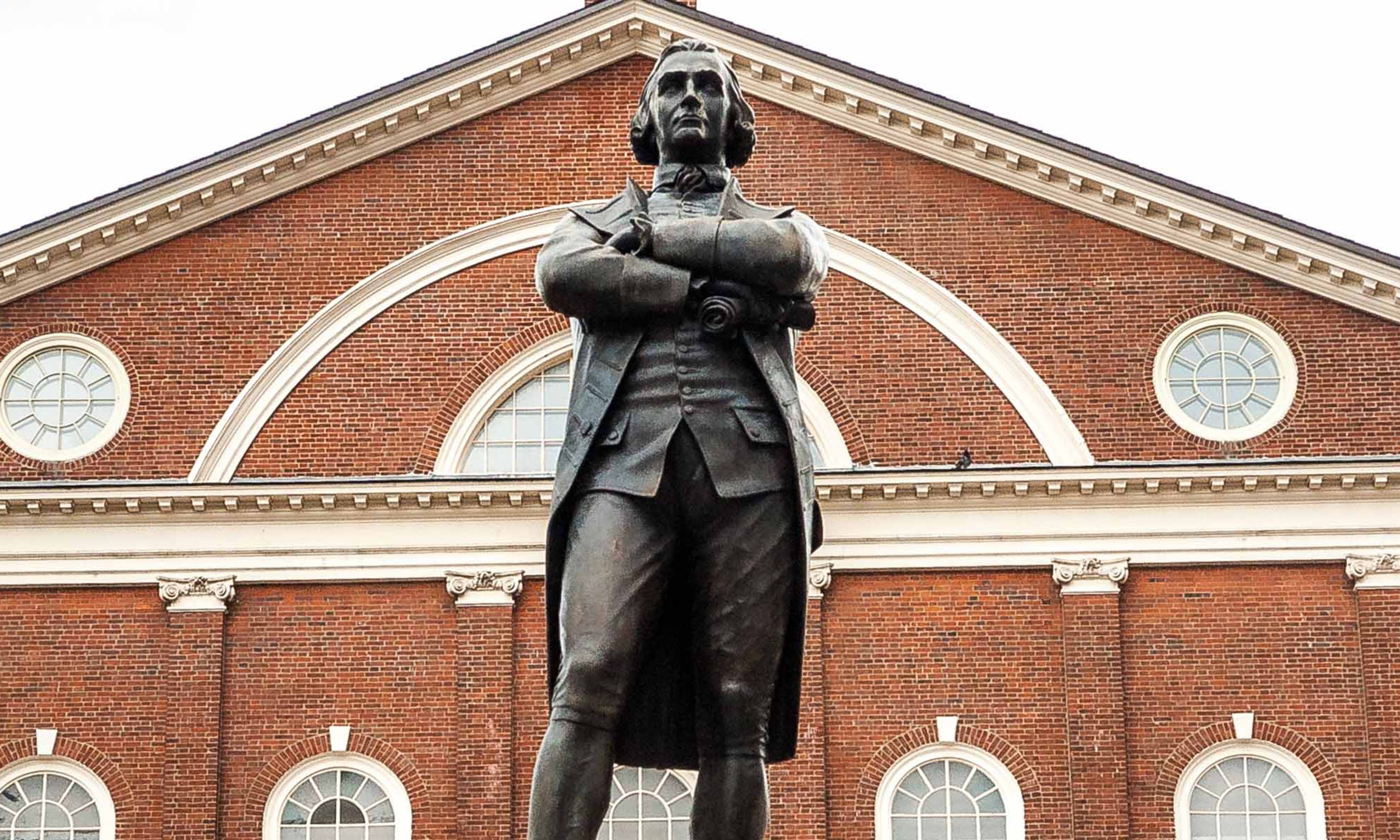
When John Adams arrived in France in 1778 to represent the new United States of America, everyone he met assumed he was “le fameux Adams” — Samuel. When he explained that he was not, he became “a man of no consequence — a cypher.”
After David McCullough and a million presidential place mats, it is hard to recover that sense, universal then here as well as in Europe, that the Adams who counted was Samuel, the older of the two cousins. Stacy Schiff, Pulitzer Prize–winning biographer of Vera Nabokov and Cleopatra, among others, aims to restore him to his proper place in the Revolution’s story, and in our memory.
Samuel, son of a prosperous brewer, was born in Boston in 1722 when it was the largest town in British North America and one of the largest in the English-speaking world. Commerce, flowing through Boston’s port, gave it prominence. Also problems: A mid-century currency crunch impelled local merchants, including Samuel’s father, to back the Land Bank, an institution that issued its own notes. When Parliament suppressed the Land Bank as inflationary, it created a political grievance — London had reached deep into local affairs — and a personal one — Samuel’s father was ruined.
Samuel dedicated his life to politics, to the exclusion of almost everything else. He inherited the family brewery, which he ran into the ground. He served as a tax collector, also incompetently. (He had little incentive to dun potential constituents.) What he excelled at was networking and outreach — meeting and greeting, talking and listening, writing. He joined or befriended artisans’ clubs with portentous fraternal names (e.g., the Loyal Nine). He published several different newspapers, one after another, filling their columns with series of essays, all pseudonymous according to the industry standard of the day. In 1765 he won a seat in the Massachusetts house, the lower, elected branch of the colonial legislature.
In person he was a man of simple tastes. (He lacked the wherewithal for anything more elaborate, but that never bothered him.) He had two wives (the first died), both named Elizabeth, both pious, both beloved: He called his second wife’s letters “cool water to a thirsty soul.” He was devoted to his children, and devout, singing hymns in a sweet voice.
Schiff faces a problem that has hampered every Adams biographer — a meager paper trail. Adams kept no diary, and was as careless with correspondence as he was with accounts. Many of his letters were burned for safety’s sake; many more communications were never written down in the first place. She mines his journalism and third-party accounts of him, both admiring and hostile, and presents the public events in which he was involved (often offstage) as dramatic set pieces.
Four big events spanning a decade anchor her narrative. In 1765, Parliament levied a stamp tax on all paper used in the colonies, from legal documents to playing cards. A Boston mob hanged the local tax collector in effigy and plundered the mansion of lieutenant governor Thomas Hutchinson. British regulars sent to maintain order were regularly jeered in the streets. In 1770 a patrol fired on a hostile crowd, killing five: deaths immortalized as the Boston Massacre. The accused soldiers were acquitted or given reduced sentences. Parliament levied yet another tax three years later, on tea. Boston’s response this time was surgically precise: A party of raiders boarded the tea-bearing ship, unloaded 342 chests, and threw them, and nothing else, into the harbor.
Adams’s roles in these events were hidden, sometimes indirect. One Schiff description will serve for all: “a masterpiece of actor-free drama.” Adams publicly deplored the 1765 riot after the debris settled. He denounced the Boston Massacre but may well have induced his cousin John to defend the British soldiers who fired on the crowd, when they were tried for murder. Massachusetts had to demonstrate that it was a rational society oppressed by an unjust occupation, not a lawless hellscape; the defendants were acquitted. Samuel attacked the tea tax up to almost the very moment the chests went in the water, yet he had no provable connection to the raiders.
His influence was ideological, and organizational. London and its loyalist supporters in America made plausible arguments that required refutation. Revenue was needed to pay down the debt incurred by the Seven Years’ War, fought in great part for the colonies’ benefit; why shouldn’t the colonies help pay? Adams in his journalism argued over and over again that the manner in which taxes were laid — by Parliament — and enforced — by officers beholden to it, not to local government — infringed on settled practice and violated natural rights. His polemics won minds. His shoe-leather politics enlisted allies, from wealthy pols to harbor rats. He reached, via committees of correspondence, beyond Massachusetts’s borders, wooing and rallying like minds the length of British North America. Beware, he warned: What London is doing to us may be done to you.
The most prominent of Adams’s political allies at home were also often the least reliable. James Otis, a brilliant orator, was erratic, finally insane. (A blow to the head in a fight with a customs collector did not help.) John Hancock, wealthy merchant and smuggler — in Boston the two were nearly synonymous — paid the bills but was vain and susceptible at times to loyalist flattery. Cousin John, who had the longest postrevolutionary career, never stinted his praise of Samuel, as regularly cited by Schiff.
Samuel Adams’s most relentless critic, also a frequent Schiff witness, was Thomas Hutchinson, who clashed with him all the years he served as lieutenant governor and governor. Scion of an old colonial family, Hutchinson loved Massachusetts and its history and conceived himself to be safeguarding its place in a friendly and protective empire. If he scattered jobs on his sons and in-laws while doing so — a mark of his wickedness, in Adams’s eyes — that was the way politics worked. Hutchinson for his part was convinced that Adams schemed for independence from Day One.
Did he? Schiff does not know. “He appears,” she writes, “to have moved gradually from redress to revolt, making an art in between of resistance.” This is well said, and probably the best anyone can say.
Was revolution inevitable? “There was no plot against America,” Schiff declares at one point in her narrative. This strikes me as wrong. Britain began tidying its empire after its expensive mid-18th-century victories. That meant a firmer hand across the Atlantic. Structure created its own plot.
Conservatives who study Adams’s methods will find many resemblances to Black Lives Matter and Antifa, the alt-right and January 6. Media howling; cancel culture (those hanged effigies); street theater; destruction of property. The American Revolution was not some organic Burkean outgrowth. (Neither was the Glorious Revolution, the source of the order that Burke defended, which is why he blunted its rough edges.) Adams and the allies he gathered around him sought to alter the system of government under which they lived, and to shatter an empire. Their justification must be that government and empire had changed first, clipping American liberties without Americans’ consent and without the possibility of recovery. If we play a game and lose, we accept the result. If we can’t play in the first place, we leave the game.
The British troops who fired on militia at Lexington, Mass., on the morning of April 19, 1775 — Schiff’s fourth big event — had orders to arrest Adams and Hancock, who had fled Boston and secreted themselves in the village parsonage until alerted by Paul Revere. The colonies greeted the news of this and subsequent clashes with war. The Adams cousins represented Massachusetts in the Continental Congress, meeting in Philadelphia, which directed the effort. They kept a relatively low profile there, so as not to give the impression that America was being dragged into war by one colony. They were the men who nominated George Washington, a Seven Years’ War veteran from Virginia, rather than their compatriot John Hancock to be commander in chief. When, after a year of conflict, Congress finally resolved on independence, Samuel signed the official declaration, but John Adams, not Samuel, was tapped to serve on the committee that drafted the document.
There would be a few more significant events in Samuel’s life — questioning, then endorsing, the proposed Constitution of 1787; chiding his fellow polemicist Thomas Paine for his irreligion. Schiff passes over these in haste, or in silence. Samuel Adams died in 1803, but his work had been completed years before. He had made a revolution. Others would defend and define it.












Comments