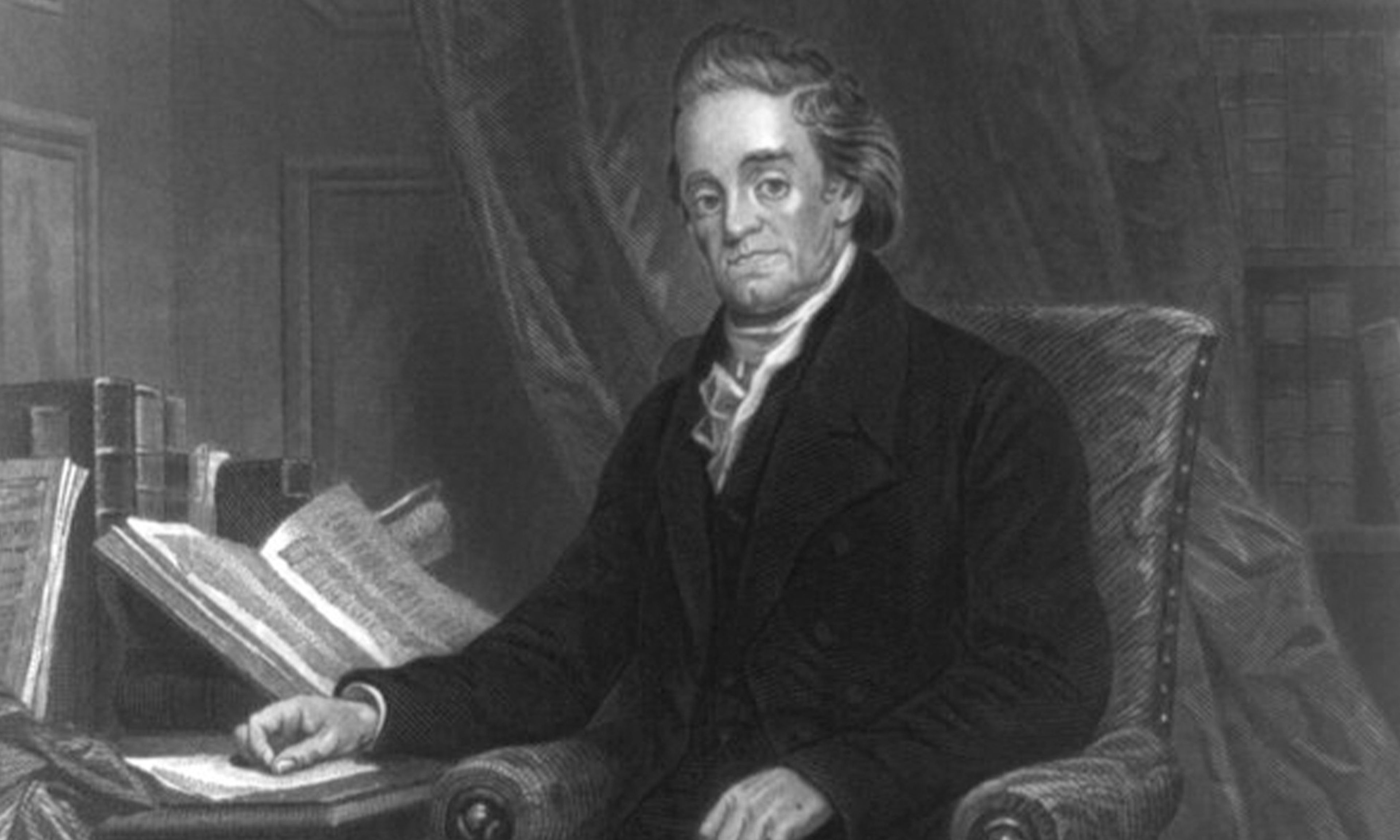
In 1790, Noah Webster experimented with an “improved” method of English spelling. He published a book, A Collection of Essays and Fugitiv Writings, that was replete with passages like this: “The liberal and eminently lerned men, who conduct the guvernment of Virginia, (and many of their leeding karacters are of this description) should not view the ministers of religion, in America, az destitute of that odious and tremendous authority over human consciences, which waz assumed under the papal hierarky.”
Webster had been influenced by his friend Benjamin Franklin, who wanted to reform English spelling. Like Franklin, he attributed opposition to spelling reform primarily to habit, indolence, and timidity. But when he tried his reforms — with words like az, breefly, cleer, dezerv, geografy, haz, hiz, tru, valu (there were thousands of others) — he drew stinging criticism. The journalist Ebenezer Hazard denounced this “new mode of spelling recommended and exemplified in the fugitiv Essays ov No-ur Webster eskwier junier, critick and coxcomb general of the United States.”
Duly chastened by a chorus of scorn, Webster mostly stifled his reformative impulse when issuing spelling books and dictionaries. But it didn’t stop him from constant orthographic fiddling. He made what he thought might be salable changes. The trouble, as we saw in part I, was that his tinkering from the 1780s to the 1820s had led to a profusion of inconsistencies between books and even within single books. And two of these were dictionaries!
Beginning in the 1820s, Webster’s chief antagonist was Lyman Cobb, who was successful enough that his own competing books, a speller and an abridged dictionary, were becoming best sellers throughout North America. Cobb’s speller alone sold 4 million copies. He promoted his own work mainly by trashing Webster as hopelessly unreliable.
Cobb’s harangues appeared in a barrage of newspaper editorials — just after Webster had completed his 1828 magnum opus, An American Dictionary of the English Language. That big two-volume work, as Cobb noted with plentiful examples, abounded with words spelled one way as main entries but differently throughout the text. For example, Webster had entries under cipher and stupefy, but then he used the spellings cypher and stupify in other entries. Multiply instances like those by the hundreds.
Webster was exhausted from decades of work, and he knew Cobb was scoring points against him. His big dictionary — the most significant and extensive work of lexicography since Samuel Johnson issued his enormous dictionary in 1755 — wasn’t selling well because of its cost and size. Webster realized that a cut-down version would have greater commercial appeal. But he had no energy for it.
So in early 1828, Webster entrusted his son-in-law, Professor Chauncey Goodrich of Yale College, to oversee an abridgment. Earlier that same year, Goodrich had seen a newly issued American abridgment of Johnson’s dictionary — by Joseph Worcester of Cambridge, Mass. Together with Webster’s publisher, Sherman Converse, Goodrich hired Worcester to condense the big book into a single handy volume.
Persuading Worcester wasn’t easy. He planned to do his own dictionary, he said. He had already begun work. But finally, with generous blandishments of cash, he relented. The project would postpone his own dictionary by only ten months, and he’d be doing a service to American lexicography by regularizing Webster’s great work. The idea was to moderate Webster’s controversial spellings and pronunciations, remove the etymologies, and drastically shorten the definitions to create a small book with wide appeal.
Meanwhile, Webster was busy revising the Bible by obscuring everything relating to sex and violence. While he was bowdlerizing the Good Book, he paid little attention to what was going on with the abridgment of his dictionary. When in 1829 the smaller dictionary appeared — a version that deleted almost everything distinctively Websterian — he became enraged.
His anger led him to a financially disastrous decision: To distance himself from the shortened book, he sold the copyright to Goodrich and cut the Goodriches from his will. From that point on, it was effectively Goodrich who controlled the spellings in Webster dictionaries. At $6 per copy, Goodrich’s “Webster” sold briskly for many decades. Webster himself came out with a revised dictionary in 1841, two years before his death, but it didn’t sell well. Goodrich flourished; Webster didn’t.
What had Goodrich done? He had defanged Cobb’s disparagements by adopting mainstream spellings, which also eliminated any advantage that Worcester’s new dictionaries might have on this score. At the same time, Goodrich provided more fodder for Cobb’s attacks by causing variable spellings to proliferate in Webster’s in-print books. Yet Goodrich’s spellings proved successful.
After Webster’s death in 1843, Goodrich engaged Yale colleagues to remake Webster’s dictionaries in various formats, excising almost all that remained of his father-in-law’s extravagant quirks. This period, from the late 1840s to the 1860s, marked the ascendancy of what we now know as Merriam-Webster dictionaries.
Another son-in-law, William C. Fowler, was furious at Goodrich the family traitor — and wildly envious. In 1845, Fowler unsuccessfully tried his hand at a Webster dictionary, restoring the patriarch’s spellings and boldly announcing in the preface that all future dictionaries would adopt these spellings — by vote of the Webster family. But this had no effect on Goodrich, whose spellings soon prevailed throughout the land.
And that, in brief, is how Americans arrived at an orthodox orthography, how Merriam-Webster first eclipsed its competitors, and how the name Webster became synonymous with dictionary. Goodrich made it so.










Comments