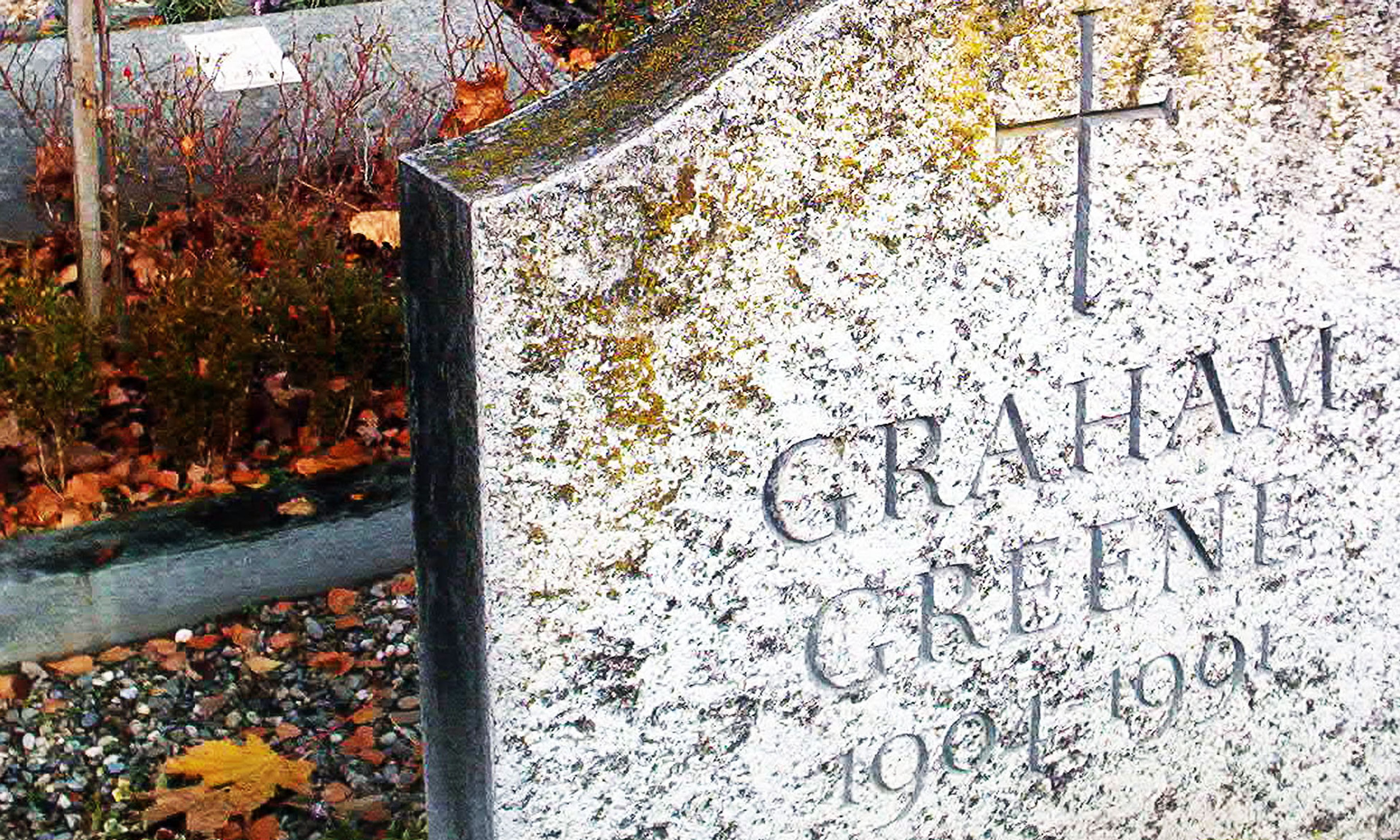
Sixty years ago, Graham Greene was widely regarded as an important novelist, perhaps even a great one, both in England and in America. His critical admirers included V. S. Pritchett, John Updike, and his close friend Evelyn Waugh, who called him a writer of “the highest imaginative power.” He was also very popular, in part because several of his books, most notably Brighton Rock (1938), The Third Man (1949), and Our Man in Havana (1958), were turned into successful films, often with his direct involvement (he was one of the first writers of stature to take a close interest in the screen). Moreover, the fact that Greene was a knee-jerk America-hater who could refer with a straight face to “Stalinist capitalism” and flaunted his friendship with Kim Philby, the infamous double agent who worked for Britain’s MI6 while transmitting secret information to his Moscow handlers, doubtless enhanced his stature in similarly inclined circles on both sides of the Atlantic.
But Greene, who died in 1991, is no longer as popular or admired in this country as he used to be, and if I had to guess, I’d say the reason is that his major novels are permeated with more or less explicitly Catholic themes and symbolism. Time was when Catholic novelists such as Greene and Waugh were well regarded, even fashionable, but religious faith has long since been shunted into a cultural siding, and today’s Catholic artists are treated contemptuously by most modern-day tastemakers. Even the radically idiosyncratic version of Catholicism espoused by Greene, who called himself a “Catholic-agnostic” and made a priest in Brighton Rock speak of “the appalling strangeness of the mercy of God,” is too often greeted nowadays with not-our-kind-dearie sniffishness.
It doesn’t help that Greene has been unlucky in his biographers. Norman Sherry, whose three-volume life was authorized by Greene, produced an unreadably obese hagiography, while Michael Shelden’s Graham Greene: The Enemy Within is so determined to paint its subject in lurid colors that it fails for the opposite reason. Not so The Unquiet Englishman, a new biography by Richard Greene (no relation) that recounts his complicated tale fairly, laying out the long story of Greene’s elaborate sex life without stooping to gratuitously salacious detail. The Unquiet Englishman is written without much style (it contains too many donnish jokes) and fails to convey what it was that made Greene catnip to women, but in every other respect it tells you what you want to know with efficient clarity.
One thing that The Unquiet Englishman makes clear is that Graham Greene was as strange as the characters in his novels. The original British edition of the book is called “Russian Roulette,” a game Greene claimed to have played for real and that he played, metaphorically speaking, in countless other ways. In addition to being a heavy drinker and frequent drug abuser (opium seems to have been his preferred tipple) who made several suicide attempts and suffered from what Richard Greene diagnoses, I think accurately, as a case of bipolar disorder, he was also what we now call a sex addict, congenitally incapable of any form of monogamy. All things considered, it’s a wonder that he died not at the hands of a vengeful husband or lover but in a hospital bed at the august age of 86.
Perhaps not surprisingly, some of Greene’s critics felt there to be something specious about his conversion to Catholicism in 1926, especially since, in Bruce Bawer’s words, “Greene seems to have disposed of so much of Catholicism that there would appear to be no reason to call it Catholicism and not something else.” George Orwell found Greene’s homemade brand of Catholicism to be unconvincing in the extreme, claiming in a New Yorker review of The Power and the Glory that Greene “appears to share the idea, which has been floating around ever since Baudelaire, that there is something rather distingué about being damned; Hell is a sort of high-class nightclub, entry to which is reserved for Catholics only.”
But Orwell, who had no use for religion of any kind, missed the point: For Greene, the sinner was uniquely close to and knowledgeable of God. As a result, his specifically Catholic novels typically hinge on a situation in which a Catholic is forced to choose between behaving “morally” and committing mortal sin in order not to hurt another person. Even when he was not writing about Catholic characters, Greene was irresistibly drawn to analogous premises. The best-known example is The Third Man, in which the lover of a heartless, even sociopathic racketeer refuses to cooperate with the police to send him to prison, not because she doubts his guilt, or the monstrousness of his behavior, but simply because she cannot stop loving him: “I don’t want to see him again, I don’t want to hear his voice. I don’t want to be touched by him, but I won’t do a thing to harm him.”
No less striking is the aspect of Greene’s novels to which Richard Greene refers when he says that “Greene claims for Catholicism the power of naming truthfully what is worst in life. As an old man he would drop his belief in a Hell beyond this world, but he continued to regard the life we are born to as hellish, or at least purgatorial.” Pinkie, the vicious but ultimately pitiable antihero of Brighton Rock, puts it more succinctly: “These atheists, they don’t know nothing. Of course there’s hell.”
How did a writer whose books are driven by such moral premises — especially one who saw sex as a sin and suffering as the one true path to purification — ever become so popular? Because Greene was also, in Evelyn Waugh’s carefully chosen words, “a story-teller of genius.” Significantly, Waugh compared Greene to Somerset Maugham, another great storyteller whose prose style was undistinguished but who nonetheless had an uncanny flair for telling tales that captivated the reading public. Indeed, Greene long divided his books into “entertainments,” incident-packed crime thrillers such as A Gun for Sale (1936) and The Ministry of Fear (1943) that were frequently laced with touches of macabre humor, and serious novels such as The Power and the Glory (1940), The Heart of the Matter (1948), and The End of the Affair (1951), which nonetheless contained elements of melodrama. Yet even these latter books are written with a sure sense of what the common reader will find involving, and it is not unfair to call them, in the best sense, middlebrow novels.
Small wonder, then, that Greene’s work, like that of John Steinbeck, works so well on the big screen, not least when he himself wrote or collaborated on the screenplays. A first-class film critic who understood the medium intimately, he worked hand in hand with Carol Reed, the director of the three finest films made of his work, The Third Man, The Fallen Idol (adapted from “The Basement Room,” a 1936 short story), and Our Man in Havana, all of which are as impressive as their source material. He even claimed that his prose incorporated his knowledge of film: “When I describe a scene, I capture it with the moving eye of the cine-camera rather than with the photographer’s eye — which leaves it frozen.”
Elsewhere, though, it is essential to read Greene’s novels to get a clear sense of their quality (especially since most of the other film versions were softened in order to make them more palatable to prudish viewers). And how do they hold up today? For my part, I admire the entertainments without reserve but have lingering doubts about some of the straight novels. I have long been struck by Edmund Wilson’s description, apropos of The Power and the Glory, of what he found most impressive about Greene’s work:
Mr. Greene is extremely successful in creating a squalid and painful world. He has a palette of sour colors, a repertory of sickening suggestions, a talent for selecting and rubbing in unpleasant details of modern civilization, such as cheap panes of stained glass, inferior dental drills, and insipid correspondence courses, that make good writing and are entirely his own.
Yet Wilson had mixed feelings of his own about The Power and the Glory, especially by comparison with The Confidential Agent (1939), in many ways the best of Greene’s entertainments: “Dispensing with the excitement of the mystery story, Mr. Greene has not wholly succeeded in creating the higher kind of excitement.” I incline to agree, which is why I cannot go along with Richard Greene in judging him to be “one of the most important figures in modern literature.” But when Graham Greene was good, he was quite extraordinarily good, and if he was, in fact, a middlebrow, then he was surely a middlebrow of genius, a consummate craftsman who elevated his melodramatic plots by infusing them with a preternatural awareness of the power of evil to immiserate the human soul. Anyone in search of high-class literary entertainment could do a lot worse than that.












Comments