In his 2008 compendium “Have You Seen . . . ?”: A Personal Introduction to 1,000 Films, the prolific and engagingly garrulous film critic and historian David Thomson judges Hiroshima Mon Amour (1959) to be an unquestioned masterpiece. “We recall the first shock this great film ever gives us,” he writes with characteristic enthusiasm, “the astonishing title, and the cinema’s insistence that the epitome of disaster and the most treasured thing can be put side by side.” Thomson explores that paradox — or seeming paradox — with mixed success in his latest book, Disaster Mon Amour. He promises that he will “try to keep a straight line with the argument,” but warns readers of “unexpected” twists in the presentation. The warning is well deserved, the promise only fitfully kept.
Thomson is perhaps best known for his monumental and idiosyncratic The New Biographical Dictionary of Film, first published in 1975 and now in its sixth edition. He is an energetic and graceful writer, if a sometimes cryptic one. Passionate appreciations and denunciations, as well as an apparently inexhaustible knowledge of the history of film and the technical aspects of moviemaking, are hallmarks of his work. At 81, he continues to react to movies with the fascination and ardor that first gripped him as a teenager in the movie houses of his native London. He revisits the juxtaposition of horror and beauty in Hiroshima Mon Amour on the first page of his new book. Thomson describes how the lovers’ “ecstatic bodies, abandoned yet yearning, provide our most enigmatic rapture, waiting for death or striving to be born. . . . You can decide that the pinnacles of cinema are disaster and rapture, and so they are twinned.”
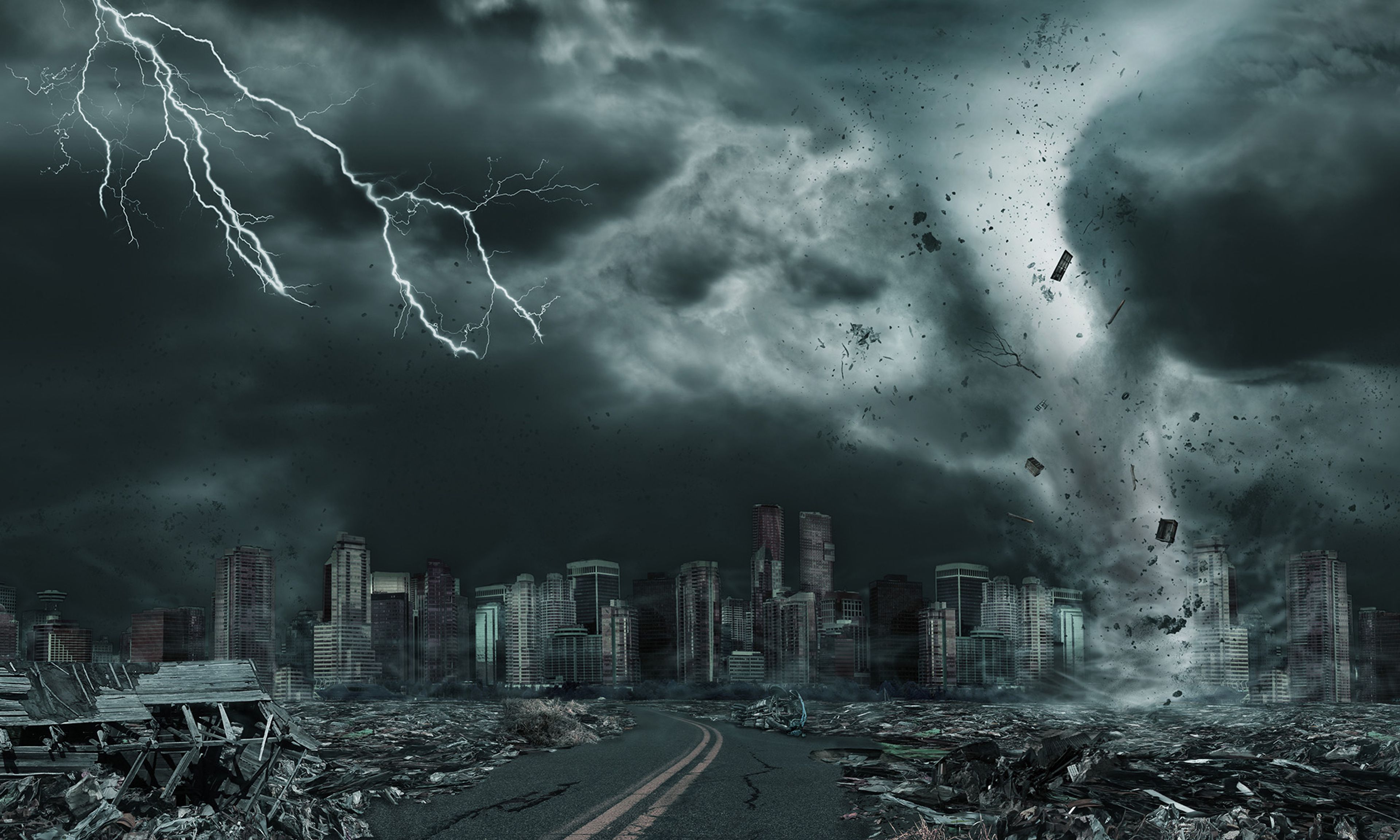
Disaster and a kind of rapture are also at work, Thomson provocatively argues, in the contemporary blockbuster and guilty pleasure San Andreas, about an earthquake and tsunami that, thanks to the miraculous “realism” of computer-generated imagery, wipe out the Hoover Dam, the Golden Gate Bridge, most of San Francisco, and countless toy human figures. It is a fantasy that Thomson, long a San Francisco resident, is keen to embrace as well as dissect. “The devastation at Hoover Dam is a sweet marvel,” he writes of the technical mastery of the filmmakers. “And that is a secret to disaster films — we want our fears of physical ruin rendered as something so beautiful we feel no pain.”
One might ask whether the “twinning” Thomson celebrates is more a danger to our grasp of the insistent realities of pain, death, and sexual desire than an imaginative exploration of them. But Thomson is determined to press the point, if only to focus the reader’s attention on the fantasy world that film so powerfully evokes in us. Watching San Andreas’s orgy of cataclysmic destruction, he gets “some of the same elation I feel in watching Fred and Ginger float across a polished floor to the sound of their clacking heels.” I get that, but still want to insist that Fred and Ginger are palpably more than digital confections, and thus better guides to our inner lives.
Disaster Mon Amour is loosely structured around Thomson’s efforts to make sense of the calamitous events of 2019–20. Movies often take a back seat here in what is part pandemic diary, part political narrative (he is a devoted reader of the Times and an MSNBC viewer), and part Cassandra-like lament on the approaching climate apocalypse. Other disasters that occupy Thomson’s thinking include George Floyd’s killing and the Black Lives Matter demonstrations, slavery, the homelessness crisis, President Trump’s Bible moment in Lafayette Square, JFK’s assassination, and the prospect of nuclear annihilation. More distant or esoteric concerns include the Black Death (1346–53), Ernest Hemingway’s lost manuscripts, Cormac McCarthy’s novel The Road, and much else. Alas, few readers, regardless of their political or philosophical persuasion, will be eager to revisit the events of 2019–20 in the impressionistic detail on offer here.
Of course, as Thomson explains, movies have long trafficked in disaster. Many moviegoers share his love of beautiful and magnificently staged catastrophe, both comic (Laurel and Hardy are particular Thomson favorites) and deadly. In the trade, according to novelist and screenwriter John Gregory Dunne, such lethal spectacles are called “whammies.” “The whammies being special effects that kill a lot of people, usually bad people, but occasionally, for motivational impact, a good person,” Dunne wrote in Monster: Living Off the Big Screen. Dunne tells how he and his wife, Joan Didion, failed in their attempt to rewrite a script for such a disaster film. He asked the movie’s director how the rewrite should go. “‘First act, better whammies,’ he said. ‘Second act, whammies mount up. Third act, all whammies,’” was the response. Dunne confessed that he and Didion had no talent for imagining how such a concatenation of violent events might work.
One of the more memorable “whammies” in the history of movies came at the end of the Academy Award–winning The Bridge on the River Kwai (1957), directed by David Lean and starring Alec Guinness and William Holden. Led by Guinness’s rigid and myopic British colonel, prisoners of war are compelled to build a bridge over the Kwai River in Thailand to complete a Japanese rail line to Burma. The colonel wins a theatrical battle of wills with the camp’s commander, thereby earning the devotion of his fellow prisoners. He convinces his captors that building the bridge in the superior British fashion, and allowing his officers to command their own troops, will improve morale and discipline, which indeed it does. Ironically, it also results in aiding the Japanese war effort. In the climactic scene, the colonel recognizes that his hubris and rule-bound sense of duty have blinded him to the larger realities of the war. In his dying moments, he collapses on a detonating device, blowing up the bridge he had so proudly built, just as a Japanese troop train is crossing. Before our age of digital filmmaking, the building and destruction of that movie bridge cost $250,000 in 1950s money. In other words: third act, all whammies.
Is it naïve to ask more of moviemakers? Aren’t these entertainments, these “sweet marvels,” essentially harmless? The literary critic Ian Watt (1917–1999) thought not. He wrote a remarkable essay in 1971 titled “‘The Bridge over the River Kwai’ as Myth,” a myth that he thought engendered dangerous fantasies of childlike omnipotence in the moviegoing public. The Bridge on the River Kwai was based obliquely on actual events, events Watt had intimate knowledge of. He had been one of the British prisoners who helped to build a bridge on the Kwai. He thought the stagey confrontations between the colonel and the Japanese camp commander demonstrated an obliviousness to what was humanly possible in such camps. The reality of the camp — the lack of food, clothes, and medicine, the impossibility of escape or rebellion, the constant threat of internal discord among the prisoners — did not allow for the sort of histrionics shown by Alec Guinness’s character. As a consequence, millions of moviegoers thought they were “seeing what something is really like when actually they are not.” The bridge in the movie, Watt noted, “was totally beyond the technical means and the military needs of the actual bridges over the Kwai; and its great beauty soon made one forget the sordid realities of the war and the prison camp.” What Watt called the “Big Bang” of blowing up the bridge was a cartoon solution to movie-scripted problems. In such films, Watt complained, “historical and political and psychological reality became infinitely plastic to the desires of the audience.”
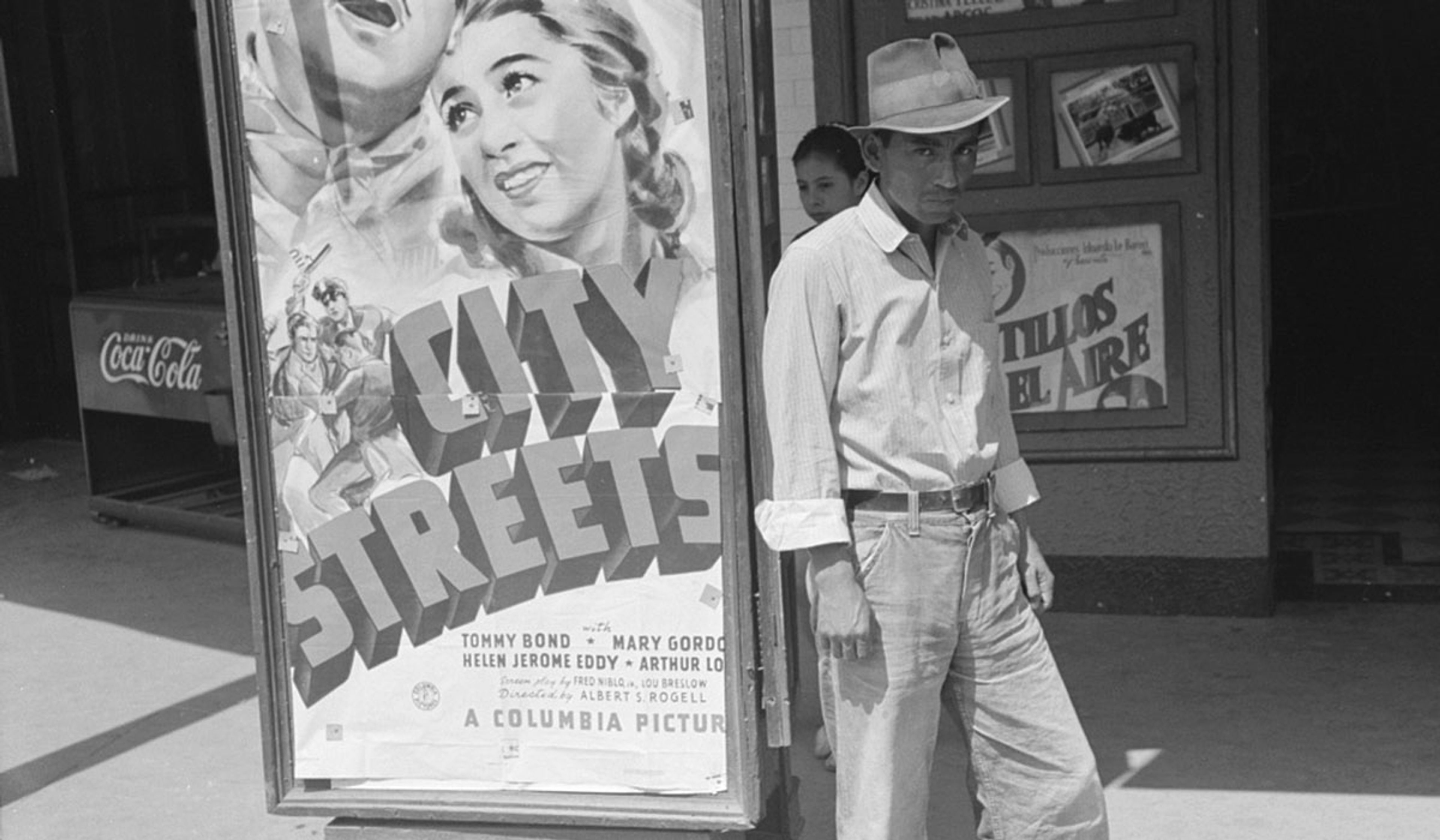
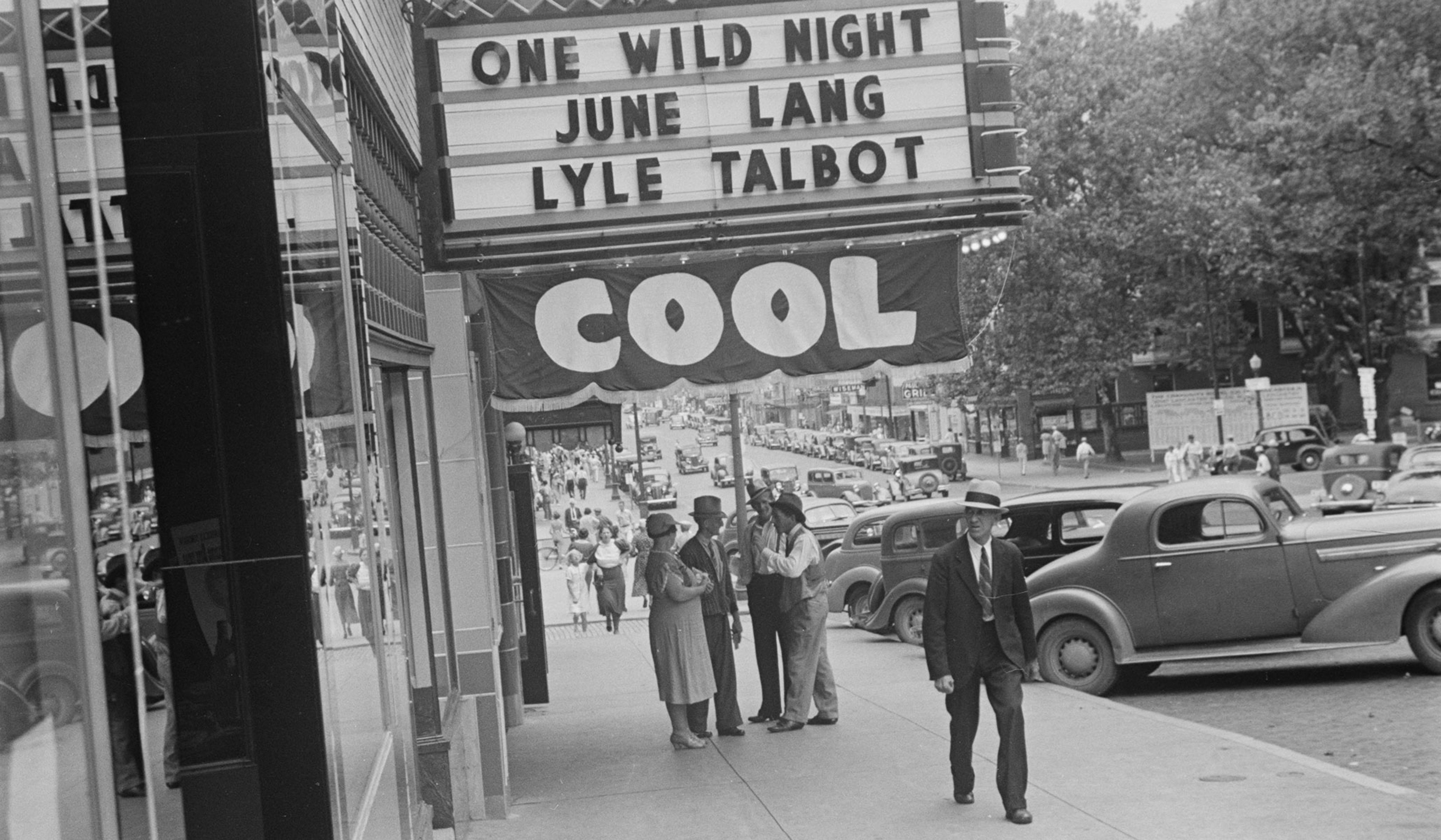
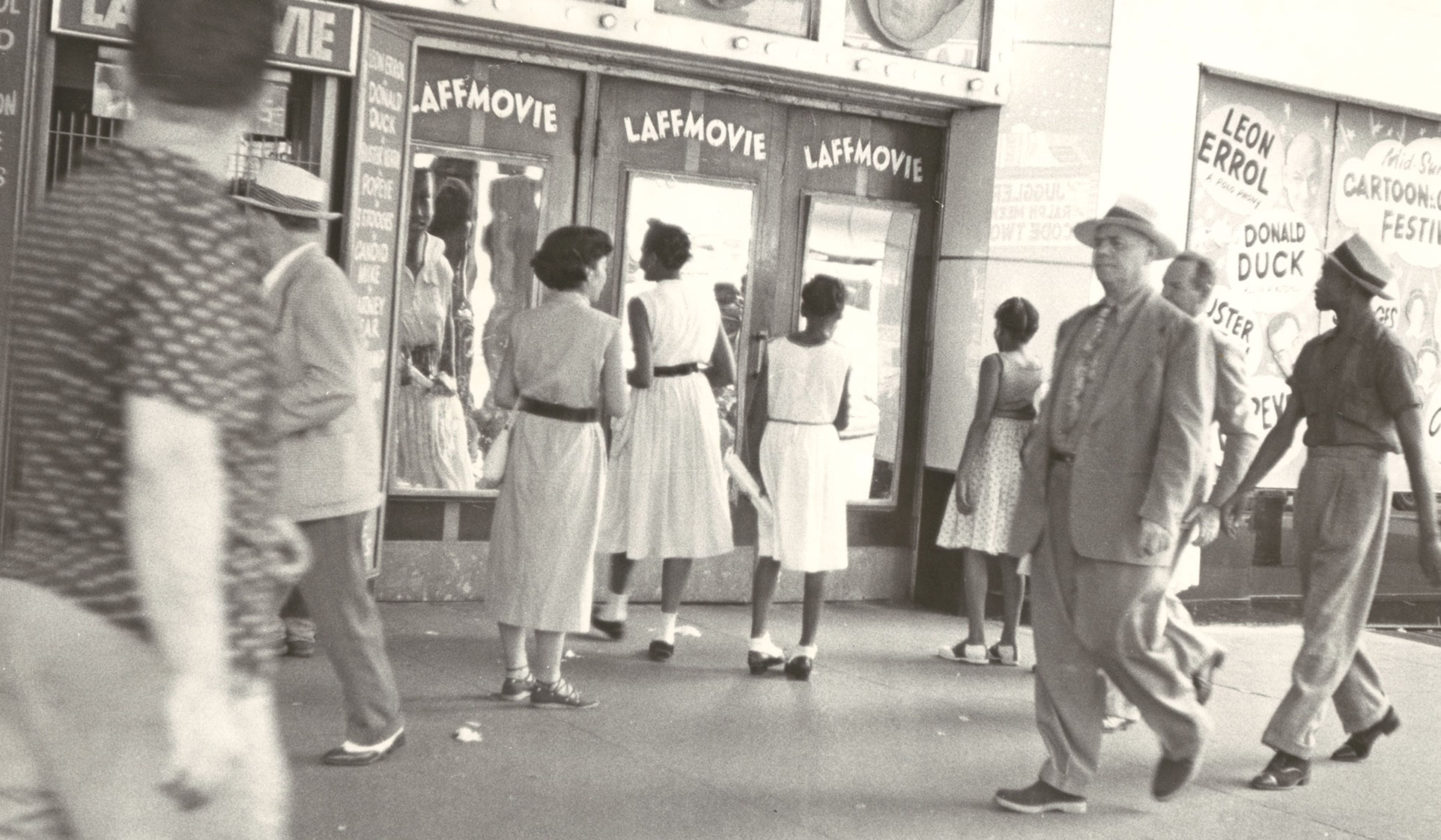
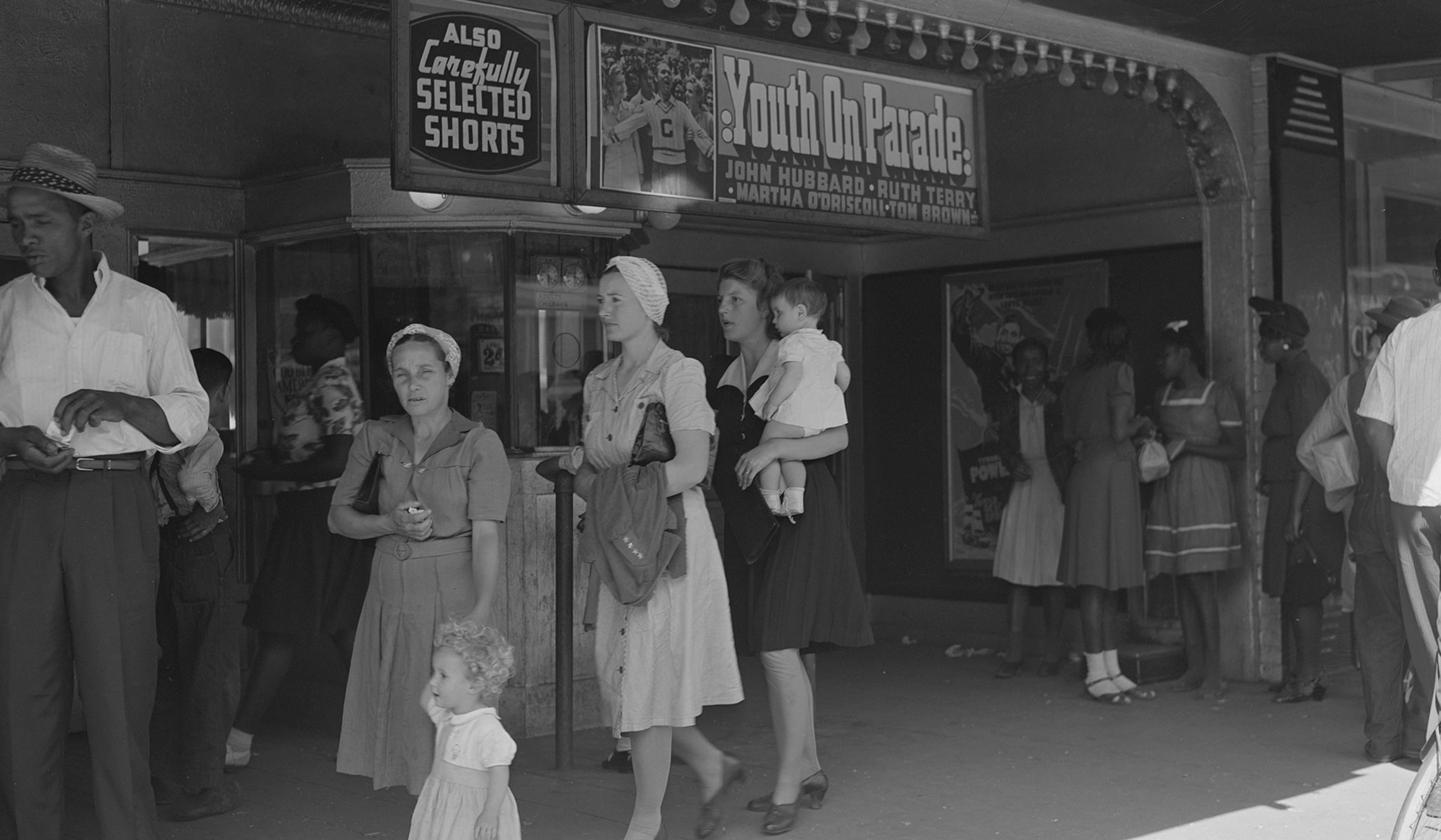


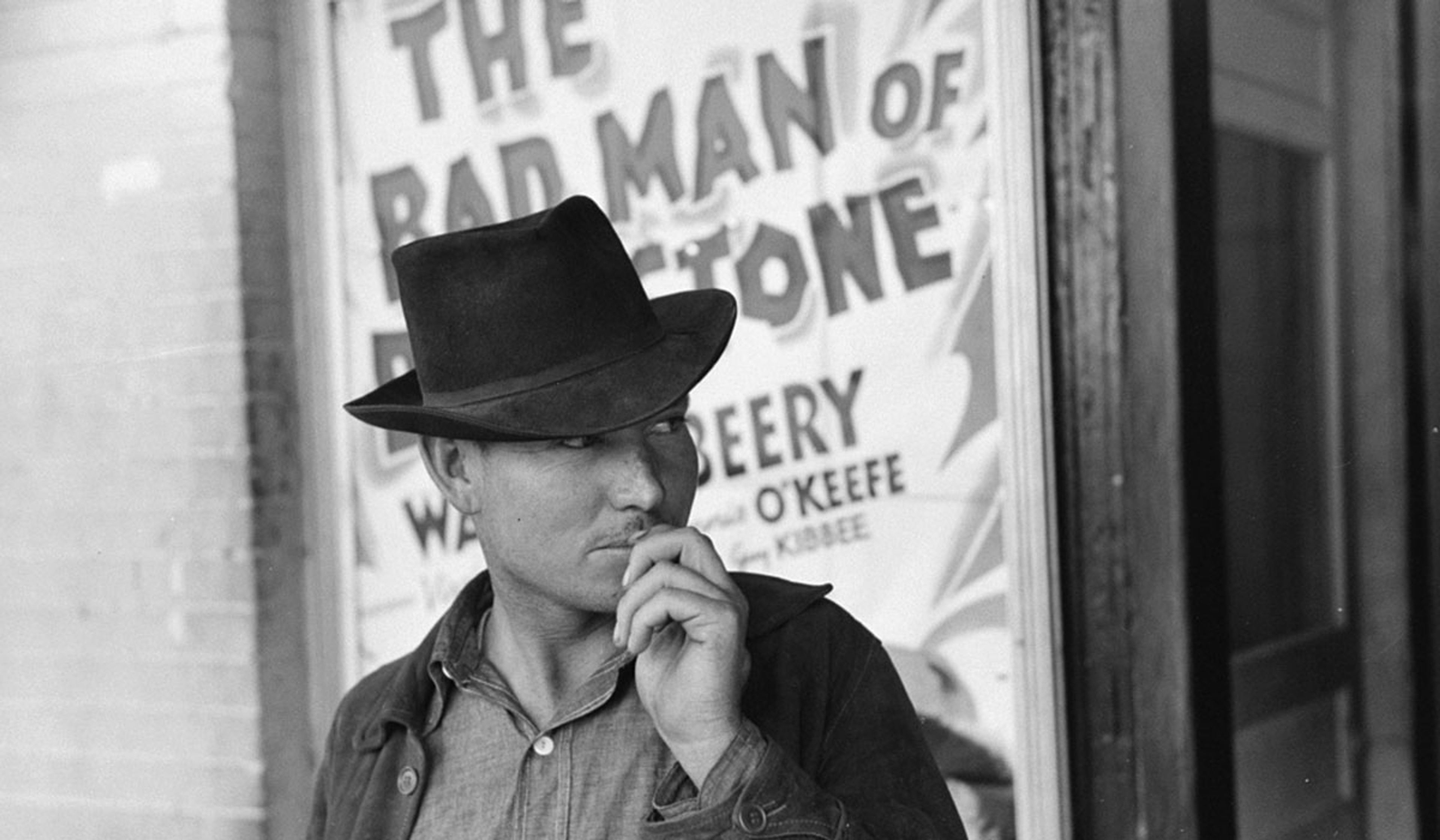

Man outside a movie theater in San Antonio, Texas, next to a poster for City Streets, March 1939.
Lee Russell/Farm Security Administration/Library of Congress
Survival in Watt’s camp was accomplished under the leadership of an officer who, insisting his troops face up to their radically circumscribed reality, placed order, discipline, solidarity, and compromise over futile acts of resistance. Imagining one could subvert the dominance of the Japanese or vanquish them by an act of individual heroism or a thrilling “whammy” is the worst kind of Hollywood make-believe.
Does indulging in such fantasies immerse us imaginatively in the paradoxical nature of our fascination, even longing, for destruction or death, as Thomson suggests? Watt was under no illusion that a film could dwell on the ugliness and tedium of life in such camps. But in prettifying that life, it told a lie that shaped public expectations about war in formative ways. “The actual circumstances of our experience on the Kwai were overwhelmed by the deep blindness of our culture both to the stubbornness of reality and to the continuities of history,” he wrote of the movie’s enormous popularity.
When you put real-life disasters on the table alongside movie mayhem, as Thomson does, riffing on our pleasure in vicariously escaping the inevitable doesn’t take us very far. Much of what Thomson writes about the perverse attraction exerted by disaster, or about the everyday presence of death, is commonplace. Let’s not forget George C. Scott as Patton looking out at a battlefield of horrendous carnage and confessing, “I love it. God help me I do love it so. I love it more than my life.” And then there are W. H. Auden’s fearless lines: “About suffering they were never wrong, / The Old Masters: how well they understood / Its human position; how it takes place / While someone else is eating or opening a window or just walking dully along.”
Contemplating our long history with the threat of nuclear Armageddon, Thomson asks: “Isn’t there a pervasive fatalism now that says, I know the world is ending, so I’m going to have a good time while I can?” That is an idea prisoners of war might entertain, but not one that would help keep them alive. As Watt reminded us, we can be clear-eyed about the inescapable pain, rather than the seductive beauty, of physical ruin.












Comments