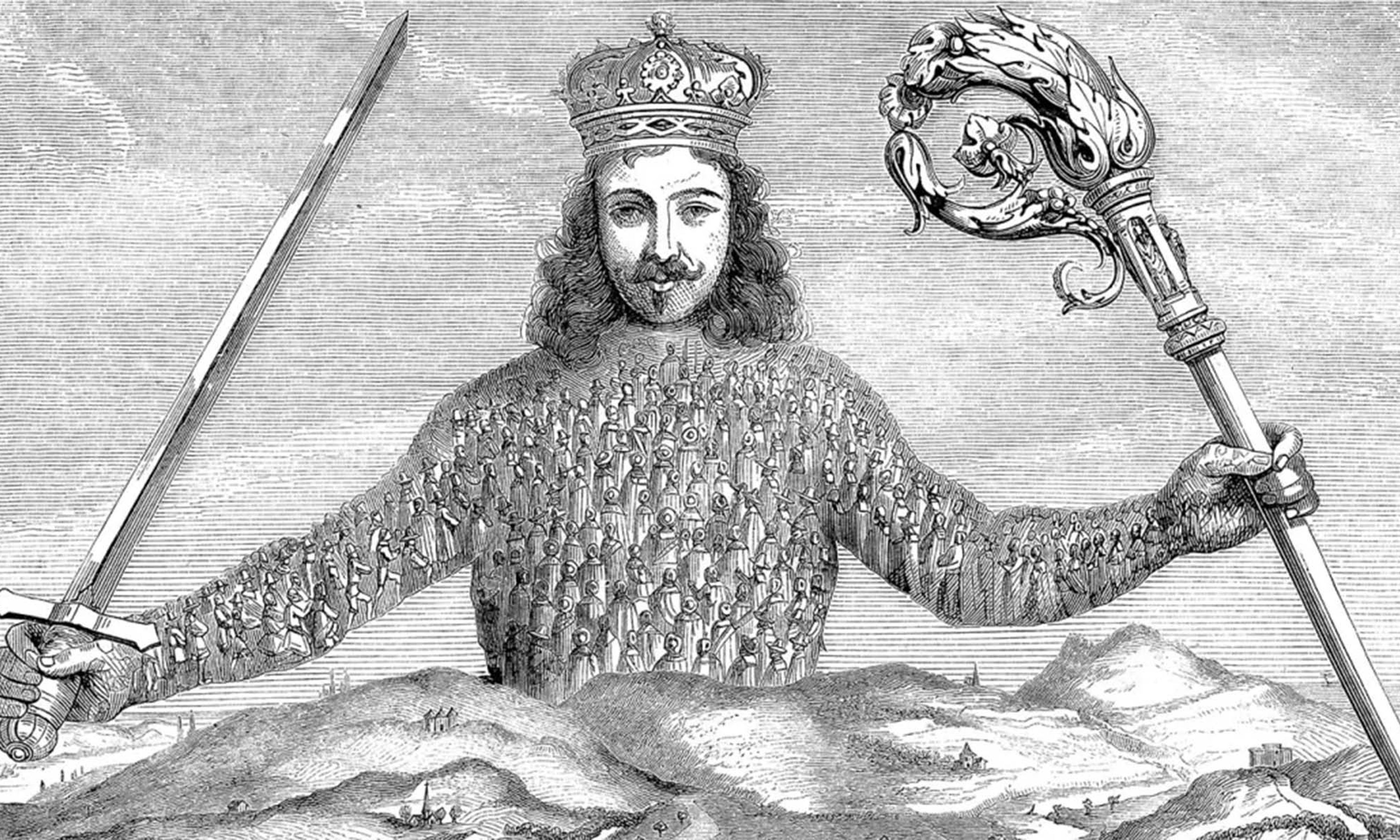
The British political philosopher and commentator John Gray has spent a lifetime sliding across the political spectrum, from Old Labour to New Right to New Labour and now, in his book The New Leviathans, to a kind of grand (or, by your taste, grandiose) pessimism.
Anyone else who had ranged so freely and widely would be distrusted as a flibbertigibbet or a crank, but Gray has never failed to win admirers along his way. The great libertarian theorist Friedrich Hayek said of Gray’s 1984 book Hayek on Liberty that it was “the first survey of my work which not only fully understands but is able to carry on my ideas beyond the point at which I left off.” My personal favorite is Gray’s 2018 book, The Seven Types of Atheism, which was a scabrous, literate critique of most forms of atheism as self-delusions among those who are still utterly possessed of Christian moral and intellectual impulses. “Contemporary atheism is a continuation of monotheism by other means,” he concluded. For Gray, most atheists merely substituted humanity for God but kept the Christian moral framework, aiming its critiques at the Church. Gray, an atheist himself, identifies with a minority tradition of unbelief that also rejects “any philosophy in which history is a process of human self-emancipation,” a tradition in which he counts others, such as playwright Samuel Beckett, who have a low view of human nature and see a materialist existence not as a reality to be easily apprehended, but as an absurd mystery to be plumbed and endured.
The subtitle indicates that The New Leviathans is another entry, perhaps the final one, in Gray’s decades-long project of interacting with and ultimately refuting Francis Fukuyama’s book The End of History and the Last Man, which somewhat ambivalently concluded that capital-H history had rendered a verdict, and liberal democracy, not communism, would spread around the globe as the final regime. Gray believes that “liberalism” — the 500-year project of man’s attempted emancipation from history — is ending, if it ever started. In this installment, Gray turns to Thomas Hobbes, whom he deems the first thinking liberal, and “the only one, perhaps, still worth reading.” The last bit of overstatement is characteristic of Gray and yet misleading, as Gray doesn’t hesitate to fill his book with insightful quotations from Locke, Mill, and other liberal thinkers.
Whereas thinkers such as Patrick Deneen have damned the liberal tradition as a self-contradictory lie, Gray skewers it, as he did his atheists, as merely derivative of and inferior to the Christian civilization on whose carcass it feeds. “In both its canonical and hyperbolic forms, liberalism is a footnote to Christianity,” he writes. “John Locke and his disciples avowedly derived their liberalism from Protestant Christianity. Later classical liberals were offspring of Christianity who became possessed by faith in reason. In John Stuart Mill, liberalism became a separate religion, with humankind serving as the Supreme Being, while hyper-liberals have made liberalism into a cult of self-creation.”
All four of the defining ideas of liberal thought are continuations of Christian monotheism. The primacy of the individual is a secular translation of the belief that each human being is created by the Deity, which has an authority over them which transcends any worldly power. The egalitarian belief that human beings have the same moral status reproduces the idea that all human beings are equal in the sight of God. Liberal universalism — the belief that generically human attributes are more important than particular cultural identities — reflects the idea that humankind is created in God’s image. The belief that human institutions are indefinitely improvable replicates the theistic faith that history is a moral narrative of sin followed by redemption.
Gray holds that Hobbes qualifies as a liberal writer because his political writing features all the four above ideas, privileging the self-preservation of the individual above the demands of the state, basing equality on the similar need of each human to be protected from the predation or evil of others, the rejection of divine rule, the universality of human nature, and so on. But for Gray these are half-truths, and another strand of Leviathan shows Hobbes as “a theorist of absurdity” who can be a guide for us as liberal civilization passes away.
For Gray, the post–Cold War faith in the spread of liberal democracy was based on two delusions. One, from his former admirer Hayek, that market capitalism could win through an “evolutionary process” by demonstrating its superior productivity. Second, from Fukuyama, that liberal democracy would similarly triumph in the process of dialectical succession. This is ultimately naïve, in that humans often forgo some level of comfort for other values (or delusions), which they believe to be higher than a higher standard of living. And because, for Gray the absurdist, by definition there is no real political direction to history.
But Gray argues as much from observation as from theory. And here The New Leviathan soars, for its richly literate, informed, and acute observation of the winds of change. Gray sketches out in succession the political civilizational ideas that are developing in the world “after liberalism.” None of them are very attractive to those outside of their premises. The first is Russia’s “Orthodox Leviathan” — its blend of Eastern Orthodox religion with a nuclear-armed Mafia-like state. Gray acutely notes this system’s hypocrisies and contradictions. But those don’t stop a political ideal from taking on a life of its own. “Russia is far from being what its Orthodox guardians would like it to be,” Gray observes. “In its ethical life it is like the West, only more so. Family breakdown, drug addiction, suicide and anomie run at higher levels than in most Western countries. The military, the intelligence services and the economy are rotted through with corruption. If Russia is a quasi-theocracy, it is also a full-blown kleptocracy. Common on the European far right and among American conservative culture-warriors, the idea that Russia is ethically superior to the West is a decadent fever-dream.”
He then moves on to the Chinese Panopticon, whose author isn’t Mao or even Xi but instead finds roots in Jeremy Bentham’s ideas for prisons, to modify behavior with rewards, punishments, segregation, and so on. Informed by Wang Huning’s conclusion that the American society of liberal individualism was atomizing and destructive of American power, the Chinese Leviathan aims not just to compel obedience, as the Gulag did before it, but really to coercively instill — perhaps more correct to say “install” — values in its human subjects, while perfecting a surveillance and manipulation system that works more tirelessly than any number of human informants to form and discipline the citizenry.
Perhaps it will offend some readers, but in addition to these, Gray shares his observations of the hyper-liberalism of the “woke,” which he views as similarly putting America onto a path out of canonical liberal society. “Woke hyper-liberalism is Puritan moral frenzy unrestrained by divine mercy or forgiveness of sin. There is no tolerance for those who refuse to be saved.”
Some readers will throw the book away in disgust at Gray’s provocations, and I don’t blame them. For instance, under the title “Feudalism and fentanyl,” he credits the feudal system for conferring “benefits on [the] subordinate populations that contemporary societies cannot provide.” He writes: “In return for their labour, serfs were promised protection by lords. Twenty-first-century serfs are abandoned to anarchy and despair.” And he substantiates it this way: “Feudalism was supported by myths of a divine order in which the poorest had a place. The twenty-first-century underclass are offered no place in any scheme of things. Like the ‘former persons’ of twentieth-century communist regimes, they are retrograde specimens of humanity on the wrong side of history.”
But for Gray, an atheist — a real one — the divine myths are just notional. Has he so rejected Homo economicus that he privileges medieval religion over longer life spans and access to the very things denied the subordinate classes by their superiors in the past, such as arms and the franchise? Is there not a trace of his former Old Left conscience that would acknowledge lengthened life spans of the poor, even if they are contracting slightly in America?
As he winds to his conclusion, we get a clearer idea of Gray’s view:
The real Leviathan is the human animal. Hobbes believed that it was driven by self-preservation: humans go on until the world brings them to a stop. He failed to see that death can come from within. Nothing is more real than the nothingness within human beings. Alone among living creatures, they know their lives are bounded by death. Awareness of their mortality impels them to seek immortality in ideas. Killing for the sake of words gives meaning to their lives. In this they exercise the privilege of absurdity, which cannot be renounced.
Only humans, among all animals, seek death or seek to inflict it over ideas and words by which they have become deluded. And they will never stop. Gray is too pessimistic for his own soul’s good, or for his analysis, however entertaining and acute it is in parts. He points to a future in which Russia may collapse into a “steampunk Byzantium with nukes,” and China “may revert to its past as a multicultural empire,” and Europe replays versions of the Holy Roman Empire. The U.S., he admits, “may drift on, a hybrid of fundamentalist sects, woke cults and techno-oligarchs.”
Here, one is left begging for Gray to interact with the more positive and realistic liberal Tocqueville, who saw American religion as providing ballast, not just demented moralism, and American technology as an outgrowth of a hugely productive can-do spirit.
By the end, I realized that Gray’s atheism is no less a debtor to Christianity than the other versions he has indicted in the past. Gray is mistaken in believing that Puritanism is only about moralistic fury. But his atheism is just a further distillation of the Calvinist doctrines of man’s total depravity, and the bondage of the human will to sin, without a corresponding redeemer God to save him. His fatalism is an imitation of the Puritan’s resignation to God’s ineffable Providence, even if it makes us look like fools. The New Leviathans is provocative and fun. One cannot fail to learn something on nearly every page. But the real mystery it leaves us is how an author so bereft of a rational foundation for valuing human life can so acutely observe the ways our age’s Leviathans transgress it.












Comments