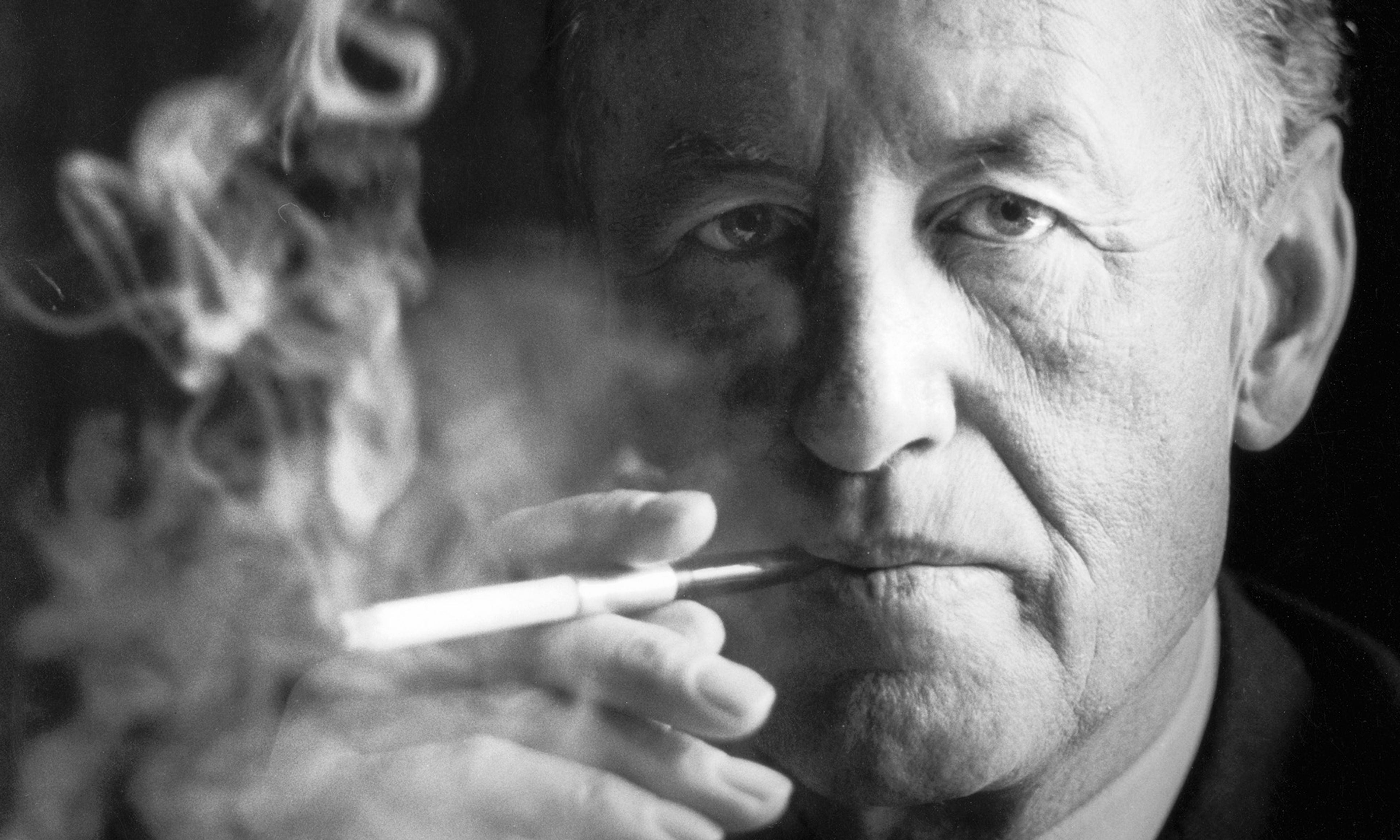
Nicholas Shakespeare’s life of Ian Fleming is a fat brick of a book, examining its subject’s times to an almost fanatical degree. I now know, for example, that the Bond author’s paternal grandfather never took a taxi in his life despite controlling, as a merchant banker, “maybe a trillion pounds” in today’s money. I know, too, that Fleming was bitten harmlessly by a snake in the summer of 1954. Though never quite boring, Shakespeare’s tome frequently explores the boundaries of the relevant. As my wife joked upon seeing the size of the review copy, “Ian Fleming: The Partial Man probably would have sufficed.”
Fleming was born in 1908 to a family already making its way in the world. His grandfather Robert had started from nothing and transformed himself into one of the wealthiest men in Europe. His father, Valentine, represented Boris Johnson’s future constituency in Parliament. Yet despite the family’s privilege, a friend would later recall that Fleming “behaved as if he was permanently deprived.” No fan of hunting or of “tramping the moors” on the family’s Scottish estate, the young man preferred instead to listen to music with his mother. When, in typical upper-class fashion, his parents shipped him to boarding school at the age of eight, the boy Fleming encountered enough unheated dormitories, “terrible” cooking, and rough discipline to feed his melancholy for years.
Though Shakespeare gives too much space to minutiae in these early chapters, he creates a vivid portrait of a youth inclined to flounder. Graduating from preparatory school to Eton, Fleming excelled athletically but was a poor student, ultimately leaving without a degree. Following an unsuccessful stint at the Sandhurst Royal Military Academy, he sat fruitlessly for the Foreign Office exam and did temporary work at the League of Nations. It was during these years — restless and largely improvised — that Fleming began experimenting with a lifestyle that would come to define both him and his most famous creation. Simply put, the future Bond author was a cad. As a female acquaintance would one day remark, likely from bitter experience, “he would sleep with someone and then honestly forget that he had done it.”
If a single experience can be said to have delivered Fleming from this blundering, it was the young man’s employment, beginning in 1931, with the Reuters News Agency. There, given modest responsibility for the first time in his life, he found himself unexpectedly able to perform adult work well. Just as important, he began to awaken as a political being. Sent to Moscow to cover a Stalinist show trial, Fleming formed a “hostile picture of the Soviet state” that would eventually inform his novels. Surveying the landscape a few years later, the future author would remark that “the threat of a territorial world war should not blind us to the ideological struggle which will have to come one day.”
Whatever its errors in pacing, Shakespeare’s account picks up dramatically when Fleming joins Naval Intelligence in the late 1930s. In his capacity as personal assistant to the director, Fleming authored the famous “Trout Memo,” a list of suggestions for “introducing ideas into the heads of the Germans.” By far the most successful of these was a plan to place “top-level” (but counterfeit) battle plans on a corpse, then wash it ashore for Hitler’s spies to find. As the British writer Ben Macintyre asserts in his superb Operation Mincemeat, the resulting deception was largely responsible for Sicily’s relative defenselessness during the Allied invasion.
Other war exploits followed. By 1940, Fleming was operating “as one of [Churchill’s] shadow warriors,” attempting to keep Spain out of the war and pull America into it. He “was part of the small advance guard” that laid a foundation for the U.S.–U.K. intelligence partnership that helped shape the 20th century. While Shakespeare is necessarily cautious, allowing that the narrative “has to be unpicked with care,” it is at least arguable that Fleming had a hand in creating what would become the Central Intelligence Agency. As Shakespeare recounts, CIA founding father William Donovan would one day present Fleming with a .38 Special bearing the engraving “for special services.”












The 1964 Aston Martin DB5 driven by actor Sean Connery as James Bond in Goldfinger and Thunderball at the Paris Retromobile fair in Paris, France, February 8, 2017.
Benoit Tessier/Reuters
If the book’s war chapters are thrilling, they are nevertheless attended by regular meta-narrative caveats, a consequence of the “stale turnips and fog” with which chroniclers of Fleming’s intelligence career must satisfy themselves. “The [Secret Intelligence Service] file on Ian Fleming is classified, if one exists,” Shakespeare writes in a characteristic admission. Moreover, the future author himself was trained for “sealed lips and leaving behind no traces.” To the extent that the young officer kept his own documentary record of the war, it is “haphazard” and “random.” Even the date of his entry into Naval Intelligence, Shakespeare acknowledges, remains “opaque.”
What does emerge, despite these distracting disclaimers, is a sense of the wartime Fleming preparing himself to create the character who would make him famous. As Shakespeare convincingly shows, Fleming’s years in Naval Intelligence “gave him the secret material that he drew on to write his novels.” Yet the Bond corpus made use of more broadly autobiographical details as well. Oddjob’s hat (in Goldfinger) is traceable to the bowlers sometimes worn by Etonians. A housemaster’s mountaineering demise became the climbing death of James Bond’s parents. Most significantly, Fleming wrote the novels in a state of wistfulness over Britain’s post-war diminishment. Capable and dashing, Bond was nonetheless “born out of turmoil.” The point of the character, in Fleming’s mind, was nothing less than to “reaffirm England as a world power.”
Whether or not this lofty aim was achievable, Fleming’s hero certainly resonated with the public. Having moved to Jamaica in the years after the war, Fleming produced Casino Royale in a little over a month in 1952. Though reviews were positive, the first print run sold out in part, Shakespeare speculates, because the word “Royale” tied neatly to Queen Elizabeth II’s approaching coronation. By the time 1957’s From Russia, with Love, the fifth book in the series, appeared, Fleming had grown tired of Bond and considered himself “the slave of a serial character.” Yet the novel was a smash hit. “My books are straight pillow fantasies of the bang-bang, kiss-kiss variety,” Fleming once wrote to a friend. For the time being, at least, he would find it impossible to stop writing them.
To read now about From Russia, with Love’s appearance is to encounter a publishing storm of almost supernatural perfection. In the autumn of 1956, a weary Anthony Eden had weathered the Suez Crisis at Fleming’s Jamaican estate, thus raising the author’s profile to stratospheric heights. The Daily Express, with its millions of readers, agreed to serialize the book shortly after its hardcover debut. Nothing could compare, however, to Life magazine’s 1961 profile of John F. Kennedy, in which the president named From Russia, with Love one of his ten favorite books. Suddenly, the American market was open to Fleming as never before. The resulting surge in interest was “like a bomb exploding,” a friend remarked. The author himself put it differently: “Surely this is a powerful criticism of the state of American education.”
Fleming would go on to write another seven Bond novels, as well as two short-story collections featuring the character. Though he managed three Bond-less books, among them the posthumous Chitty-Chitty-Bang-Bang, he never freed himself from his famous protagonist’s clutches. By the time of his death, in August 1964, Fleming was nearly one with his main character, a state of affairs the author had greeted with no small dismay. “Ian Fleming Dead; Created James Bond,” the New York Times’ headline ran. For much of the world, no further explanation was necessary.
Can James Bond long endure in this unconfident age? Clearly, he will have to change — indeed, already has if the woke-fest that was 2021’s No Time to Die is any measure. Yet whatever happens to the famous spy, his creator enjoyed what was surely one of the most fascinating and eventful careers of the 20th century. I could have done with a hundred fewer pages and a sprightlier clip, but no matter. Nicholas Shakespeare has drafted a worthy appreciation of that life.












Comments