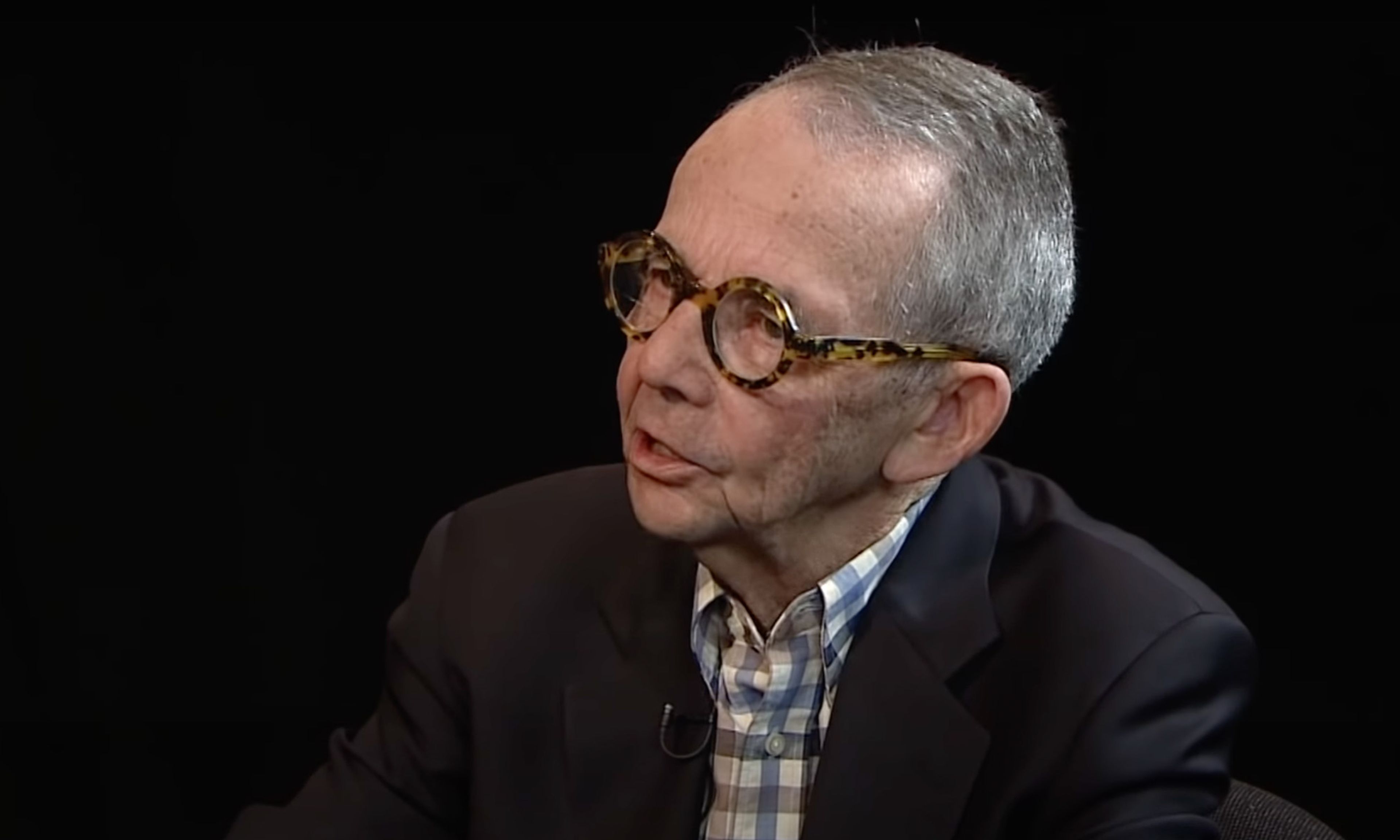
Every reader of this magazine, surely, knows the name of Joseph Epstein. One of the most gifted and prolific essayists of the past 50 years, he is the author of over 30 books and has been published in many of the country’s most prestigious publications, including National Review. What readers may not know is that he never set out to be a writer.
Born in Chicago in 1937, he had planned — vaguely — on being a salesman like his father, who made a good living manufacturing and importing costume jewelry and other trinkets to sell to Woolworth’s and concession stands at state fairs. His mother was intelligent and had a love for language, but she never pushed him to become a scholar or a writer or anything else. “She was never less than dutiful as a mother, providing meals, fresh laundry, an always immaculate apartment,” he writes in his autobiography, Never Say You’ve Had a Lucky Life: Especially If You’ve Had a Lucky Life. “What she never provided,” he continues, “was advice.”
This isn’t a complaint. Rather, he finds himself fortunate to have been born at a time when children were not the center of their parents’ lives and forced to bear the weight of their parents’ unfulfilled dreams. He was left mostly to his own devices. He liked to go to the movies, play basketball, attend school socials, smoke Lucky Strikes at a restaurant near school over lunch, and occasionally visit prostitutes with friends 60 miles away in Braidwood or Kankakee. He was not particularly studious. In high school, he writes, he “rarely received a grade above a C” in any class but gym and graduated “169 out of 213 students.”
He spent an uninspiring year at the University of Illinois and was expelled in the spring for trying to sell an accounting exam that a friend had found and stolen before an upcoming test. Epstein writes that he had already started losing interest in the university during his first semester. Joining a fraternity proved disappointing and the school was large and impersonal. “Around this time,” Epstein writes, “in an act of intellectual aspiration, I applied to the University of Chicago, about which I knew very little and about my chances of getting in even less. Nonetheless it seemed worth a shot.”
After returning home in the middle of the semester and working for several weeks for a company that manufactured phonograph needles, Epstein visited the dean of students at Chicago to check on his application:
A middle-aged man, fully suited and wearing a necktie, as was the custom of the day — I myself wore a sport jacket and necktie for the meeting — he greeted me cordially. I told him I was trying to make plans for the autumn and asked him if he could give me any word about my application to the university. He inquired about how I spelled my name, rose, walked over to a file cabinet, extracted a folder that he quickly glimpsed at, and said: “Yes, sure, you’re accepted.”
The University of Chicago would change him. The school was unlike anything he had ever experienced. It was centered on a great-books core. “No textbooks were allowed in the school’s core courses,” Epstein writes, and the “notion of in loco parentis (the school taking up many of the duties of parents) was all but abandoned. . . . A high seriousness permeated the school.” It introduced him to worthwhile life pursuits beyond money, and he came to believe that “only intelligence, intellectual penetration, erudition mattered.” He adds: “My gestalt, a word I would not have used, or even known without the University of Chicago, had radically altered.” He majored in English, heard both T. S. Eliot and Marianne Moore read their work, and fell in love with periodicals.
I might say the rest is history, but that isn’t quite right. As Epstein notes, the University of Chicago was just a beginning for him — and not a particularly promising one either. (“None of my teachers there whom I encountered in later years,” he writes, “had any memory of me, and for the good reason that I rarely spoke in class and produced no distinguished work. My mind was elsewhere.”) There followed two years in the Army, where he worked in the Public Information Office, which gave him plenty of time to read. He got his start as a writer at the New Leader, where he published his first piece in 1959 and later worked briefly as an editor in the early 1960s after a stint at Kiwanis Magazine. He left the New Leader after a little more than a year and moved to Little Rock to write press releases for an urban-renewal agency. In 1965, he published a breakthrough article on urban renewal in Harper’s that brought him national attention, but it wasn’t until he was named editor of the American Scholar in 1975 and began writing 6,500-word essays under the name of Aristides that he became the writer we know today.
Many of the essays in Epstein’s latest collection first saw the light of day in the American Scholar. The new essays are from 2018 and after. They show him, at 87, to have lost nothing of his acuity and verve.
A Joseph Epstein essay typically opens with a statement or anecdote. “Some people acquire foreign languages more easily than others,” he writes in “Learning Latin.” “I, alas, am one of those others.” He starts “Waiter, There’s a Paragraph in My Soup!” with George Bernard Shaw’s remark that “[I] could remember no time at which a page of print was not intelligible to me, and can only suppose I was born literate.” “I wish I could suppose the same,” Epstein responds. And he kicks off one of his better-known essays, “But I Generalize,” like this: “As a university teacher, I don’t normally call students ‘honey,’ yet not long ago I not only called a student ‘honey,’ but, in a state of complete exasperation, I invited her to dance.” Demonstrating another touchstone of his style — the witty generalization — he adds that “it happened, as scandalous things frequently do, out of town.” His dry sense of humor is in the spirit of Evelyn Waugh and is unmatched today.
Epstein progresses by contrast and quotation. He is surely one of the best indirect sources of memorable sayings. Like a fine conversation, an Epstein essay can shift suddenly to a different topic in a way that seems entirely natural. In an essay on growing old, for example, he not only writes about aging and time but also about dress, cars, great books and great writers, schedules, being in control, the midlife crisis, the Depression, and the hippies. He quotes or refers to over 30 writers and mentions Jane Fonda, John Lennon, Gandhi, Henri Matisse, and a dozen other figures to boot.
This can make his essays seem all surface, no depth. In a favorable review of one of Epstein’s earlier collections, the critic William Pritchard remarked that his essays were “immensely readable” and yet also “forgettable.” They “don’t have plots and don’t develop arguments you’re required to weigh, qualify, dissent from or agree with. They’re like Shakespearean ‘trifles, light as air’ that sometimes come to seem ‘strong as proofs of holy writ.’”
This “forgettability” is not a deficiency per se but an aspect of Epstein’s “unsentimental embrace of the real,” as Pritchard calls it. In the Sewanee Review some years ago, the essayist Mel Livatino recalled with amusement a complaint from a Marxist friend that there were no ideas in Epstein’s work. “My colleague had a small handle on the wrong end of a half-truth,” Livatino wrote. “Familiar and critical essayists are not typically known for purveying ideas; instead, they reflect on others’ ideas in the light of experience.”
If William Carlos Williams’s remark in his long poem Paterson that there are “no ideas but in things” can be taken as his mantra, Epstein’s might be “no ideas but in experience.” It is only after he has mined his own experience and surveyed that of others that he comes to a sometimes tentative, sometimes bold conclusion.
Epstein’s willingness to reflect on ideas “in the light of experience,” as Livatino puts it, hasn’t won him fans among the liberal elite. Joyce Carol Oates wrote a letter to the New York Times calling for his head at the American Scholar after he wrote an essay critiquing feminism. Epstein notes in his autobiography that he seems “to have a clear penchant for going against the grain of our times” but hopes that “this contrarian strain” is not “perverse, but instead a response to the goofy times more and more prevalent in the world in which I found myself.”
Yet his latest collection — a selective volume in the best sense of the word — mostly avoids polemics. Many of the classics are here, and the new essays are on reading, learning Latin, owning cats, dealing with death, and taste.
That last essay in the volume offers us another possible mantra for Epstein: “No ideas but tasteful ones.” It is not that all tasteful ideas are good but that crass ones are obviously bad and that a good life can be characterized as an adventure in taste:
Good taste, David Hume’s “delicacy of taste,” if it is to be acquired, must be acquired on one’s own. The only way to do so is make a conscious attempt to eliminate all that is distasteful in one’s public presentation. Prejudice has to go. So, too, narrow views. One’s opinions must not be too firmly pressed; nor must one live to win arguments, political or other. Charm, if one can command it, may be taken on, and with it quiet elegance, though neither in a too obvious way. Any hint of vulgarity must be effaced.
Epstein’s own adventure in taste shines in both the essays and the autobiography, even if there is some overlap between the two. We see how his tastes have changed and how they have not. If there is one criticism of Epstein, it might be that his consistency, at times, lacks charm, but who can always charm? Mostly, though, he is that rarest of beings — the serious man who doesn’t take himself too seriously.
“My own role in life has been largely spectatorial,” he writes in his autobiography. “I have spent most of my years on the sidelines, glass of wine in hand, entertained by the mad swirl of the circus put on by humanity, trying to figure out what is and is not important in life. I have, from time to time, put down the glass of wine and, in essays, reviews, short stories, written up my findings. Chief among them is that the world, for all its faults, flaws, faux pas, remains an amusing place.” How fortunate we are to have Joseph Epstein to observe it.












Comments