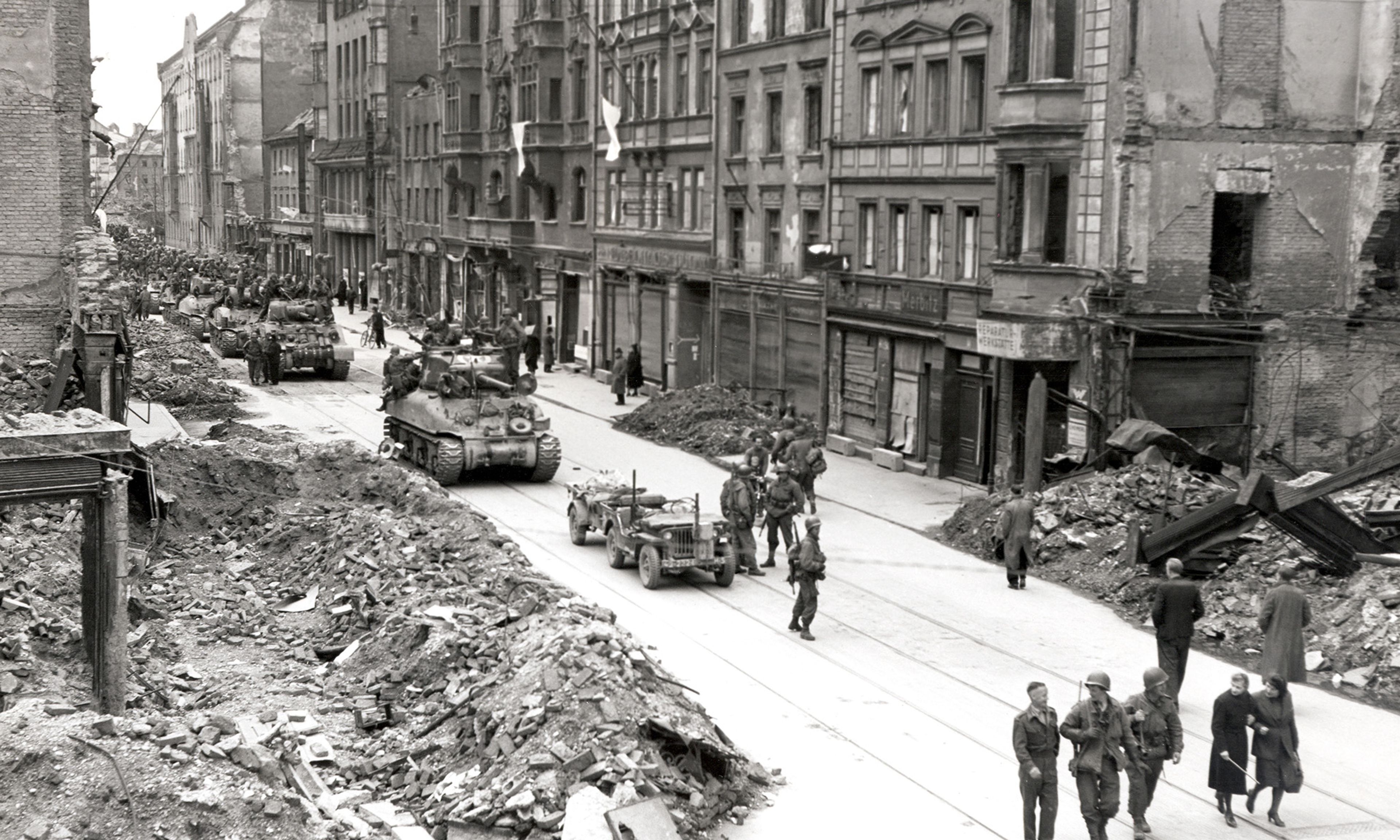
Most wars end with a whimper rather than a bang. Until the rise of industrial-scale warfare, state-versus-state conflicts were apt to end after one big, pitched battle. The side that lost would, in the course of negotiations, cede a border march or a colony to the victor or pay an indemnity. Pre-modern states often didn’t have the capacity, the manpower, or the stamina to engage in protracted conflict. Total war — an existential fight to the death — was usually the arena only of barbarian invasion.
We think of the Second World War as the quintessential war, the prototypical war. But even in the modern age, few wars have ended in the total conflagration that engulfed Germany and Japan in the spring and summer of 1945. After Cornwallis’s surrender at Yorktown in October 1781, more than a year would pass before British negotiators formally agreed to recognize American independence, and it was more than two years later that the last British troops left New York Harbor. But, after Yorktown, the fighting was largely over. In the American Civil War, 1864 was by far the worst year. By the spring of 1865, Southern resistance had collapsed across all fronts. The Great War ended, in the autumn of 1918, with all sides exhausted and depleted. But at the time of the armistice, German armies, though retreating, were doing so mostly in good order. And on both the Eastern and the Western Fronts, Germans still occupied foreign soil.
The Second World War didn’t end like those wars at all. The last year of that war, both in the Pacific and in Europe, brought on an unparalleled crescendo of death and violence, of pitiless steel and human suffering.
Craig Shirley’s April 1945 brings the reader to those months — the worst in memory for anyone who lived through them and still walks this earth. After years of fighting, after Stalingrad and Kursk and Normandy, after Midway and Guadalcanal and Leyte Gulf, there was hardly any doubt as to who would win the war. So what kept the Germans and Japanese in the field — and fighting — despite there being so little hope?
Scholars such as Robert M. Citino have identified three reasons: First, yes, there was ideology — the Japanese Bushido code and the warrior’s devotion to the emperor; German national socialism, master-race hype, and a certain amount of führer worship. Second, there was the fear of Allied revenge. German generals knew what crimes the Wehrmacht had committed inside the Soviet Union, and they knew that the Russians would not be ready to forgive. The Japanese, likewise, lived in dread of American revenge for Pearl Harbor and for the merciless, barbarous way in which the Empire of the Rising Sun had fought the Pacific War. And, finally, there was the hope, however much of a long shot, that by turning the Allied invasions of Germany and Japan into an absolute horror and bloodbath, the Axis powers could knock the Allies out of their commitment to a policy of unconditional surrender.
It didn’t work. In Europe, the Soviet invasion of East Prussia and the advance on Berlin turned into an orgy of destruction. Solzhenitsyn was there, in 1945, for the march of the Red Army and the revenge it took on Germany. He never forgot the tragedy of it. He never forgot what men might do to each other: “I remember myself in my Captain’s shoulder boards and the forward march of my battery through East Prussia, enshrouded in fire, and I say: ‘So were we any better?’”
The Western allies, after repulsing the German counteroffensive through the Ardennes at the Battle of the Bulge, were making steady, if slow, progress into the Rhineland and beyond. Things looked grim, if on the right path, in Europe. But the monstrous casualties at Iwo Jima in February and March 1945, followed by the invasion of Okinawa in April, came as a shock to the American people, who thought — who hoped — that the war was winding down.
The virtue of Shirley’s book is that he puts the reader there, in the moment, almost as if one were reading a 77-year-old Twitter feed. His approach is visceral but haphazard. To take one example, on a single page in the first chapter, Shirley jumps, in consecutive paragraphs, from U.S. government “regulations on textiles and lumber” to an American Mustang pilot over Germany witnessing a V-2 rocket “whooshing by him” to newspaper reports of “a despondent Adolf Hitler walking among the ruins of a bombed-out German city.” Shirley’s book is more a compilation of the proverbial first draft of history — journalism — than a comprehensive narrative account of, say, Germany’s last days or the Berlin campaign. To get the cause-and-effect, the details of that military campaign, read Antony Beevor’s The Fall of Berlin, 1945.
What can we learn from Shirley’s book that hasn’t already been written in dozens of others on the 20th century’s worst months? We can learn that no one knows, in the moment, where things are going. There will always be surprises. There will always be shocks. And the daily news report is often as wrong as it is accurate.
The worst thing we can do is to forget that and blindly stumble into another catastrophe.
In war — even in a just war, as Shirley takes pains to document — the innocent suffer alongside the guilty.












Comments