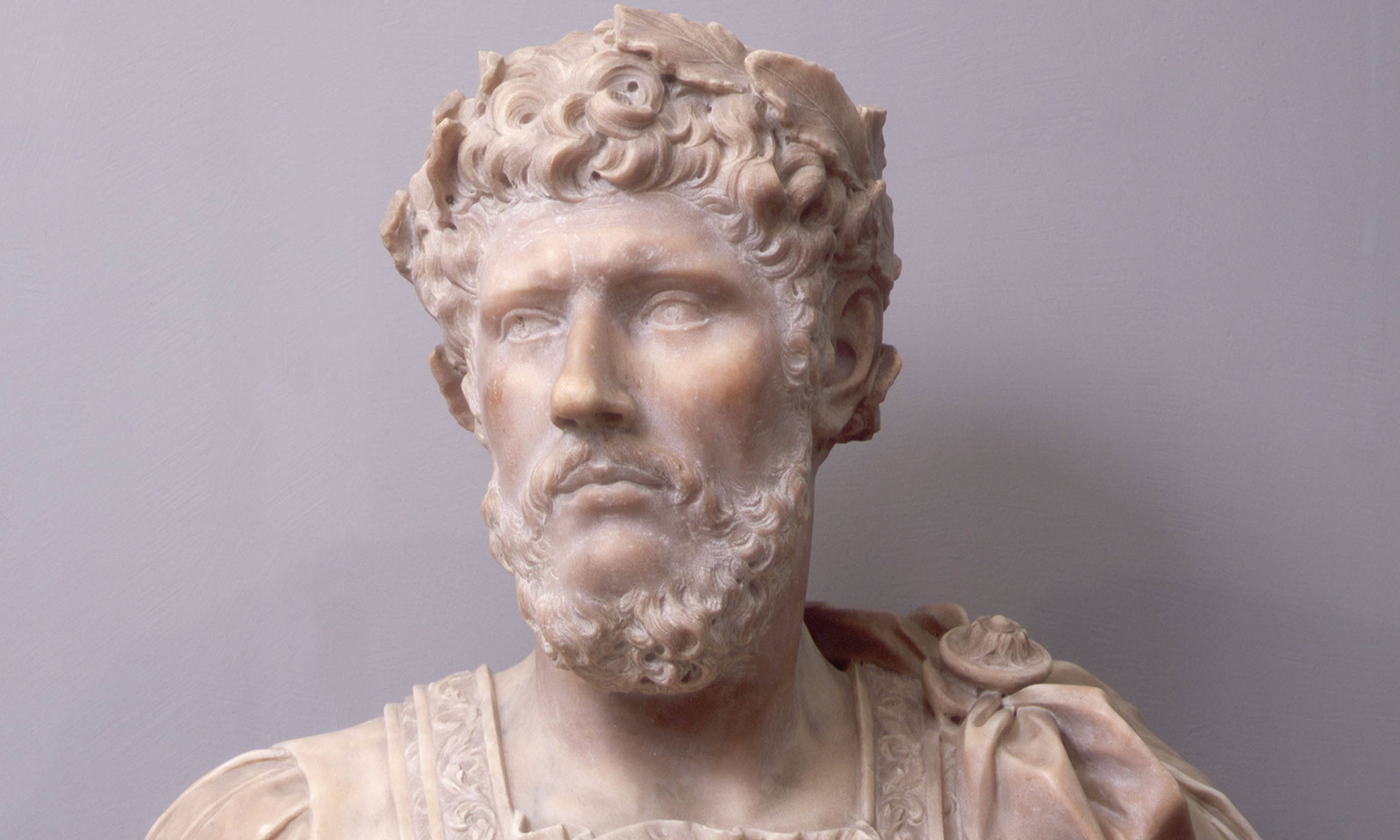
The closest the world has come to knowing a philosopher-king of the kind recommended by Plato in his Republic — “States will never be happy until rulers become philosophers or philosophers become rulers” — was surely Marcus Aurelius (a.d. 121–180). Evenhanded, just, merciful, Marcus Aurelius (born Marcus Annius Verus) read widely, wrote well (in Greek), and was thoughtful in all his imperial dealings, both domestic and foreign. He was alone among Roman emperors in leaving behind a small body of written work. His Meditations, which sets out his own philosophical views, continues to be read in our day. Some have characterized it as a postscript to the Republic. Given the erratic, not to say murderous, behavior of many of his imperial predecessors — Tiberius, Caligula, Nero, Domitian — how did so sterling a character as Marcus come about?
That is the subject of Donald J. Robertson’s excellent biographical study, Marcus Aurelius: The Stoic Emperor. Robertson, who has written about Marcus Aurelius’s Stoicism before, here takes up the Roman emperor’s biography — his family life, his teachers, his military campaigns, his rule over the greatest empire the world has ever known. In Decline and Fall of the Roman Empire, Edward Gibbon wrote that “from the time of Trajanus in a.d. 98 to the death of Marcus Aurelius in a.d. 180 was the happiest time in human existence.”
Robertson begs to differ, at least partially. His book contains a chapter on Hadrian that features a highly mercurial character: a man who had a tyrannical streak that did not exclude pretension, violence, vengeance, and menace generally. Despite these flaws in his own character, Hadrian saw future brilliance in the still-young Marcus Aurelius — dubbing him Verissimus (the most truthful one) — whom he adopted as a grandson to ensure his becoming his eventual successor. Because Marcus Aurelius was still too young to reign, Hadrian adopted as his son Antoninus Pius, another man of extraordinary virtue, who became Marcus’s adoptive father.
Marcus’s own father died when he was three or four years old, but he was fortunate in his mother, Domitia Lucilla, who made sure he was exposed to the best possible teachers, rhetoricians and philosophers both. A Hellenophile, Lucilla, as Robertson portrays her, was a woman of even temperament and serious learning who took Marcus, her firstborn child (a sister would be born after him), well in hand. She taught him, as Robertson writes, “to pay close attention to his thoughts and look deep within himself, examining his own motives and values,” and that “doing good outwardly is not enough; the real goal of life is to be good in ourselves.”
Marcus Aurelius begins his Meditations by singling out all his teachers, noting what he learned from each. Of his mother he writes: “Her reverence for the divine, her generosity, her inability not only to do wrong but even to conceive of doing it. And the simple way she lived — not in the least like the rich.” He goes on to thank Fronto, Rusticus, Apollonius, and several others who contributed to his learning and character. The longest entry is devoted to “my adoptive father,” Antoninus. The entry ends: “You could say of him (as they say of Socrates) that he knew how to enjoy and abstain from things that most people find it hard to abstain from and all too easy to enjoy. Strength, perseverance, self-control in both areas: the mark of a soul in readiness — indomitable.”
Meditations is an extraordinary work, begun during the plague of 166, when Marcus Aurelius was 45. The book is partial autobiography, a diary and a self-help book both, with much of the self-help directed at its author, as, for example, when Marcus reminds himself of the limits of fame and praise. “People who are excited by posthumous fame,” he writes, “forget that the people who remember them will die soon, too.” All that public praise amounts to is “a clacking of tongues.” As for being concerned about fame and praise, “you might as well be upset at not being a hero to your great-grandfather.”
Marcus is especially good on death, on removing the sting, or fear, of it. Longevity for him is overrated. (He himself died at 59, presumably of the plague.) More than once he reminds us of the briefness of life. “Consider the abyss of time past, the infinite future. Three days of life or three generations: What’s the difference?” And: “Human lives are brief and trivial. Yesterday a blob of semen; tomorrow embalming fluid, ash.” In Meditations he defines death as “the end of sense-perception, of being controlled by our emotions, of mental activity, of enslavement to our bodies.” We should, he instructs, “not look down on death, but welcome it. . . . A thoughtful person should await death not with indifference, not with impatience, not with disdain, but simply view it as one of those things that happen to us.”
Marcus Aurelius claimed not to be a philosopher, which technically he wasn’t, but he was deeply thoughtful, and among Roman emperors exceptional in his learning. If he was not a philosopher, he nonetheless lived, as near as it was possible for him to do, the philosophy of Stoicism. Rusticus, one of his main tutors, was a Stoic who introduced the young Marcus to the writings of Epictetus. Robertson notes that Rusticus “appears to have helped Marcus first and foremost to overcome two vices, which are often found together: vanity and anger.”
Stoicism, which often in the pages of the Meditations passes under the term logos, “the all-directing logos,” is living in accord with nature. “Nature of any kind,” Marcus writes, “is forward progress. And progress for a rational mind means not accepting falsehood or uncertainty in its perceptions, making unselfish actions its only aim, seeking and shunning only the things it has control over, embracing what nature demands of it — the nature in which it participates, as the leaf’s nature does in the tree’s.” As the classicist Gregory Hays writes in the introduction to his edition of Meditations, the Stoics defined “free will as a voluntary accommodation to what is in any case inevitable.”
“Of all the Roman emperors,” the Russian poet Joseph Brodsky writes in his “Homage to Marcus Aurelius,” “Marcus Aurelius gets the best press.” In a notable example, Matthew Arnold wrote of him:
[Marcus Aurelius] is perhaps the most beautiful figure in history. He is one of those consoling and hope-inspiring marks, which stand forever to remind our weak and easily discouraged race how high human goodness and perseverance have once been carried, and may be carried again. The interest of mankind is peculiarly attracted by examples of signal goodness in high places; for that testimony to the worth of goodness is the most striking which is borne by those to whom all the means of pleasure and self-indulgence lay open, by those who had at their command the kingdoms of the world and the glory of them. Marcus Aurelius was the ruler of the grandest of empires; and he was one of the best of men.
Brodsky himself praises Marcus, writing: “You were just one of the best men who ever lived, and you were obsessed with your duty because you were obsessed with virtue.”
Marcus Aurelius’s reign as emperor was far from worry-free. As Brodsky writes: “He was a good caretaker; he didn’t lose what he inherited, and if the empire under him didn’t expand, it was just as well; as Augustus said, ‘Enough is enough.’” Under Marcus’s rule, Rome fought several frontier wars, against the Parthians, the Armenians, the Sarmatians in the east; then the Marcomanni, the Quadi, and other German tribes and nations. He had to fight off rebellion from within led by Avidius Cassius, who declared himself emperor based on a rumor that Marcus had died. Then there was the plague. More than sufficient here to keep a man busy.
As a military leader, Marcus Aurelius showed remarkable clemency. Although the Roman economy was built on slavery, his Stoicism, according to Robertson, drove him from turning defeated enemies into slaves. He treated even rivals with a leniency rare among Roman emperors: No senators were executed or proscribed during his reign. While the subject is a complicated one, he is said to have been merciful to the rising sect known as Christians, and he was impressed by the Talmudic learning of the Jews. He sold off some of the imperial jewels rather than further tax his subjects.
Yet for all the splendor of Marcus Aurelius’s public life, his private — that is to say his family — life is clouded. “Caesar’s wife must be above suspicion,” or so Julius Caesar held, but Marcus Aurelius’s wife, Faustina, the daughter of his adoptive father, Antoninus, according to various accounts was not. In the less than always reliable Augustan History it is reported that “it is reasonably well known that Faustina chose both sailors and gladiators as paramours,” and some say that Marcus’s one surviving son, Commodus, was begotten by her in adultery. As for Commodus, the Augustan History records of Marcus Aurelius that “this man, certainly great and of such character, and associated with the gods in life and in death, left one son, Commodus; and had he been fortunate he would not have left a son.”
Commodus went on after his father’s death to rank among the worst of Roman emperors. He was cruel, arbitrarily violent, a fantast quite possibly deranged. He ordered the execution of several senators, and during his twelve-year term as sole emperor (a.d. 180–192) he wreaked general havoc throughout the empire. Marcus Aurelius lived long enough to recognize that in appointing his son his successor he had made a grave error. In 192, at the age of 31, he, Commodus, was assassinated, according to the historian Cassius Dio, strangled in his bath through the agency of a group whom he himself had marked out for execution.
Few have been the truly great figures upon the world historical stage. Fewer still those who have been able to withstand the allurements of political power. Marcus Aurelius is prominent, perhaps primary, among them.












Comments