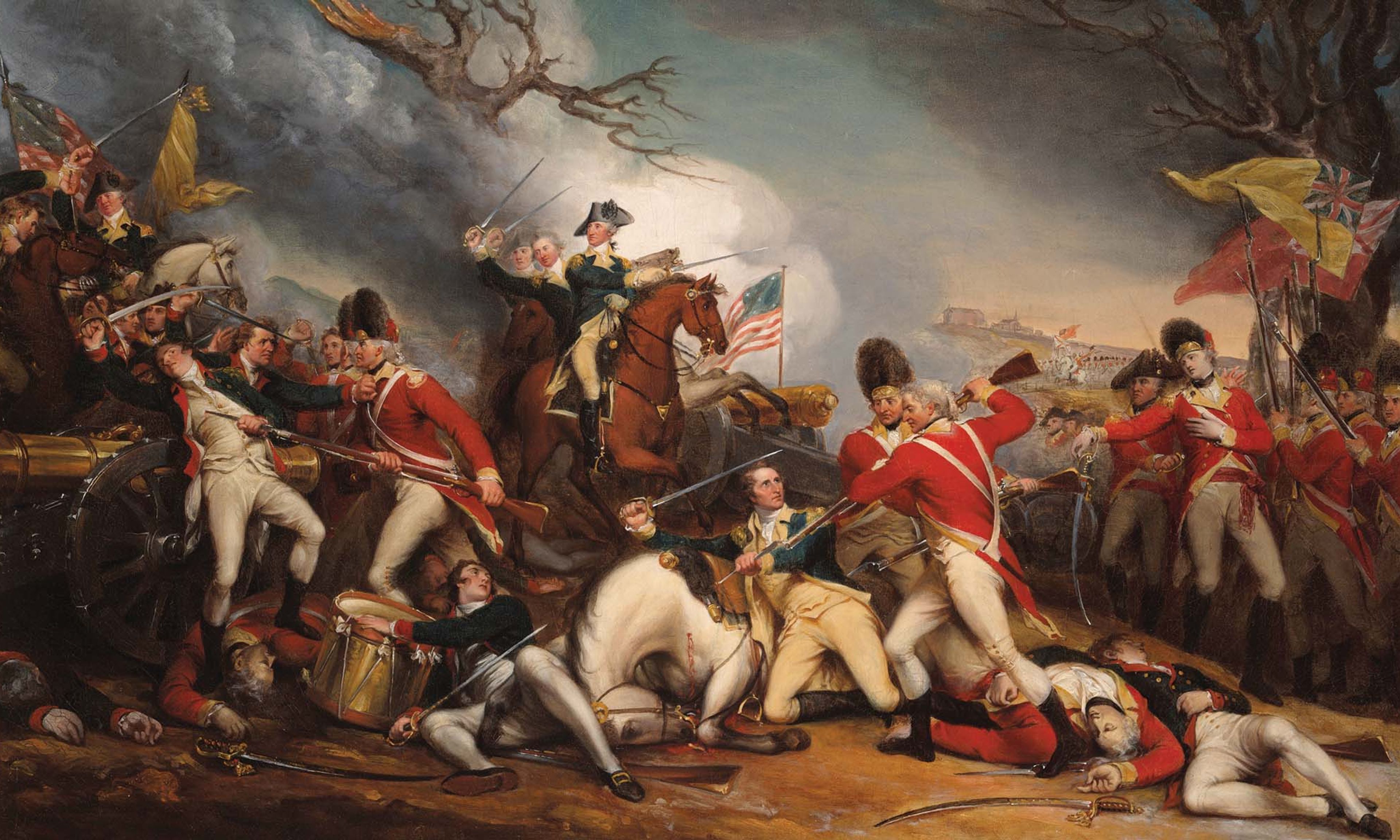
The painter John Trumbull (1756–1843) isn’t well known, but every sensate American knows his icons of courage, revolution, and war. In a series of paintings of episodes in the Revolutionary War, he devised how we imagine the signing of the Declaration of Independence, heroism on the battlefields, pivotal surrenders, and George Washington’s unique alliance of heroism and humility. Four of his history paintings hang in the Capitol Rotunda, seen by millions.
In its early days, America needed a civic religion. Trumbull created its iconography. Glorious Lessons, by Richard Brookhiser, puts the spotlight on the image-maker. Who was Trumbull, and why do his history paintings still matter?
Brookhiser is well known for incisive, philosophical biographies of Washington, John Marshall, James Madison, and Gouverneur Morris, among other books. He’s a historian but not an art historian, which is, in many ways, refreshing. He’s got a journalist’s eye, and a documentarian’s, giving readers a “you are there” perspective. He knows the facts of Trumbull’s era, as a good historian must, and he’s a good looker, which means he plumbs Trumbull’s art with precision and sensitivity.
With Trumbull, the art’s the thing. His Revolutionary War group pictures are complex, pungent, and beautifully painted. That said, they look like eyewitness accounts. They weren’t, really, but Trumbull was more than imaginative. We learn in the first few chapters of Glorious Lessons that he was the son of Jonathan Trumbull, Connecticut’s governor during the Revolution. Though tiny Connecticut wasn’t a battlefield state, it was the rebellion’s central supplier, of food, weapons, horses, and anything and everything that made for a winning battle. When a commander needed to cut down trees to slow the British invasion of Upstate New York, Connecticut sent 4,000 axes. Pater Trumbull was the logistics man, and his son, John, was there, off and on, but in the know.
The young Trumbull wanted to be an artist. His father wanted him to be a lawyer. He’d gone to Harvard at his father’s insistence, and graduated at the bottom of his class. John once wrote to him telling him that good artists in ancient Greece were piled high with honors. “You appear to forget, Sir,” the governor noted, “that Connecticut is not Athens.” During the war, John served as an officer in a Connecticut regiment and on General Horatio Gates’s staff at Fort Ticonderoga. He could draw and had studied perspective at Harvard. Before long, Washington hired him to make maps.
As the son of Connecticut’s governor, Trumbull sooner or later met everyone. Glorious Lessons takes us to London in 1780, where Trumbull studied with Benjamin West after Benjamin Franklin introduced them. He’d already met John Singleton Copley in Boston. He knew Joshua Reynolds well. In West’s workshop, he became Gilbert Stuart’s lifelong friend. What a weird time Brookhiser describes, with Trumbull, the son of a rebel governor and himself a veteran of a rebel army, living the bohemian artist’s life in enemy territory. He was finally arrested for spying — a tit for tat, Trumbull believed, after Major André’s arrest in America. Finally, through West’s direct intervention with George III, Trumbull was expelled, not hanged.
In Paris a few years later, Thomas Jefferson hosted Trumbull. Jefferson, the new American minister to France, was on the lookout for talented and politically sensible young men. In London, Trumbull gorged himself on British high-establishment portrait style, but in Paris he focused on both the Old Masters and young political painters such as Jacques-Louis David. Sharing a house with Jefferson, Trumbull became enmeshed in Jefferson’s love life, acting as a go-between for the future president and Maria Cosway, an English artist married to another man.
Jefferson was a visionary and magpie as well as shrewd on many fronts. He knew Trumbull was a good painter, and he knew Trumbull was political. He also understood, and here he was unusually savvy, that the new country would need image-makers. Americans weren’t, and wouldn’t be, bound by ethnicity or religion as were Europeans, but by ideals and shared experience. Who would visualize these ideals? Who would visualize the Revolutionary events that Jefferson — and others — fostered? What happened in the 1770s and ’80s, he knew, would become history before long. Who could present these events in a way that always seemed timely, even urgent? Not beyond ego, Trumbull believed he was the only artist who could present the Revolution’s movers and shakers as uniquely prescient. He could paint to get people’s attention. Brookhiser, the historian rather than the art historian, nails Trumbull. His pictures depict people who are long dead; but on the battlefield, in victory and defeat, and in crafting a new, experimental country, these people had us in mind.
Jefferson wasn’t a painter, but he was visual. Having lived in Europe, he knew the power of images in a way Americans didn’t. America was mostly a primitive, survivalist place, if not anti-art then having no time for art. It was a Protestant place, too, with New England Protestants especially antsy around images. Still, he — and Trumbull — understood that political cohesion, especially in a big, sprawling country, would come in part from a shared visual vocabulary.
Campaigns are about stories, too. When Jefferson and Trumbull met, the Constitution hadn’t even been ratified. Jefferson was in his mid 40s. He didn’t know he’d be president or that we’d even have a president. He knew he was in for the long haul, though, and that a political campaign has to start with a good story. He knew that in a democracy, citizens voted for flesh-and-blood individuals. Portraiture put a face to a name.
By the mid 1780s, Trumbull had already thought about a series of paintings depicting Revolutionary battles, having absorbed works such as West’s Death of General Wolfe from 1770. Once Jefferson saw Trumbull’s Battle of Bunker’s Hill, painted in 1786, he encouraged him to paint The Declaration of Independence, which, of course, would star Jefferson. Within a few years, Trumbull painted eight scenes from the Revolutionary War. Each is roughly 20 by 30 inches, and the set is on view at the Yale University Art Gallery. He planned to make money from selling prints based on the pictures. It wasn’t his most successful project financially, but the four large versions in the Capitol Rotunda, Declaration of Independence, Surrender of General Burgoyne, Surrender of Lord Cornwallis, and General George Washington Resigning His Commission to Congress, painted in the 1820s, keep him famous today.
Brookhiser writes two elegant, fascinating chapters profiling the pictures in Trumbull’s series. He recounts how Trumbull used what we’d call wide shots, the liberties he took, and how he borrowed the poses of Christian martyrs from the Old Masters in depicting fallen generals. In the Declaration painting, Jefferson is the tallest and reddest figure, and John Hancock, whom Trumbull loathed, is a pasty, seated dwarf. The Death of General Mercer at the Battle of Princeton is his only picture showing Washington in battle and it was his favorite, the one he’d save in a fire. It’s a surge scene, as Washington and his troops, thought to have been defeated, charge once more, and it’s also violent. Brookhiser calls the dead and dying, men and horses, a “harem of the expired.”
In depicting heroism and sacrifice, The Battle of Bunker’s Hill made Abigail Adams, no softie, shiver. “He teaches mankind,” she wrote to her sister, “that it is not rank or titles but character that concerns posterity.”
Cornwallis’s surrender has the feel of an epoch ending. Many of the French, British, and American figures had connections to the French and Indian War. For Americans, the surrender was a milestone on the road to freedom. For the French and British, it was one more moment in a mammoth rivalry between European powers. Trumbull, we learn, was particular about portrait likenesses. He knew most of the top figures. If the subject couldn’t sit for him — some had died — he’d find his son to pose.
Another good and necessary chapter concerns the story the paintings tell as a unit. The Revolution, battle-wise, started badly but ended well. No victory was cost-free.
The British are never shown as monsters. In the middle of a battle, rank and privilege melt away. In contrast with much European political painting, there are no gods, Graces, or Fates helping or hurting. Everything is in the hands of humanity.
Glorious Lessons is both art history and biography. We learn about Trumbull’s marriage, not a happy one, his relationship with his son, not a good one, his career as a portraitist, which paid the bills, and his gift of his art to Yale in exchange for an annuity. During his long life, he was in and out of the political arena. His brother, Jonathan Jr., was also a Connecticut governor as well as the second speaker of the U.S. House. As his father had anticipated, painting wasn’t a lucrative career for Trumbull. In his old age — and he lived far longer than Yale imagined he would — the annuity not only provided him with modest security. It established Yale’s art gallery. There, many decades after Trumbull’s death, the young Yalie Brookhiser first saw the Revolutionary War paintings, a prelude to discovering his own calling in life years later.
It’s a succinct book, both scholarly and direct, on the making of an artist and a patriot. It’s wonderful art history.












Comments