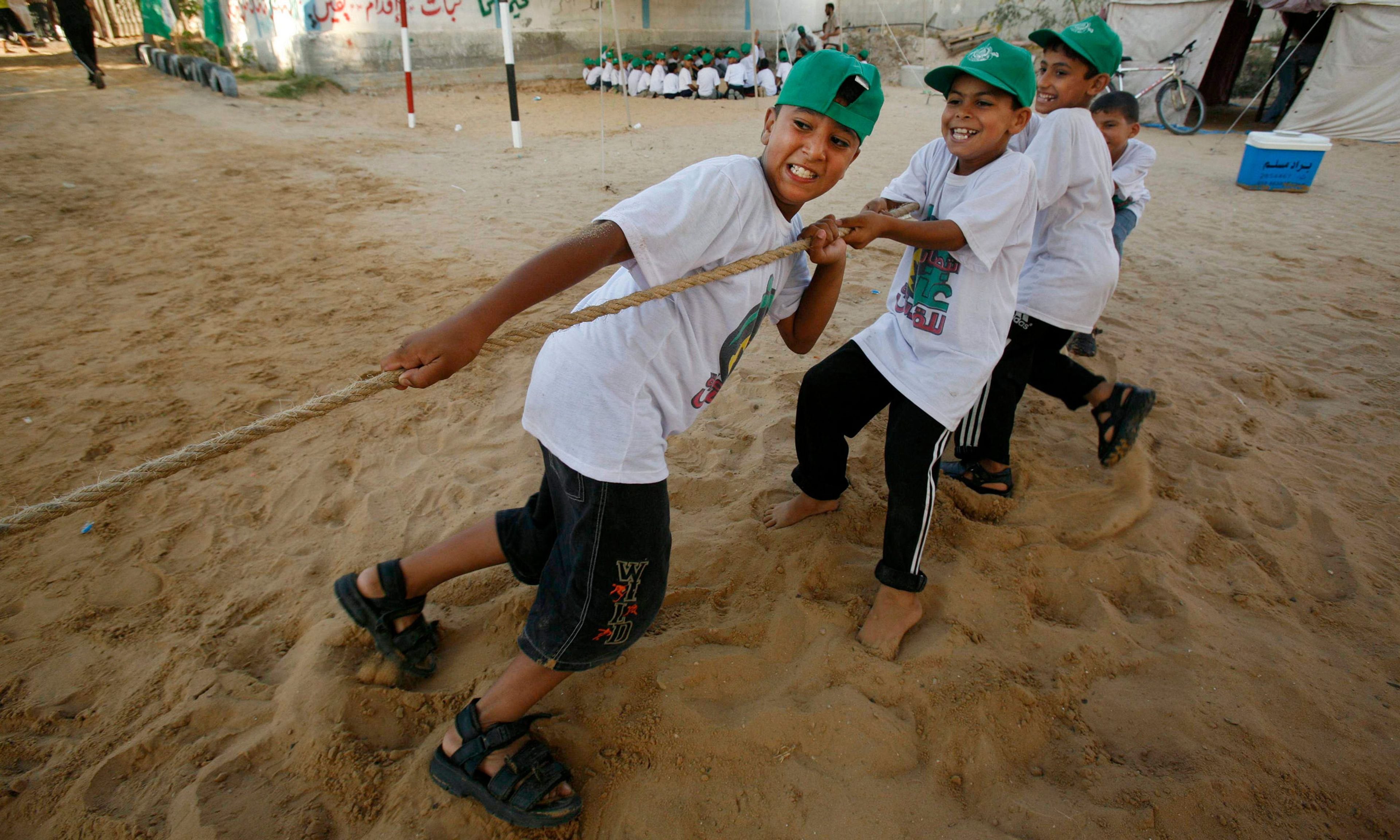
Underemployed educators have recently suggested that school games breed the urge for conflict. But school games, which of course are conflict, have been observed, by any who cared to watch, to divert excess energy into outlets not merely nondestructive but creative: physical health, the formation of team spirit, an appreciation of excellence, and so on. These school lessons survive past all remembrance of literature, European history, and other mixtures of fact and opinion.
The current fashionable “reconsideration” of school sports is not an attempt to cure a problem but to cure a solution. An examination of this misguided jollity may yield some useful insight.
Some school officials, noting that war is bad, have ruled that the Tug of War be renamed the Tug of Peace.
Consider two opposing teams, pulling on a rope, a game we will call the Tug of Peace. At the conclusion of the contest, what will the stronger team have demonstrated? That their vision of Peace (the game’s title) has irrefutably prevailed over that of their opponents. This, is, of course, the definition of War.
“Peace” may always be found through submission, which, in the case of games, is called “defeat”; or, in war, through surrender, which the pacifist experiences prior to the contest as “reason” and afterwards as slavery.
All the above states are, of course, temporary, for the only total peace is in the grave. Victor and vanquished, pacifist and warrior, tug of war, and tug of peace, all are the progress of Sisyphus. Save death, there is no human completion that is final. Those offering the same will be found on the continuum of fools, ideologues, purveyors of snake oil, and the thugs and dictators who, inevitably, supplant them. The aggressor suggests parlay as a cost-free ruse de guerre. Any considering his false-flag approach have just been defeated.
A sporting event is not only a contest of strength and will but, enjoyed vicariously, a celebration of the essence of human life, which is the play of antagonisms.
That contact sports are currently disparaged as promoting violence is a late-appearing sign of a culture narcotized by prosperity. We see this in the realm of foreign politics, in the noble proclamation that we would be better off if we all just “got along,” that is to say, if the culture, momentarily feeling fat and sassy, simply shared with its aggressors its perception that “we all want the same things,” and invited them to choose those things we all want.
A most loathsome example of meddling in sports is the Left’s destruction of those hard-won women’s rights specified under Title IX. The destruction of women’s athletics in the name of Fairness is, just like the West’s ignorant indictments of the State of Israel, a denial of legitimate effort and accomplishment — holding, in effect, that playing fair is cheating.
The derogation of Israel is anti-Semitism, the destruction of girls’ and women’s sports is misogyny, the Tug of Peace is, finally, not the attempt to ban war but to demean those struggles with incontrovertible outcomes. I will refrain from naming the late election.
Orwell posited 1984 as a year of accomplished dystopia. Here peace is war, and freedom is slavery. Given 2,000 years of Judeo-Christian culture, he erred by only 1.25 percent in his prediction.
We may rename the Tug of War the Tug of Peace, not only in the schoolyard but in the Middle East, where perennial indictments of the Jewish State are called the Peace Process, just as in our cities where the Left insists riot, violent thuggery, and theft may be assimilated if just renamed “protest.”
But hypocrisy, the unresolved remainder, must be accounted for, just as in any mathematic equation. The victims of newspeak, whether the shopkeepers bankrupted by riots or diaspora Jews forced to confront anti-Semitism, must either submit (which is to say repress their shock and outrage) or rethink their position.
In the first case, the repressed perceptions must emerge as hatred of those who have not submitted — their stalwartness, of course, an affront. This is an effortless and logical choice. The second case, however, sentences the individual to some effort and pain. It is called freedom.
The Old Testament includes the Five Books of Moses. His is the story of Repression. For everything, in his life, has been renamed. He is an infant Jew, scheduled for slaughter. He is saved and raised as an Egyptian prince; but witnessing the persecution of the Jewish slave, he defends the Jew, and Pharaoh notes his choice.
All his life, the Egyptians have been trying to murder him every time he identifies as a Jew. He realizes it, resigns, and flees to the wild. He can no longer pass as Egyptian, and knowing nothing of the Jews, it does not occur to him to live among them. So he becomes a recluse. Then one day, he sees a bush, which burns but will not consume itself. God speaks to him from the bush and tells him to return to Egypt and to free the Jews.
What is the burning bush, which will not cease burning? It is his mind. He was living a lie in the comfort of the palace, and he is now living a lie in the illusion of “uninvolvement.” The bush will not stop burning until he confronts the truth.
The truth of an existential struggle cannot “lie somewhere in the middle.” Between war and peace, there must be one outcome or the other. As there must be between Freedom and Slavery.












Comments