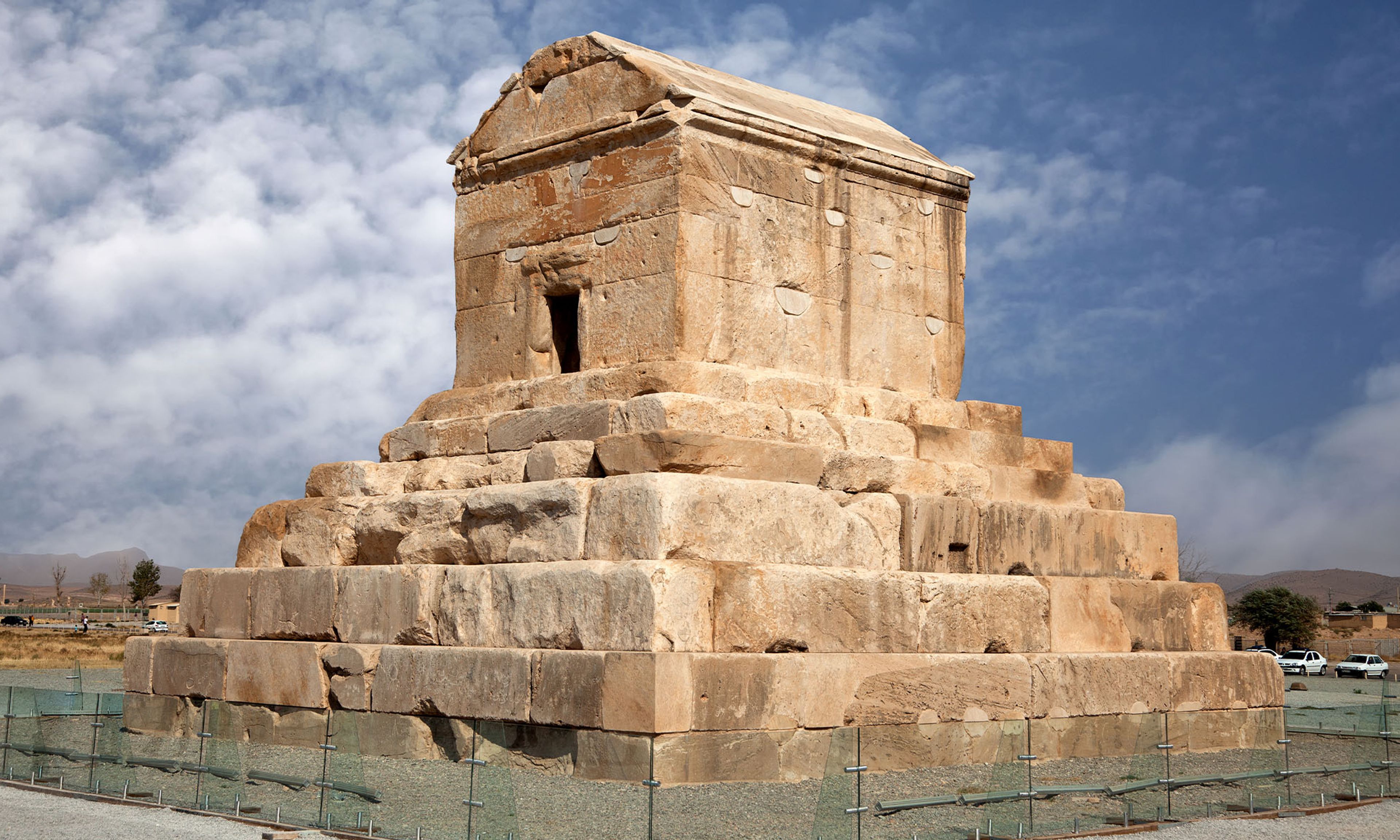
Few are the figures who have justly earned the epithet “the Great” after their names. Alexander was surely deserving of it, and so, too, Peter and Catherine of Russia. Pompey Magnus, not really. Julius Caesar didn’t need it, for the very name Caesar in time came to stand, in its transliterated forms of Czar and Kaiser, for king. Frederick, king of Prussia, perhaps. Gandhi was never called “the Great,” nor was Winston Churchill, though both clearly were. As for Cyrus, the sixth-century b.c.e. king of Persia, the epithet would appear to be entirely deserved.
I write “would appear” to be deserved, for after reading Matt Waters’s recent study of Cyrus, one feels one can be certain of little about the Persian king. A professor of classics and ancient history at the University of Wisconsin at Eau Claire, Waters casts an impressive veil of doubt on much that was known about Cyrus and his role in the ancient world.
Certainly much I thought I knew about Cyrus turns out to be dubious. What I thought I knew came chiefly from those two Greek proto-novelists, Herodotus (c. 484–425 b.c.e.) and Xenophon (c. 430–355 b.c.e.), both of whom were born well after the death of Cyrus in 530 b.c.e., and whose accounts of his life were based chiefly on hearsay — hearsay because, as Professor Waters’s book makes relentlessly clear, little in the way of hard evidence is available. Of Herodotus on Cyrus, Waters writes: “While Herodotus’ acumen as a storyteller and literary artist is seldom questioned these days, as a historian (at least by modern standards) he has been considered along the entire spectrum from keen observer to naïve dupe, from antiquity to the present.” And of Xenophon he writes: “Xenophon strikes modern readers as an aristocratic soldier with a general proclivity to autocratic rule and a concomitant distaste for democracy, an aspiring philosopher with prosaic writing ability.”
In the ancient world greatness was measured and thereby chiefly conferred by military conquest. Cyrus’s conquests included, in Professor Waters’s words, “the three major powers of his time: the Medes in northern Iran, the kingdom of Lydia in Anatolia, and the Babylonian Empire that encompassed Mesopotamia as well as much of the Levant.” Quite as impressive, what he conquered remained under Persian rule for more than two centuries, from 550 to 330 b.c.e., much longer than the reigns under the conquests of Alexander, who viewed Cyrus as a model of sorts and availed himself of many of the latter’s methods of rule. “Alexander,” Professor Waters writes, “revered Cyrus’ memory.”
But, then, Cyrus was revered generally. In Laws, Plato speaks admiringly of him, having the character he calls Athenian in the dialogue say: “While the Persians steered a middle course between subjection and liberty, in the time of Cyrus, they began by winning their own freedom and went on to make themselves masters of many peoples. As a government they gave these subjects their share of liberty and placed them on equal terms with themselves; their soldiers thus grew attached to their commanders, and showed themselves forward in danger.” Cicero also found Cyrus eminently praiseworthy and cites him in various of his works.
Cyrus earned the friendship of the Jews for freeing them from Babylonian captivity when he conquered Babylon. He allowed them to return home and build their Second Temple, which, as Flavius Josephus reports, he not only financed but filled with many of the treasures taken by the Babylonians from the First Temple. He has been in the good book of the Jews ever since. He has also been in the Jews’ veritable Good Book, the Old Testament. In Isaiah 45:1–4 the Lord essentially takes credit for Cyrus’s accomplishments, and speaks directly to him, Cyrus,
whose right hand I grasp, Subduing nations before him. . . . I will go before you and level the mountains; Bronze doors I will shatter, and iron bars I will snap. I will give you treasures out of the darkness, and riches that have been hidden away, That you may know I am the Lord, the God of Israel, who calls you by your name. For the sake of Jacob, my servant, of Israel my chosen one I have called you by your name, giving you a title, though you knew me not.
The impulse of Professor Waters in King of the World is neither iconoclastic nor innovatory. He writes neither to denigrate Cyrus nor to uncover the true figure hidden from all others who have written about him earlier.
At one point, Professor Waters mentions an interruption in his narrative, but his book doesn’t really have a narrative. Instead, the book is a work of pure scholarship, setting forth what we know and cannot know about one of the great figures in history. As such, King of the World has considerable scholarly value without giving much in the way of pleasure. One might almost have forgone its main body of 183 pages of text and instead glimpsed its 216 footnotes and three fine-print appendices and called it a day.
Professor Waters’s scholarly investigation of Cyrus somehow tends to diminish its subject. The Cyrus presented by Herodotus and Xenophon was destined for greatness: even in boyhood, handsome, of noble temperament, wise; in later life not needing to crush his conquered enemies, allowing religious worship different from his own, the very model of the benign ruler. In fact, Xenophon’s account of Cyrus, his Cyropaedia, has been thought a guidebook for wise leadership.
King of the World contains much information, but with too little of it filled out. Professor Waters notes that “in the history of empires, Cyrus represents a watershed moment,” but he doesn’t quite tell us what that moment is. “Cyrus was clearly more than a great conqueror; he had a long-range vision,” Waters writes, but neglects to set out what this vision encompassed. He writes that “the king was the sun around whom all else revolved. The Persian king’s physical stature, costume, and regalia were all carefully managed to highlight his august position,” but then does not describe the physical stature, costume, or regalia of Cyrus.
Dubiety drenches Professor Waters’s pages. This begins with uncertainty about Cyrus’s very name: “It is not even clear,” Waters writes, “what Cyrus’ name means.” The fate of Croesus, king of Lydia, at the hands of Cyrus “cannot be corroborated.” As for the war with Babylonia, the political history of that empire, “especially vis-à-vis Cyrus and the Persians, remains opaque,” and “the preliminaries of the Persian–Babylonian conflict are not understood.” Turns out that “‘the real Cyrus,’ with regard to the man’s personality and outlook, is unattainable.” No surprise to learn “there are significant gaps in our knowledge of Cyrus’ reign, c. 559 to August of 530.” We cannot even be certain about his death, how it came about and at whose hands. “Not even clear,” “cannot be corroborated,” “remains opaque,” “not understood,” “unattainable,” “significant gaps,” “cannot even be certain” . . . after all this, one wonders if a better title for Professor Waters’s book might have been “What We Don’t Know about Cyrus the Great and Aren’t Ever Likely to Know.”












Comments