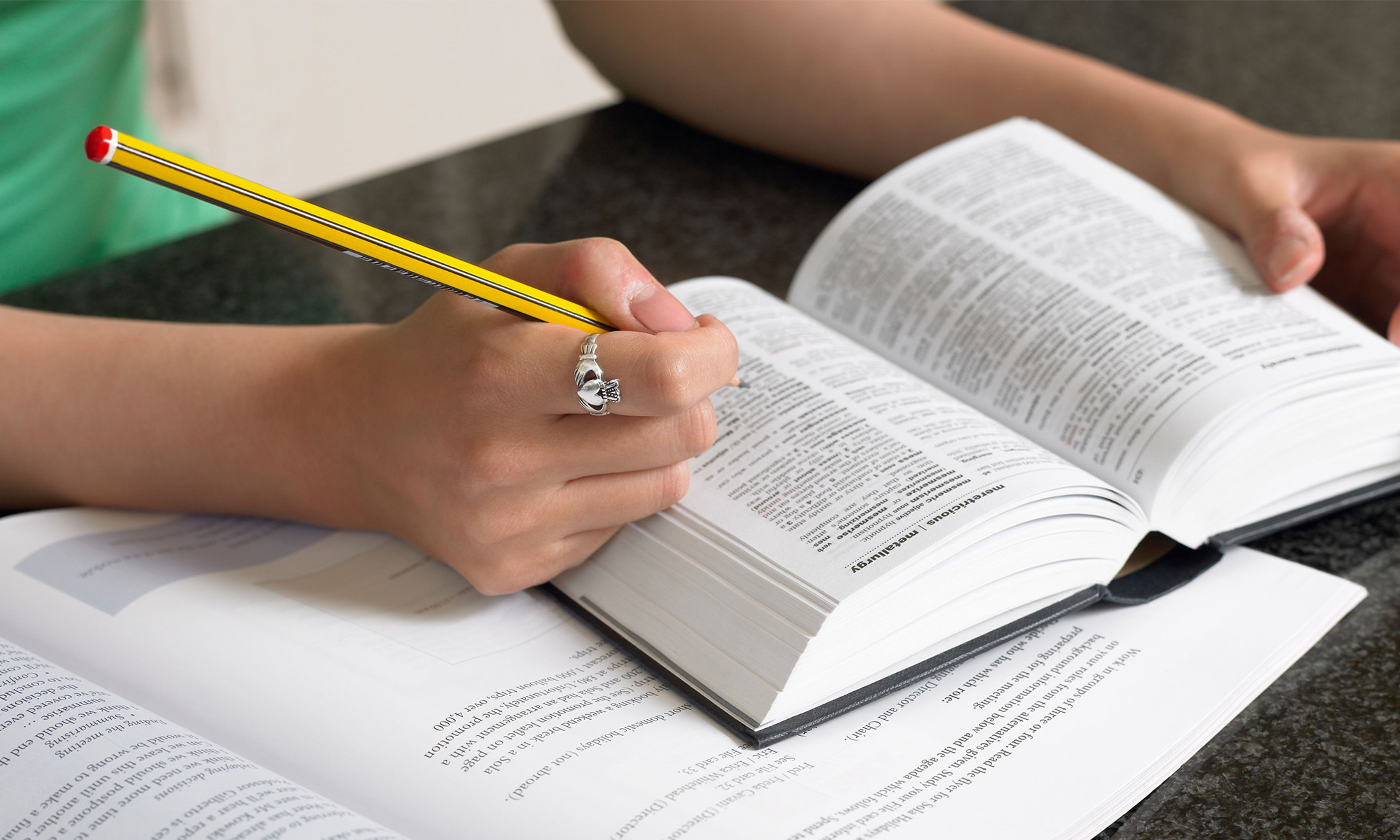
Scholars wouldn’t be surprised at the copious literature about lexicography — “the art or practice of writing dictionaries,” as Samuel Johnson defined it in 1755. After all, every scholarly discipline has its technical treatises and learned journals. What might surprise anyone, though, is the number of trade books about the writing of one particular dictionary: the Oxford English Dictionary.
The genre began with K. M. Elisabeth Murray’s Caught in the Web of Words: James A. H. Murray and the Oxford English Dictionary (1977). The author was the chief lexicographer’s granddaughter, who gave us a serious and searching account of how an autodidact from a small Scottish village became editor of the greatest scholarly undertaking of the Victorian era. The OED was to account for every word in the language, to show all its senses over time, and to give published instances of each sense throughout history. It required an army of contributors across the English-speaking world and a chief editor who could organize their findings and reduce everything to the printed page.
Caught in the Web of Words is the enthralling story of the endless difficulties that nearly led to the abandonment of the whole enterprise. Like other lexicographers in history, Murray made the mistake of agreeing to be paid by the letter (a certain sum for words beginning with A, another sum for B, and so on). What nobody had realized was the extent of the language’s word-stock. It was as if a builder had bid on constructing a large house without understanding that he was actually going to create Versailles.
Speaking of shelter, Murray worked in nothing so grand. The OED’s birthplace was a corrugated-iron shed in his backyard, called the Scriptorium. It was outfitted with slots on the wall for storing, in alphabetical order, hundreds of thousands of paper slips on which illustrative quotations were written. As the Scriptorium was being constructed, Murray’s neighbor noticed that it would interfere with his view of the Oxford spires. He was the legendary law professor A. V. Dicey, an expert on English constitutional law. Dicey complained to Murray that the Scriptorium was “injuring his outlook,” and he threatened to sue. So the Scriptorium was sunk three feet into the ground to give Dicey a better view.
That catastrophic move meant that the Scriptorium suffered perpetual seepage. Heaters were installed, but they made the air so noxious that it was difficult to breathe inside the uncomfortable structure. Murray’s junior colleagues complained of the situation through the years, sometimes balking at entering until the heaters were turned off.
Not so bad, you might say, since the project was planned to take only a decade, beginning in 1879. But you can’t build Versailles in a decade. When Murray died 36 years later, in 1915, the work was still only about two-thirds complete.
If Elisabeth Murray’s book is mostly a biography of her grandfather, the greater sweep of the story is told by Peter Gilliver in The Making of the Oxford English Dictionary (2016). At twice the length, this book gives a greater perspective and brings us up to date. The OED’s second edition, of 1989, edited by John Simpson and Edmund Weiner, came in at 20 volumes — as opposed to the 13 volumes completed in 1928 by Murray’s successors. Gilliver brings us into the third edition, which is exclusively online. He writes with the benefit of 30 years’ experience as a practicing lexicographer on the OED staff.
Still another perspective is provided by Professor Lynda Mugglestone, of Pembroke College, Oxford, with her Lost for Words: The Hidden History of the Oxford English Dictionary (2005). Mugglestone discusses the work through the lens of social history. She notes that “the intended empiricism of the dictionary is filtered through distinctly male-as-norm ideologies.” The definition of pension, for example, long suggested that “women cannot be famous artists or writers,” given that the word was said to denote a sum paid “as a matter of bounty, to aged artists, authors, etc., in recognition of eminent achievements, or to their widows.” Examples like that were legion — thousands of them eliminated in the 1989 edition.
There is more. Charlotte Brewer’s Treasure-House of the Language: The Living OED (2007) is a lively account that begins with the publication of the final installment of the first edition. John Simpson, chief editor of the second and third editions, has written a terrific memoir: The Word Detective: Searching for the Meaning of It All at the Oxford English Dictionary (2016). Then there is The Ring of Words (2006), by Gilliver and two other OED editors, chronicling J. R. R. Tolkien’s early professional work on the great book, beginning in 1915. And if you’d like an entertaining account of what it’s like to read the full dictionary over the course of a year, there’s Ammon Shea’s Reading the OED: One Man, One Year, 21,730 Pages (2008).
We can’t forget Simon Winchester, the superb historical researcher who writes with uncommon brio in all his work, including The Meaning of Everything: The Story of the Oxford English Dictionary (2003). Winchester gives the best account, for example, of the raving A. V. Dicey and his agitated insistence on sinking the Scriptorium into the ground: “Murray and his colleagues were forced to sit with their feet in boxes filled with newspapers, to protect them from the chill and the draughts.”
But the most famous treatment of all is Winchester’s best seller The Professor and the Madman (1998), about the American doctor who, having been confined at Broadmoor Asylum after murdering an innocent father and husband, devotes the remainder of his life to sending Murray illustrative quotations — more than 12,000 of them. There are astonishing turns in the story; if they occurred in a work of fiction, they’d be considered over-the-top implausible.
Yes, it was made into a major motion picture. If you haven’t seen it, do. You won’t regret it.











Comments