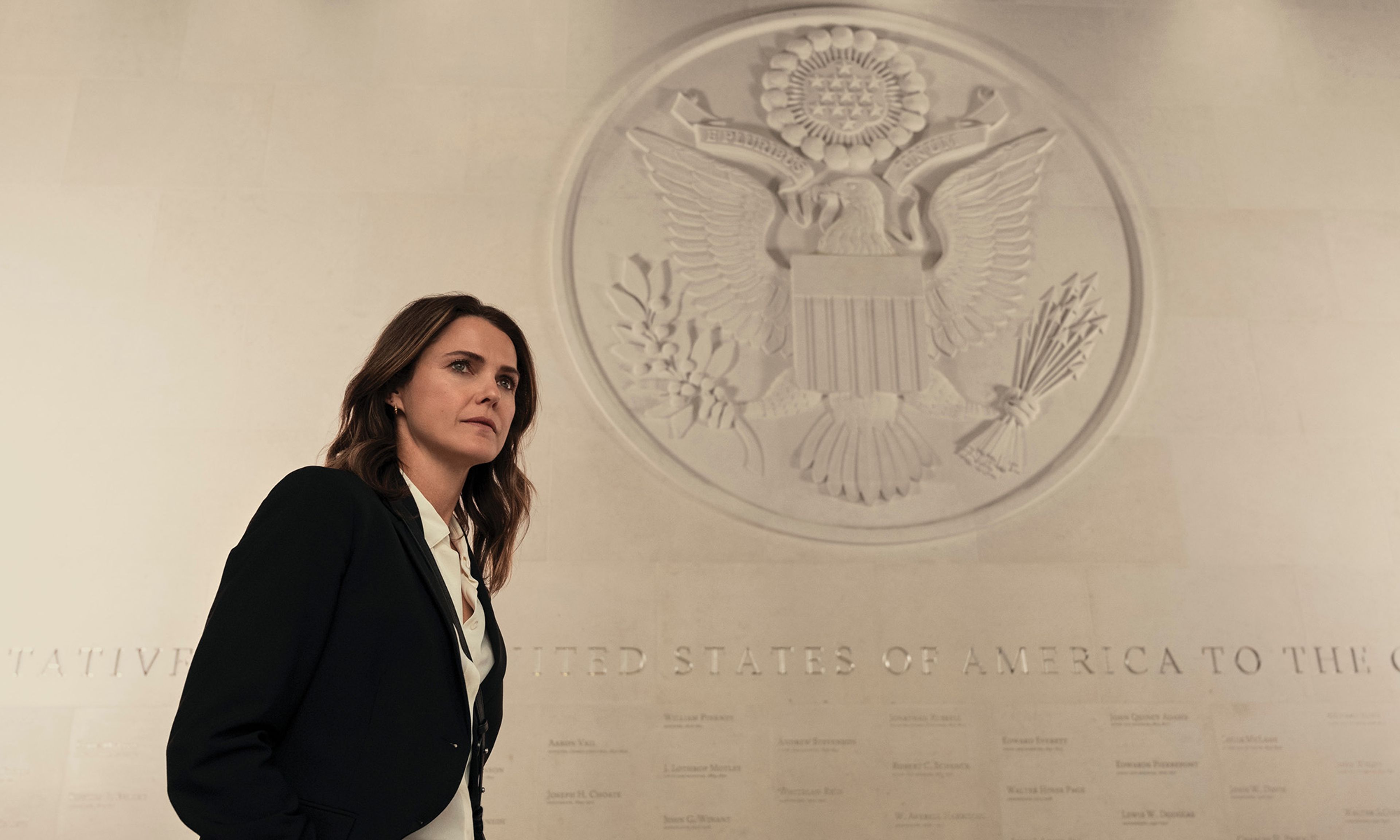
To judge by reviews, the Netflix series The Diplomat is about a highly accomplished woman being thrust into a position of real power but feeling unprepared because she is used to taking a back seat to her more accomplished husband. The woman in question is a foreign service officer named Kate Wyler (Keri Russell), who is unexpectedly named U.S. ambassador to the U.K. Her husband, Hal (Rufus Sewell), is a former U.S. ambassador to Lebanon who says he is happy to go along for the ride but cannot help reaching for the steering wheel.
While Kate is still in Washington, packing for her next posting in Kabul, a British aircraft carrier is attacked in the Persian Gulf, and scores of British sailors are killed. Because there is no U.S. ambassador to the U.K. at the moment, Kate’s Kabul posting is canceled and, owing to the urgency of the situation, she and Hal are flown directly in a private jet to London for her new assignment, deferring her Senate confirmation. (This is highly unusual but has happened in war zones.)
Before Kate can sleep off her jet lag, she is drawn into disagreements within and between London and Washington about how to respond. Because no state or non-state actor has claimed responsibility, the story quickly becomes a whodunit, with the list of suspects starting with Iran, then moving on to Russia, then circling back (as whodunits tend to do) to seemingly innocent witnesses to the crime. While leaving the twists and turns for the viewer to discover, I will say that the plot is worth sticking with because, however improbable, it unfolds with great panache.
And great locations. Netflix crews were allowed to film both outside and inside the Foreign, Commonwealth and Development Office in Westminster, as well as at the new American embassy in the gentrified Battersea neighborhood. They also gained entry to the Palais-Royal in Paris, which opens its doors to the public only once a year. And while Winfield House, the residence of the U.S. ambassador in Regent’s Park, does not appear, a substitute was found in Wrotham Park, an 18th-century mansion in Hertfordshire.
My guess is that the groundwork for all this access was laid over the past decade, when Netflix and the British company Left Bank Pictures co-produced the extraordinary series The Crown, about the life of Queen Elizabeth II. That production began in 2014 and ended, after six seasons and an expenditure of around $500 million, in 2022 (long enough to make some good contacts).
Nowadays, Joseph Nye’s definition of “soft power” — the ability of a country to cultivate goodwill through attraction rather than coercion — rings a bit hollow, because U.S. diplomacy has grown weaker since September 11, 2001. But America still has some soft power in reserve. I don’t mean at the State Department, which, despite fielding some very skilled diplomats, is as divided as the rest of Washington. I mean in Netflix, a company that has forged meaningful ties in every country of the world except China, North Korea, Syria, and Russia (where it did have connections but severed them in response to Putin’s invasion of Ukraine).
Netflix was never a production studio in the traditional Hollywood sense. Its name evokes none of the romance attached to the five “majors” that constituted the Motion Picture Association (MPA): Universal Pictures, Paramount Pictures, Warner Bros., Walt Disney Studios, and Sony Pictures. Only recently has it joined the MPA, along with its rival streamer Amazon Prime, and the “minor-major” Amazon MGM Studios. Yet despite being an outlier, Netflix is now one of the most significant players in the global market for what the Office of the U.S. Trade Representative calls “audiovisual entertainment.”
Here’s why. Mention the MPA anywhere in the world and you will get blowback about the cartel-style tactics it has deployed over the past century, assisted by the ever-reliable muscle of the U.S. government, to make sure it dominates as many movie markets as possible. Netflix doesn’t get this blowback, because for the past quarter century it has been conducting its overseas business in a manner that, compared with the MPA’s strong-arming, is downright diplomatic.
For example, Netflix has gradually built creative partnerships in over 50 countries, making films and TV series with local producers about local people speaking their local language. And it has dubbed a great many of these (in up to 45 languages) and distributed them worldwide. Nor does Netflix avoid countries where co-production is not feasible. Instead, it works with telecom providers and governments to grow subscriptions with content that appeals to local audiences while respecting both their inability to pay at higher levels and, just as important, their cultural and religious mores. When was the last time Hollywood did that?
To return to The Diplomat, the show is very much about the strain in Kate and Hal’s marriage, exacerbated by the abrupt reversal of their status. And thanks to the clever script and wonderfully subtle performances of Russell and Sewell, it is a delight to watch their quarrels, reconciliations, and — in Kate’s case — vexation at having to appear photogenically glamorous when her mind is on more important things. (Adding irony to the comedy, Hal is the real glamour-puss.)
But this is not merely a show about a marriage, decked out with the trappings of diplomacy and international crisis. It has too much zing and freshness for that. Instead, the secret sauce of The Diplomat is the incongruity of the plum London ambassadorship — typically bestowed upon a high-living, funds-bundling political appointee — being filled by a savvy, scrappy career officer who would rather be in Kabul.
This insight I owe to Beth Jones, a retired career officer with long experience in Kazakhstan (where she was U.S. ambassador) and other challenging posts. The Diplomat’s executive producer, Debora Cahn, met Ambassador Jones at a retreat for U.S. government officials advising the producers of the series Homeland, and invited her to be a consultant for The Diplomat. When I asked Ambassador Jones what The Diplomat gets right, she immediately said, “All the talking and persuading that goes on. The way Kate keeps arguing the point.” Quoting Hal’s line “talk to everybody,” she added that in “difficult places” that is the only way to proceed.
Of course, talking to everybody requires listening as well. And this in turn requires a command of their language. It would have added considerably to the Wylers’ halo of authenticity if we had heard them utter a word of Pashto, Dari, Farsi, Arabic, or Russian. The main shortcoming of The Diplomat is the ever so American tendency to see the rest of the world as a more or less scenic backdrop to what is essentially a drama about us.
For example, we learn early on that the moving force behind Kate’s appointment is not the president but his chief of staff, Billie Appiah (Nana Mensah). And her reason is not the attack in the Gulf but the fact that the president intends to replace the vice president, and Billie wants her mentor, the London deputy chief of mission Stuart Hayford (Ato Essandoh), to assess how well Kate might handle the VP job. When asked about this, Francis Ricciardone, former ambassador to the Philippines, Egypt, and Turkey (as well as deputy ambassador to Afghanistan), thought it even more of a stretch than appointing a career officer to London in the first place.
To be sure, Netflix had the good sense to reach out to, and listen to, Ambassador Jones. Repeated in all but a few countries, this policy of talking (and listening) is the best way to rise above our American myopia. Netflix’s business model is not perfect, but it surpasses all previous efforts to build a global audience for film and television not made in Hollywood. It has even got Americans reading subtitles. Call me an optimist, but I am hoping that the third season of The Diplomat (now in production) will venture into some part of the world where savvy, scrappy Kate and Hal can be shown doing what they do best.












Comments