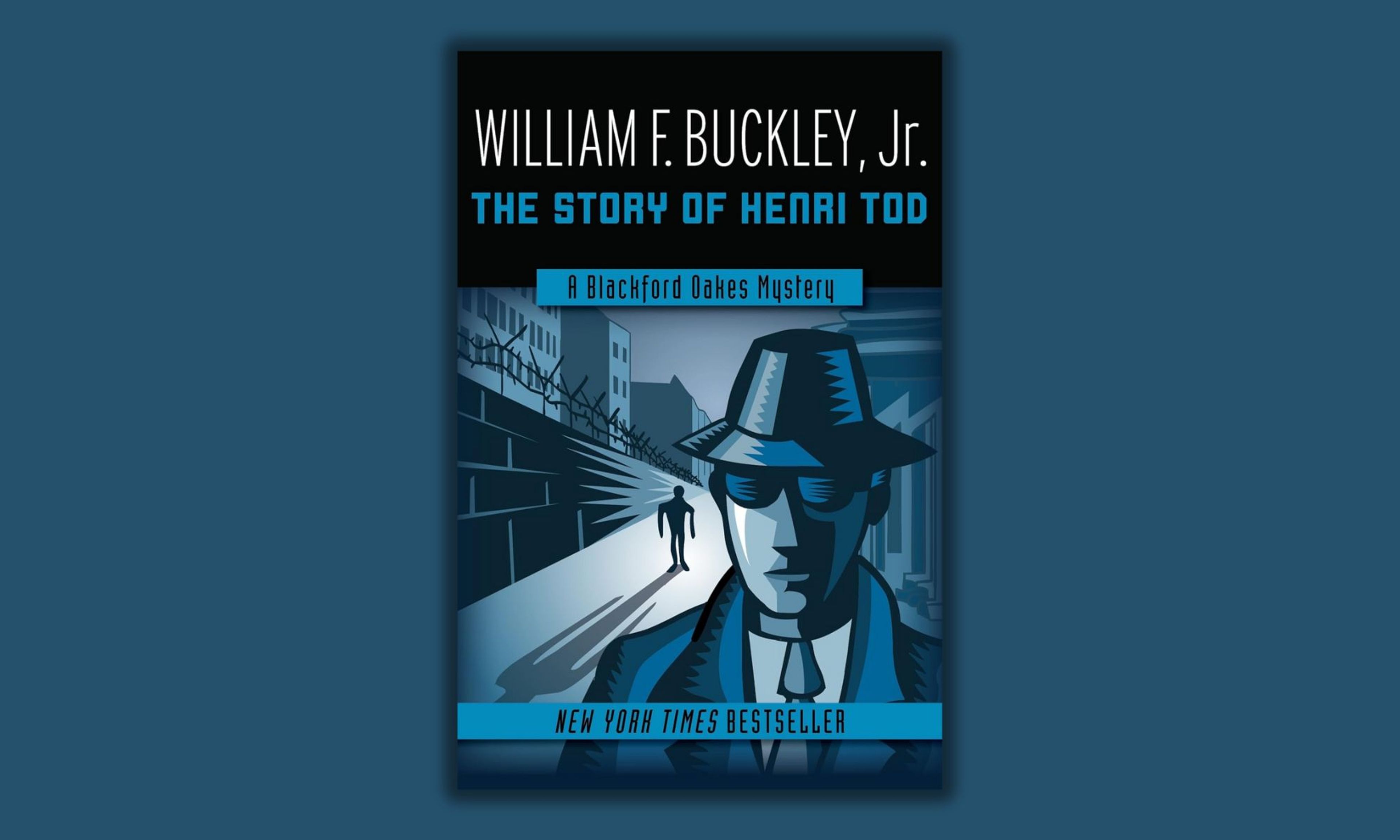
When, in 1996, I interviewed William F. Buckley Jr. about his Cold War fiction, I waited an hour to bring up a subject that made me a bit uneasy. The public, after all, had come to know Buckley as a conservative Catholic who was critical of the Second Vatican Council and had written three dozen articles about two popes. I simply could not, however, leave his office at National Review, on East 35th Street, without asking about an aspect of his spy novels that might seem to be at odds with his beliefs: the philandering ways of protagonist Blackford Oakes.
“Well, in my judgment,” Buckley answered, “when you write a novel post– about 1955, there’s got to be a sexual element. I remember one time having dinner with Nabokov in Switzerland, which was a yearly event. I said, ‘You look very pleased with yourself today, Vadim.’ He said, ‘I am, I have finished my OSS.’ ‘What’s OSS?’ ‘Obligatory sex scene.’”
Buckley explained to me that the sexual factor was so widespread in popular culture that it had become “a conventional daily element in the imaginary life.” So, he concluded, “a book that doesn’t have it is a book about which people, not even knowing what it is, tend to feel something’s missing. I recognized this even starting in, and have those two scenes in Saving the Queen, one involving the brothel and the other the queen herself.”
He was referring to the first of what would be eleven spy novels featuring the CIA’s Blackford Oakes. Published in February 1976, Saving the Queen was an immediate New York Times bestseller, but sales in the U.K. were poor.
“Why?” I asked. Buckley’s OSS.
Buckley admitted that he had committed “literary iconoclasm” by inserting into the fictional wilderness of mirrors an unheard-of theme: The Americans were the good guys. If that was not enough to irritate the critics, he fancied Oakes a “strikingly handsome” spook who would risk his life in defense of Western civilization — and take the queen to bed.
In Saving the Queen, Oakes is a year out of Yale (magna cum laude) and employed by the CIA’s Directorate of Operations. His initial assignment is as an engineer employed by a foundation researching British bridge construction. It’s a convenient cover, since Oakes’s mother (Carol), divorced from his father (Tom), is remarried to an English aristocrat (Sir Alec Sharkey) and living in London. The mission is clear: Find the mole in Queen Caroline’s inner circle who is leaking secrets to the Russians.
Oakes is granted access to the Royal Archives and secures, unexpectedly, an invitation to a dinner the queen is hosting at Windsor Castle, where she meets him in the receiving line: “The Queen smiled and suddenly her eyes deglazed and she actually looked at the person she was addressing. She found herself most agreeably surprised by a young man of poise, with extraordinarily attractive features, blue eyes, dark blond hair, and an ever-so-slightly mischievous expression.” It really comes as no surprise when they end up in bed, for “she felt something she had never felt before.” As the OSS is unfolding in a room near the queen’s, Oakes (credit to Buckley’s wit) envisions his obituary: “Born, December 7, 1925. Schools: Scarsdale H.S., Yale (’51). Executed, 1952, for viol. fornication provisions of Treason Act of 1351.”
The queen (married), Buckley pointed out when the book was published, seduces Oakes (single). The Brits were not amused.
Oakes has several inamoratas in the subsequent novels: Erika Chadinoff, the erudite Soviet spy in Stained Glass (1978); Amanda Gaither, the voluptuous assistant to the CIA’s director in Marco Polo, If You Can (1982); Linda Lewis, the comely USIA librarian in The Story of Henri Tod (1984); and Ursina Chadinov (no relation to Erika), the stunning Russian medical school professor in Last Call for Blackford Oakes (2005).
One critic for the New York Times, in his review of Last Call, wrote that “Buckley’s sex scenes have always been vulgar and prudish simultaneously.” But, as Buckley once wrote of Oakes’s “arrant but lovable presumption” in “bedding down a British Queen,” such encounters had to be written “on the understanding that it is done decorously and that there is no aftertaste of the gigolo.” Notably, the women in Oakes’s life are all intelligent and accomplished, in addition to their more obvious attractions, and they tend to take the lead.
While the novels are plot-driven, the Buckley OSS shows his flair for dialogue, such as when Oakes finds himself at a Kentucky Derby party in Amanda Gaither’s Washington, D.C., apartment in Marco Polo:
“You are an extraordinarily beautiful woman,” he said impassively as he stirred the charcoal. She replied, affecting the accent of Greta Garbo, “You should see the rest of me.” He turned to her, her smiling face reflecting the torchlight, and he knew that she had issued an invitation. “When,” his voice was steady as he resumed his work with the coals, which he now found himself stoking, “is the rest of you visible?”
Oakes’s dalliances, as with his job-related heroics, don’t arise from systematic forethought. “I fancy he is distinctively American,” Buckley emphasized when explaining the character’s genesis, “and the first feature of the distinctively American male is, I think, spontaneity — a kind of freshness born of curiosity and enterprise and native wit.”
Blackford Oakes, created by Buckley at the age of 50, is more than “the devilishly beautiful young man” Erika Chadinoff admires. He is a World War II Air Force fighter pilot who quotes Paradise Lost from memory and is familiar with the classics in literature, art, and music, thanks, Oakes says, to Yale, as well as with contemporary divas, thanks, I say, to Buckley’s legendary friendships. He, of course, also reads National Review, and his relaxed sophistication nicely complements a discerning palate for fine dining. He exhibits an “air of discreet defiance,” cultivated when he attended a British boarding school, and often sports khakis and a crewneck sweater. In all, there is never any doubt which good guy JFK and CIA director Allen Dulles, in Stained Glass, will call up for a delicate assignment in Bavaria: “Have them get out the folder on Blackford Oakes, O-a-k-e-s, and bring it in,” Dulles directs an assistant. “We’ve got work to do.”
Oakes meets his match in the love of his life, Sally Partridge, whose compelling presence drives a subplot in the novels from the moment he bumps into her at the Victorian Fencing Club after a Yale football game in Saving the Queen. (Buckley, however, strategically delays the OSS until his 1987 novel Mongoose R.I.P., in which an older Oakes recalls their first encounter.)
Oakes is a senior at Yale and Sally, with her “piercing, intelligent green eyes,” a graduate student. The playful repartee begins, and he wastes no time inviting her, the next day, for a late-night burger, after which they make plans to see Lucia di Lammermoor (sung by Lily Pons) at the Met in New York City. Twenty-four hours later, back at his Davenport College dorm room, Oakes tells his roommate: “I’ve been with the girl I’m going to marry.”
The marriage takes place — eventually. There are obstacles: The left-leaning Sally wants Oakes to quit the CIA. There’s also her own ambition as a Jane Austen scholar, which lands her a position at the University of Mexico. From there, in Mongoose, she writes to break the news to Oakes, in one of her many dazzling letters, that she has decided to marry another man. But, she writes, “I do love you, and I will always love you.” Her husband, a freelance agent for the CIA, it turns out, is killed by a communist assassin, leaving Sally Partridge de Morales a pregnant widow and inter alia longing, she states in another letter, to see Oakes. He completes his assignment in Cuba, and in Tucker’s Last Stand (1990), the next installment in the series, heads to Mexico City.
On their 13th wedding anniversary, in A Very Private Plot (1994), Oakes recalls the afternoon on fraternity row when he felt “hypnotic, delirious, because nothing else at Yale mattered to him after that, other than Sally.” He “could not believe that he had allowed fifteen years to go by before marrying her.”
Buckley may have felt obliged to make his hero something of an international ladies’ man, but Oakes invariably treated the women in his life with courtesy and delicacy. And the women — royalty or not — were more than capable of holding their own.












Comments